
July 18, 2026
When Markets Shift Permanently: Understanding the Forces Behind Petra Diamonds Business Rescue and Cullinan Retrenchments
The diamond industry has always operated on the premise that scarcity drives value. For more than a century, that premise held firm. But a structural transformation now underway across global gem markets is rewriting the rules of the industry in ways that cost-cutting, currency hedging, and operational efficiency cannot fully address. The situation unfolding at Petra Diamonds — spanning Petra Diamonds business rescue and Cullinan retrenchments at Finsch and formal retrenchment consultations at Cullinan — is not simply a corporate restructuring story. It is a visible consequence of deeper forces reshaping what natural diamonds are worth, and to whom.
When big ASX news breaks, our subscribers know first
The Market Forces That Made This Restructuring Inevitable
Natural diamond pricing has experienced sustained deterioration over the past several years, but the reasons behind that decline are more nuanced than headlines typically convey. Two distinct pressures have converged simultaneously: cyclical demand weakness driven by macroeconomic uncertainty, and a structural demand shift tied to the rapid commercial scaling of lab-grown diamonds.
The cyclical component is well understood. Geopolitical mining pressures, including ongoing tensions across the Middle East, have suppressed consumer confidence in luxury goods categories globally. High-end jewellery purchasing is acutely sensitive to sentiment, and prolonged uncertainty has pushed discretionary spending into more liquid or defensive categories. This alone would create difficulty for producers. However, the structural shift is the more consequential pressure — and the more permanent one.
Lab-grown diamonds, produced through either High Pressure High Temperature (HPHT) or Chemical Vapour Deposition (CVD) processes, now achieve near-identical optical, chemical, and physical properties to mined natural diamonds. To the naked eye — and to most gemological instruments without specialist testing — a high-quality lab-grown stone is indistinguishable from its mined equivalent. The production cost per carat for lab-grown stones has fallen dramatically over the past decade, compressing retail prices and eroding the premium that natural diamonds historically commanded.
Critically, this pricing pressure has not been uniform across diamond sizes and categories. Smaller stones — those typically below one carat — have experienced the most severe value compression because they are the most easily replicated at commercial scale in lab settings. This is precisely the profile of diamonds that Finsch predominantly produces.
The gap between lab-grown and natural diamond pricing has widened to the point where smaller natural stones struggle to justify their extraction cost in many market conditions — a dynamic that fundamentally changes the economic viability of mines whose output skews toward this size profile.
Compounding these market dynamics is a currency problem specific to South African producers. A persistently strong South African rand erodes the rand-denominated revenue received at mine level from dollar-denominated diamond sales. Furthermore, when the rand strengthens against the US dollar, every dollar earned at auction translates into fewer rands at the point of operational expenditure — squeezing margins even when international prices hold steady. Combined with rising energy costs and input inflation, this creates a structural mismatch between fixed operational costs and volatile, declining revenue.
Commodity prices and miners like Petra are directly affected by this dynamic. Petra Diamonds CEO Vivek Gadodia has characterised current conditions as representing an unprecedentedly weak diamond market, attributing the deterioration to simultaneous global macroeconomic pressures and the suppressive effect of regional geopolitical disruption — a combination the company views as unlikely to produce any meaningful near-term price recovery.
What Business Rescue Actually Means Under South African Law
The term "business rescue" carries significant weight in South African corporate law, and its meaning is frequently misunderstood in public discourse. Under Chapter 6 of the Companies Act 2008, business rescue is a formal legal mechanism designed specifically for financially distressed companies that retain some prospect of recovery. It is explicitly not liquidation.
How the Process Works
When a company enters business rescue, a licensed business rescue practitioner is appointed and assumes substantial authority over company operations. The practitioner's mandate is to develop and implement a restructuring plan that either returns the company to solvency or achieves a better outcome for stakeholders than immediate liquidation would produce.
Key procedural features of the South African business rescue framework include:
- The practitioner holds decision-making authority that supersedes the board during the rescue period
- A moratorium on legal proceedings against the company takes effect upon commencement
- Creditors, employees, and shareholders are entitled to formal consultation and information disclosure
- The practitioner must publish a business rescue plan within 25 business days of appointment
- If the plan is rejected by creditors or fails to produce viability, the process can convert to liquidation
For comparative context, it is worth understanding how this mechanism relates to equivalent frameworks in other jurisdictions:
| Jurisdiction | Equivalent Mechanism | Key Characteristic |
|---|---|---|
| South Africa | Business Rescue (Companies Act 2008) | Practitioner-led with debtor-in-possession elements |
| United Kingdom | Administration | Court-supervised, creditor-focused |
| United States | Chapter 11 Bankruptcy | Debtor-controlled, court-approved restructuring plan |
| Australia | Voluntary Administration | Creditor-vote driven, 20-business-day initial process |
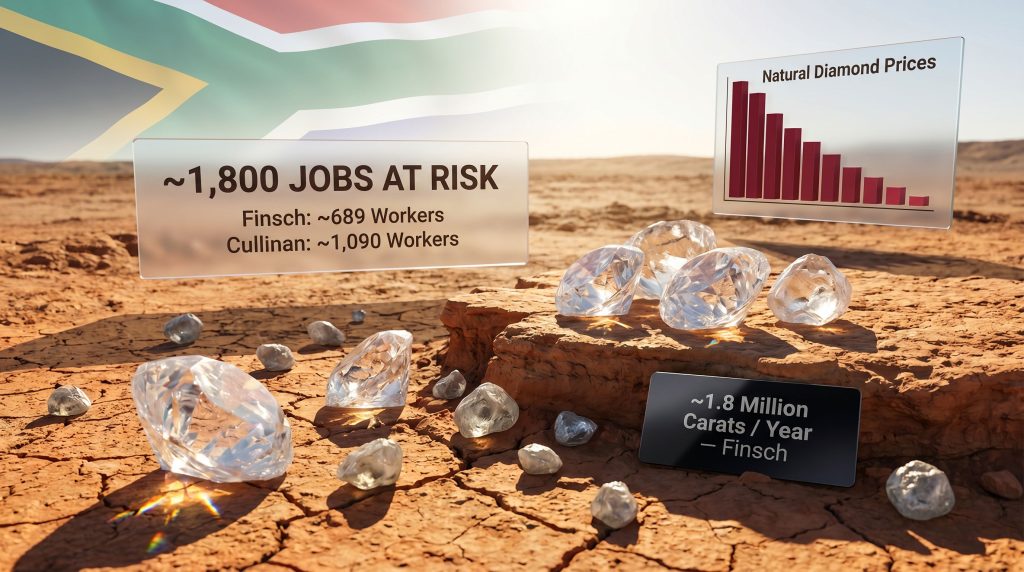
The South African model occupies a middle ground — practitioners hold significant independent authority, but the process retains consultation requirements that give creditors and employees formal standing. This distinction matters considerably for the approximately 689 workers at Finsch whose employment future is now subject to the practitioner's restructuring plan.
Finsch Diamond Mine: Scale, Significance, and What Triggered the Filing
Finsch Diamond Mine sits near Lime Acres in South Africa's Northern Cape Province and holds a position of considerable importance within the country's mining sector. Operating continuously since the early 1980s, it represents over four decades of uninterrupted diamond production. According to the Minerals Council of South Africa, the mine produces approximately 1.8 million carats annually and holds reserves estimated to support more than 20 additional years of extraction at current rates.
That reserve profile is important context. Finsch is not a depleted asset approaching natural end-of-life. Its business rescue filing reflects a revenue and cost problem, not a geological one. The mine's kimberlite pipe contains substantial remaining resource, but the commercial viability of extracting that resource depends on prices that current market conditions do not support.
The Kimberlite Factor: Why Geology Matters Here
Kimberlite pipes — the volcanic structures from which primary diamond deposits are extracted — vary significantly in their diamond grade (measured in carats per hundred tonnes, or CPHT) and in the size and quality distribution of stones recovered. Finsch's kimberlite is characterised by a production profile weighted toward smaller stones. This geological reality, which cannot be changed through operational decisions, is what makes the mine disproportionately vulnerable to the specific pricing dynamics currently afflicting the market.
Higher-value mines producing larger, gem-quality stones enjoy greater natural insulation from lab-grown competition because large natural diamonds remain significantly harder to replicate at commercial scale. Finsch, by contrast, sits at the most exposed end of the natural diamond market spectrum.
Section 189A at Cullinan: The Retrenchment Process Explained
While Finsch entered formal business rescue, Petra's Cullinan Diamond Mine has been placed on a different but equally significant legal track: the Section 189A large-scale retrenchment process under South Africa's Labour Relations Act.
Understanding Section 189A
Section 189A governs workforce reductions affecting ten or more employees and imposes a structured consultation framework that employers must follow before any retrenchments can proceed. Key requirements include:
- The employer must issue a formal written notice to affected employees and recognised unions detailing the reasons for proposed retrenchments, the number of affected workers, and proposed severance terms
- A mandatory minimum consultation period of 60 days must elapse, during which genuine engagement on alternatives to retrenchment is legally required
- The Commission for Conciliation, Mediation and Arbitration (CCMA) is available to facilitate disputes arising from the process
- Unions retain the right to strike in response to retrenchment proposals that follow the legislative process
At Cullinan, current estimates indicate that approximately 1,090 workers face potential retrenchment, with an initial formal notice reportedly affecting around 200 workers in the first communication. Combined with Finsch, the total workforce exposure across Petra's South African operations reaches approximately 1,800 positions, as reported by Business Live.
Cullinan's Distinct Commercial Profile
Cullinan Diamond Mine carries extraordinary historical weight. Located approximately 100 kilometres north-east of Johannesburg in Gauteng Province, it is responsible for some of the most significant gem diamond recoveries ever recorded, including stones that formed part of the British Crown Jewels. Its production profile, weighted toward larger, higher-quality stones, distinguishes it sharply from Finsch's smaller-stone output.
This distinction is commercially meaningful. Cullinan's large-stone production is considerably more insulated from lab-grown competition than Finsch's output. Yet the mine remains exposed to broader cost pressures — energy, labour, equipment, and currency dynamics — that compress margins regardless of stone quality. The Section 189A process at Cullinan therefore reflects a cost-structure problem more than a revenue quality problem, which makes the union's objections particularly pointed.
The National Union of Mineworkers Response
The National Union of Mineworkers has taken a firm and publicly vocal position on Petra's restructuring actions. NUM Petra Diamonds chief negotiator and national health and safety secretary Masibulele Naki has argued forcefully that attributing financial distress to labour costs misrepresents where the value in mining operations actually originates. The union's position is that workers are the source of productive value in mining, not a cost liability to be adjusted when market conditions deteriorate.
NUM has characterised the retrenchment process as an attempt to use workforce reduction as a primary response to structural market failures that workers had no hand in creating — a framing that places the burden of adaptation squarely on the most economically vulnerable parties in the production chain.
The union has formally called on the South African government to intervene in the restructuring process, raising several specific concerns:
- Retrenchments at this scale will intensify economic hardship in already vulnerable mining communities in both the Northern Cape and Gauteng
- Job losses of this magnitude carry secondary economic consequences for local supply chains, service industries, and dependent households
- The precedent of deploying business rescue and Section 189A simultaneously as workforce reduction tools could normalise this approach across the broader sector
Whether government intervention materialises remains unclear. Furthermore, calls for intervention and formal government action are distinct, and the outcome of any political engagement is speculative at this stage. Effective mining risk management at a corporate level might have anticipated some of these pressures earlier, though the structural forces at play were arguably beyond any single operator's control.
The next major ASX story will hit our subscribers first
South Africa's Position in African Diamond Production
Understanding Petra's situation requires appreciating where South Africa sits within the broader African diamond landscape. Among the global diamond producers, the country ranks outside the top three by volume but retains a distinctive position based on gemstone quality and per-carat value.
| Country | Regional Ranking (Output Volume) | Key Characteristic |
|---|---|---|
| Botswana | #1 in Africa | Highest volume; Debswana partnership with De Beers |
| Angola | #2 in Africa | Rapid production growth; expanding operations |
| Democratic Republic of Congo | #3 in Africa | Mixed artisanal and industrial production |
| South Africa | #4-5 in Africa | Lower volume, premium gemstone quality and value |
South Africa's competitive differentiation has always rested on quality rather than quantity. That quality premium remains real, particularly for large-stone producers. However, it does not provide protection for operations whose geological profile aligns with the most price-depressed segment of the current market.
Systemic Stress, Not Isolated Mismanagement
The simultaneous distress at two major South African diamond operations signals something beyond individual corporate difficulty. When a company with assets of Petra's scale — including a mine as historically significant as Cullinan — reaches the point of concurrent Petra Diamonds business rescue and Cullinan retrenchments proceedings, it reflects sector-wide pressure that warrants broader analysis.
Potential downstream implications include:
- Disruption to South Africa's diamond cutting and polishing industries, which depend on consistent rough stone supply from domestic mines
- Accelerated mining industry consolidation, with distressed asset pricing potentially attracting acquisition interest from larger producers or investment entities
- Long-term questions about the viability of South African diamond operations without fundamental changes to cost bases or revenue models
Four Scenarios for Petra's South African Operations
The trajectory of Petra's restructuring is genuinely uncertain. The following scenarios represent distinct but plausible pathways, each carrying different implications for workers, communities, and the broader sector.
Scenario 1: Successful Business Rescue with Partial Workforce Retention
The practitioner develops a viable plan for Finsch involving operational scale-down rather than full closure. Cullinan retrenchments proceed but at a reduced scale following the mandatory consultation period. Some jobs are preserved under a restructured cost model.
Scenario 2: Asset Sale or Third-Party Acquisition
Distressed asset pricing at Finsch or Cullinan attracts a strategic buyer willing to restructure the cost base under different operational assumptions. New ownership potentially preserves a portion of the workforce under revised terms.
Scenario 3: Liquidation and Permanent Closure
The business rescue process at Finsch fails to produce a viable plan and converts to liquidation. Full workforce displacement at Finsch follows, Cullinan retrenchments proceed in full, and the economic impact on Northern Cape communities is severe. The diamond slump driving these outcomes continues to affect the broader sector.
Scenario 4: Government-Facilitated Negotiated Outcome
NUM's intervention calls gain political traction, resulting in a government-mediated process that delays or modifies the retrenchment timeline. A social plan framework is developed to cushion workforce impact, though the underlying financial pressures remain unresolved.
Key Statistics at a Glance
| Metric | Data Point |
|---|---|
| Total jobs at risk (combined) | ~1,800 |
| Workers at risk — Finsch | ~689 |
| Workers at risk — Cullinan | ~1,090 |
| Initial retrenchment notice (Cullinan) | ~200 workers |
| Finsch annual production capacity | ~1.8 million carats |
| Finsch reserve life estimate | 20+ years |
| Cullinan location | ~100 km north-east of Johannesburg |
| Finsch location | Near Lime Acres, Northern Cape |
| Restructuring mechanism — Finsch | Business Rescue (Companies Act 2008) |
| Restructuring mechanism — Cullinan | Section 189A (Labour Relations Act) |
| Petra Diamonds listing | London Stock Exchange |
Frequently Asked Questions
Does business rescue automatically mean job losses at Finsch?
Not automatically. The business rescue process is specifically designed to prevent permanent closure and may result in a restructured operation that retains a reduced workforce. However, if the practitioner's plan requires workforce reduction to achieve viability, retrenchments can form part of the approved rescue plan.
How long does the Section 189A process at Cullinan take?
South African labour law mandates a minimum 60-day consultation period before any retrenchments can be implemented. During this window, the employer is legally required to engage with employees and unions on alternatives to job losses.
Why are smaller diamonds more exposed to market weakness than larger stones?
Smaller natural diamonds face direct commercial competition from lab-grown alternatives that are now produced at scale with near-identical visual and chemical properties. Larger natural diamonds retain greater scarcity value and remain considerably harder to replicate at commercial volumes, providing relative price resilience that smaller-stone producers do not enjoy.
Could Finsch be sold rather than closed?
Asset sales represent one plausible outcome within or following the business rescue process. Whether a viable buyer exists at a price that reflects the mine's long-term reserve value versus its current market economics is the central question that would determine this pathway's feasibility. Consequently, the Petra Diamonds business rescue and Cullinan retrenchments situation continues to evolve as stakeholders assess all available options.
This article is intended for informational purposes only and does not constitute financial or investment advice. Scenarios described represent analytical projections based on publicly available information and are subject to change as circumstances evolve. Readers should consult qualified advisers before making any investment or employment-related decisions based on this content.
Want to Track the Next Major ASX Mineral Discovery Before the Market Does?
Discovery Alert's proprietary Discovery IQ model delivers real-time alerts on significant ASX mineral discoveries, cutting through complex data to surface actionable opportunities the moment they are announced — explore historic examples of exceptional discovery returns to understand what early positioning can mean, and begin your 14-day free trial at Discovery Alert to secure your market-leading edge.