August 8, 2026
The Processing Layer Problem: Why America's Critical Minerals Crisis Is Not What Most People Think
Most commodity supply chain debates focus on where materials are dug out of the ground. The more consequential question, and the one now driving policy at the highest levels of the US government, is where those materials are transformed into usable industrial inputs. Smelting, refining, chemical separation, and alloy production represent the true chokepoints in global critical minerals supply chains, and it is at this processing layer that China has built its most durable strategic advantage.
Understanding this distinction is essential to understanding why the Trump critical minerals summit represents something more substantive than a diplomatic showcase. It is an attempt to engineer a structural correction in how the Western world produces, processes, and stockpiles the materials underpinning modern defence systems, clean energy infrastructure, and advanced technology manufacturing.
When big ASX news breaks, our subscribers know first
Why the Processing Layer Is the Real Strategic Vulnerability
China's dominance in critical minerals is not primarily a story about geology. Many of the world's significant mineral deposits are located in Australia, Canada, the Democratic Republic of Congo, Chile, and the United States itself. The strategic problem is that a large proportion of those raw materials are shipped to China for processing before re-entering global supply chains as refined products, alloys, or components.
Estimates from the International Energy Agency and US Geological Survey consistently show that China controls between 60% and 80% of global rare earth processing capacity, and holds commanding positions in the refining of cobalt, lithium chemicals, and several technology-critical metals. This means that even where Western nations retain extraction capacity, they remain dependent on Chinese industrial infrastructure to convert raw ore into usable material.
The minerals at the centre of the policy debate include:
- Copper – essential for EV motors, power grid wiring, and military hardware
- Rare earth elements – critical for permanent magnets in wind turbines, EV drivetrains, and missile guidance systems
- Lithium – the electrochemical foundation of modern battery technology
- Cobalt – a key cathode material in high-energy-density battery cells
- Nickel – used in battery chemistries, stainless steel, and defence alloys
- Gallium and germanium – semiconductor materials where China has already deployed export controls as a geopolitical tool
Key Insight: The policy challenge facing the United States is not simply about securing access to mineral deposits. It is about rebuilding Western capacity across the entire value chain, from ore to finished industrial material, at a scale sufficient to reduce dependence on Chinese processing infrastructure.
The Trump Critical Minerals Summit: Architecture and Timeline
The Trump critical minerals summit is not a single event. It is the visible peak of a policy architecture that has been assembled across multiple forums since the administration intensified its focus on supply chain security. Furthermore, Trump's executive order on critical minerals laid important groundwork for the escalation from bilateral agreements toward a genuinely multilateral governance framework.
| Milestone | Date | Key Feature |
|---|---|---|
| Inaugural Critical Minerals Ministerial | Early 2026 | 54 nations plus the European Commission represented |
| FORGE Framework Announcement | 2026 | Nonbinding cooperation framework for allied-nation sourcing |
| Project Vault Strategic Stockpile Initiative | 2026 | Approximately $12 billion commitment to mineral reserves |
| White House Mining Executive Roundtable | August 2026 | More than 100 mining executives, including BHP and Rio Tinto |
| State Department Roundtable with Trump | August 3-8, 2026 | Focus on MOUs, deal progress, and supply chain commitments |
The four structural pillars supporting this architecture are:
- Supply chain security – establishing reliable mineral flows from domestic and allied-nation sources for priority sectors
- Price floor mechanisms – creating reference pricing structures designed to protect non-Chinese producers from predatory below-cost competition
- Trade and cooperation frameworks – bilateral and multilateral agreements on sourcing, processing, and investment rules
- Strategic stockpiling – building government-held reserves capable of buffering supply disruptions or deliberate geopolitical coercion
What Is the FORGE Framework?
The Framework for Responsible Global Extraction, known as FORGE, is the Trump administration's primary multilateral instrument for coordinating critical mineral policy across allied nations. It operates as a nonbinding cooperation agreement, which gives it diplomatic flexibility but also limits its enforceability.
FORGE is designed to interface with existing instruments like the Minerals Security Partnership, a US-led grouping that includes Australia, Canada, Japan, South Korea, the United Kingdom, and the European Commission. Where the MSP focuses primarily on investment and project financing, FORGE is intended to address market structure, including sourcing rules, processing requirements, and trade practices that currently advantage Chinese producers.
The nonbinding character of FORGE is simultaneously its greatest diplomatic strength and its most significant structural limitation. Nations can participate without committing to specific production targets or price support obligations, which broadens participation. However, this also means that the framework's effectiveness depends entirely on the willingness of member nations to align their domestic policies voluntarily.
Project Vault: The $12 Billion Strategic Stockpile
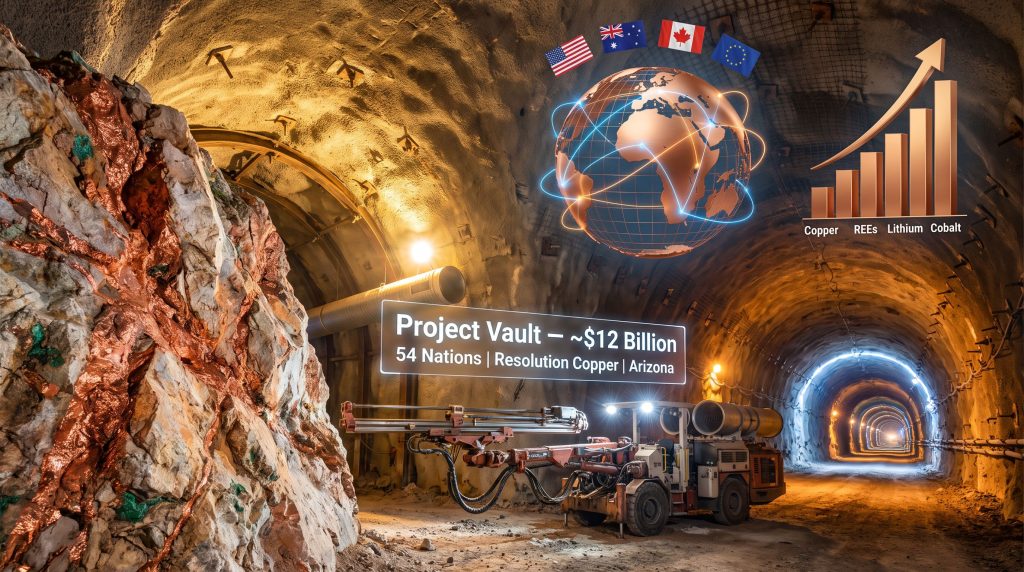
The most concrete financial commitment to emerge from the Trump critical minerals policy agenda is Project Vault, a government-held strategic stockpile of critical minerals valued at approximately $12 billion. The conceptual precedent is the US Strategic Petroleum Reserve, which demonstrated that government buffer stocks can meaningfully reduce vulnerability to supply disruptions when calibrated correctly.
Project Vault targets minerals where supply concentration risk is highest, prioritising materials for which the US has both significant downstream demand and limited processing redundancy outside of China. The Defense Production Act provides the legal mechanism for accelerated procurement, allowing the government to move faster than standard appropriations processes would normally permit.
What is Project Vault? Project Vault is the Trump administration's strategic initiative to build a government-held stockpile of critical minerals valued at approximately $12 billion. The program targets materials essential to defence, clean energy, and advanced manufacturing supply chains, and is designed to reduce US vulnerability to supply disruptions from geopolitically concentrated sources.
A comparison with allied-nation approaches reveals that the US is moving with unusual scale, though not in isolation:
| Country/Bloc | Key Policy Instrument | Primary Minerals Focus | Alignment with US Framework |
|---|---|---|---|
| United States | Project Vault, FORGE, MSP | Copper, REEs, Lithium, Cobalt | Anchor nation |
| Australia | Critical Minerals Strategy 2030 | Lithium, Cobalt, Nickel, REEs | High – MSP member |
| Canada | Critical Minerals Strategy | Cobalt, Nickel, Lithium, Graphite | High – FORGE partner |
| European Union | Critical Raw Materials Act | REEs, Lithium, Manganese | Moderate – observer alignment |
| Japan | Economic Security Promotion Act | REEs, Lithium, Cobalt | High – bilateral agreements |
Who Was in the Room: BHP, Rio Tinto, and the Resolution Copper Dimension
The White House mining executive roundtable convened more than 100 senior industry figures, making it the broadest direct engagement between the Trump administration and the global mining sector to date. The scale of attendance signals that the administration views private sector participation as integral to delivering on its supply chain objectives, not merely as a backdrop to policy announcements.
Among the most closely watched attendees were executives from BHP (ASX: BHP) and Rio Tinto (ASX: RIO), the joint venture partners behind the Resolution Copper project in Arizona. The project is widely considered one of the most significant prospective sources of new domestic US copper supply, with the deposit's scale placing it in the upper tier of undeveloped copper resources globally. In addition, the copper supply gap facing allied nations has intensified focus on projects of this scale.
The White House engagement marked a particularly significant milestone for BHP, as it represented the first major public appearance for the company's newly appointed North Americas president, Jess Farrell. The timing underscores how central the US market has become to BHP's strategic positioning.
Resolution Copper's general manager confirmed that engagement with the US government has translated into concrete operational progress, with the joint venture now having awarded major contracts for drilling programs and underground development works. This is a material development: contract awards at this stage of a project's development cycle typically signal that the project team has achieved sufficient confidence in the regulatory and financing environment to commit to significant capital expenditure.
South32 (ASX: S32) also had representation at the summit through its Hermosa project in Arizona, a base metals development targeting zinc, manganese, and other materials relevant to both battery supply chains and defence applications. Arizona has consequently emerged as an unusual concentration point for US critical minerals development, hosting two of the most advanced major projects in the domestic pipeline simultaneously.
The China Factor: Export Controls, Price Suppression, and the Western Response
China's rare earth export restrictions on gallium and germanium, both critical semiconductor materials, provided a concrete demonstration of the leverage that supply concentration creates. These controls did not merely disrupt markets temporarily; they forced Western governments and manufacturers to confront a vulnerability that had previously existed primarily in policy papers rather than operational reality.
The more persistent challenge, however, is not export controls but price suppression. Chinese state-subsidised production of rare earths and other critical minerals has historically operated at price points that make Western projects economically marginal. A Western mining project with genuine free-market production costs of, say, $X per unit of rare earth oxide cannot compete sustainably against Chinese production priced to reflect state subsidies rather than actual costs.
This dynamic is why price floor mechanisms have entered the policy conversation as a structural response rather than a temporary measure. The logic is straightforward: if Western projects cannot achieve bankable economics at current market prices because those prices reflect Chinese subsidies rather than competitive costs, then some form of reference pricing or government procurement guarantee may be necessary to sustain project development. The Guardian reports that G7 nations are actively exploring minimum price mechanisms as part of a coordinated allied response.
Critical Policy Consideration: Price support mechanisms for critical minerals represent a significant departure from standard commodity market policy. Their effectiveness depends heavily on the breadth of allied-nation participation. A unilateral US price floor without equivalent allied support could redirect Chinese supply to non-participating markets rather than reducing overall Chinese market influence. This is the central coordination problem that FORGE is attempting to address.
The risks of getting price floor design wrong are equally significant. Set floors too high relative to genuine production costs and the mechanism distorts investment decisions, directing capital toward marginal projects that would not be viable under any realistic market scenario. The WTO framework adds additional complexity, as price support mechanisms that function as de facto subsidies may trigger trade law challenges from non-participating nations.
The next major ASX story will hit our subscribers first
Copper's Elevated Status: From Industrial Metal to Strategic Priority
One of the less obvious but analytically important features of the Trump critical minerals summit is the elevation of copper to the same strategic tier as rare earth elements. Copper has historically been treated as an industrial commodity subject to normal market mechanisms, not as a strategic material requiring government intervention.
The reclassification reflects several converging pressures:
- The electrification of transport requires dramatically more copper per vehicle in EVs compared to internal combustion engines, with estimates ranging from three to four times the copper intensity
- Grid infrastructure expansion demanded by renewable energy deployment is highly copper-intensive
- Defence systems including radar, communications equipment, and propulsion systems rely on copper at quantities that make supply security a genuine military readiness concern
- The US domestic copper production base has been in structural decline relative to projected demand, creating a gap that is expected to widen materially through 2035 and beyond
Resolution Copper's potential contribution to closing this gap is significant, but the project's timeline illustrates a broader challenge for US critical minerals development. Large-scale mining projects require lengthy permitting processes, extensive environmental review, and substantial upfront capital commitment before a single tonne of production is achieved. The gap between policy intent and production reality is measured in years to decades, not months.
What the Summit Means for ASX-Listed Investors
For investors holding positions in ASX-listed miners with US exposure, the Trump critical minerals summit carries implications that extend beyond headline sentiment. The structural analysis points toward several specific considerations:
BHP (ASX: BHP) and Rio Tinto (ASX: RIO) are the most directly exposed large-cap names through Resolution Copper. White House-level engagement with the project does not eliminate the remaining regulatory hurdles, but it does signal that the political environment for advancing those processes has shifted materially. Project timelines and permitting velocity are the key variables to monitor.
South32 (ASX: S32) represents a secondary but meaningful exposure point through Hermosa. The project's base metals profile, including zinc and manganese alongside other materials, positions it across multiple demand themes simultaneously. Furthermore, the surge in critical minerals demand across defence and clean energy sectors reinforces the strategic case for projects of this nature.
More broadly, the policy architecture being built around the Trump critical minerals summit creates a demand signal that extends across the entire sector. Projects in allied nations, particularly Australia, that were previously marginal at prevailing market prices may become economically viable within frameworks that include price support mechanisms, government offtake commitments, or co-investment from allied-nation programs.
Investor Consideration: The critical minerals policy environment rewards projects with two characteristics above all others: proximity to allied-nation processing infrastructure and commodity profiles that align with defence and energy transition priorities. Projects that check both boxes are likely to attract disproportionate attention from both government and private capital as the policy framework matures. This is not financial advice; all investment decisions should be made with reference to individual circumstances and professional guidance.
The 54-Nation Alliance: Strength in Numbers or Coordination Illusion?
The inaugural Critical Minerals Ministerial brought together representatives from 54 nations alongside the European Commission, a scale of participation that the State Department described as part of an effort to reshape global mineral markets. The breadth of representation is diplomatically impressive, but the analytical question is whether this coalition can achieve the coordination necessary to actually alter market structures. Chatham House has noted that the gap between commitment and delivery remains a central challenge for the US-led framework.
Historical precedent from commodity markets suggests that large multilateral frameworks face significant free-rider problems. Nations that participate in a price support framework benefit from higher market prices without necessarily bearing the full cost of maintaining those prices, creating incentives to defect from commitments when market conditions change. The nonbinding nature of FORGE makes this challenge more acute, not less.
The counter-argument is that the security context for critical minerals differs fundamentally from normal commodity markets. When supply disruption carries national security consequences rather than merely economic costs, the calculus for sustained cooperation changes. Nations that experienced the consequences of medical supply chain concentration during the pandemic era, for instance, have demonstrated greater willingness to accept economic costs in exchange for supply security in subsequent policy decisions.
Unresolved Questions That Will Define the Decade
The Trump critical minerals summit marks an inflection point, but the policy architecture it represents is far from complete. Three questions will determine whether the initiative delivers durable structural change or functions primarily as a diplomatic signal:
- Will price floor mechanisms achieve sufficient allied-nation adoption? Without broad participation, unilateral price support risks distorting markets without reducing Chinese dominance
- Can Resolution Copper navigate its remaining regulatory pathway within the current policy window? The project's most recent progress signals are encouraging, but large-scale US mining projects have a history of encountering unexpected delays
- How will China respond to the consolidation of a Western critical minerals alliance? Chinese policy responses to perceived encirclement have historically included accelerated resource diplomacy in non-aligned nations, which could partially offset Western alliance building
The answer to these questions will not be known quickly. The nature of critical minerals supply chains is that they operate on decade-scale development timelines, meaning that policy decisions made in 2026 will manifest as production outcomes in the mid-2030s at the earliest. However, the role of critical minerals in the energy transition adds urgency to these timelines that goes beyond purely commercial considerations.
What the summit has established is that the political will to attempt this structural correction exists at the highest levels of the US government, and that allied nations are engaged at a scale not previously seen. Whether that political will proves durable enough to see projects through to production is the central uncertainty that informed observers should be tracking.
This article is intended for informational purposes only and does not constitute financial or investment advice. Past performance is not indicative of future results. Readers should seek independent professional advice before making any investment decisions. Forward-looking statements involve risks and uncertainties that could cause actual outcomes to differ materially from those described.
Want to Spot the Next Major ASX Mineral Discovery Before the Market Does?
Discovery Alert's proprietary Discovery IQ model delivers real-time alerts on significant ASX mineral discoveries across copper, rare earths, lithium, and other critical minerals — instantly translating complex data into actionable insights for investors at every level. Explore Discovery Alert's discoveries page to see how historic discoveries have generated substantial returns, and begin your 14-day free trial today to position yourself ahead of the market.