May 20, 2026
Critical Minerals Processing: The Transformation of Global Battery Manufacturing Networks
The evolution of global battery manufacturing increasingly depends on sophisticated processing networks that can transform raw materials into battery-grade compounds. These conversion facilities represent the crucial middle stage between mining operations and final battery production, yet many advanced economies have found themselves dependent on foreign processing capacity for critical materials like lithium. Moreover, establishing a battery-grade lithium refinery requires significant technological expertise and strategic partnerships.
Strategic partnerships between established industrial powers and resource-rich nations are reshaping how battery supply chains operate, with digital technologies playing an unprecedented role in accelerating facility development and optimising production processes. Furthermore, data-driven mining operations are becoming essential for maximising efficiency in these complex conversion processes.
How Vertical Integration Creates Competitive Advantage in Critical Minerals
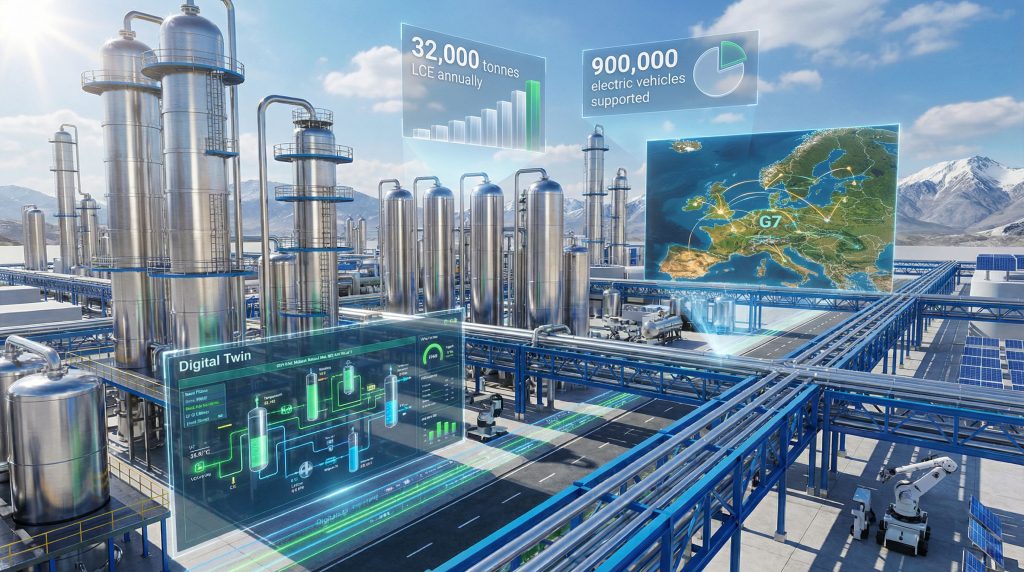
Modern lithium conversion partnerships leverage proven industrial blueprints to achieve rapid capacity deployment across multiple jurisdictions. The Rock Tech Red Rock facility in Ontario exemplifies this approach, designed to produce 32,000 tonnes of lithium carbonate equivalent (LCE) annually, sufficient to supply approximately 900,000 electric vehicles with battery materials.
This production capacity represents more than a manufacturing milestone; it demonstrates how strategic lithium conversion partnership initiatives can close critical gaps in regional supply chains. The facility development strategy combines existing Canadian mining operations with new conversion capacity, creating what Rock Tech CEO Mirco Wojnarowicz describes as a fully vertically integrated supply chain from rock to battery-grade lithium, establishing a critical minerals corridor entirely within Ontario.
The economic advantages of blueprint replication become apparent when examining traditional facility development timelines. Conventional lithium conversion projects typically require extensive feasibility studies, custom engineering work, and lengthy permitting processes. By contrast, blueprint transfer methodologies utilise proven designs from existing facilities, dramatically reducing both development timelines and execution risks.
| Development Phase | Traditional Timeline | Blueprint Transfer Benefits |
|---|---|---|
| Feasibility Study | 18-24 months | Proven design validation |
| Engineering Design | 24-36 months | Standardised specifications |
| Permitting Process | 36-48 months | Regulatory precedent |
| Construction Phase | 36-42 months | Reduced execution risk |
The Red Rock project leverages engineering and permitting work completed for the Guben facility in Germany, creating a direct technology transfer that materialises years of development work into accelerated Canadian deployment. This approach demonstrates how international cooperation can compress typical development cycles whilst maintaining technical and regulatory standards.
When big ASX news breaks, our subscribers know first
Supply Chain Sovereignty Through Domestic Processing Infrastructure
G7 nations are prioritising domestic lithium processing capacity as a strategic response to supply chain vulnerabilities in critical minerals. The concentration of lithium conversion facilities in non-allied nations has created dependencies that extend beyond commercial considerations into national security implications. Additionally, CRM facility developments across Europe are accelerating to address these strategic concerns.
Parliamentary State Secretary Stefan Rouenhoff of Germany emphasises the strategic importance of secure and sustainable supply chains for critical raw materials, positioning the Rock Tech-Siemens partnership as a signal for continued expansion of German-Canadian cooperation in this sector. This ministerial-level endorsement indicates that lithium conversion capacity development operates within formal G7 strategic frameworks rather than purely commercial arrangements.
The Canadian Minister of Energy and Natural Resources, Tim Hodgson, frames the partnership within the Critical Minerals Production Alliance, stating that Canada and G7 allies are moving from ambition to action in developing secure and sustainable critical mineral supply chains that both economies and defence industries depend upon. This explicit connection between lithium processing and defence capabilities illustrates how critical minerals processing transcends civilian applications.
Key Strategic Drivers Include:
- Midstream Processing Gaps: North American battery value chains previously lacked adequate conversion capacity, forcing reliance on foreign processing facilities
- Defence Industry Requirements: Military applications increasingly require secure supply chains for battery technologies and energy storage systems
- Economic Sovereignty: Domestic processing creates high-value manufacturing jobs and technology spillover effects
- Export Development: Value-added mineral processing enables transition from raw material exports to finished product exports
The Red Rock facility addresses what industry analysis identifies as a critical gap in North American battery value chains through midstream lithium processing. While North America possesses substantial mining capacity, the conversion step that transforms raw lithium materials into battery-grade compounds has historically been outsourced, creating vulnerability points in strategic supply chains.
Digital Twin Technology Revolutionising Mineral Processing
Digital Twin applications in modern lithium conversion represent a fundamental shift toward data-driven facility optimisation and risk reduction. Siemens Canada CEO Faisal Kazi describes how the partnership leverages digital twin and industrial digitalisation technologies to support lithium conversion development in Ontario, ultimately strengthening battery supply chains within G7 nations.
The Digital Twin deployment spans the complete project lifecycle from feasibility study through engineering, construction, and operation. This comprehensive approach enables virtual, data-driven modelling of processes, energy flows, and material streams, allowing operators to optimise and validate design parameters, efficiency metrics, emissions profiles, and operational reliability before committing capital investments. For more insights on this technology, see how digital twin technology is transforming lithium processing.
Digital Twin Capabilities Include:
- Real-time Process Monitoring: Continuous optimisation of conversion efficiency rates and quality control parameters
- Predictive Maintenance Systems: Equipment lifecycle management and downtime reduction through predictive analytics
- Energy Flow Optimisation: Integration with renewable energy sources and demand response systems
- Emissions Monitoring: Environmental compliance tracking and sustainability target achievement
- Material Stream Tracking: Automated quality control and inventory management systems
The technology enables validation of multiple operational parameters simultaneously rather than sequential design-construction-validation workflows typical of traditional facility development. By modelling energy flows as a specific parameter, Digital Twin technology supports integration with renewable energy sources and optimisation of energy consumption patterns.
Process optimisation through virtual modelling represents a departure from trial-and-error operational adjustments toward predictive system management. The ability to validate operational reliability before capital commitment reduces the financial risks associated with large-scale industrial facility development whilst improving long-term operational performance.
International Cooperation Frameworks Accelerating Development
The Rock Tech-Siemens partnership demonstrates how international cooperation accelerates critical minerals project development through proven blueprint transfer and coordinated government support. The collaboration structure encompasses multiple phases, beginning with Digital Twin technology deployment and expanding to comprehensive engineering support and potential replication across G7 member countries. Furthermore, this partnership exemplifies the broader Siemens digitisation technology being leveraged across various lithium projects.
The Guben facility in Germany provides the operational precedent for this technology transfer, described as fully permitted and engineered, creating regulatory and technical frameworks that can be adapted to Canadian regulatory requirements. This precedent-based approach materially reduces execution risk and supports more efficient paths toward final investment decisions.
Multi-Phase Partnership Structure:
- Phase 1: Digital Twin technology deployment during feasibility studies and engineering phases
- Phase 2: Additional Siemens solutions, services, and engineering support for converter development
- Phase 3: Operational excellence programs and production optimisation
- Phase 4: Expansion to additional projects in G7 member countries
The partnership operates within the Critical Minerals Production Alliance framework, establishing formal coordination between corporate development strategies and governmental strategic objectives. This institutional alignment reduces friction in permitting processes and creates pathways for coordinated funding applications.
Joint funding applications are being pursued with Natural Resources Canada, the Government of Ontario, and through Canadian-German cooperation programmes. This coordinated approach to public funding demonstrates how G7 governments are aligning financial support mechanisms to accelerate strategic capacity development.
Strategic Insight: The blueprint transfer methodology creates measurable advantages in capital efficiency, timeline compression, and risk reduction compared to greenfield facility development, whilst maintaining technical standards and regulatory compliance.
Market Impact and Competitive Positioning
Strategic lithium conversion partnership arrangements are reshaping global market dynamics by diversifying processing capacity across allied nations and reducing concentration risks in conversion infrastructure. The 32,000 tonnes LCE annual capacity from a single facility represents significant market impact when replicated across multiple jurisdictions within cooperative frameworks. Consequently, the battery metals investment landscape is experiencing unprecedented transformation.
The production capacity sufficient to supply 900,000 electric vehicles annually demonstrates direct linkages between midstream conversion capacity and downstream manufacturing requirements. This supply chain integration enables more predictable cost structures and delivery schedules for battery manufacturers whilst reducing dependencies on non-allied processing facilities.
Competitive Advantages Include:
- Supply Security Enhancement: Diversified processing capacity reduces single-point-of-failure risks
- Cost Structure Optimisation: Shared development costs and proven technologies improve capital efficiency
- Market Share Growth: Increased G7 control over global lithium processing capacity
- Technology Leadership: Advanced digitalisation capabilities in mineral processing operations
The partnership approach enables technology sharing agreements for strategic resource processing and joint investment in next-generation conversion technologies. These cooperative frameworks position G7 nations competitively against regions with established processing capacity whilst building long-term strategic advantages.
Development of circular economy partnerships for lithium recycling represents future expansion opportunities for strategic conversion partnerships. Integration with downstream battery manufacturing alliances creates additional value chain coordination possibilities within allied nation frameworks.
Investment Implications and Risk Assessment
Strategic lithium conversion partnership ventures present distinct investment characteristics compared to traditional mining ventures or standalone processing facilities. The combination of proven technology transfer, government coordination, and strategic mineral frameworks creates investment profiles with both enhanced returns potential and strategic security considerations.
Investment Considerations:
- Capital Efficiency: Blueprint transfer reduces development costs and timeline risks
- Market Access: G7 framework positioning provides preferential supply chain integration
- Technology Premium: Digital Twin optimisation creates operational advantages
- Strategic Value: Critical minerals classification enhances asset security and government support potential
The funding coordination between multiple government levels and international cooperation programmes creates additional capital sources beyond traditional project financing. Joint applications for public funding with Natural Resources Canada, provincial governments, and international cooperation programmes diversify financing risks whilst providing strategic endorsement.
Risk factors include technology transfer dependencies, regulatory coordination complexities, and market demand fluctuations for electric vehicle battery materials. However, the strategic classification of lithium conversion within G7 frameworks provides additional security against adverse policy changes or market disruptions.
The next major ASX story will hit our subscribers first
Future Outlook: Scaling Strategic Mineral Partnerships
The success of strategic lithium conversion partnership models will likely determine expansion patterns for other critical minerals processing capacity development. The Rock Tech-Siemens collaboration serves as a reference model for industrial ventures across the critical minerals sector, with potential replication to rare earth processing, cobalt refining, and graphite purification operations. Additionally, broader mining industry innovation trends are shaping the future of these partnerships.
Next-generation Digital Twin capabilities are evolving toward autonomous operations integration, artificial intelligence enhancement for predictive optimisation, and comprehensive sustainability monitoring systems. These technological advances will further compress development timelines whilst improving operational performance and environmental compliance.
Expansion Pathways Include:
- Geographic Replication: Proven partnership models applied to additional G7 jurisdictions
- Mineral Diversification: Extension of cooperation frameworks to other critical minerals
- Downstream Integration: Coordination with battery manufacturing and electric vehicle production
- Circular Economy Development: Integration of recycling and secondary processing capacity
The partnership announcement at the Canadian Critical Minerals Forum during the Prospectors and Developers Association of Canada Trade Show demonstrates institutional support for expanding these cooperation models. Government-industry coordination forums provide platforms for scaling successful partnerships across broader critical minerals sectors.
Strategic lithium conversion partnerships represent a fundamental evolution in how advanced economies approach critical minerals security, combining industrial cooperation, technology transfer, and digital innovation to create resilient supply chains that support both economic competitiveness and strategic autonomy within allied nation frameworks.
Are You Tracking Critical Minerals Investment Opportunities?
Discovery Alert's proprietary Discovery IQ model delivers instant notifications when significant critical minerals discoveries are announced on the ASX, empowering investors to capitalise on opportunities in lithium, rare earths, and other strategic commodities as they emerge. Explore how historic mineral discoveries have generated substantial returns and begin your 14-day free trial today to secure your competitive advantage in this rapidly evolving sector.