
July 14, 2026
The Processing Gap That Could Define the Next Industrial Era
Geological wealth has never guaranteed industrial power. Throughout modern history, nations rich in raw resources have routinely ceded economic control to those possessing the technical capacity to transform those resources into finished goods. The story of critical minerals processing in the US and China is, at its core, a rerun of this dynamic played out at extraordinary strategic stakes. The mineral deposits exist. The ore bodies are mapped. In many cases, the United States sits atop resources that exceed China's in both grade and volume. What is absent, and what no amount of mining permits can replace, is the downstream industrial infrastructure required to convert raw ore into strategically usable materials.
Understanding why critical minerals processing in the US and China has become the defining strategic divergence of the decade requires moving beyond headlines about trade wars and tariffs. It requires examining the metallurgical, economic, and policy realities that determine where raw materials become strategic assets, and where they remain inert rock.
When big ASX news breaks, our subscribers know first
The Processing Bottleneck: Why Mining Is Actually the Easy Part
From Ore to Oxide to Alloy: A Cascade of Compounding Difficulty
Mining is a civil engineering problem. It involves moving material, managing ground conditions, and applying well-established extraction techniques. Processing is an entirely different class of challenge. For most critical minerals, and particularly for rare earth supply chains, the transformation from raw ore into a commercially usable product involves multiple discrete chemical and metallurgical stages, each exponentially more demanding than the last.
The journey from ionic clay leachate to separated rare earth carbonate is achievable with relatively accessible hydrometallurgical methods. Converting that carbonate into individual oxides requires more sophisticated solvent extraction chemistry. Transforming those oxides into metals and ultimately into functional alloys demands technical expertise and capital infrastructure that took decades to develop and cannot be replicated through policy announcements alone.
As Joe Mazunda, editor and analyst at Exploration Insights, puts it in a recent interview: in most critical minerals, the processing component carries greater strategic importance than the extraction phase itself. The technical knowledge required at each downstream stage compounds in complexity, meaning that the gap between mining capability and processing capability is not linear. It widens at every transformation step.
Why Ionic Absorption Clay Deposits Change Everything
One of the least understood aspects of the rare earth processing challenges is the role that deposit geology plays in determining processing complexity. Chinese heavy rare earth production, including dysprosium and terbium essential for permanent magnets in electric vehicle motors and precision defence systems, derives primarily from ionic absorption clay deposits. These deposits require no blasting. Extraction involves applying a leaching solution to the clay matrix, which releases adsorbed rare earth ions into solution. The mining phase is, relative to hard rock alternatives, straightforward.
The competitive advantage of ionic absorption clays does not lie in how they are mined. It lies in how the resulting leachate is processed. The hydrometallurgical expertise required to convert that leachate through carbonate, oxide, and alloy stages is precisely where China's processing supremacy is most acute, and where Western nations face the steepest rebuilding challenge. Ionic absorption clay deposits at commercial scale are largely absent in the United States, meaning the US faces both a deposit-type disadvantage for heavy rare earths and a processing knowledge deficit for the deposit type that matters most.
How China Built a Processing Advantage That Spans Decades
Deliberate Policy, Not Accident
China's dominance in critical minerals processing was not the product of chance or geography. It was constructed systematically across four decades through industrial policy, technology absorption, state capital allocation, and regulatory asymmetry. During China's high-growth decades, its government and enterprises engaged in a comprehensive programme of acquiring processing knowledge from Japanese, Korean, German, and American industrial partners through joint ventures, licensing arrangements, and technology transfer agreements that frequently lacked reciprocal protections.
What makes this history particularly significant is the observation that Chinese processing capabilities did not remain static at the point of initial technology transfer. The ecosystem continued evolving. China now holds processing capabilities in multiple critical mineral categories that exceed those of the nations from which the foundational knowledge was originally drawn. As Mazunda notes, Chinese entities absorbed high-end technology globally during their growth phase, and critically, the information flow was entirely one-directional. Western nations gained no equivalent access to Chinese processing methodologies in return.
The Self-Reinforcing Ecosystem
Processing dominance creates its own perpetual motion. Once Chinese facilities achieved scale, they generated cost advantages that made competing facilities economically unviable. Those cost advantages attracted additional mineral feedstock from global mining operations, which further increased processing volumes, reducing unit costs and deepening the scale moat. Infrastructure, technical workforce expertise, equipment manufacturing, and downstream consuming industries all concentrated in geographic proximity, creating an integrated industrial ecosystem that individual processing facilities in Western nations cannot replicate in isolation.
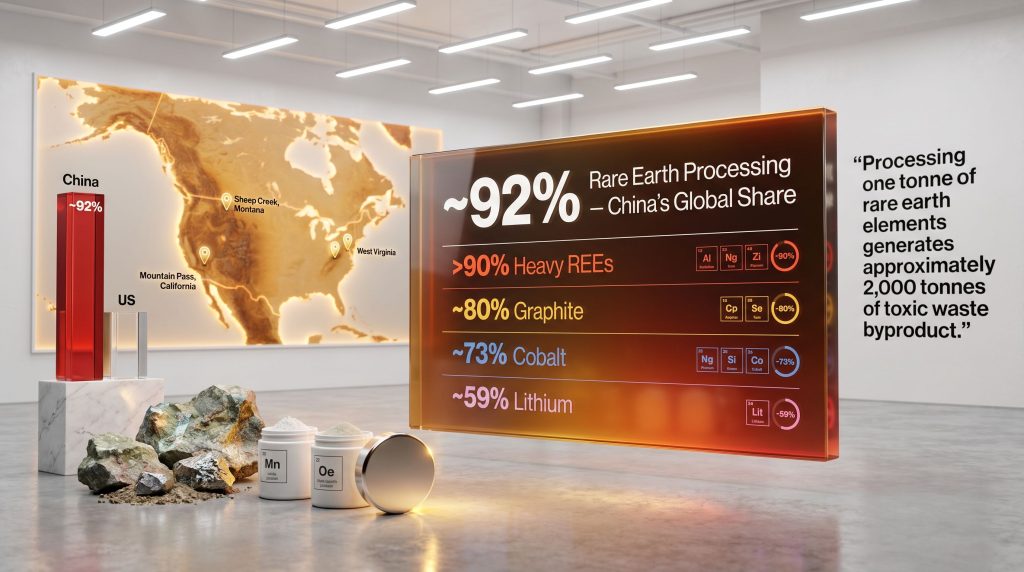
The environmental compliance differential further entrenched this advantage. Processing one tonne of rare earth elements generates approximately 2,000 tonnes of toxic waste byproduct, a figure that makes permitting and operating Western processing facilities substantially more capital intensive than historical Chinese operations that functioned under less stringent regulatory oversight. This is not an argument for weakening Western environmental standards. It is a quantification of the structural cost disadvantage that Western processors must overcome.
By the Numbers: The Scale of China's Processing Grip
The concentration of global critical minerals refining capacity within a single nation has no precedent in modern commodity markets. The following data illustrates the scope of this concentration across strategically significant mineral categories:
| Mineral Category | China's Estimated Processing Share | Primary Strategic Application |
|---|---|---|
| Rare Earth Elements (overall) | ~92% | EV motors, wind turbines, defence |
| Heavy REEs (dysprosium, terbium) | >90% | Permanent magnets, military systems |
| Battery-grade Graphite | ~80% | Lithium-ion cell anodes |
| Cobalt | ~73% | EV batteries, aerospace alloys |
| Nickel | ~68% | Battery cathodes, stainless steel |
| Lithium | ~59% | EV batteries, grid energy storage |
| Gallium and Magnesium | >90% | Semiconductors, electronics |
These figures illustrate a concentration of processing control that no other commodity sector in modern industrial history has approached. The relevant comparison is not OPEC's influence over oil supply, but a scenario in which a single nation controlled oil refining for the entire global economy.
An important analytical distinction must be drawn between global supply and accessible supply. Even where alternative processing capacity nominally exists, geopolitical alignment, contractual obligations, and logistical infrastructure mean that Western manufacturers cannot simply redirect to alternative processors in a disruption scenario. The practical concentration of accessible processing capacity for Western end users is arguably higher than the headline market share figures suggest.
America's Geological Wealth: A Strategic Asset Stranded Without Processing
The Endowment Paradox
The United States possesses a mineral endowment that, in terms of gross resource base, exceeds China's across multiple critical mineral categories. This is the endowment paradox at the heart of the current strategic challenge: America's rare earth supply chain relies on substantial geological wealth that is largely untapped, but without domestic processing infrastructure to transform extracted ore into usable materials, that wealth cannot be converted into supply chain independence.
Mazunda is direct on this point. The US is significantly better endowed than China from a geological standpoint. The processing capability gap, estimated at two to three decades, represents the actual strategic deficit. Geological endowment and strategic independence are not the same thing.
Key Domestic Deposits and Their Limitations
- Mountain Pass, California: The only currently active rare earth mine in the US, operated by MP Materials. The facility includes partial on-site processing but does not complete the full transformation to metal alloy domestically.
- Sheep Creek, Montana: Identified as potentially the highest-grade rare earth deposit in the US. Remains in development stage without current production.
- Coal Waste and Tailings, West Virginia: Active pilot programmes targeting rare earth element recovery from legacy coal mining waste streams. Represents an innovative non-traditional feedstock approach but remains pre-commercial in scale.
- Ionic Clay Deposits: The deposit type that supplies the majority of Chinese heavy rare earths is largely absent at commercial scale within US borders, creating a structural feedstock challenge for heavy rare earth supply chains specifically.
The pattern across these assets is consistent: geological potential exists, but the gap between deposit identification and commercially operating, fully integrated processing capacity represents a multi-decade development timeline under the most favourable conditions.
The Current State of US Processing Infrastructure
An Honest Assessment
The gap between political ambition and industrial reality in US critical minerals processing is significant. Several initiatives have advanced from concept toward implementation, but the aggregate capacity being developed remains a fraction of what would be required for meaningful supply chain independence across the full range of strategically significant minerals.
| Initiative | Description | Current Status |
|---|---|---|
| DoD Niobium Processing Assessment | Preliminary evaluation for domestic niobium refining infrastructure | $26.4M DoD allocation |
| USCM-INL Collaborative R&D | Research agreement targeting REE and gallium recovery from non-traditional sources | Pilot scaling phase |
| Coal Waste REE Recovery (WV) | Processing pilots extracting rare earths from legacy coal tailings | Active pilot programmes |
| Project Vault | Multi-mineral strategic reserve with minimum price guarantee mechanism funded by end users | Conceptual framework |
| 2026 Critical Minerals Ministerial | Eleven new bilateral memoranda of understanding including with Argentina to secure upstream supply | Diplomatic track |
A critical structural issue identified by Mazunda is the historical mismatch between processing investment and mine development. The previous administration recognised the need for greater processing capacity but did not simultaneously accelerate mine permitting to generate the feedstock required to make those processing facilities economically viable. Processing capacity without mine feed is strategically incomplete. Mine permits without processing infrastructure solve only half the problem. Both elements of the supply chain must develop in coordination.
Why Subsidies Alone Cannot Close the Gap
A point that Mazunda emphasises, and that is frequently lost in policy discussions, is the distinction between capital cost reduction and revenue certainty. Government subsidies and low-cost financing can reduce the capital burden of building processing infrastructure. They cannot, however, change the long-run economics of a facility operating into uncertain market prices over a twenty-year mine life.
The power sector analogy is instructive. For decades, new power plant construction required guaranteed minimum return rates of approximately 15% before private capital would commit. The mechanism was a price guarantee, not cheap construction financing. The same logic applies to critical mineral processing facilities. What changes the fundamental investment calculus is certainty about long-run revenue, not reduction of upfront construction costs.
Project Vault, as currently conceptualised, addresses this gap through a minimum price guarantee mechanism funded by end user contributions into a strategic reserve. The unresolved question is which product form — whether concentrate, carbonate, oxide, or alloy — qualifies for price support. As Mazunda notes, the end user will ultimately dictate the product specification, and it will likely be cathode or alloy because that is what manufacturers require. That specification must be defined before the price guarantee mechanism can function as intended.
The next major ASX story will hit our subscribers first
China's Export Controls and the Accelerating Bifurcation of Supply Chains
Geopolitical Leverage Through Processing Chokepoints
China's rare earth export restrictions represent the logical application of a leverage position built over decades. The strategic logic mirrors the semiconductor export controls applied by the United States against Chinese advanced chip technology, but with a crucial asymmetry. The US controls advanced chip design software and fabrication equipment. China controls the raw and processed materials required to manufacture those chips and the technologies that depend on them.
Each side is applying export control pressure at the point in the technology-materials stack where it holds dominant position. The difference is timeline. Rebuilding semiconductor design capability would take China an estimated ten to fifteen years under aggressive investment scenarios. Rebuilding rare earth and critical mineral processing capability in the West is, by the estimates of those closest to the industry, a multi-decade undertaking.
The Commodity Price Signal Problem
Export restrictions create immediate supply disruption signals that drive short-term price spikes in affected minerals. However, Mazunda highlights a more nuanced dynamic: the impact of supply bifurcation extends beyond spot prices. When Western nations are effectively excluded from Chinese-processed supply, they must source from the subset of non-Chinese processing capacity that exists, paying a scarcity premium that erodes the cost competitiveness of downstream manufacturing.
The Middle East briefly appeared as a potential alternative processing hub, with Gulf states positioning themselves as a carbon-neutral bridge for critical mineral processing. That pathway has stalled. Processing economics, infrastructure requirements, and geopolitical complexity have made the Gulf processing ambition unviable at the timelines originally envisioned, forcing Western nations to confront domestic and allied processing development as the only credible long-term alternative.
The Real Cost of Rebuilding Western Processing Capacity
Capital Requirements vs. Available Commitments
The financial gap between what is required and what has been committed to rebuild Western critical minerals processing capacity is substantial. Copper processing infrastructure alone, to achieve meaningful US independence, carries an estimated capital requirement approaching $85 billion. Current federal commitments represent a fraction of this figure across all mineral categories combined.
Private capital faces a structural hesitation problem. Processing facilities have long payback periods, typically matching or exceeding mine life durations of fifteen to twenty years. Commodity price exposure over that period creates revenue uncertainty that standard project finance frameworks struggle to accommodate without additional risk mitigation mechanisms, precisely the gap that Project Vault is designed to address.
The economics of critical minerals processing in the West are not simply a cost problem. They are a revenue certainty problem. Capital can be made cheap through government mechanisms. What cannot be engineered through policy is market price certainty across a twenty-year project lifecycle without explicit price floor commitments.
The North American Integration Opportunity Being Squandered
One of the more consequential analytical points emerging from industry commentary is the missed opportunity represented by North American supply chain integration. A coordinated approach combining US geological resources, Canadian processing infrastructure, and Mexican manufacturing capacity would constitute a credible integrated alternative to Chinese-dominated refining networks.
Current tariff structures work directly against this outcome. A 25% tariff applied to Canadian copper products creates an economic incentive for Canadian operators to redirect refined copper toward European buyers rather than US manufacturers. The tariff friction that was designed to encourage domestic sourcing is instead fragmenting the allied supply chain it was intended to consolidate. Mazunda identifies this as a significant self-inflicted strategic wound: the tariff logic and the supply chain security logic are working against each other simultaneously.
What Would It Actually Take to Achieve Processing Independence?
A Framework for Building Domestic Capacity
Closing a two-to-three decade processing gap requires more than accelerated permitting and diplomatic memoranda. Furthermore, based on the structural analysis of what China built and what Western nations currently lack, a realistic framework involves six sequential requirements:
- Secure mine feed at scale: Accelerate permitting for high-grade domestic deposits and formalise binding supply agreements with allied nation producers to guarantee feedstock for processing facilities.
- Bridge the pilot-to-commercial transition: Move existing research and development programmes from laboratory or small pilot scale to industrial production scale with dedicated federal financing specifically targeting scale-up costs.
- Establish product-specific price floors: Define minimum price guarantees at the alloy or cathode level that provide long-run revenue certainty, changing the investment calculus for private capital deployment.
- Prioritise smelting and refining infrastructure: Focus on states with existing industrial bases, regulatory frameworks aligned with industrial development, and available workforce in metallurgical disciplines.
- Build workforce and technical training pipelines: Invest in hydrometallurgical engineering education and metallurgical training programmes that do not currently exist at the scale required for a domestic processing industry.
- Formalise allied nation supply agreements: Move beyond diplomatic memoranda to binding commercial agreements that link upstream mining production in allied nations to US downstream processing facilities with volume and pricing certainty.
The Leapfrog Possibility
A speculative but analytically credible pathway exists for Western nations to bypass some conventional processing stages through technological innovation. Waste stream recovery from legacy mining operations, coal tailings, and electronic waste represents a feedstock source that does not require greenfield mine development or lengthy permitting processes. If processing technology can be developed or adapted specifically for these non-traditional feedstocks, near-term processing capacity can be built faster than conventional mine-to-refinery supply chains allow.
This approach does not eliminate the need for conventional processing infrastructure, but it could accelerate early-stage capacity development while longer-term conventional supply chains mature. The critical constraint is scaling processing technology developed for heterogeneous waste feedstocks to economically viable throughput levels.
Realistic Timeline Expectations
The uncomfortable reality, acknowledged consistently by those with direct industry and technical expertise, is that the processing gap cannot be closed on a politically convenient timeline. Permitting a single large processing facility in the United States can require five to ten years under current regulatory frameworks. Training a generation of hydrometallurgical engineers and metallurgists to staff those facilities requires additional years.
Establishing the supplier ecosystems, equipment manufacturers, and technical service providers that support industrial-scale processing requires decades of accumulated development. The parallel to semiconductor fabrication is instructive as a cautionary analogy. Western nations that ceded chip manufacturing to Asian foundries over decades have found, despite extraordinary capital commitments, that rebuilding that capability takes far longer than building it initially.
FAQ: Critical Minerals Processing in the US and China
What is the difference between critical minerals mining and processing?
Mining refers to the physical extraction of ore from the ground. Processing encompasses the chemical, metallurgical, and hydrometallurgical transformation of that ore through multiple stages into commercially usable materials, including concentrates, carbonates, oxides, metals, and alloys. Processing typically represents the greater technical challenge, higher capital requirement, and greater strategic value in the supply chain.
Why does China dominate critical minerals processing globally?
China built its processing dominance over four decades through deliberate industrial policy, systematic absorption of processing technology from international partners, state capital allocation to downstream infrastructure, and operational cost advantages from historically less stringent environmental regulation. Processing expertise was then continuously advanced rather than preserved at its initial level.
Which critical minerals does the US currently process domestically?
The US has limited domestic processing capacity across most critical mineral categories. Mountain Pass, California represents the only active rare earth production, with partial on-site processing. Various pilot programmes target alternative feedstocks including coal waste. For most critical minerals, the US relies on foreign processing, frequently including Chinese facilities. Consequently, critical minerals demand continues to grow while domestic capacity lags significantly behind.
What are heavy rare earths and why are they harder to process?
Heavy rare earth elements include dysprosium, terbium, erbium, and related elements at the higher end of the lanthanide series. They occur at lower concentrations than light rare earths, frequently in ionic absorption clay deposits in southern China. Their separation from mixed rare earth streams requires more sophisticated solvent extraction chemistry than light rare earth separation, and the specific technical expertise for heavy rare earth processing is highly concentrated in China.
How do China's export controls affect US manufacturers?
Export restrictions on processed rare earth materials, gallium, germanium, and other minerals limit the supply accessible to US manufacturers of defence systems, electric vehicles, wind turbines, semiconductors, and advanced electronics. Manufacturers either pay significant price premiums for available non-Chinese supply or face production constraints when alternative supply cannot be readily sourced from partner nations.
What is Project Vault?
Project Vault is a conceptual US strategic reserve mechanism for critical minerals, funded through contributions from end users of those minerals. Unlike conventional stockpiling, the mechanism is designed to provide minimum price guarantees to processing facilities and miners, addressing the revenue certainty problem that makes long-term private investment in domestic processing economically difficult.
Can recycling and waste recovery replace primary processing?
Not in its current form. Recycling and waste recovery can contribute meaningfully to supply, particularly for elements with established collection infrastructure. However, recovery rates from end-of-life products remain insufficient to meet growing demand, and waste stream processing still requires many of the same technical capabilities as primary processing. These pathways supplement rather than replace primary processing development.
How long would it realistically take for the US to achieve rare earth processing independence?
Given current infrastructure deficits, workforce gaps, permitting timelines, and the compounding technical complexity of processing development, most industry-informed estimates suggest a multi-decade timeline for meaningful processing independence. Accelerated federal investment, policy alignment, and technological innovation could compress this timeline, but the structural realities of industrial ecosystem development mean that years or a single political cycle is not a realistic timeframe.
The Strategic Takeaway: Processing Supremacy as the New Industrial Frontier
The Nation That Controls Processing Controls the Technology Stack
The critical minerals challenge facing the United States and its allies is fundamentally a processing problem, not a geology problem. Mineral endowment is substantial and, in many categories, exceeds China's. What is absent is the industrial infrastructure, technical workforce, and sustained policy commitment required to transform that geological wealth into strategic self-sufficiency.
The semiconductor fabrication analogy bears repeating because it is the most accurate available precedent. Western nations that allowed chip manufacturing to concentrate in Asia discovered, when geopolitical friction escalated, that rebuilding that capability required extraordinary capital, time, and policy commitment — and that even with all three, the gap could not be closed quickly. Critical minerals processing in the US and China represents an analogous challenge, and in some dimensions a deeper one, because the industrial knowledge required spans hydrometallurgy, materials science, environmental engineering, and equipment manufacturing in ways that are less visible and less politically legible than semiconductor fabrication.
Closing a two-to-three decade processing gap demands the kind of coordinated, sustained industrial investment that Western economies have not undertaken since the postwar reconstruction era. Policy reform, diplomatic engagement, and capital incentives are necessary conditions. They are not sufficient conditions. The sufficiency condition is time, and the clock has been running for decades already.
This article is intended for informational and educational purposes only. It does not constitute financial, investment, or professional advice. Projections, timelines, and market share data referenced herein are drawn from industry commentary, publicly available government sources, and expert analysis, and are subject to change. Readers should conduct their own due diligence and consult qualified advisors before making investment or policy decisions related to critical minerals or mining sector equities.
Want To Stay Ahead of Critical Mineral Discoveries Before the Market Catches On?
As the race to close the processing gap intensifies, early identification of significant ASX mineral discoveries — particularly in critical minerals — could represent substantial opportunity for informed investors. Discovery Alert's proprietary Discovery IQ model delivers real-time alerts on significant ASX mineral discoveries, transforming complex geological data into actionable insights for both short-term traders and long-term investors. Explore why historic mineral discoveries have generated extraordinary returns, then begin your 14-day free trial at Discovery Alert to position yourself ahead of the market.