June 26, 2026
The Hidden Fault Line Inside One of the World's Richest Resource Economies
Every resource boom carries within it the seed of its own vulnerability. History is littered with commodity-rich economies that generated extraordinary wealth during periods of high prices, only to find themselves structurally exposed when cycles turned. Western Australia sits at precisely this kind of crossroads today, not because its resources are depleting, but because the way it participates in global supply chains may be leaving the most valuable portions of the economic equation on the table.
The central question confronting WA's policymakers, investors, and industry leaders is no longer how much can be extracted. It is how deeply the state can embed itself in the transformation of raw materials into high-value industrial products. This is the defining strategic challenge of the Western Australia critical minerals processing and downstream industries agenda, and the answer will shape the state's economic trajectory for generations.
When big ASX news breaks, our subscribers know first
The Structural Imbalance Hidden Inside a $200 Billion Economy
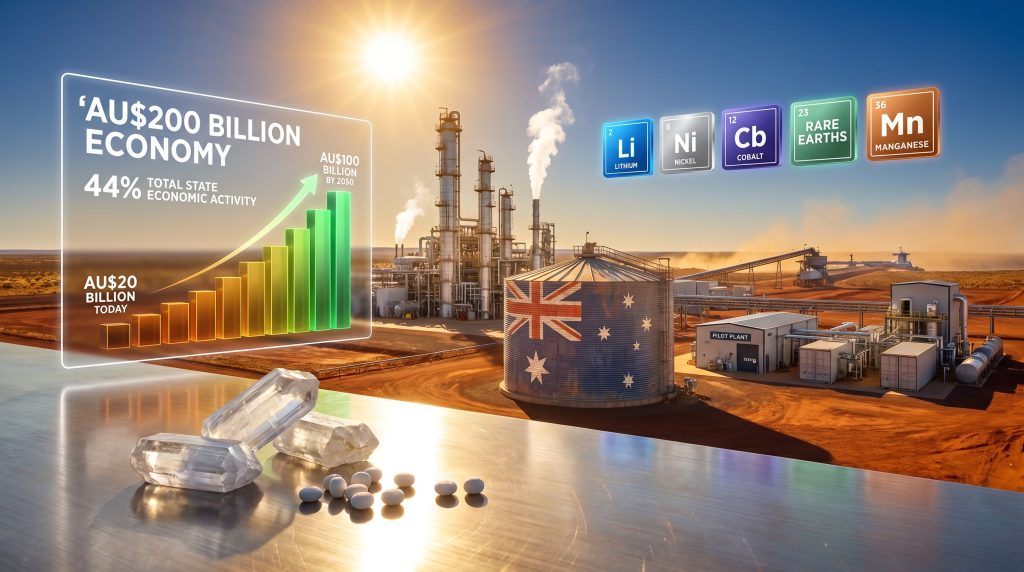
WA's resources sector is, by any measure, a global heavyweight. It contributes approximately AU$200 billion annually and accounts for 44 per cent of total state economic activity, according to analysis from the Bankwest Curtin Economics Centre (BCEC). These are figures that command international attention. However, within them lies a concentration of risk that deserves equal scrutiny.
Iron ore alone generates AU$126 billion in output and commands more than 80 per cent of state royalty revenue. Mining and petroleum royalties collectively delivered close to AU$10 billion in a single fiscal year, equivalent to roughly 20 per cent of all state government revenue. Furthermore, four in every five export dollars earned by WA flow to a single trading partner: China.
According to the BCEC, an economy where one commodity funds the overwhelming majority of royalties and one country absorbs the vast bulk of exports is not genuinely diversified. It is structurally leveraged to conditions that are entirely outside its own control.
This dual concentration, across commodity type and export destination, creates a fragility that strong headline numbers can obscure. Price cycles, geopolitical disruptions, or shifts in Chinese industrial policy can transmit directly into WA's fiscal position in ways that few other advanced economies would tolerate.
Why the Old Growth Model Is Running Out of Road
For decades, WA's prosperity formula was elegant in its simplicity: find more, dig more, ship more. Volume was the engine of growth. That model still functions, but the global forces now reshaping how mineral wealth translates into national prosperity are fundamentally altering its long-term viability.
Rapid decarbonisation trajectories, the acceleration of electric vehicle adoption, and intensifying geopolitical competition among major powers for control of critical supply chains are collectively rewriting the rules. Nations and sub-national economies that remain locked at the extraction end of the value chain increasingly risk becoming permanent raw material suppliers to more industrially sophisticated trading partners.
The BCEC analysis is direct on this point: WA's next phase of growth must be driven by creating value, not merely increasing extraction volumes. The broader picture of critical minerals in Australia reflects the same imperative — upstream dominance alone is no longer a sufficient economic strategy.
What Western Australia Actually Holds, and What It Is Currently Missing
A World-Class Critical Minerals Endowment
The resource foundation underpinning WA's downstream ambitions is genuinely exceptional. The state hosts world-class reserves spanning virtually every mineral on Australia's national critical minerals list.
| Critical Mineral | WA's Global Position | Primary End-Use Application |
|---|---|---|
| Lithium | World's largest producer | EV batteries, grid-scale storage |
| Nickel | Top-tier global supplier | Battery cathodes, stainless steel |
| Cobalt | Significant co-product reserves | High-density battery chemistries |
| Rare Earth Elements | Globally significant deposits | Permanent magnets, defence technology |
| Manganese | Major reserve holder | Steel production, battery anodes |
WA is currently the world's dominant lithium producer, with the Pilbara and Goldfields regions anchoring global spodumene supply. Rare earth deposits, nickel laterite systems, and cobalt co-product streams collectively position the state as a potential full-spectrum battery supply chain jurisdiction of genuine global significance.
The Processing Gap: Where Value Currently Leaks Out of the System
Despite this upstream endowment, WA currently lacks integrated midstream and downstream manufacturing capacity at scale. The dominant export model remains intermediate product shipment: spodumene concentrate, mixed hydroxide precipitate, and rare earth carbonate rather than refined, battery-ready materials.
Refining and chemical conversion operations have historically concentrated in Asian processing hubs, particularly in China, which controls an estimated 60 to 80 per cent of global critical mineral refining capacity. This is not an accident. It reflects decades of deliberate Chinese industrial policy that systematically built processing infrastructure while other nations focused on extraction.
The consequence for WA is stark. The state captures the extraction margin but surrenders the processing premium — the higher-value, more defensible portion of the supply chain. A tonne of spodumene concentrate is worth a fraction of the battery-grade lithium hydroxide it could become after additional processing steps.
One critically underappreciated dynamic involves what industry practitioners call the conversion efficiency gap. The technical challenge of transforming hard-rock lithium into battery-grade material is substantially more complex than transforming brine-based lithium. Advances in lithium processing technology are consequently central to WA's midstream ambitions, as the metallurgical pathways for spodumene-to-hydroxide conversion involve multi-stage chemical processing that is still being refined at commercial scale.
Building the Downstream Processing Architecture
Australia's First Hard-Rock Lithium Refinery: What It Proves
In February 2025, a landmark development shifted the conversation from theoretical to operational. Australia's first hard-rock lithium ore-to-lithium phosphate refinery commenced operations at Pilgangoora in the Pilbara region. The facility processes spodumene concentrate into battery-ready lithium phosphate, directly targeting electric vehicle manufacturers and grid-scale energy storage customers.
The strategic significance of this development extends well beyond the facility's own production volumes. It establishes a replicable operational proof-of-concept: onshore refining of hard-rock lithium is technically and commercially viable within Australia. For investors and policymakers alike, that demonstration matters enormously. Capital tends to follow proven pathways, and the Pilgangoora refinery provides the first credible domestic template.
The CMAP Initiative: Lowering the Capital Barrier for Processing Innovation
Perhaps the most structurally important initiative currently underway in WA's downstream processing agenda is the Critical Minerals Advanced Processing Common-User Facility (CMAP). An initial AU$3 million has been allocated for feasibility planning, with the broader proposal targeting a AU$200 million pilot plant facility co-funded on a 50:50 basis between state and federal governments, to be located in the Perth metropolitan area.
CMAP's design logic addresses one of the most persistent barriers to downstream processing development: the capital intensity of pilot-scale testing. For small and medium enterprises, building dedicated processing facilities to validate new technologies is prohibitively expensive. CMAP would provide shared access to pilot-scale equipment, enabling multiple companies to commercially validate processing approaches before committing to full-scale capital expenditure.
Think of CMAP as an industrial incubator for processing technology. By sharing infrastructure costs across multiple users, it dramatically compresses the capital risk for individual enterprises while accelerating the collective technical maturation of WA's midstream sector.
This shared-access model has proven effective in other advanced manufacturing contexts globally. Breakthrough processing technologies rarely emerge from single, well-resourced actors. They emerge from competitive experimentation across multiple approaches — exactly the environment CMAP is designed to create.
International Partnerships Anchoring in WA's Processing Ecosystem
Several significant international partnerships are already establishing WA's credentials as a processing destination:
- POSCO, South Korea's largest steelmaker, has established its first Critical Minerals R&D Laboratory in WA, with research programs spanning lithium ore blending, rare earth element refining, and low-carbon steel production pathways.
- ICD Europe (UK-based) is developing a critical minerals and precious metals recycling facility in WA, introducing circular economy infrastructure that complements primary production and addresses the growing secondary supply chain.
- CSIRO and Panasonic Energy have entered a joint development program targeting new nickel laterite processing technologies, addressing one of the sector's most technically demanding refining challenges.
The POSCO partnership deserves particular attention. Korean steelmakers have been among the most aggressive global actors in securing upstream and midstream critical mineral positions, driven by their own domestic vulnerability to supply disruptions. POSCO's R&D presence in WA signals an intent that goes beyond opportunistic resource access, toward genuine technical collaboration on processing innovation.
The Economic Opportunity: Modelling the Downstream Horizon
From AU$20 Billion to AU$100 Billion: The Scenario Analysis
Under an accelerated development scenario modelled by the BCEC, the Western Australia critical minerals processing and downstream industries sector could expand from approximately AU$20 billion today to exceed AU$100 billion annually by 2050. That represents a fivefold increase in downstream sector output over a 25-year horizon.
This projection is contingent on sustained investment in enabling infrastructure, successful attraction of global processing capital, and continued policy coherence across state and federal levels. It is a scenario, not a forecast, and investors should treat it accordingly. However, it establishes the upper boundary of what is plausibly achievable given WA's resource endowment and the trajectory of critical minerals demand.
Upstream vs. Downstream: Why the Value Architecture Matters
| Economic Metric | Upstream Extraction Model | Downstream Processing Model |
|---|---|---|
| Revenue per tonne | Lower (raw/concentrate pricing) | Higher (refined/battery-grade premium) |
| Employment intensity | Lower (highly automated) | Higher (skilled technical workforce) |
| Royalty and tax base | Commodity-price dependent | More diversified and stable |
| Geopolitical exposure | High (single market dependency) | Reduced (broader customer base) |
| Innovation spillovers | Limited | Significant (R&D, intellectual property, tech transfer) |
The employment dimension is particularly significant and often underappreciated in public debate. Downstream processing and refining operations generate substantially higher-skill, higher-wage employment per tonne of mineral processed. Chemical engineers, process metallurgists, quality assurance specialists, and materials scientists represent a fundamentally different workforce profile to the operators who dominate the upstream sector.
The Policy Architecture Required to Unlock WA's Processing Potential
WA's Battery and Critical Minerals Strategy 2024–2030
WA's Battery and Critical Minerals Strategy 2024–2030 establishes a 10 to 20-year roadmap for transitioning from primary extraction toward advanced processing and onshore manufacturing. The strategy emphasises WA's low sovereign risk environment, strong ESG governance standards, and transparent regulatory frameworks as competitive differentiators in attracting global processing investment.
Priority policy levers within the strategy include enabling infrastructure investment, streamlined approvals for processing facilities, and targeted incentive structures for downstream capital deployment. Each of these levers addresses a specific identified barrier to processing investment that analysis has consistently surfaced.
The National Critical Minerals Reserve: A Demand Signal That De-Risks Private Investment
Australia is in the process of establishing a strategic critical minerals reserve, a stockpile mechanism designed to buffer supply disruptions and underpin long-term commitments to clean energy and defence technology customers. For WA specifically, this reserve framework creates a credible floor demand signal that can reduce the investment risk calculus for private sector processing infrastructure.
The reserve also strengthens Australia's negotiating leverage in supply agreements with allied nations, particularly those in Europe and North America, that are actively seeking to diversify away from Chinese-controlled processing capacity. In this context, WA's processing ambitions align naturally with allied-nation supply chain security objectives.
Infrastructure as the Critical Constraint
Economic analysis consistently identifies enabling infrastructure — specifically power, water, transport, and industrial precinct development — as the primary bottleneck constraining downstream processing expansion in WA. Without reliable, competitively priced energy supply, world-class mineral processing remains economically unviable regardless of resource quality.
WA's abundant solar and wind resources represent a genuine structural advantage here. The state's renewable energy potential can support green hydrogen and low-carbon processing pathways that align directly with the ESG requirements of European and North American battery supply chain customers. Furthermore, port infrastructure across the Pilbara and Geraldton regions requires targeted investment to handle higher-value refined product flows.
The next major ASX story will hit our subscribers first
The Structural Risks That Could Derail WA's Downstream Ambitions
China's Processing Dominance: A Deeply Entrenched Competitive Reality
China's control of an estimated 60 to 80 per cent of global critical mineral refining capacity is not a temporary market position. It reflects decades of deliberate industrial policy, patient capital allocation, and systematic workforce development that created processing infrastructure at a scale and cost structure that no single competing jurisdiction can replicate quickly.
WA's processing sector must consequently compete not only on technical capability but on cost structure, scale, and speed to market. These are dimensions where Chinese incumbents currently hold significant advantages. Geopolitical tensions have simultaneously created a genuine market opportunity for allied-nation supply alternatives while also introducing investment volatility that discourages long-duration capital commitments.
The Capital Attraction Problem
Downstream processing facilities are capital-intensive in a way that junior mining companies and even mid-tier producers often cannot self-fund. The risk profile demands policy certainty and demand visibility that WA's processing sector has not yet fully established.
The lithium price correction of 2023 to 2024 illustrated this vulnerability sharply. Spodumene concentrate prices fell by more than 80 per cent from their 2022 peaks, triggering project deferrals, processing facility cancellations, and investor retreats across the sector. Securing offtake agreements with creditworthy counterparties before committing processing capital remains a structural prerequisite that many emerging WA projects have struggled to satisfy.
The Workforce Gap: A Constraint That Cannot Be Solved Quickly
Transitioning from a mining-dominant to a processing-intensive economy requires a fundamentally different technical workforce profile. The chemical engineers, metallurgists, process technologists, and materials scientists that a AU$100 billion downstream sector would require are not produced quickly, and WA's current tertiary and vocational education pipeline is not yet calibrated to supply them at the necessary scale.
In the medium term, attracting international technical expertise will be an unavoidable necessity while domestic training capacity is developed. This creates additional complexity around immigration policy, housing affordability, and the cultural integration of international specialists into WA's predominantly fly-in, fly-out resource sector workforce.
How WA Compares Globally: Benchmarking Against Competing Processing Jurisdictions
| Jurisdiction | Processing Maturity | Key Advantages | Key Vulnerabilities |
|---|---|---|---|
| China | Dominant (60–80% global share) | Scale, cost, integrated supply chains | Geopolitical risk perception among buyers |
| Western Australia | Emerging (early-stage) | Resource endowment, ESG credentials, renewables potential | Limited scale, workforce gaps |
| Canada | Developing | Allied-nation status, existing refining base | Higher cost structure |
| United States | Rebuilding | Domestic demand base, IRA incentive framework | Limited upstream resources |
| European Union | Early-stage | Strong regulatory framework, significant demand base | Minimal domestic resource endowment |
WA's position in this competitive landscape is genuinely distinctive. No other jurisdiction combines a resource endowment of comparable scale and diversity with the sovereign risk credentials, ESG governance standards, and renewable energy potential that WA offers. The challenge, however, is translating those intrinsic advantages into the capital attraction, processing infrastructure, and skilled workforce that would allow them to be commercially expressed. Australia's green metals push provides important context for understanding how WA fits within the broader national industrial ambition.
Frequently Asked Questions: Western Australia Critical Minerals Processing
What critical minerals does Western Australia produce?
WA produces lithium, nickel, cobalt, rare earth elements, and manganese at globally significant scale, covering virtually all minerals on Australia's national critical minerals list. The state is currently the world's largest lithium producer by volume.
What is the CMAP facility and why does it matter?
The Critical Minerals Advanced Processing Common-User Facility (CMAP) is a proposed AU$200 million pilot plant co-funded equally by the Australian and WA governments. It will provide shared access to processing equipment for small and medium enterprises, enabling commercial-scale testing of downstream processing technologies without requiring individual companies to bear full capital costs independently.
How much could WA's downstream processing sector be worth by 2050?
Under an accelerated development scenario modelled by the BCEC, WA's critical minerals processing and downstream manufacturing industries could exceed AU$100 billion annually by 2050, compared to approximately AU$20 billion today, representing a fivefold expansion over 25 years.
Why is downstream processing strategically important for WA?
Downstream processing allows WA to capture the value-added premium on its mineral resources rather than exporting raw or intermediate products at commodity prices. It creates higher-skilled employment, diversifies the economic base beyond iron ore dependency, and reduces structural exposure to a single export market.
What international companies are investing in WA's processing sector?
POSCO (South Korea) has established a Critical Minerals R&D Laboratory in WA. ICD Europe (UK) is building a recycling facility for critical minerals and precious metals. CSIRO and Panasonic Energy are jointly developing nickel laterite processing technology within the state.
What is WA's Battery and Critical Minerals Strategy?
The WA Battery and Critical Minerals Strategy 2024–2030 is the state government's framework for transitioning from raw material extraction toward advanced processing and downstream manufacturing over a 10 to 20-year horizon, emphasising sovereign risk advantages, ESG standards, and targeted infrastructure investment as the primary competitive differentiators.
Converting Resource Wealth Into Enduring Industrial Capability
The BCEC's analysis concludes with a finding that should inform every investment and policy decision in this space: WA's future prosperity will depend increasingly on how effectively it converts resource wealth into broader economic capability — industrial competitiveness, innovation, and intergenerational prosperity.
That conversion is not guaranteed. It requires simultaneous action across infrastructure investment, workforce development, policy certainty, and international partnership formation. Sequential, incremental reform will not be sufficient given the pace at which global supply chain configurations are being restructured.
For investors, the implication is that the early-stage development of the Western Australia critical minerals processing and downstream industries sector represents a risk-adjusted opportunity that is beginning to clarify as proof-of-concept evidence accumulates. The Pilgangoora refinery and the CMAP framework together establish that the technical and policy foundations are being laid.
The Chamber of Minerals and Energy of WA's position paper on WA's critical minerals opportunity offers further detail on the structural enablers and policy priorities identified by industry bodies operating at the coalface of this transition.
What remains is the capital formation, workforce development, and demand commitment architecture that will determine whether WA captures the processing premium its mineral endowment warrants. The window is genuinely open. Whether it stays open long enough for WA to fully transition from resource extractor to industrial processor may well define the state's economic identity for the remainder of this century.
Readers seeking further analysis of Western Australia's economic diversification challenges and critical minerals policy landscape can explore reporting and economic research published by the Bankwest Curtin Economics Centre (BCEC) and the Resources Review at resourcesreview.com.au, which offer additional perspectives on WA's structural economic transition and the policy frameworks shaping its future direction.
Want to Identify the Next Major Critical Minerals Discovery Before the Market Does?
Discovery Alert's proprietary Discovery IQ model delivers real-time alerts the moment significant ASX mineral discoveries are announced, transforming complex critical minerals data into clear, actionable opportunities for both traders and long-term investors — explore historic discoveries and their exceptional returns to understand the magnitude of what early positioning can achieve, then begin a 14-day free trial at Discovery Alert to secure a market-leading edge as WA's downstream processing sector continues to evolve.