June 26, 2026
Europe's Circular Economy at a Crossroads: The Battle Over Aluminium Scrap
The global race to decarbonise heavy industry has exposed a fundamental contradiction at the heart of European trade policy. On one hand, the EU has committed to ambitious climate targets that depend heavily on recycled materials. On the other, it remains bound by open-trade frameworks that allow those same materials to flow freely to the highest bidder abroad. Nowhere is this tension more visible right now than in the debate over aluminium scrap, where the EU aluminium scrap export curbs delayed until September have placed European industrial policy at a defining inflection point.
When big ASX news breaks, our subscribers know first
Why Recycled Aluminium Is More Than a Commodity
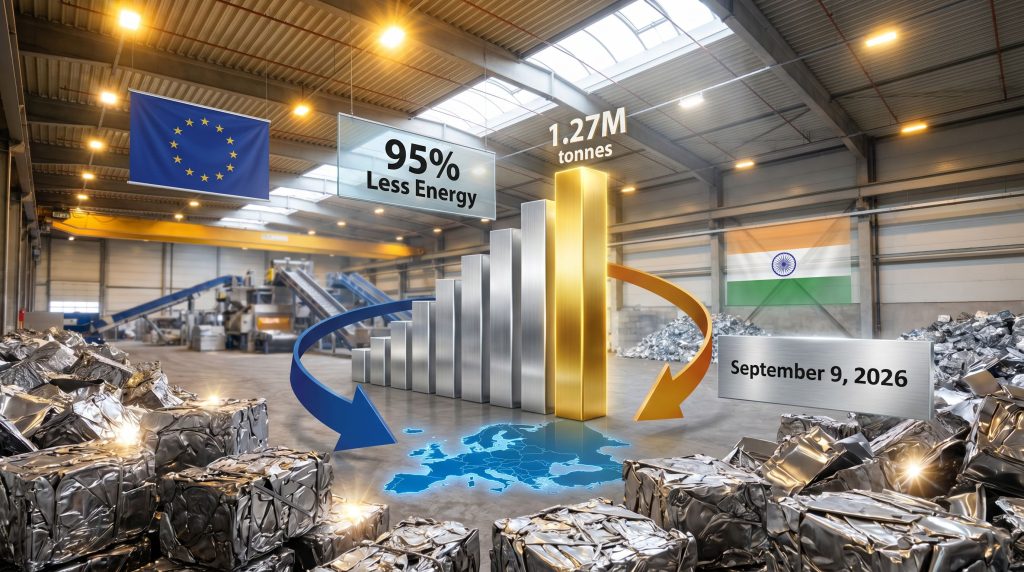
To understand the stakes, it helps to start with the physics. Producing aluminium from bauxite ore is one of the most energy-intensive industrial processes on earth, requiring enormous quantities of electricity across electrolytic smelting cells that run continuously for years. By contrast, recycling aluminium scrap back into usable metal requires approximately 95% less energy than primary production. This is not a marginal efficiency gain; it is a transformational difference that sits at the core of the EU's industrial decarbonisation strategy.
Secondary aluminium also sidesteps the emissions embedded in bauxite mining, refining, and long-distance ore transport, most of which originates from Guinea, Australia, and Brazil. Retaining scrap within European borders is therefore not simply a commercial preference for domestic smelters. It functions as a strategic lever for reducing industrial energy demand and cutting scope-three carbon emissions across the manufacturing supply chain.
The Supply Leak That Policymakers Can No Longer Ignore
Despite these well-understood advantages, Europe has been haemorrhaging its secondary aluminium supply at an accelerating rate. According to European Aluminium, the sector's principal producer lobby, EU aluminium scrap exports reached a record 1.27 million metric tonnes in 2025, representing approximately a 50% increase compared to 2019 volumes. Export flows continued rising through the first four months of 2026, suggesting that price signals alone are insufficient to reverse the trend.
The bulk of this material is flowing to Asia, with India now standing as the single largest destination country. This is not incidental. India's rapidly expanding aluminium rolling and secondary smelting capacity has created a voracious appetite for imported feedstock, and European scrap, which tends to be well-sorted and relatively high-purity, is an attractive input for Indian producers targeting quality-sensitive end markets.
Furthermore, the aluminium tariffs impact has added additional complexity to global trade flows, reshaping where buyers source secondary material and how competitive European scrap appears on international markets.
The scale of scrap outflow is not a marginal inefficiency. It represents a structural leak in Europe's circular economy that undermines both climate targets and industrial competitiveness simultaneously.
The Policy Architecture: What Export Controls Would Actually Look Like
European Trade Commissioner Maroš Šefčovič publicly announced plans to restrict aluminium scrap exports in November 2025, with an initial implementation target of spring 2026. That deadline has since been pushed back, with the revised timeline now pointing to September 9, 2026, following the EU institutions' traditional August recess. The European Commission had not issued a formal public statement on the delay at the time of reporting.
Three primary regulatory instruments are under consideration, each with distinct market implications:
| Policy Tool | Mechanism | Estimated Market Impact |
|---|---|---|
| Export Tariffs | 25-30% levy applied to scrap values | Adds approximately €50-€150 per tonne for overseas buyers |
| Export Licensing Requirements | Mandatory permits required for all scrap shipments | Introduces administrative friction and regulatory cost to deter low-value exports |
| Recycled Content Mandates | Domestic manufacturers required to meet minimum recycled-content thresholds | Creates structural pull-side demand for locally retained scrap |
Each instrument carries different risk profiles and enforcement challenges. Tariffs are the most blunt instrument but the easiest to administer. Licensing requirements can be calibrated more precisely but introduce bureaucratic complexity. Recycled content mandates address the demand side of the equation rather than the supply side, and may prove more durable over time because they align industrial incentives rather than simply imposing penalties.
The India Complication: A Geopolitical Variable
The September delay is not occurring in a vacuum. A critical geopolitical variable has entered the equation in the form of a recently concluded EU-India free trade agreement, which has elevated bilateral trade sensitivities at precisely the moment the Commission is weighing measures that would directly disadvantage Indian buyers of European scrap.
India currently sources roughly 20% of its aluminium scrap from Gulf states, particularly the United Arab Emirates. That supply line was disrupted significantly in June 2026, when the UAE announced its own aluminium scrap export ban, removing a meaningful volume of feedstock from the global secondary market. The cascading effect is straightforward: with Gulf supply constrained, Indian buyers will intensify their focus on European sources, placing upward pressure on EU scrap demand from abroad.
This dynamic creates a compounding policy challenge. Any EU export restriction that materially disadvantages India arrives in the context of a freshly signed bilateral trade relationship, raising the diplomatic stakes and potentially inviting retaliatory friction in other trade categories. Consequently, the Commission faces a balancing act with few easy precedents.
Cascading Effects on Global Secondary Aluminium Markets
The combined effect of potential EU restrictions and the UAE ban is beginning to reshape global scrap trade architecture across three time horizons:
- Short-term: Intensified competition for EU scrap between Asian buyers and European smelters, likely driving spot price premiums for high-purity scrap fractions
- Medium-term: Potential price escalation for secondary aluminium across Asian manufacturing hubs, particularly in automotive and packaging supply chains that rely on recycled feedstock
- Long-term: Accelerated domestic investment in scrap collection and sorting infrastructure across India and other Asian economies as a hedge against export restriction risk from multiple supplier regions
Divided Industry: Who Wants the Ban, and Who Fears It?
The delay to September reflects a genuine impasse between two well-organised and credible industry positions, each grounded in legitimate economic concerns.
European Aluminium, representing primary and secondary producers who favour export controls, frames the issue in terms of structural competitiveness and climate obligations. The group points to record export volumes as evidence that market forces are actively working against the EU's circular economy commitments. Its director general, Paul Voss, has framed the situation as a medium-term industrial challenge rather than a short-term market anomaly.
Recycling Europe, whose membership includes companies that shred end-of-life vehicles and other complex products to extract aluminium fractions, takes the opposing view. The group argues that the framing of the debate has been distorted by focusing on headline export tonnages rather than material quality. Its core counter-arguments are worth examining in detail:
- Only 20% of total EU aluminium scrap volume is actually exported, meaning the vast majority is already being processed domestically
- A significant proportion of exported scrap consists of lower-grade mixed fractions that current EU smelting technology cannot economically process to acceptable purity standards
- Export restrictions on lower-grade material would not redirect it into domestic smelters — it would simply remove the economic incentive for collection, leaving it unprocessed or landfilled
- Reduced revenue from scrap exports would undermine recycler economics, potentially triggering capacity closures and investment cancellations across the sector
Restrictions could lead to recyclers reducing operations and cancelling investments, leaving significant volumes of recyclable material remaining uncollected and unprocessed, according to Recycling Europe's position.
Stakeholder Position Summary
| Stakeholder Group | Position | Core Argument |
|---|---|---|
| European Aluminium (producers) | Pro-restriction | Record exports undermine domestic decarbonisation capacity |
| Recycling Europe (processors) | Anti-restriction | Only 20% of scrap is exported; restrictions harm recycler economics |
| European Commission | Undecided / Delayed | Balancing competing interests; formal comment withheld |
| India (external) | Implicitly opposed | Relies on EU scrap; UAE ban increases import dependency |
The Hidden Complexity: Scrap Quality Grades and Processing Constraints
One dimension of this debate that rarely receives adequate attention in mainstream coverage is the technical reality of aluminium scrap grading. Not all scrap is equivalent, and the grade structure of the material matters enormously for the policy outcome.
Aluminium scrap is typically classified across a spectrum ranging from clean, single-alloy production offcuts at the high end, through to mixed automotive shredder residue at the low end. The energy savings associated with recycling are most fully realised when processing clean, high-purity scrap, because contaminated or mixed-alloy material requires additional sorting, refining, and alloying steps that consume energy and generate processing losses.
European smelters have historically been configured to process higher-purity scrap fractions, partly because European environmental standards limit the types of furnace inputs that can be used without triggering emissions controls. Lower-grade mixed scrap often finds its export market in Asia precisely because Asian smelters operate under different regulatory frameworks and can economically process material that would be challenging to handle profitably within the EU.
This technical reality cuts to the heart of the policy debate. A blanket export restriction that fails to distinguish between high-purity and low-grade scrap fractions risks creating a situation where restrictions apply to material that cannot actually be absorbed by domestic smelters, triggering the economic damage Recycling Europe warns of without delivering the circular economy benefits that European Aluminium seeks.
The next major ASX story will hit our subscribers first
What September 2026 Could Deliver: Three Scenarios
Scenario 1: Full Export Restrictions Implemented
Export tariffs of 25-30% are applied alongside licensing requirements. Asian buyers face materially higher acquisition costs, European smelters gain preferential access to secondary feedstock, and decarbonisation timelines accelerate. The risk profile, however, includes potential WTO challenges and trade retaliation from affected partners, particularly India.
Scenario 2: Partial Measures with Scrap-Grade Carve-Outs
Lower-grade scrap fractions are exempted from restrictions, with controls applying only to high-purity, processed scrap. This compromise satisfies neither lobby fully but avoids triggering the recycler economics collapse that Recycling Europe warns of. It also provides a defensible position under WTO rules by targeting measures at material that demonstrably can be processed domestically.
Scenario 3: Further Delay or Policy Substitution
Diplomatic sensitivity around the EU-India trade relationship and continued stakeholder disagreement causes another postponement. The Commission opts instead for voluntary industry agreements or accelerated deployment of recycled content mandates. Export volumes continue rising, with the circular economy gap widening further before any structural intervention takes effect. EU aluminium scrap export curbs and their relationship to recycled content targets will likely remain a pressure point regardless of which path is taken.
The Broader Industrial Policy Precedent
The September decision carries implications that extend well beyond aluminium. The EU's approach to secondary aluminium scrap will establish a template for how it handles export controls on other recyclable material streams, including steel scrap, copper, and eventually plastics under the evolving Critical Raw Materials framework.
The EU's Critical Raw Materials Act identifies aluminium as strategically important for both the green and digital transitions, given its role in electric vehicle structures, renewable energy infrastructure, and lightweight construction applications. In this context, Europe's supply chain resilience has become inseparable from domestic scrap retention policy. Furthermore, the broader debate around critical raw materials transition makes clear that aluminium is far from the only material where these tensions will emerge.
Top aluminium producers are watching the September outcome carefully, as European raw materials supply constraints could reshape investment decisions across the entire primary and secondary production landscape. The EU aluminium scrap export curbs delayed until September outcome will ultimately signal how seriously the bloc is willing to act on its own circular economy ambitions when those ambitions collide with trade liberalisation commitments and geopolitical sensitivities.
Whether the September 2026 deadline holds, is extended again, or produces only partial measures, the underlying structural tension will not resolve itself. Europe is attempting to build a genuinely closed-loop industrial system for one of its most energy-intensive material streams, while simultaneously honouring open-trade commitments and navigating the geopolitical sensitivities of new bilateral relationships. The outcome of that attempt will shape European industrial competitiveness for the decade ahead.
Disclaimer: This article is intended for informational purposes only and does not constitute financial or investment advice. Forward-looking scenarios and projections involve uncertainty and should not be relied upon as predictions of specific outcomes. Readers are encouraged to consult primary sources and seek independent professional advice before making any investment or business decisions based on this content.
Want to Stay Ahead of the Next Major ASX Mineral Discovery?
Discovery Alert's proprietary Discovery IQ model delivers real-time alerts on significant ASX mineral discoveries — instantly transforming complex commodity data into actionable investment insights for both short-term traders and long-term investors. Explore historic discoveries and their remarkable returns, then begin your 14-day free trial at Discovery Alert to position yourself ahead of the broader market.