June 24, 2026
The Structural Forces Driving Europe's Scrap Retention Debate
Circular economy policy rarely unfolds in a straight line. When regulators attempt to redirect material flows that markets have optimised over decades, the result is rarely clean, and the EU aluminium scrap export curbs debate unfolding inside the European Commission is a textbook illustration of this complexity. Europe is generating more recyclable aluminium than ever before, yet an increasing share of that material is leaving the continent entirely, drawn by stronger prices and greater processing appetite in non-EU markets. The regulatory response now taking shape will test whether the EU can align commercial incentives with its decarbonisation ambitions, or whether a poorly calibrated intervention ends up weakening the very recycling infrastructure it intends to protect.
When big ASX news breaks, our subscribers know first
What EU Aluminium Scrap Export Curbs Actually Mean
The phrase "export curbs" covers a wide range of possible interventions, and the distinctions between them matter enormously for industry stakeholders. The European Commission has been developing a suite of potential instruments targeting the outflow of aluminium scrap from EU borders, with preparatory work intensifying through early 2026. Rather than a single blunt measure, three distinct mechanisms are under active consideration, each with a different risk profile and implementation logic.
Breaking Down the Three Policy Instruments
| Policy Instrument | Core Mechanism | Primary Market Effect |
|---|---|---|
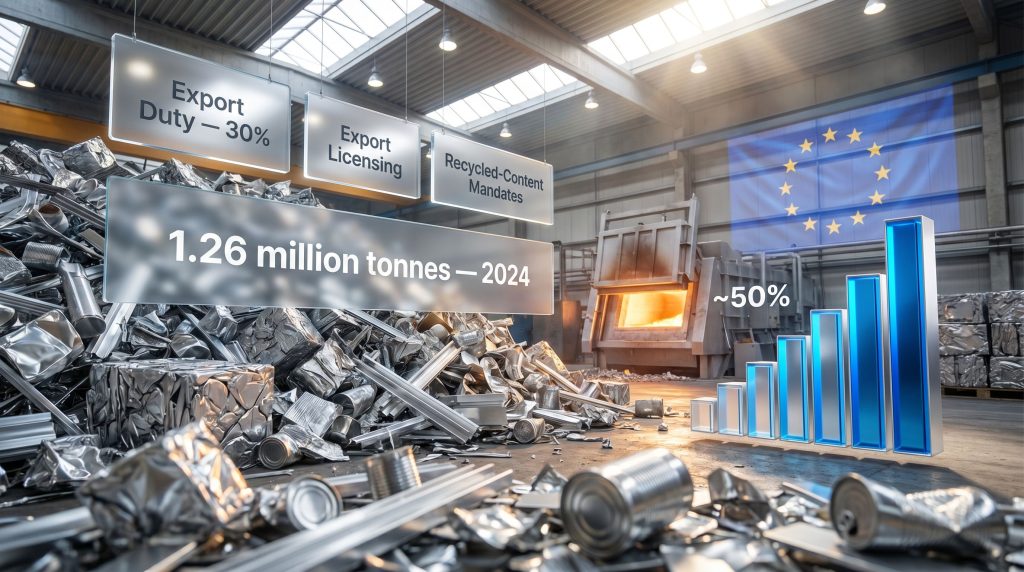
| Export Duties | A tariff applied at the point of export, with a 30% rate under consideration | Increases the cost of exporting scrap, redirecting material toward domestic buyers |
| Export Licensing | A permit-based approval system controlling shipment volumes and destinations | Creates administrative oversight without a direct price signal |
| Mandatory Recycled-Content Targets | Minimum thresholds requiring manufacturers to use secondary aluminium | Structurally increases domestic scrap demand over the long term |
Each instrument addresses the same problem through a different economic mechanism. Export duties operate through price, licensing through volume control, and recycled-content mandates through demand creation. Understanding this distinction is critical because the unintended consequences of each differ dramatically, particularly for smaller recycling operators who depend on global market access to remain financially viable.
The Regulatory Timeline: Where the Policy Process Stands
The Commission's approach to this issue has been methodical. A metal scrap surveillance system was introduced first, establishing baseline data on export flows before any restrictive measures were proposed. A targeted public consultation followed, closing in January 2026. Formal proposed measures are anticipated by Q2 2026, though as of the time of writing, no export ban, duty regime, or licensing framework has been enacted.
On 28 May 2026, a joint letter was submitted to Executive Vice President Stéphane Séjourné and Commissioner Maroš Šefčovič by European recycling companies and associations acting through Recycling Europe. The letter raised concerns about the design of any forthcoming restrictions, signalling that the recycling sector's opposition is organised and politically engaged.
The Commission's stated intention is to produce a framework that is balanced across the interests of primary producers, recyclers, downstream manufacturers, and scrap traders, though reconciling those interests will require considerable policy craftsmanship.
The Scale of the Export Surge: Why Numbers Are Driving Urgency
Record Volumes and What They Reveal
EU aluminium scrap exports reached 1.26 million tonnes in 2024, a figure that is approximately 50% higher than volumes recorded five years earlier. This is not a marginal shift or a temporary spike driven by short-term price arbitrage. It represents a structural acceleration in outflows that has fundamentally changed the Commission's calculus on intervention.
To put this in context, aluminium scrap is among the most energy-efficient raw materials available to European manufacturers. Secondary aluminium production consumes roughly 5% of the energy required to produce primary aluminium from bauxite, and generates approximately 95% less carbon dioxide in the process. Every tonne of scrap that leaves the EU represents a lost opportunity, and furthermore, the broader decarbonisation benefits of retaining this material domestically are increasingly central to European industrial policy.
The Structural Mismatch Underlying the Outflow
Several forces are driving the export surge simultaneously:
- Global demand differentials: Asian markets, particularly in Southeast and East Asia, have developed substantial secondary aluminium processing capacity and actively compete for high-quality EU scrap grades on price.
- Domestic processing gaps: European secondary aluminium remelters have not expanded their capacity at a pace sufficient to absorb growing scrap generation volumes, creating a structural absorption deficit.
- Price incentives: The combination of competitive international bids and logistical efficiency means exporting is frequently more commercially attractive than domestic remelting, particularly for certain scrap grades.
A critical and underappreciated insight within this debate is that the export problem cannot be resolved through trade restriction alone. Without parallel investment in domestic secondary processing infrastructure, constraining exports risks creating a domestic scrap surplus that depresses recycler margins without channelling material into productive manufacturing use.
Industry Fault Lines: Who Supports Restrictions and Who Opposes Them
The Decarbonisation Argument for Retention
The Commission's rationale for intervention draws on three interconnected policy priorities. First, retaining scrap within EU borders directly supports climate targets by enabling lower-carbon secondary production to displace higher-carbon primary smelting. Second, reducing reliance on imported primary aluminium improves strategic supply autonomy, a priority that has intensified since supply chain vulnerabilities were exposed during the post-pandemic period. Third, a functioning domestic circular economy for aluminium is central to the EU's Green Deal industrial strategy and its packaging and waste regulation frameworks.
Secondary aluminium is not a niche feedstock. It already accounts for a substantial and growing share of total European aluminium supply, and its role is expected to expand as automotive lightweighting, construction decarbonisation, and packaging sustainability commitments drive demand for low-carbon metal. Indeed, Europe's critical minerals supply chain strategy increasingly hinges on the ability to retain and process these secondary materials domestically.
The Recycling Sector's Counter-Case
The recycling industry's opposition is nuanced and deserves careful consideration rather than dismissal. The core arguments presented in the joint letter to the Commission include:
- Recycling operations are commercially viable partly because they can sell scrap into the highest-value market available, whether domestic or international. Restricting that access compresses margins in ways that can threaten the financial sustainability of collection and processing operations.
- Domestic demand for certain scrap grades and alloy compositions may be structurally insufficient to absorb all available volumes profitably. Not all scrap is equal, and domestic remelters may not be equipped to process every grade competitively.
- If restrictions reduce the commercial attractiveness of scrap collection, collection rates could actually fall, producing a counterproductive outcome for recycling rates and the circular economy alike.
Furthermore, industry warnings about EU recycling aims being undermined by poorly designed export curbs have gained significant traction in sector discussions, adding weight to the recycling lobby's case.
Stakeholder Positions at a Glance
| Stakeholder Group | Preferred Policy Outcome | Core Risk Concern |
|---|---|---|
| Primary Aluminium Producers | Strong export restrictions | Unfair competition from cheaper imported primary metal |
| Secondary Smelters and Remelters | Domestic scrap retention policies | Insufficient affordable secondary feedstock |
| Recycling Companies | Flexible international market access | Revenue loss and margin compression from restrictions |
| Downstream Manufacturers | Recycled-content mandates with supply certainty | Cost and reliability of secondary material supply |
| Scrap Traders and Exporters | Minimal or no restrictions | Trade flow disruption and loss of established buyer relationships |
Scenario Analysis: Three Policy Paths and Their Consequences
Scenario A: A 30% Export Duty
A straightforward tariff at the 30% rate under discussion would produce an immediate suppression of export volumes by making EU scrap significantly more expensive in international markets. In the short term, this would redirect material toward domestic buyers, but the consequences are not uniformly positive.
A domestic scrap surplus in the absence of adequate remelting capacity could depress recycler revenues, weakening the commercial case for collection investment. There is also a meaningful legal risk: export duties on recyclable materials occupy contested territory under WTO rules, and trading partners in Asia with established EU scrap import dependency would have strong incentives to initiate dispute proceedings. Notably, the recycling body's formal opposition to this approach underscores the depth of concern within the sector.
Scenario B: A Licensing Regime
An export licensing system offers more administrative flexibility than a hard tariff. The Commission could set volume ceilings, prioritise certain destinations, and calibrate restrictions without creating the blunt price distortions of a duty. However, licensing imposes compliance costs that fall disproportionately on smaller and mid-sized recyclers, who lack the administrative infrastructure of large industrial operators. This could accelerate consolidation in the European recycling sector, with ambiguous effects on overall collection and processing efficiency.
Scenario C: Mandatory Recycled-Content Targets
Among the three options, mandatory recycled-content requirements for manufacturers represent the most structurally coherent long-term solution. By creating guaranteed domestic demand for secondary aluminium, this instrument addresses the root cause of the export problem — which is the insufficiency of domestic demand relative to supply — rather than simply restricting the export valve.
Recycled-content mandates are also more defensible under WTO frameworks because they operate on the demand side rather than imposing export penalties. They align naturally with existing EU packaging regulations and the broader Green Deal architecture. The main limitation is timeline: demand-side instruments take years to fully reshape market behaviour, whereas the scrap leakage problem is being framed as an urgent near-term issue.
Industry analysts broadly consider a hybrid approach, combining a calibrated licensing system with phased recycled-content mandates, to be the most likely outcome given the Commission's commitment to balancing stakeholder interests.
The WTO Dimension and Geopolitical Implications
Navigating International Trade Law
Export restrictions on raw materials and recyclables sit in legally complex territory under WTO disciplines. The EU would need to justify any duty regime on environmental or strategic security grounds to withstand trade dispute scrutiny. Precedents from other jurisdictions demonstrate both the strategic utility and the legal vulnerability of such instruments. China's historical export restrictions on rare earth materials, for example, were ultimately found to violate WTO rules despite the strategic rationale offered in their defence.
The EU's critical raw materials supply framework provides a broader policy context within which aluminium scrap retention sits, but this domestic legislation does not insulate export restrictions from international trade law challenges. The legal design of any final measure will be as important as its economic ambition.
The Broader Strategic Autonomy Context
The EU aluminium scrap export curbs debate is one expression of a wider EU industrial policy shift toward securing domestic supply chains for materials critical to the green transition. The same tension between open trade and strategic retention is playing out across battery materials, rare earth processing, and semiconductor supply chains. How the Commission resolves the aluminium case will set precedents that resonate well beyond the secondary metals sector.
Consequently, the pressures that have already reshaped aluminium and steel tariffs in other jurisdictions serve as an important reference point for European policymakers calibrating their own approach to strategic material retention.
The next major ASX story will hit our subscribers first
Frequently Asked Questions: EU Aluminium Scrap Export Curbs
What is the current status of EU aluminium scrap export restrictions?
As of mid-2026, the European Commission is still in the policy development phase. A public consultation closed in January 2026, and formal proposed measures are expected by Q2 2026. No export ban, duty, or licensing framework has been enacted.
Why does the EU want to restrict aluminium scrap exports?
The primary drivers are climate targets, strategic supply security, and support for the circular economy. Secondary aluminium production generates roughly 95% less CO₂ than primary smelting from bauxite, making domestic scrap retention central to European industrial decarbonisation strategy.
How much aluminium scrap does the EU currently export?
EU aluminium scrap exports reached a record 1.26 million tonnes in 2024, approximately 50% above volumes recorded five years prior, reflecting a significant structural acceleration in outflows.
Who is opposing the export restrictions?
European recycling companies and associations, coordinated through Recycling Europe, formally wrote to the European Commission in May 2026 opposing restrictions that could harm recycler viability and reduce collection incentives.
Could export curbs backfire on the circular economy?
Yes. If restrictions reduce the commercial attractiveness of scrap collection and processing, recycling rates could paradoxically decline. Effective policy must ensure domestic demand is sufficient to absorb available scrap at commercially viable prices before, or alongside, any export constraint. This concern is shared by many global aluminium producers who monitor how such policies affect secondary metal supply dynamics internationally.
Key Takeaways for Industry Observers
- EU aluminium scrap exports hit a record 1.26 million tonnes in 2024, creating political urgency around what policymakers describe as scrap leakage from the single market.
- Three instruments are under consideration: a 30% export duty, an export licensing system, and mandatory recycled-content targets, each carrying distinct risk profiles for different stakeholder groups.
- The recycling sector's formal opposition reveals a fundamental tension in circular economy policy design: environmental goals and commercial viability cannot simply be assumed to be compatible without careful structural alignment.
- A hybrid approach combining licensing controls with demand-side recycled-content mandates is widely considered the most likely durable policy outcome.
- Formal proposals are expected by Q2 2026, making this one of the most consequential near-term regulatory developments for European secondary aluminium markets.
- The outcome will carry implications well beyond aluminium, establishing precedents for how the EU manages strategic material retention across its broader green transition supply chain agenda.
This article is intended for informational purposes only and does not constitute financial or investment advice. Policy timelines, regulatory outcomes, and market projections referenced herein involve inherent uncertainty and are subject to change as the European Commission's legislative process develops.
Want to Stay Ahead of the Commodity Trends Reshaping Global Markets?
Discovery Alert's proprietary Discovery IQ model delivers real-time alerts on significant ASX mineral discoveries — including those tied to aluminium, critical minerals, and the materials central to Europe's green transition — turning complex commodity dynamics into actionable investment insights. Explore how historic mineral discoveries have generated substantial returns and begin your 14-day free trial today to position yourself ahead of the broader market.