June 24, 2026
The Hidden Economics Behind Gas Prices That Politicians Don't Want You to Understand
Most Americans experience crude oil price movements through a single, highly visible number: the price on the pump at their nearest gas station. When that number fails to fall as quickly as headlines suggest crude oil is dropping, the instinct is to look for someone to blame. Politicians, predictably, oblige. However, the economics of how crude oil becomes retail gasoline are far more layered than any social media post can capture, and the gap between a falling crude benchmark and a stubbornly high pump price is less a mystery than a structural feature of how petroleum markets actually function.
Understanding why Trump oil companies gouging consumers made headlines in late June 2026 requires first understanding why pump prices and crude prices have never moved in perfect synchrony, and why they never will. Furthermore, the crude oil price trends that shaped the months leading up to this moment provide essential context for the political firestorm that followed.
When big ASX news breaks, our subscribers know first
The Multi-Stage Journey From Oil Well to Gas Station
Crude oil extracted from the ground does not become the gasoline in a vehicle's tank without passing through an extensive series of transformations. After extraction, crude must be transported to a refinery, processed through distillation and cracking units, converted into finished fuel blends, tested for seasonal regulatory compliance, shipped through distribution networks, and finally sold through retail outlets. Each of these stages carries its own cost structure, inventory position, and pricing logic.
The result is a well-documented lag of approximately two to four weeks between movements in crude benchmarks and corresponding shifts in retail gasoline prices. This delay is not unique to any particular market, nor is it evidence of manipulation. It is a physical and logistical reality embedded in the supply chain's architecture.
What makes this lag politically combustible is its asymmetric nature. Energy economists have extensively studied what is known as the rockets and feathers phenomenon: retail prices tend to rise quickly when crude prices spike but fall more slowly when crude declines. The mechanism behind this asymmetry involves inventory cost management, competitive pricing dynamics among retailers, and the timing of forward supply contracts. Refiners holding inventory purchased at higher prices cannot instantly reprice their output to reflect a crude market that has since moved lower.
Breaking Down What Consumers Actually Pay For
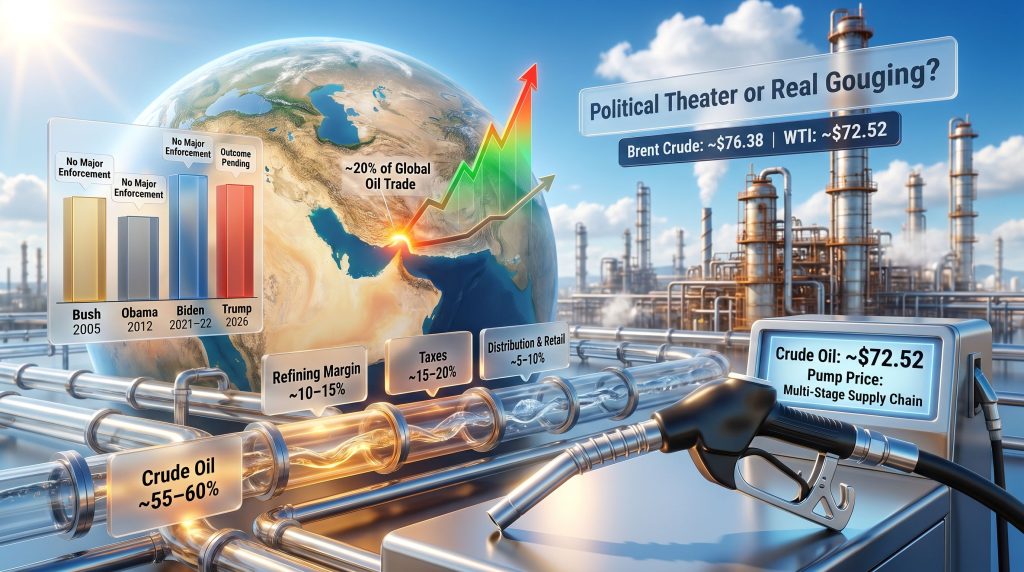
The U.S. Energy Information Administration regularly publishes data on the composition of retail gasoline prices, and the figures reveal a price structure that crude movements alone cannot control. According to EIA analysis, the approximate cost breakdown of a gallon of gasoline looks broadly as follows:
| Cost Component | Approximate Share of Pump Price |
|---|---|
| Crude oil cost | ~55-60% |
| Federal + state taxes | ~15-20% |
| Refining margin | ~10-15% |
| Distribution and retail markup | ~5-10% |
Federal excise tax on gasoline is fixed at 18.4 cents per gallon, but state and local taxes vary enormously. California consumers routinely pay some of the highest fuel taxes in the country, while Texas consumers face a significantly lighter tax burden. A crude price decline of ten dollars per barrel translates to a reduction of roughly 24 cents in the crude cost component of a gallon of gasoline, but that reduction is diluted across a price structure that includes fixed tax layers the market cannot alter.
Key insight: Even a sharp crude price drop delivers only a fraction of its value to the final pump price, and that fraction takes weeks to arrive due to supply chain timing. The political perception of price gouging frequently emerges from this structural gap, not from evidence of coordinated industry behaviour.
What Happened in Late June 2026 and Why It Matters
The immediate trigger for the political escalation was a specific convergence of market events. In late June 2026, international benchmark Brent crude futures for August delivery fell 0.91% to $76.38 per barrel, while U.S. WTI futures for August dropped 0.94% to $72.52 per barrel. These declines reflected easing fears about supply disruptions in the Persian Gulf, specifically around the Strait of Hormuz. Understanding the geopolitical oil price factors at play is essential to making sense of why these price movements unfolded as they did.
The easing came after the International Maritime Organization secured safety guarantees allowing more than 11,000 seafarers who had been stranded in the Persian Gulf due to security concerns to begin exiting through the Strait. The IMO confirmed the operation would proceed in coordination with Iran, Oman, other regional coastal states, the United States, and the maritime industry. With that clearance, markets began pricing out a portion of the supply risk premium that had been embedded in crude benchmarks.
Pump prices, however, did not immediately follow crude lower. This is precisely when President Trump posted on Truth Social, asserting that crude prices were dropping sharply while oil companies were failing to pass those reductions on to consumers, and directing the Department of Justice to investigate the matter. According to Politico, the White House's response to the Hormuz-driven price spike reflected mounting pressure from consumers and political allies alike.
Karen Young, a senior research scholar at Columbia University's Center on Global Energy Policy, characterised the intervention as political theatre, explaining that this is not how gasoline pricing actually works in the United States. Her analysis pointed to the role of state and local taxes and the multi-week transmission process through refiners before crude price changes reach consumers at the pump.
The Legal Landscape for a DOJ Price Gouging Probe
Directing the DOJ to investigate oil company pricing may generate significant political momentum, but it faces meaningful legal constraints. The United States has no permanent federal statute prohibiting fuel price gouging outside of declared emergencies. The Federal Trade Commission holds investigative authority over anti-competitive behaviour, but establishing actionable price gouging under federal law requires demonstrating coordinated conduct or market manipulation, not simply documenting elevated margins during a supply disruption.
Historical precedent offers limited optimism for enforcement outcomes:
| Administration | Accusation | Regulatory Response | Outcome |
|---|---|---|---|
| George W. Bush (2005) | Post-Katrina gasoline price gouging | FTC investigation launched | No major enforcement action |
| Barack Obama (2012) | Oil speculation driving pump prices | CFTC review of trading activity | Limited regulatory changes |
| Joe Biden (2021-2022) | Oil companies profiting from Ukraine war supply shock | FTC investigation, windfall tax proposals | No federal legislation passed |
| Donald Trump (2026) | Oil companies not passing crude declines to consumers | DOJ probe instructed | Outcome pending |
The pattern across administrations is consistent: investigations are politically significant and generate public attention, but they rarely result in direct consumer price relief or major enforcement actions.
The Strait of Hormuz: A Chokepoint That Moves Global Markets
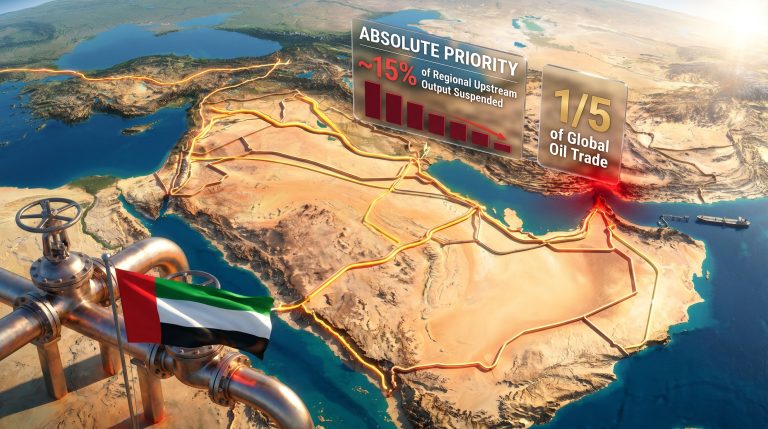
Understanding why crude prices spiked and then began retreating in mid-2026 requires appreciating the outsized role the Strait of Hormuz plays in global energy logistics. The strait handles approximately 20% of global oil trade flows, making it the single most consequential maritime chokepoint for petroleum markets.
When security concerns around the strait intensified, the effects moved rapidly through multiple cost layers:
- Spot crude prices absorbed an immediate risk premium reflecting potential supply disruption
- Longer vessel transit times increased freight and insurance costs, which refiners eventually pass downstream
- Air freight capacity was simultaneously stressed as commercial logistics networks were redirected
- Supply chain normalisation following the strait's reopening was expected to take several weeks, according to DHL Global Forwarding's leadership, meaning price relief at the pump would not be instantaneous even after the geopolitical trigger had resolved
The DHL Global Forwarding CEO for Greater China noted that while the strait reopening should ease supply chain pressures over time, the normalisation process would unfold gradually rather than immediately. This technical reality reinforces why crude price declines triggered by geopolitical de-escalation do not translate instantly to lower pump prices.
Refining Margins, Production Profitability, and the Profit Concentration Question
One of the less-discussed dimensions of the debate over whether Trump oil companies gouging consumers is a legitimate claim involves the behaviour of refining margins, technically known as crack spreads, which measure the difference between the cost of crude inputs and the market value of refined product outputs.
Crack spreads fluctuate independently of crude prices. A refiner holding crude inventory purchased at elevated prices during a period of geopolitical tension cannot immediately write down that inventory to match a crude market that has since softened. This inventory effect creates a natural delay between crude price declines and downstream product price reductions that has nothing to do with coordinated pricing behaviour.
What the data from 2025 and 2026 also shows is a broader structural shift in industry profitability:
- Major integrated oil companies reported elevated profit margins during periods of geopolitical supply disruption
- Profit concentration has increased among the top tier of global oil majors as smaller independent operators face margin compression
- Share buybacks and dividend distributions have outpaced capital reinvestment in new production capacity among the largest firms, which constrains supply responsiveness over time
Analytical note: Elevated profitability during supply disruptions is consistent with normal commodity market behaviour in industries characterised by inelastic short-run demand. The policy question is not whether profits are high, but whether they result from coordinated conduct or from market structure responding to genuine supply constraints.
Why U.S. Domestic Production Cannot Simply Override Global Prices
A persistent misconception in public energy discourse is that expanded domestic production directly reduces what American consumers pay at the pump. The mechanism is far more indirect. U.S. crude oil is priced at global benchmarks, specifically WTI and Brent, not at a domestically discounted rate. Increased U.S. output adds to global supply, which can exert modest downward pressure on the global crude price, but that pressure is distributed across all consumers worldwide rather than being captured exclusively by Americans.
The U.S. also exports substantial crude volumes, meaning domestic production feeds global markets rather than functioning as a price shield for American households. In practical terms, a significant increase in U.S. output might reduce the global crude benchmark by a few dollars per barrel over time, which would then flow through the supply chain and reach U.S. pump prices in diluted form weeks later.
This structural reality creates a fundamental tension in energy policy messaging. A pro-production platform marketed as a path to lower consumer fuel costs operates through slow, indirect, globally diffused mechanisms. Meanwhile, geopolitical actions that generate supply risk premiums can produce immediate and sharp price increases that overwhelm any production-side relief.
Geopolitical Risk and the Iran Factor
The crude price environment that preceded Trump's gouging accusation cannot be understood without acknowledging the role of U.S. military action against Iranian nuclear infrastructure in 2026. Those strikes generated a significant spike in global crude prices, as markets priced in both the risk of Iranian supply disruption and the potential for broader regional escalation affecting Persian Gulf shipping. Indeed, the trade war and oil markets dynamic that had already been building throughout 2025 compounded these pressures considerably.
Analysts estimated that the resulting geopolitical risk premium added materially to weekly U.S. gasoline costs, with consumer cost increases running into the billions of dollars over a compressed period. The premium embedded in crude prices following the Iran strikes persisted well beyond the initial event as markets continued pricing ongoing supply risk. As PBS NewsHour reported, Trump's own public statements on oil prices shifted noticeably during this period, illustrating the political complexity of the situation.
This creates a notable policy tension:
- Geopolitical confrontation with major oil-producing regions generates immediate crude price spikes
- Domestic production expansion exerts modest, slow, globally distributed downward pressure on crude prices
- The net effect on U.S. consumers depends on which force is larger at any given moment
- A risk premium arising from military action can easily exceed any price relief generated by incremental production increases
Strategic tension: When foreign policy decisions introduce supply risk premiums into global crude markets, no amount of domestic drilling can immediately offset the consumer price impact. The arithmetic of geopolitical risk consistently outpaces the arithmetic of incremental production.
The next major ASX story will hit our subscribers first
The Refining Capacity Constraint Few People Talk About
Beyond geopolitics, a structural supply-side factor that receives insufficient attention in public debate is the erosion of U.S. refining capacity. Several refining facilities permanently closed following the disruptions of 2020 and have not been replaced. The result is a domestic refining system operating at higher utilisation rates than it was a decade ago.
When refineries are running near capacity, a decline in crude prices does not automatically produce lower pump prices, because the refining bottleneck constrains throughput regardless of input costs. Seasonal fuel blend transitions compound this problem. The shift from summer-blend to winter-blend gasoline formulations, which are subject to different regulatory specifications in different states, creates temporary supply tightness that further delays price pass-through even when crude markets are moving favourably for consumers.
The Legislative Debate: Windfall Taxes and Their Trade-offs
The political response to elevated oil company profitability has not been limited to DOJ referrals. Lawmakers including Senator Edward Markey have called for FTC investigations into potential price coordination among major oil companies, and proposals for windfall profit taxes on earnings above defined thresholds have circulated in various forms. In addition, the role of OPEC's market influence has added another layer of complexity to the legislative debate, as policymakers grapple with forces that extend well beyond domestic borders.
The trade-off analysis on windfall taxes is genuinely contested among economists:
- Supporters argue that extraordinary profits during supply disruptions represent a transfer of wealth from consumers and households to corporate shareholders that warrants policy correction
- Critics contend that windfall taxes reduce investment incentives, potentially tightening supply further over the medium term and producing higher prices in subsequent periods
- Historical evidence from windfall profit tax regimes in the 1980s in the United States showed mixed results, with some studies finding reduced domestic production in response to the tax and others finding minimal investment effects at the margins
The policy debate reflects a deeper question about market power in the U.S. energy system: whether the concentration of profitability among a small number of major integrated oil companies represents a structural feature that requires legislative correction, or whether it is a market outcome that will self-correct as capital eventually responds to attractive returns.
FAQ: Trump, Oil Companies, and Consumer Gas Prices
Does crude oil price directly control what consumers pay at the pump?
No. Retail gasoline prices are determined by a combination of crude oil costs, refining margins, distribution expenses, and federal, state, and local taxes. According to EIA data, crude oil represents roughly 55% to 60% of the final pump price. A decline in crude prices takes several weeks to transmit fully through the supply chain to retail stations. For a broader view of how these dynamics are evolving, the current crude oil market overview offers valuable context.
Can the DOJ legally force oil companies to lower gas prices?
The DOJ can investigate potential anti-competitive behaviour but has no direct authority to mandate retail pricing. Price controls would require congressional legislation and would represent a substantial departure from existing U.S. energy market policy.
Why do gas prices fall more slowly than crude oil prices?
This is the rockets and feathers pricing asymmetry, extensively documented in energy economics literature. Retailers and refiners adjust prices upward quickly during crude price increases to protect margins but pass on savings more slowly during declines due to inventory cost management and competitive dynamics.
What role does the Strait of Hormuz play in U.S. gas prices?
The strait handles approximately 20% of global oil trade and is the world's most critical oil transit chokepoint. Disruptions create immediate supply risk premiums in global crude markets that flow through to U.S. pump prices regardless of domestic production levels.
Have past federal investigations into oil company pricing led to consumer relief?
Historically, no. Federal investigations across multiple administrations have rarely resulted in enforcement actions or direct consumer price relief, reflecting both the structural complexity of petroleum supply chains and the limitations of existing price gouging statutes at the federal level.
Key Takeaways for Consumers and Market Observers
-
The price lag is structural, not conspiratorial. The petroleum supply chain creates inherent delays between crude price movements and pump price adjustments that are well-documented in energy economics literature.
-
Geopolitical risk premiums are the dominant near-term price driver, and they can overwhelm any production-side relief generated by domestic output expansion.
-
Increasing U.S. production does not directly lower domestic pump prices because U.S. crude is priced at global benchmarks and exported to global markets.
-
DOJ investigations carry political weight but historically produce limited consumer outcomes, given the structural complexity of proving Trump oil companies gouging consumers under existing federal law.
-
The Strait of Hormuz reopening is the most meaningful near-term catalyst for pump price relief, as it reduces the supply risk premium embedded in global crude benchmarks, though supply chain normalisation will take additional weeks.
-
Refining capacity constraints and seasonal blend requirements create independent bottlenecks that can delay price pass-through even when crude markets are favourable for consumers.
Disclaimer: This article contains analysis of energy market dynamics, policy proposals, and economic mechanisms based on publicly available information as of the publication date. It does not constitute investment or financial advice. Forecasts and projections about energy prices involve significant uncertainty and should not be relied upon as predictions of future outcomes. Readers are encouraged to consult qualified financial and energy market professionals before making investment decisions related to the energy sector.
Want to Stay Ahead of Commodity Market Shifts Driven by Geopolitical Events?
Discovery Alert's proprietary Discovery IQ model delivers real-time alerts on significant ASX mineral discoveries, instantly converting complex commodity data into actionable insights for investors at every level — explore historic discoveries and their market returns or begin your 14-day free trial at Discovery Alert to position yourself ahead of the next major market move.