
June 24, 2026
When Geography Becomes Destiny: Understanding Aluminium's Geopolitical Price Sensitivity
Commodity markets have long operated under a principle that physical economists often underestimate: perceived risk moves prices faster and further than actual disruption. In the aluminium market, this dynamic is nowhere more visible than in the relationship between Gulf regional stability and LME price behaviour. When a single waterway threading between Oman and Iran becomes the subject of geopolitical tension, the downstream effects ripple through futures curves, warehouse receipts, and smelter contracts across the globe within hours.
The LME aluminium price drops as Gulf supply concerns ease, and the events of late June 2026 offered a textbook demonstration of how rapidly embedded risk premiums can dissolve when diplomatic signals shift the narrative. Furthermore, understanding this relationship requires examining not just the price mechanics, but the underlying geography that makes the Gulf so critical to global metal flows.
When big ASX news breaks, our subscribers know first
The Strait of Hormuz: A Single Point of Failure for Gulf Metal Flows
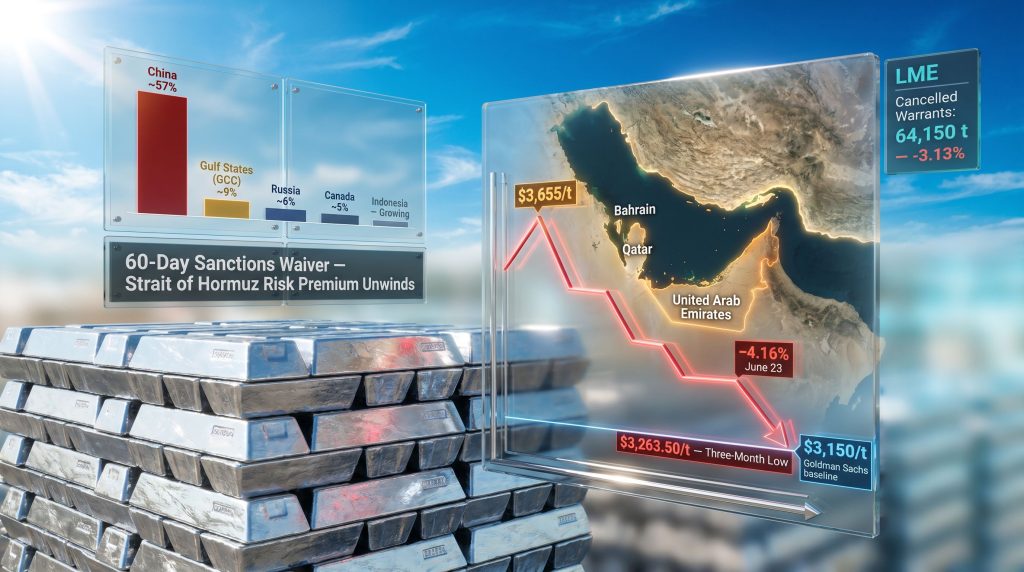
To understand why a US-Iran diplomatic development can move aluminium prices by more than four percent in a single session, it helps to examine the structural geography of Gulf metal production. The Strait of Hormuz is not simply an oil corridor. It is the sole maritime gateway for the aluminium smelting operations of Qatar, Bahrain, and the UAE, collectively representing approximately 9% of global primary aluminium output.
That figure may seem modest against China's dominant ~57% share, but the Gulf's influence on price formation is disproportionate to its production volume. The metals geopolitics of this region are uniquely complex, and here is why:
- Unlike land-based smelting regions, Gulf producers depend entirely on maritime logistics for both inbound raw material flows (alumina, caustic soda) and outbound finished metal exports
- A blockade or even a credible threat of one simultaneously compresses supply on both ends of the production chain, creating a dual constraint that amplifies scarcity pricing
- The geographic concentration of this risk in a single flashpoint means that political deterioration can translate into supply anxiety almost instantaneously
This is the Strait of Hormuz multiplier effect: a small production share carrying outsized price leverage because of where it sits on the map.
The Risk Premium Build-Up: From Baseline to Four-Year High
Prior to the diplomatic breakthrough in late June 2026, LME aluminium had staged a dramatic climb. The metal reached a four-year high of approximately $3,655 per tonne in May 2026, driven by force majeure declarations from smelters across the Gulf and mounting fears that the Strait of Hormuz could remain disrupted for an extended period.
Goldman Sachs had projected LME aluminium to average $3,150 per tonne in the first half of 2026 under a scenario of sustained but unescalated uncertainty. The gap between that baseline and the May peak of $3,655 per tonne provides a concrete measure of the risk premium the market was carrying at its peak: approximately $500 per tonne. That is not a marginal adjustment. It represents a near 16% premium layered on top of fundamental supply-demand pricing, driven almost entirely by geopolitical anxiety.
Analyst projections at the height of the disruption suggested prices could breach the $4,000 per tonne threshold if the blockade persisted beyond a 90-day window, a scenario that would have represented the most significant aluminium supply shock in over a decade.
The June 23 Price Correction: A Full Breakdown
The preliminary US-Iran agreement, which included a 60-day sanctions waiver, altered the market's forward-looking supply narrative with immediate effect. The expectation that Strait of Hormuz trade flows would normalise was sufficient to trigger one of the sharpest single-session declines seen in the aluminium market in recent memory.
Spot and Near-Term Contract Movements
| Contract Type | June 22 Price | June 23 Price | Change |
|---|---|---|---|
| Cash Bid | $3,403/t | $3,263/t | -4.11% |
| Cash Offer | $3,405/t | $3,263.50/t | -4.16% |
| 3-Month Bid | $3,405/t | $3,269/t | -3.99% |
| 3-Month Offer | $3,406/t | $3,271/t | -3.96% |
| LME Asian Reference Price | N/A | $3,232.50/t | Broad market weakness |
The cash offer price of $3,263.50 per tonne marked a three-month low, with the intraday session touching $3,334 per tonne, the weakest level since late March 2026. From the May peak to the June 23 close, LME aluminium shed more than $390 per tonne in roughly four weeks.
Longer-Dated Contracts: What the Curve Shape Reveals
The December 2027 contracts provided a subtler but analytically important signal:
- December 2027 bid eased from $3,180/t to $3,115/t, a decline of approximately 2.04%
- December 2027 offer moved from $3,185/t to $3,120/t, also down roughly 2.04%
The fact that longer-dated contracts fell by roughly half the percentage of spot contracts is not trivial. It suggests the market is not fully pricing out long-run supply uncertainty. Structurally cautious positioning remains embedded further along the forward curve, reflecting the understanding that a 60-day sanctions waiver is not the same as a durable peace settlement.
Commodity markets price in geopolitical risk well before physical supply is actually disrupted. The reversal of that risk premium can be equally swift and just as dramatic, but the market rarely abandons all caution at once.
LME Inventory Data: Reading the Warehouse Signals
Price movements alone do not tell the complete story. Exchange inventory data provides a complementary lens for understanding the physical dimension of the correction. In addition, the alumina market impact of these shifts deserves close attention from upstream producers and buyers alike.
Warehouse Stock Summary: June 22 vs June 23
| Inventory Metric | June 22 | June 23 | Change |
|---|---|---|---|
| Opening Stocks | 315,300 t | 313,800 t | -1,500 t (-0.48%) |
| Live Warrants | 247,575 t | 247,575 t | Unchanged |
| Cancelled Warrants | 66,225 t | 64,150 t | -2,075 t (-3.13%) |
The most telling data point is the 3.13% decline in cancelled warrants to 64,150 tonnes. Cancelled warrants represent metal that has been formally earmarked for physical withdrawal from LME-registered warehouses. A falling cancelled warrant figure signals that fewer market participants are in urgent need of physical delivery, consistent with a narrative where the perceived risk of imminent supply shortage is receding.
Critically, live warrants held steady at 247,575 tonnes, indicating that the price correction was not driven by a sudden influx of new metal into exchange storage. The correction is a sentiment-driven event, not a physical supply surge. The LME alumina Platts price at $307.10 per tonne provides the upstream cost anchor, offering a reference point for assessing smelter margin evolution as finished metal prices compress.
Global Aluminium Supply Geography: Concentration Risk and Market Leverage
The June 23 correction invites a broader examination of how global aluminium supply is distributed and where vulnerability concentrations sit. Consequently, the role of top aluminium producers in shaping regional price dynamics has never been more relevant.
Comparative Supply Concentration
| Region | Estimated Share of Global Primary Output | Key Risk Factors |
|---|---|---|
| China | ~57% | Trade policy, energy costs, carbon regulation |
| Gulf States (GCC) | ~9% | Geopolitical conflict, Strait of Hormuz access |
| Russia | ~6% | Sanctions, export restrictions |
| Canada | ~5% | Trade tariffs, export volume declines |
| Indonesia (emerging) | Growing | Ramp-up timelines, infrastructure constraints |
One factor that deserves more attention than it typically receives is the Canadian supply picture. Canadian aluminium exports fell 20% year-on-year in Q1 2026, a decline that has been tightening North American supply chains independently of anything happening in the Gulf. The ongoing impact of US aluminium tariffs has compounded this pressure, underscoring that multiple regional supply constraints can operate simultaneously.
Is the Correction a Floor Reset or a Peak-to-Trough Reversal?
The most consequential question for buyers, producers, and investors is whether the June 23 sell-off represents a temporary risk premium unwind or the beginning of a more sustained structural repricing.
The Case for Further Price Downside
- If the 60-day sanctions waiver transitions into a formalised peace framework, the remaining risk premium embedded in longer-dated contracts could continue unwinding
- Goldman Sachs projects a downward price trajectory in H2 2026 as new supply capacity, particularly from greenfield smelting projects in Indonesia, enters the market
- A recovering inventory trajectory on LME exchanges would confirm physical supply normalisation and support a drift back toward the $3,150/t Goldman baseline
- Gulf smelters lifting force majeure declarations would restore confidence in the continuity of established supply chains
The Case for a Price Floor
- The 60-day waiver is explicitly preliminary. Negotiations could break down before formalisation, rapidly reinstating the blockade-driven supply disruption premium
- Indonesian greenfield smelting capacity faces real execution risk. Infrastructure constraints and ramp-up timeline uncertainty could delay the anticipated inventory build that underpins the bearish outlook
- Long-dated contracts declining by only ~2% versus ~4% in spot indicates residual structural caution that has not been fully resolved by a single diplomatic announcement
- Aluminium demand from the energy transition, including EV battery housing, solar frame structures, and grid infrastructure expansion, remains structurally robust and could absorb incremental supply more quickly than bearish models anticipate
Risk Scenario: If US-Iran negotiations collapse within the 60-day waiver window, aluminium prices could rapidly recover toward the $3,500-$3,655/t range as the supply disruption premium is reinstated. Buyers carrying unhedged physical exposure should stress-test their positions against this tail scenario before assuming the correction is permanent.
The next major ASX story will hit our subscribers first
A Less Discussed Dynamic: The Dual Constraint Problem for Gulf Smelters
What makes Gulf aluminium production uniquely vulnerable to maritime disruption goes beyond simple export restriction. Unlike a land-locked smelter that might see finished product stranded but continue operating, Gulf smelters face what might be described as a dual constraint when Hormuz access is threatened.
Primary aluminium production requires substantial inbound raw material logistics. Alumina, the refined precursor to aluminium metal, is not produced in sufficient quantities locally across all Gulf smelting locations. Caustic soda, used in the Bayer process to refine bauxite into alumina, similarly depends on maritime supply chains.
A blockade therefore does not merely strand finished metal; it threatens the ability of smelters to continue production at all. Force majeure declarations are not an overreaction in this context. They reflect a genuine operational reality where raw material inflows and finished product outflows become simultaneously compromised. Indeed, outages at Gulf smelters have historically demonstrated how quickly this dual constraint can escalate into broader market dislocation.
This structural vulnerability is why the Gulf's 9% production share carries price leverage far exceeding what the raw percentage would suggest in a purely arithmetic model of supply and demand. Furthermore, China industrial demand patterns add another layer of complexity, given that Chinese buying behaviour can amplify or dampen the effect of Gulf supply shocks on global pricing.
Strategic Watchpoints for the Weeks Ahead
For those monitoring LME aluminium closely, the following near-term and medium-term indicators will determine how the LME aluminium price drops as Gulf supply concerns ease continues to unfold from here:
Near-Term (Next 30-60 Days):
- Confirmation or collapse of the formalised US-Iran peace framework beyond the 60-day waiver period
- Speed and completeness of Gulf smelter force majeure lifts and production restoration timelines
- Direction of LME cancelled warrants, which will signal whether physical demand urgency is building or continuing to soften
- Any further deterioration in Canadian export volumes, which could offset Gulf supply normalisation in North American markets
Medium-Term (H2 2026 and Beyond):
- Indonesian smelting capacity additions and the degree to which ramp-up timelines align with Goldman Sachs supply projections
- Global energy transition demand trajectory, particularly EV production volumes and utility-scale solar deployment rates
- Whether LME exchange stock levels build materially, confirming that physical supply has genuinely normalised following the Gulf disruption
The narrative that the LME aluminium price drops as Gulf supply concerns ease is compelling in the immediate term, but the structural uncertainty embedded in longer-dated forward contracts suggests the market is not declaring victory yet. The gap between a diplomatic announcement and a durable geopolitical settlement is where the next chapter of this price story will be written.
Disclaimer: This article contains forward-looking statements, price forecasts, and analyst projections sourced from publicly available research. These represent estimates only and should not be construed as investment advice. Commodity markets are subject to rapid change, and past price behaviour is not indicative of future performance. Readers should conduct independent due diligence before making any financial or commercial decisions based on the information contained herein.
Want to Stay Ahead of the Next Major Commodity Discovery Before the Market Moves?
Discovery Alert's proprietary Discovery IQ model delivers real-time alerts on significant ASX mineral discoveries, instantly translating complex commodity data into actionable investment insights — explore the historic returns major discoveries have generated and begin your 14-day free trial at Discovery Alert to position yourself ahead of the broader market.