May 13, 2026
Global supply chain vulnerabilities in critical minerals have reached unprecedented levels, with concentration risks creating systemic dependencies that threaten national security and economic stability. The Australia-India critical minerals partnership demonstrates how bilateral agreements can address these vulnerabilities while creating mutual economic benefits. The interconnected nature of modern manufacturing requires diversified sourcing strategies that can withstand geopolitical tensions and supply disruptions.
Understanding the Geopolitical Minerals Landscape
The Supply Chain Security Imperative
China's dominance across critical mineral processing presents a fundamental challenge for advanced economies. The nation controls approximately 85% of rare earth element refining capacity and 60% of lithium processing, creating bottlenecks that affect everything from electric vehicle production to renewable energy infrastructure.
| Economy | Lithium Dependency | Cobalt Dependency | Rare Earth Dependency |
|---|---|---|---|
| India | 100% imports | 95% imports | 100% imports |
| United States | 80% imports | 75% imports | 100% imports |
| European Union | 85% imports | 85% imports | 95% imports |
Australia emerges as a critical counterweight in this landscape, producing approximately 45,000 tonnes of lithium carbonate equivalent in 2024, representing roughly 60% of global production. However, the processing capacity remains concentrated elsewhere, creating a two-stage vulnerability where raw materials flow to single processing centres before reaching end markets.
Furthermore, the US‑China trade war impacts have demonstrated how geopolitical tensions can disrupt established supply chains. The 2021-2022 supply chain disruptions resulted in production delays costing the global electric vehicle industry billions in deferred manufacturing output, highlighting the cascading effects of mineral supply constraints.
"The critical minerals sector requires fundamental restructuring to meet 21st-century supply chain security demands whilst maintaining cost competitiveness across global markets," noted the Australian Government's Critical Minerals Strategy.
Traditional supply chains fail when they rely on single-source dependencies that create:
- Processing bottlenecks that delay downstream manufacturing
- Limited negotiating power when supply is geographically concentrated
- Vulnerability to politically-motivated export restrictions
- Insufficient stockpile capacity to weather extended disruptions
- Inadequate alternative sourcing arrangements during crises
When big ASX news breaks, our subscribers know first
How Do ECTA, CMIP, and CSP Create Competitive Advantages?
Trade frameworks and investment partnerships represent the structural foundation for reshaping global mineral supply chains. The Australia-India critical minerals partnership demonstrates how bilateral agreements can address systemic vulnerabilities while creating mutual economic benefits.
Economic Cooperation and Trade Agreement Framework Analysis
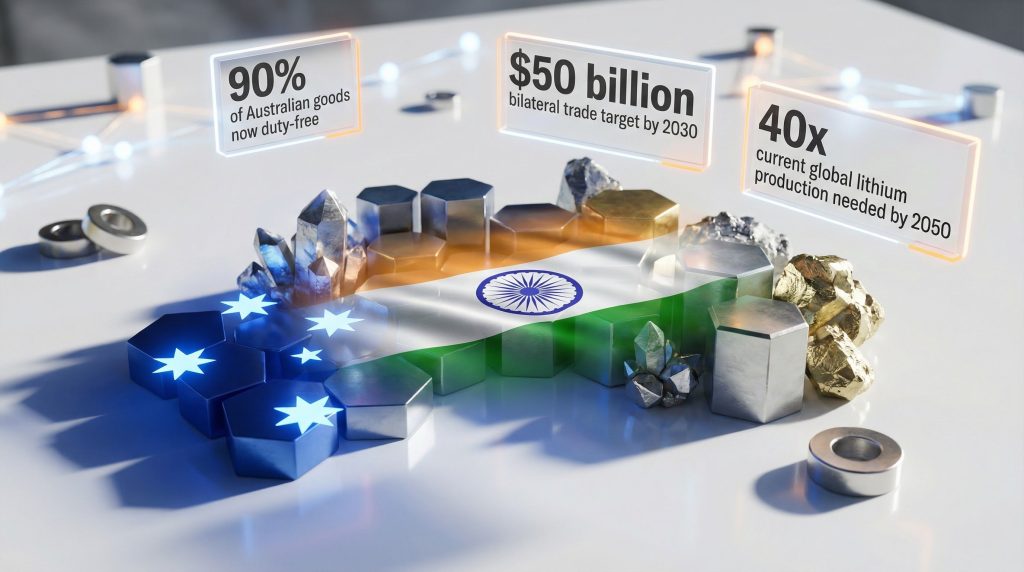
The Economic Cooperation and Trade Agreement, implemented on December 29, 2022, eliminates customs duties on over 90% of Australian goods exports to India by value. This tariff elimination directly impacts critical mineral procurement costs for Indian manufacturers.
Key tariff reductions include:
- Lithium ore and concentrate: Zero tariffs (previously 5-10% MFN rates)
- Cobalt-bearing materials: Immediate duty-free access
- Rare earth minerals: Progressive elimination over 3 years
- Processing equipment: Reduced import duties for mining technology
The agreement's rules of origin provisions ensure that mineral products meeting specific regional content requirements qualify for preferential treatment, incentivizing value-added processing within the partnership framework.
For Indian battery manufacturers, the cost reduction translates to 15-25% savings on critical mineral inputs compared to traditional suppliers, improving competitiveness in global markets while securing supply chain reliability.
Critical Investment Minerals Partnership Deep Dive
Launched in March 2022, the Critical Investment Minerals Partnership represents a USD 5.8 million Australian commitment over three years to support Indian participation in Australian mineral projects. The partnership operates through co-investment structures that distribute risk between public and private sectors.
Investment allocation mechanisms:
- Risk-sharing frameworks: Blended finance structures leveraging government support with private capital
- Project evaluation criteria: Alignment with India's National Critical Mineral Mission objectives
- Equity participation models: Minority and majority stake opportunities for Indian partners
Priority evaluations currently target:
- Lithium ventures in Western Australia's Pilbara region
- Cobalt development projects in Queensland's central highlands
- Rare earth processing facility partnerships
- Battery recycling technology collaborations
The partnership recognises that supply chain security requires shared investment responsibility, enabling technology transfer that accelerates India's domestic processing capabilities whilst providing Australian projects with patient capital and market access.
Comprehensive Strategic Partnership Implementation
The broader Comprehensive Strategic Partnership encompasses critical minerals collaboration as a strategic pillar alongside defence, education, and technology cooperation. This framework creates institutional mechanisms for sustained collaboration across multiple sectors.
Technology transfer protocols include:
- Formal frameworks for sharing exploration and processing methodologies
- Intellectual property protection arrangements for joint research outcomes
- Standards harmonisation for environmental assessment and safety protocols
- Regulatory alignment reducing compliance complexity for joint ventures
The Australia-India Critical Minerals Research Hub facilitates joint research throughout the value chain from exploration to recycling, with university collaborations between institutions like IIT Hyderabad and Monash University driving innovation in processing technologies.
Workforce mobility agreements enable simplified visa and work authorisation processes for technical specialists, geologists, and engineers transferring between projects, creating knowledge networks that enhance both countries' capabilities.
What Are the Economic Multiplier Effects for Both Nations?
Resource sector transformation creates cascading economic effects that extend far beyond mining operations. The scale of planned investments and infrastructure development generates employment, technology transfer, and industrial capacity building that reshapes national economic profiles.
Australia's Resource Sector Transformation
Australia's mining sector generated USD 2.9 trillion in cumulative resource export revenue from 2014 to 2024, demonstrating the economic significance of the sector's expansion. Current development pipelines indicate this growth trajectory will continue with enhanced focus on critical minerals.
Development pipeline statistics:
| Metric | Current Status | Projected 2030 |
|---|---|---|
| Projects in Development | 100+ mining and processing projects | USD 50 billion investment potential |
| Construction Jobs | 30,000 positions during development phase | Sustained employment through 2030 |
| Operational Roles | 20,000 permanent positions | Expanding with production scaling |
| Lithium Production Capacity | 45,000 tonnes LCE annually | Doubling capacity by 2030 |
The transformation involves technology integration through Industry 4.0 implementations:
- IoT sensors and automated monitoring systems optimising extraction efficiency
- AI-driven processing optimisation reducing waste and improving yields
- Remote operations capabilities enhancing safety and productivity
- Environmental remediation technologies meeting sustainability requirements
Capacity scaling requires simultaneous expansion across multiple infrastructure categories, including extraction equipment, processing facilities, transportation networks, and environmental management systems. The USD 50 billion investment requirement reflects the comprehensive nature of this industrial transformation.
India's Manufacturing Ecosystem Benefits
India's manufacturing sector benefits from secured critical mineral supplies through enhanced cost competitiveness and supply chain resilience. The country's electric vehicle production targets of 30% of all vehicle sales by 2030 require substantial mineral input scaling.
Manufacturing transformation metrics:
- Lithium demand increase: 5-fold growth by 2030 for battery production
- Cobalt requirements: 3-4x demand increase for electronics and batteries
- Rare earth needs: Doubling requirements for renewable energy equipment
- Cost reduction: 15-25% savings on mineral procurement through Australian partnerships
Domestic value addition opportunities include:
- Battery cell manufacturing: Converting imported lithium into finished battery packs
- Cobalt and nickel processing: Creating refined products for electronics applications
- Rare earth separation: Converting raw materials into high-value compounds
- Battery recycling facilities: Recovering critical minerals from end-of-life products
Indian automotive manufacturers are establishing supply agreements with Australian lithium producers, whilst battery manufacturing startups develop processing facilities designed around Australian raw material specifications. This integration creates just-in-time production systems that reduce inventory costs whilst improving supply reliability.
Which Specific Projects Are Driving Partnership Success?
Project-level implementation determines whether strategic partnerships translate into tangible economic outcomes. Current priority investments under the Australia-India critical minerals partnership focus on ventures that align with both countries' industrial development objectives.
Priority Investment Targets Under CMIP
The Critical Investment Minerals Partnership evaluates projects based on strategic alignment with India's mineral security needs and financial viability within established development timelines. Priority selection follows systematic criteria ensuring commercial returns and technical feasibility.
Lithium project evaluations in Western Australia:
- Greenbushes Mine expansion: One of the world's largest hard-rock lithium operations with established production capacity
- Spodumene processing projects: Converting raw ore into battery-grade lithium compounds
- New exploration ventures: Targeting proven geological formations with Indian equity participation
Cobalt development assessments in Queensland:
- Central highlands exploration projects under active evaluation for joint venture potential
- Processing facility partnerships creating refined cobalt products for Indian electronics manufacturers
- Technology sharing arrangements for extraction and processing optimisation
Rare earth processing facility partnerships:
- Separation technology collaboration targeting high-value compound production
- Joint research initiatives on processing efficiency improvements
- Market access arrangements for Indian rare earth applications
- Recycling technology development recovering materials from electronic waste
The partnership structure enables Indian companies to acquire meaningful equity stakes in development-stage projects whilst contributing market access and processing expertise. Financial arrangements typically follow blended finance models where government support leverages private investment from both countries.
Australia-India Critical Minerals Research Hub Initiatives
Joint research programmes target technological advances across the entire minerals value chain, from exploration methodologies to recycling processes. The research hub coordinates university partnerships with industrial applications to accelerate innovation commercialisation.
Research focus areas include:
- Exploration technologies: Advanced geological survey methods and remote sensing applications
- Processing innovations: Efficiency improvements targeting 25% performance gains by 2028
- Recycling methodologies: Recovering critical minerals from electronic waste streams
- Environmental management: Minimising ecological impact throughout the production cycle
University collaborations between IIT Hyderabad and Monash University create knowledge exchange programmes where Australian mining expertise combines with Indian engineering capabilities. These partnerships generate intellectual property through shared research outcomes whilst training the next generation of minerals industry professionals.
How Does This Partnership Address Clean Energy Transition Goals?
Global decarbonisation initiatives require massive scaling of renewable energy infrastructure and electric transportation systems. The minerals intensity of clean energy technologies creates unprecedented demand for lithium, cobalt, rare earths, and other critical materials.
Net-Zero Emissions Pathway Analysis
Achieving net-zero emissions by 2050 requires mineral production increases that dwarf current global capacity. The International Energy Agency projects massive demand scaling across all critical mineral categories.
2050 mineral demand projections:
| Mineral | Current Global Production | 2050 Requirement | Scaling Factor |
|---|---|---|---|
| Lithium | ~500,000 tonnes LCE | 20 million tonnes | 40x increase |
| Cobalt | ~175,000 tonnes | 3.5 million tonnes | 20x increase |
| Rare Earths | ~300,000 tonnes | 2.1 million tonnes | 7x increase |
These projections assume widespread adoption of electric vehicles, grid-scale battery storage, wind turbines, and solar photovoltaic systems. Furthermore, the partnership aligns with global decarbonisation in mining initiatives by:
- Securing long-term supply arrangements reducing uncertainty for clean energy investments
- Developing processing capacity closer to end-use markets
- Creating technology innovation improving extraction and processing efficiency
- Establishing recycling infrastructure extending mineral resource availability
Technology Innovation Acceleration
Joint research initiatives target breakthrough technologies that reduce mineral intensity whilst improving performance. Current programmes focus on processing efficiency, extraction optimisation, and recycling advancement.
"Joint R&D initiatives target 25% efficiency improvements in mineral processing by 2028, reducing energy consumption and waste generation whilst increasing output quality."
Innovation areas include:
- Direct lithium extraction techniques reducing environmental impact and processing time
- Cobalt-free battery chemistries decreasing dependence on constrained supplies
- Rare earth separation optimisation improving yield and reducing waste streams
- Closed-loop recycling systems maximising material recovery from end-of-life products
These technological advances create competitive advantages for partnership participants whilst contributing to global sustainability objectives through more efficient resource utilisation.
What Are the Broader Regional Security Implications?
Critical mineral partnerships extend beyond bilateral trade relationships to reshape regional security architectures. The Australia-India collaboration contributes to Indo-Pacific strategic stability by creating alternative supply chains that reduce single-source dependencies.
Indo-Pacific Strategic Mineral Corridors
Regional mineral corridor development creates geographic alternatives to existing trade routes whilst building resilient supply networks. The Australia-India critical minerals partnership forms a foundational element of broader Indo-Pacific economic integration.
Alternative supply route benefits:
- Geographic diversification reducing chokepoint vulnerabilities
- Political risk distribution across multiple stable jurisdictions
- Economic integration strengthening regional partnerships through trade interdependence
- Technology sharing creating innovation networks across allied nations
The partnership aligns with Quad Critical Minerals Initiative objectives, which involve Australia, India, Japan, and the United States in coordinated supply chain development. This multilateral approach creates redundancy and resilience that individual bilateral arrangements cannot achieve.
In addition, the evolving mining industry evolution demonstrates how regional partnerships can leverage technological advances to create competitive advantages over traditional suppliers.
Trilateral Framework Evolution
The Australia-Canada-India Technology Partnership represents expanding cooperation beyond bilateral arrangements, as outlined by the Government of Australia's trilateral agreement. This trilateral framework, with workstream establishment targeted for 2026, addresses technology standards harmonisation and innovation ecosystem development.
Trilateral cooperation areas:
- Standards harmonisation across mining, processing, and environmental management
- Innovation ecosystem development linking research institutions and industry partnerships
- Workforce mobility enabling talent exchange across all three nations
- Investment coordination preventing competitive conflicts between partner countries
Regional partnership expansion creates network effects where bilateral relationships reinforce broader strategic objectives. The Australia-India foundation enables additional partnerships with like-minded countries sharing similar supply chain security concerns.
The next major ASX story will hit our subscribers first
How Can Investors Capitalise on Partnership Opportunities?
Investment opportunities within the Australia-India critical minerals partnership span multiple asset classes and risk profiles. Understanding the structural advantages created by government agreements enables investors to identify ventures with enhanced probability of commercial success.
Investment Vehicle Analysis
Partnership-supported investments benefit from risk-sharing mechanisms and government backing that improve project economics compared to purely private ventures. Multiple investment structures accommodate different risk tolerances and capital requirements.
Joint venture structures include:
- Risk-sharing mechanisms: Government co-investment reducing individual investor exposure
- Profit distribution models: Equity participation reflecting capital contribution and market access provision
- Technology sharing arrangements: IP licensing and knowledge transfer agreements
- Market access guarantees: Offtake agreements securing revenue streams for project development
Government incentive programmes provide:
- Tax benefits for critical mineral projects meeting partnership criteria
- Regulatory fast-tracking reducing permitting timelines and compliance costs
- Infrastructure support including transportation and utilities development
- Research grants for technology innovation and processing optimisation
Sector-Specific Growth Projections
Different critical mineral segments offer varying risk-return profiles based on market dynamics, technological maturity, and supply-demand fundamentals. Investors can select exposure based on portfolio objectives and risk tolerance.
| Mineral Segment | Expected IRR Range | Risk Level | Market Premium |
|---|---|---|---|
| Lithium Projects | 15-25% | Moderate-High | 20-40% above baseline |
| Cobalt Ventures | 12-20% | High | 15-30% premium |
| Rare Earth Processing | 18-28% | Moderate | 25-50% premium |
Investment considerations include:
- Market access advantages through preferential treatment under bilateral agreements
- Supply chain integration reducing customer acquisition costs and improving margins
- Technology transfer benefits accessing Australian mining expertise and Indian processing capabilities
- Currency hedging through natural matching of costs and revenues across both countries
Early-stage investors can participate in exploration and development phases, whilst later-stage investors can acquire positions in operating projects with established production capacity and market relationships.
What Challenges Could Impact Partnership Success?
Despite structural advantages, the Australia-India critical minerals partnership faces implementation challenges that could affect investor returns and strategic objectives. Risk assessment requires understanding both technical and political factors that influence project success.
Regulatory and Policy Risk Assessment
Cross-border projects encounter regulatory complexity spanning multiple jurisdictions with different approval processes, environmental standards, and permitting requirements. Timeline variations create uncertainty for investment planning and project development.
Permitting timeline considerations:
- Australia: 18-36 months for major mining projects, depending on environmental complexity
- India: 12-24 months for processing facilities, with state-level variations
- Cross-border approvals: Additional 6-12 months for investment and technology transfer clearances
Environmental compliance costs include:
- Impact assessment requirements varying between jurisdictions
- Rehabilitation bonding securing environmental restoration commitments
- Monitoring and reporting ongoing compliance throughout project lifecycles
- Community engagement addressing local stakeholder concerns and traditional land rights
Political stability factors encompass:
- Election cycle considerations affecting policy continuity and regulatory priorities
- Trade policy changes potentially altering bilateral agreement terms
- Resource nationalism influencing foreign investment approval processes
- International relations impacting cooperation frameworks and strategic partnerships
Technical and Operational Hurdles
Project implementation requires substantial infrastructure development and specialised expertise that may not be readily available in all regions. Technical challenges create cost overruns and timeline delays that affect investment returns.
Infrastructure development requirements:
- Transportation networks: Rail and port facilities for bulk mineral movement
- Processing facilities: Specialised equipment for mineral concentration and refining
- Power and water systems: Reliable utilities for energy-intensive operations
- Environmental management: Waste treatment and disposal infrastructure
Workforce skill gaps present challenges in:
- Specialised technical roles: Metallurgists, process engineers, and equipment operators
- Safety and regulatory compliance: Personnel trained in modern mining standards
- Cross-cultural collaboration: Teams working effectively across different business environments
- Technology transfer: Knowledge sharing between Australian and Indian operations
Technology transfer barriers include:
- Intellectual property protection ensuring competitive advantages whilst enabling collaboration
- Technical adaptation modifying Australian technologies for Indian operating conditions
- Knowledge retention preventing loss of transferred expertise through personnel turnover
- Continuous innovation maintaining technological leadership through ongoing research investment
What Does Success Look Like by 2030?
Partnership success requires measurable outcomes across trade volumes, supply chain resilience, and strategic positioning. Establishing clear performance indicators enables progress tracking and course correction throughout implementation.
Key Performance Indicators
Success metrics span economic, strategic, and operational dimensions reflecting the partnership's multifaceted objectives. Regular assessment against these indicators guides policy adjustments and investment prioritisation.
Bilateral trade volume targets:
- USD 50 billion milestone representing doubling of current trade flows
- Critical minerals share reaching 25-30% of total bilateral trade value
- Value-added products increasing proportion of processed versus raw material exports
- Market diversification reducing dependence on single-commodity price cycles
Supply chain resilience metrics include:
- Import dependency reduction: India decreasing critical mineral import reliance by 30-40%
- Processing capacity development: Australia establishing 25% of lithium processing domestically
- Alternative supplier development: Both countries reducing single-source dependencies below 50%
- Strategic stockpile establishment: 90-day supply buffers for essential minerals
Employment generation outcomes:
- Direct job creation: 50,000+ positions across mining, processing, and support services
- Indirect employment: 100,000+ roles in equipment supply, logistics, and professional services
- Skills development: 25,000 technical personnel trained through partnership programmes
- Regional development: Balanced growth across multiple geographic areas in both countries
Strategic Positioning Assessment
Long-term strategic success depends on market positioning that creates sustainable competitive advantages whilst contributing to broader regional security objectives.
Market share projections by 2030:
| Objective | Current Status | 2030 Target |
|---|---|---|
| Australia's share of India's lithium supply | 15% | 60-70% |
| Indian investment in Australian mining projects | USD 2 billion | USD 15 billion |
| Joint technology patents filed | 50+ annually | 200+ annually |
| Bilateral research collaborations | 25 active programs | 100+ active programs |
Innovation leadership indicators:
- Patent filings in critical mineral processing and extraction technologies
- Technology commercialisation converting research outcomes into industrial applications
- Standards development influencing global best practices through partnership innovations
- Knowledge export transferring partnership lessons to other bilateral relationships
Regional influence expansion:
- Quad partnership effectiveness demonstrating viable alternative supply chain models
- Third-country engagement extending partnership benefits to other Indo-Pacific nations
- Multilateral framework development creating templates for additional critical mineral partnerships
- Strategic autonomy enhancement reducing collective dependence on single-source suppliers
The Australia-India critical minerals partnership represents a fundamental shift toward supply chain diversification and strategic resource security. Furthermore, this partnership aligns with Australia's broader critical minerals strategy to position the nation as a reliable supplier to democratic allies. Success by 2030 will be measured not only through bilateral trade statistics but through enhanced resilience of global critical mineral supply chains and reduced strategic vulnerabilities for democratic allies.
This analysis is for educational purposes and should not be considered investment advice. Critical mineral markets involve significant risks including commodity price volatility, regulatory changes, and technical challenges that may affect investment outcomes. Readers should conduct independent research and consult professional advisors before making investment decisions.
Ready to Capitalise on Critical Minerals Investment Opportunities?
Discovery Alert's proprietary Discovery IQ model identifies emerging critical minerals opportunities across the ASX in real-time, helping investors capitalise on the growing Australia-India minerals partnership and broader clean energy transition. Start your 14-day free trial today to receive instant notifications on significant mineral discoveries before they move the market.