August 14, 2026
Global economic stability increasingly depends on materials that most people have never heard of, yet these substances form the backbone of everything from smartphone production to military defense systems. Critical minerals supply chains represent a complex web of dependencies that could fundamentally alter international power dynamics over the next decade. Unlike conventional commodities such as oil or wheat, these specialized materials create unique vulnerabilities where single countries control the vast majority of global processing capacity.
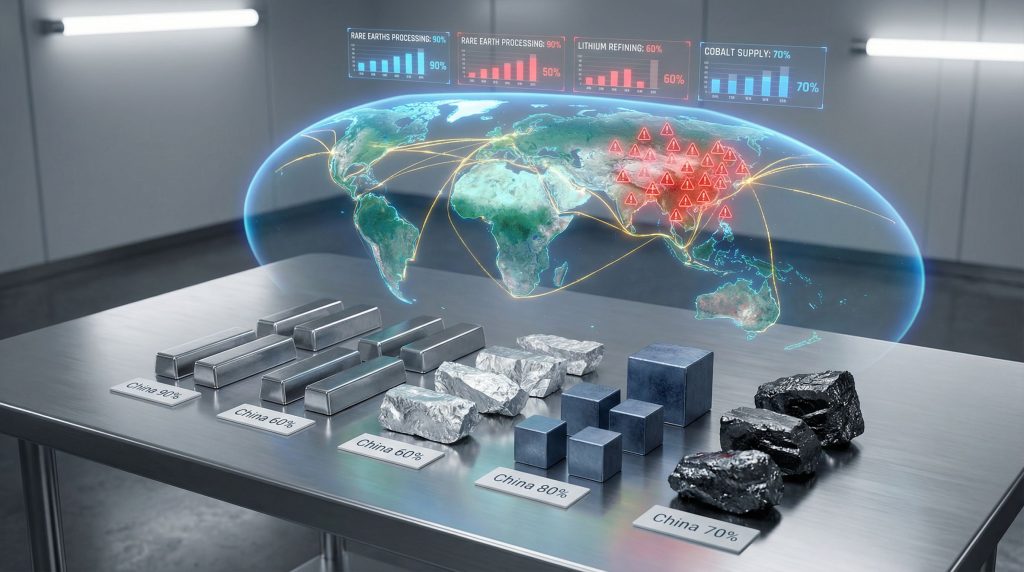
The concentration of processing capabilities creates what analysts describe as structural chokepoints that differ fundamentally from traditional market risks. When China controls 85-90% of rare earth element refining or 95% of gallium processing, according to U.S. Geological Survey data, it establishes leverage points that cannot be quickly replicated elsewhere. This concentration extends beyond simple market share to encompass specialised technical knowledge, processing infrastructure, and decades of operational refinement.
Strategic Vulnerabilities in Resource Processing
The most concerning aspect of current critical minerals supply chains lies not in resource extraction but in processing concentration. While mining operations for many critical materials exist across multiple continents, the specialised facilities required to transform raw materials into usable industrial inputs remain concentrated in remarkably few locations.
Processing Concentration by Material:
- Rare Earth Elements: 85-90% processed in China
- Lithium: 60% processing capacity in Chinese facilities
- Cobalt: 80% of global refining occurs in China
- Gallium: 95% of processing concentrated in China
- Antimony: 70% of primary production from Chinese sources
This concentration creates cascading vulnerabilities throughout global supply chains. Modern jet engines contain 15-20 different critical minerals, many in trace quantities that make supply chain transparency difficult without detailed component disclosure from manufacturers. Furthermore, the complexity increases when considering that many critical materials emerge as by-products of larger mining operations, creating supply dynamics tied to entirely different market forces.
The By-Product Dependency Challenge
Unlike primary commodities where production decisions respond directly to market demand, many critical minerals exist as secondary outputs from larger industrial processes. This creates unique supply constraints that traditional diversification strategies cannot easily address.
Gallium extraction exemplifies this challenge perfectly. Approximately 95% of gallium production derives from aluminium smelting operations, where gallium appears as a trace element requiring specialised extraction circuits. Most existing aluminium facilities lack gallium recovery capability, making retrofitting technically challenging and expensive. New facilities designed for integrated gallium recovery require $50-100 million capital investment per facility and 3-5 year development timelines.
However, hafnium separation from zirconium processing presents similar constraints. These elements possess virtually identical chemical properties, requiring specialised vacuum distillation equipment operating at temperatures exceeding 1,900°C. Global hafnium capacity remains below 100 tonnes annually, constrained not by resource availability but by processing expertise and infrastructure limitations.
In addition, indium recovery from zinc refining demonstrates how by-product economics limit supply responsiveness. With indium concentrations typically ranging from 5-200 parts per million in zinc ore, recovery requires multiple concentration stages and specialised precipitation processes. Recovery efficiency depends on zinc ore quality and refining facility design, creating supply constraints independent of indium demand signals.
When big ASX news breaks, our subscribers know first
Why Concentration Creates National Security Vulnerabilities
The strategic implications of processing concentration extend far beyond typical market volatility concerns. When defence contractors depend on materials where alternative suppliers require 7-15 years to develop equivalent capacity, it creates systematic vulnerabilities that traditional risk management approaches cannot adequately address.
Defence Industry Dependencies
Military readiness faces particular exposure through specialised material requirements that cannot be quickly substituted without complete system redesigns. Antimony serves as a critical example, where this element hardens lead ammunition and artillery shells, improving penetration characteristics essential for military effectiveness. The recent strategic antimony update highlights how these dependencies are being addressed through targeted investments.
Current antimony supply dynamics present significant strategic risks:
- Global primary production: 120,000-130,000 tonnes annually
- Chinese production share: 70% of global supply
- U.S. domestic production: Zero (ceased in 1982)
- U.S. strategic reserves: Approximately 22,000 tonnes
- Military specification requirements: 99.7% purity levels
Hafnium presents even more acute vulnerabilities for submarine reactor systems. The U.S. Navy's nuclear submarine fleet, including attack submarines and next-generation Columbia-class vessels, depends on hafnium for reactor control systems. Hafnium's exceptional neutron absorption characteristics (thermal neutron absorption cross-section of 104.5 barns) cannot be replicated by alternative materials, making substitution impossible without fundamental reactor redesigns.
Gallium arsenide semiconductors enable military radar and electronic warfare systems operating at frequencies where silicon alternatives cannot match performance specifications. Military systems operating in X-band and Ku-band frequencies depend on gallium-based components, with 95% of processing capacity concentrated in China.
Cascading Supply Chain Effects
Supply restrictions create impacts that propagate through multiple tiers of defence contractors within weeks. When China implemented gallium export controls in December 2024, semiconductor manufacturers faced immediate sourcing challenges affecting electronics supply chains globally. This demonstrates how processing concentration translates directly into geopolitical leverage during international tensions.
The vulnerability extends beyond direct material dependencies to encompass sub-component suppliers who may have even narrower sourcing options. Consequently, a single restriction at the processing level can affect weapons system production timelines across multiple platforms simultaneously, creating operational readiness concerns that extend far beyond immediate material costs.
Traditional Diversification Strategy Limitations
Current approaches to supply chain resilience consistently underestimate the time horizons and capital requirements necessary for meaningful diversification. Developing alternative processing capabilities requires not only substantial financial investment but also specialised technical expertise that exists in limited facilities globally.
Development Timeline Realities
Mining Project Development:
- Exploration and resource estimation: 2-4 years
- Feasibility studies and permitting: 2-3 years
- Financing and development: 1-2 years
- Construction and commissioning: 2-3 years
- Total timeline: 7-15 years from discovery to production
Processing Facility Construction:
- Engineering and design: 1-2 years
- Environmental approvals: 12-24 months
- Construction: 2-4 years
- Total development: 4-8 years for greenfield facilities
These timelines create fundamental mismatches with strategic planning requirements. Defence systems typically operate on 10-30 year life cycles, while supply chain diversification projects require 7-15 years minimum development periods. For instance, systems currently in production may face supply vulnerabilities before alternative sources become operational.
Capital Investment Barriers
The financial scale required for critical minerals processing creates natural barriers to entry that limit potential diversification options:
- Large-scale lithium processing: $500 million – $2 billion USD
- Rare earth separation facility: $1-4 billion USD
- Antimony processing expansion: $200-400 million USD
These capital requirements exceed the financial capacity of most developing nations and require sustained government support or international consortium backing. Even when financing becomes available, the specialised technical expertise required for critical minerals processing represents a scarce resource that cannot be rapidly transferred.
Technical Expertise Constraints
Processing rare earth elements requires highly specialised knowledge that exists in limited facilities globally. Engineers trained in rare earth separation methodologies represent a scarce resource, making technology transfer slower than capital investment alone might suggest. China's processing dominance partly reflects accumulated expertise and process refinement developed over decades of operational experience.
Rare earth processing complexity involves managing radioactive by-products, handling corrosive chemical processes, and maintaining strict environmental controls. These requirements create technical barriers that cannot be overcome through financial investment alone, requiring years of operational experience to achieve commercial efficiency levels.
Export Restrictions and Economic Cascade Effects
Recent export controls demonstrate how quickly mineral dependencies translate into industrial disruptions across global supply chains. The implementation of gallium restrictions in late 2024 provides a real-world case study of how processing concentration creates immediate operational challenges for strategic industries.
Escalation Scenario Analysis
Graduated Restriction Implementation:
- Initial export licensing creates supply uncertainty and price volatility
- Manufacturers begin defensive stockpiling, driving further price increases
- Alternative suppliers struggle with capacity constraints and technical barriers
- Industrial users face 12-24 month adjustment periods for sourcing alternatives
Complete Export Prohibition Scenarios:
- Immediate supply shortages affect production timelines across multiple industries
- Emergency government stockpile releases provide 6-24 months temporary relief
- Accelerated investment in alternative sources begins with 3-7 year development timelines
- Industrial capacity shifts toward regions with secure supply access
Market Psychology During Supply Disruptions
Supply restriction announcements create immediate psychological impacts that often exceed actual physical shortages. Manufacturers begin defensive stockpiling even when current inventory levels remain adequate, creating artificial demand spikes that exacerbate price volatility and supply concerns.
The 2010-2011 rare earth export restrictions provide historical context for these dynamics. When China reduced rare earth exports by 30-40%, global prices increased by 300-500% within months, forcing Japanese manufacturers to accelerate recycling technology development and alternative material research programmes. However, even with these efforts, achieving commercially viable alternatives required 3-5 years of intensive development.
International Partnership Frameworks for Risk Mitigation
The Minerals Security Partnership (MSP) represents a coordinated international response to critical minerals supply chain vulnerabilities. With participation from 13+ countries, this initiative attempts to develop alternative supply networks through shared investment and technical cooperation while maintaining environmental and social governance standards.
Partnership Framework Advantages
Shared Risk Distribution:
- Investment costs distributed across multiple national economies
- Coordinated technical expertise and knowledge transfer programmes
- Diplomatic leverage for securing resource access agreements
- Environmental standards supporting sustainable long-term production
Collective Purchasing Power:
- Industry consortiums enabling smaller companies to participate in sourcing alternatives
- Standardised specifications reducing individual company technical risks
- Shared infrastructure development reducing per-participant costs
Framework Limitations and Challenges
Despite coordinated efforts, international partnerships face structural constraints that limit their effectiveness in addressing immediate supply vulnerabilities:
- Development timelines still require 5-10 years minimum for meaningful capacity additions
- Political changes can affect long-term commitment levels across participating nations
- Competition between partners for preferred project access and resource allocation
- Limited ability to address immediate supply disruptions through emergency measures
Regulatory Coordination Challenges:
Environmental impact assessments and indigenous consultation requirements vary significantly across participating countries, extending project timelines in developed jurisdictions where regulatory approval processes can require 12-36 months or longer.
Industrial Preparation Strategies for Supply Chain Disruptions
Strategic preparation requires comprehensive risk assessment extending beyond traditional inventory management toward complete supply chain mapping and alternative sourcing development. Companies in critical sectors need detailed understanding of their mineral dependencies and contingency plans for various disruption scenarios.
Comprehensive Risk Assessment Framework
Tier 1: Immediate Vulnerability Mapping
- Identify all critical mineral dependencies throughout production processes
- Map supplier geographic concentration levels and processing facility locations
- Assess current inventory levels against potential disruption timeline scenarios
- Evaluate substitute material possibilities and associated performance trade-offs
Tier 2: Strategic Sourcing Development
- Establish relationships with alternative suppliers across different geographic regions
- Invest in recycling capabilities to reduce virgin material dependency
- Participate in industry consortiums for collective purchasing power and shared risk
- Develop technical capabilities for material substitution where technically feasible
Advanced Recycling and Urban Mining
Urban mining from electronic waste streams could potentially provide 20-30% of future critical mineral supply, according to International Energy Agency projections. Advanced separation technologies reduce processing energy requirements while creating closed-loop manufacturing systems that minimise virgin material needs. The advancement in battery recycling process technologies demonstrates how recycling can contribute to supply chain resilience.
Recycling Technology Development:
- Improved hydrometallurgical processes enable higher recovery rates from complex electronic assemblies
- Automated disassembly systems reduce labour costs and improve material separation efficiency
- Artificial intelligence optimisation of recycling processes maximises material recovery while minimising energy consumption
The next major ASX story will hit our subscribers first
Future Demand Projections and Technology Evolution
Critical mineral requirements face unprecedented growth driven primarily by clean energy transitions and electric vehicle adoption. The International Energy Agency projects demand increases of 21 times for lithium, 42 times for cobalt, and 25 times for rare earth elements by 2040 under net-zero emissions scenarios.
This demand growth occurs against increasingly complex geopolitical relationships and growing awareness of supply chain vulnerabilities among strategic planners globally. The mining industry evolution continues to adapt to these changing dynamics through technological innovation and improved extraction methodologies.
Alternative Material Development Pathways
Substitute Material Research:
- Nanotechnology approaches reduce material quantity requirements for specific applications
- Synthetic alternatives emerge for high-value applications where performance specifications allow substitution
- Advanced materials engineering creates hybrid solutions combining multiple elements to reduce dependency on single critical materials
Technology Innovation Trajectories:
- Solid-state battery development potentially reduces lithium requirements per unit energy storage
- Advanced magnetic materials research seeks alternatives to rare earth permanent magnets
- Semiconductor technology evolution may enable alternative materials for specific electronic applications
Geopolitical Evolution Scenarios
Scenario A: Continued Concentration Dynamics
- Existing suppliers maintain market dominance through operational efficiency gains and vertical integration
- New entrants face sustained capital and technical barriers limiting market entry
- Geopolitical tensions increase around resource access rights and pricing mechanisms
Scenario B: Successful Diversification Implementation
- International partnerships achieve meaningful alternative processing capacity within 7-10 years
- Regional supply chains develop for specific mineral categories reducing global dependencies
- Market competition reduces concentration risks while maintaining supply security for strategic applications
Investment and Policy Navigation Strategies
Investment strategies must balance the extended development timelines inherent in mining projects with urgent requirements for supply chain security. Policymakers face similar challenges supporting domestic capabilities without creating inefficient protected markets that ultimately increase costs for strategic industries.
Direct Investment Considerations
Mining Project Evaluation:
- Focus on politically stable regions with established environmental and social governance practices
- Prioritise operations with shorter development timelines and proven reserve bases
- Consider integrated processing capabilities alongside raw material extraction capacity
Technology Infrastructure Investments:
- Recycling technology companies with proven scalable business models and intellectual property protection
- Transportation and logistics firms specialising in critical materials handling and secure supply chain management
- Energy infrastructure supporting remote mining operations in strategic resource regions
Policy Support Mechanisms
Strategic Reserve Management:
- Coordinated stockpile acquisition and release protocols during supply disruptions
- Regular assessment of reserve adequacy against projected demand growth and potential disruption scenarios
- International coordination mechanisms for emergency supply sharing during crisis periods
Research and Development Funding:
- Alternative materials research programmes targeting specific critical mineral applications
- Process innovation supporting domestic processing capability development
- Environmental technology advancement enabling sustainable extraction and processing operations
The recent executive order on critical minerals demonstrates how policymakers are prioritising these strategic considerations at the highest levels of government. Furthermore, the development of a comprehensive critical minerals strategy requires coordinated action across multiple sectors and international partnerships.
International Cooperation Frameworks:
- Bilateral and multilateral agreements supporting shared supply chain resilience
- Technical assistance programmes for developing alternative processing capabilities
- Environmental standards coordination supporting sustainable long-term production capacity
The Australian government's critical minerals supply initiatives exemplify how nations are developing strategic responses to supply chain vulnerabilities through targeted investment and international partnerships.
Critical minerals supply chains will likely remain a defining factor in international economic relationships over the next decade. Successfully navigating these dependencies requires coordinated effort across industry, government, and international partnership frameworks, with realistic timelines acknowledging the substantial technical and financial barriers to meaningful diversification.
Disclaimer: This analysis contains forward-looking projections and scenario-based assessments that involve inherent uncertainties. Actual developments in critical minerals markets, geopolitical relationships, and technology advancement may differ significantly from projections discussed. Investment decisions should be based on comprehensive due diligence and professional financial advice.
Ready to Capitalise on Critical Minerals Investment Opportunities?
Discovery Alert's proprietary Discovery IQ model delivers real-time alerts on significant critical minerals discoveries across the ASX, instantly empowering subscribers to identify actionable opportunities ahead of the broader market. Understand why major mineral discoveries can lead to substantial returns and begin your 30-day free trial today to position yourself ahead of the market.