June 18, 2026
The Race Beneath Britain's Surface: Why Critical Minerals in the UK Are Drawing Global Attention
The global energy transition has quietly redrawn the map of strategic importance. Countries once overlooked for mineral wealth are now being examined with fresh urgency as supply chains fracture, trade relationships shift, and the critical minerals demand for battery metals, conductor materials, and industrial inputs accelerates beyond historical precedent. Britain, long associated with post-industrial decline in mining, is re-entering this conversation with geological credibility and growing international interest.
Understanding why this matters requires a closer look not just at what lies beneath the UK's surface, but at the convergence of capital markets, policy architecture, processing infrastructure, and workforce capacity that will determine whether geological potential translates into economic reality.
When big ASX news breaks, our subscribers know first
The Strategic Case for Domestic Critical Minerals in the UK
Import Dependency and the Supply Chain Vulnerability Problem
The UK currently relies heavily on imported supplies of minerals including lithium, cobalt, copper, nickel, and tungsten. Each of these inputs is concentrated in a small number of producing nations, many of which carry elevated geopolitical risk profiles. This dependency exposes British industrial supply chains to price volatility, export restrictions, and logistical disruption at precisely the moment when demand from electric vehicle manufacturing, grid-scale battery storage, and electrification infrastructure is rising sharply.
The structural problem is not unique to the UK. Across Western economies, policymakers are grappling with the same fundamental tension: the materials required to build a low-carbon industrial base are largely sourced from regions that present strategic risk. However, the difference for Britain is that it sits on meaningful domestic mineralisation that has, until recently, remained commercially underdeveloped.
The UK's Critical Minerals Strategy identifies five core pillars for addressing this challenge:
- Supply chain security through diversification of import sources and domestic production
- Domestic capability expansion across exploration, extraction, and processing
- Skills development to rebuild geoscience and mining engineering expertise
- R&D investment in extraction technologies and processing innovation
- Circular economy recovery to reclaim critical minerals from waste streams and end-of-life products
Supporting this framework, the Critical Minerals Intelligence Centre (CMIC), operated by the British Geological Survey, provides independent analysis of global supply risk, demand forecasting, and value chain vulnerabilities. Its work forms the evidence base for national minerals policy, offering a data-driven foundation for decisions that will shape the UK's industrial future over decades.
The UK Mining Conference: A Barometer of Sector Momentum
Record Attendance Signals Growing International Recognition
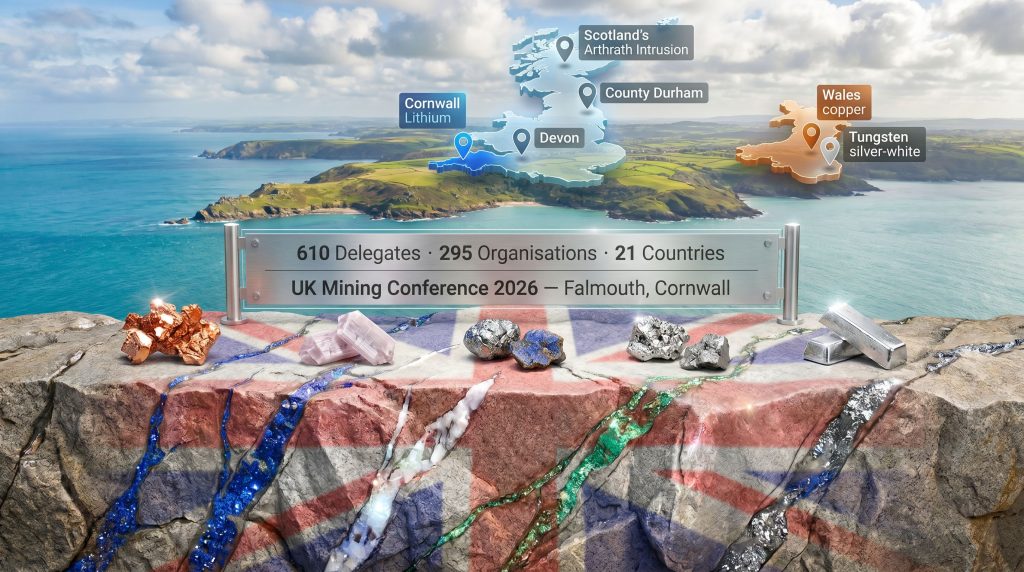
Held annually in Falmouth, Cornwall, the UK Mining Conference has established itself as the country's primary gathering point for the full spectrum of minerals sector participants. The 2026 edition, the seventh consecutive year of the conference, took place on 10 and 11 June at the Princess Pavilion and Gyllyngdune Gardens, and delivered attendance figures that exceeded all previous records.
The scale of the 2026 event reflects a sector that is gaining serious international traction:
| Conference Metric | 2026 Data |
|---|---|
| Total Attendees | 610 |
| Organisations Represented | 295 |
| Countries Represented | 21 |
| Events Staged | 12 |
| Venues Used | 6 |
| Local Suppliers Engaged | 30+ |
The diversity of the attendee base is significant. Mineral explorers, mine operators, specialist manufacturers, investors, academics, government departments, and trade associations were all represented, creating a genuinely multi-stakeholder forum. Furthermore, the presence of delegates from 21 countries signals that the UK Mining Conference critical minerals in the UK discussion is no longer a domestic conversation — it is an internationally observed discussion.
Satellite Events Expand the Conference's Intellectual Footprint
Beyond the main programme, a series of specialist satellite events deepened the conference's thematic reach across six Falmouth venues:
| Satellite Event | Attendees | Key Focus |
|---|---|---|
| Geothermal Forum | 167 (incl. 52 A-level students) | Low-carbon energy, renewable heat |
| Geologists' Workshop | ~72 | Real-world geological problem-solving |
| Investors' Congress (inaugural) | ~72 | Mining investment frameworks, UK opportunities |
The inaugural Investors' Congress is particularly noteworthy. Its creation signals a deliberate effort to address what many in the sector regard as the single most binding constraint on project development: access to patient, risk-tolerant capital. The Geothermal Forum's inclusion of 52 A-level students reflects a parallel strategy of pipeline building at the educational level, recognising that the workforce crisis in geoscience cannot be solved without engaging young people years before they reach the labour market.
Britain's Geological Endowment: What Actually Lies Beneath
The Cornubian Granite Batholith and the South West's Mineral Legacy
The Cornubian Granite Batholith, the ancient igneous formation underlying much of Cornwall and Devon, is Britain's most mineralogically significant geological feature from a critical minerals perspective. The hydrothermal systems associated with its emplacement created conditions favourable for concentrating lithium, tin, tungsten, copper, and cobalt across multiple vein and greisen systems.
Active operators in the South West now span a range of development stages, including Cornish Lithium, Cornish Metals, Cornish Tin and Lithium, Cornwall Resources, and Tamar Minerals. What was once framed as industrial heritage is increasingly being repositioned as a forward-looking mineral province with commercial-scale potential.
A characteristic feature of the Cornubian system that is not widely appreciated outside specialist geology circles is the distinction between hard rock lithium hosted in lithium mica minerals such as zinnwaldite and lepidolite, and geothermal brine lithium dissolved in deep saline waters. These require fundamentally different extraction technologies and carry different capital intensity profiles. This technical divergence within a single geological province creates both complexity and optionality for developers.
Scotland, County Durham, and Wales: A National Minerals Geography
The UK's geological opportunity extends well beyond the South West. In addition, the strategic role of tungsten and other critical metals is increasingly evident across multiple British regions:
- County Durham: The Weardale Granite hosts mineralisation relevant to Northern Lithium's ongoing exploration programme, representing a Northern England analogue to Cornish lithium geology
- North Yorkshire: Anglo American is active in the region, with potash and polyhalite mineralisation offering a distinctive multi-nutrient fertiliser proposition with global export potential
- Scotland: The Arthrath Intrusion and broader Scottish geology are under active assessment by Aberdeen Minerals, Argyll Metals, and Winshear Metals Corp, targeting a range of base and critical metal targets
- Wales: Vale's Clydach Refinery represents one of the UK's few existing downstream processing facilities, providing a working template for the kind of value-adding infrastructure the sector urgently needs to replicate at scale
The full list of minerals currently being explored or extracted across the UK spans a strategically important range:
- Lithium — central to battery storage for EVs and grid applications
- Cobalt — essential for high-energy-density cathode chemistries
- Copper — foundational conductor for electrification at every scale
- Nickel — critical for nickel-manganese-cobalt and nickel-cobalt-aluminium battery formulations
- Tin — high-value application in electronics, soldering, and specialty alloys
- Tungsten — dense, high-melting-point metal with defence and industrial cutting tool applications
- Polyhalite — multi-nutrient fertiliser mineral with growing international market recognition
- Gold — present across several UK exploration programmes as an economic co-product
A critical distinction in assessing UK mineral projects is the difference between geological endowment and economic resource. The former describes what exists in the ground; the latter requires drilling data, metallurgical testwork, economic modelling, and bankable feasibility studies before capital can be committed. Much of the UK currently sits between these two states.
The Investment Problem: Geology Is Not the Binding Constraint
Why Capital Remains the Sector's Defining Bottleneck
The challenge facing critical minerals development in the UK has been stated clearly by those closest to it: raising long-term finance for domestic mineral projects remains structurally difficult, even as geological evidence becomes more compelling and policy interest intensifies. Institutional investors have historically allocated minimal capital to UK mining relative to international comparators, reflecting a perception that British projects carry higher regulatory risk, longer development timelines, and less certain exit pathways.
Cornish Lithium's Founder and Executive Chairman, Jeremy Wrathall, articulated this tension at the conference, arguing that the UK must act without further delay to unlock long-term investment, accelerate mineral project development, and power production at a scale that can genuinely benefit local populations and industrial users across the country.
The five most commonly cited investment barriers in the UK critical minerals space are:
- Extended project lead times that conflict with institutional return horizons, particularly for listed funds with quarterly reporting obligations
- Permitting and planning complexity that introduces schedule risk at every development stage, from initial land access through to mine construction consent
- Limited domestic processing and refining infrastructure, which reduces the value capture argument for UK-origin ore and forces developers to model offshore processing into their economics
- Underdeveloped capital market frameworks for early-stage mineral exploration, where the London market has fewer specialist mining investors than the Toronto Stock Exchange or ASX ecosystems
- Asset class perception risk, where the institutional framing of UK mining as structurally marginal creates a self-fulfilling capital allocation gap
Consequently, completing definitive feasibility studies has become an increasingly critical step in de-risking projects sufficiently to attract institutional capital at the scale the sector requires.
The Processing Gap: Where UK Value Is Currently Lost
Even where extraction is technically and economically viable, the absence of domestic processing and refining infrastructure means that ore concentrates leave the UK as low-value intermediates. The processing challenges facing British developers are significant, with refining economics captured by facilities in continental Europe, Asia, or North America. This is not merely an economic inefficiency; it represents a fundamental gap in supply chain sovereignty.
Vale's Clydach Refinery in Wales demonstrates that downstream processing capability can exist within the UK. The challenge is building a broader ecosystem of facilities capable of handling the diverse mineralogy of British ores, from spodumene and lithium mica processing to tin smelting and tungsten refining. Each requires specialised engineering and meaningful capital commitment at a time when the investment environment for such infrastructure remains challenging.
Technology, AI, and the Modernisation of UK Mineral Exploration
Artificial Intelligence as a Geological Accelerant
One of the more technically forward-looking themes explored at the 2026 UK Mining Conference was the intersection of artificial intelligence and geological interpretation. The role of AI in mineral exploration is increasingly evident, with AI-driven tools applied to subsurface modelling, geophysical anomaly detection, drill target optimisation, and resource estimation workflows in ways that compress exploration timelines and reduce the cost of geological uncertainty.
For a country like the UK, where historical mining data exists in fragmented archives spanning centuries of activity, AI offers a particular opportunity. Legacy geological records, old mine plans, assay databases, and geophysical surveys represent an underutilised informational asset. Machine learning approaches that can synthesise these datasets into predictive targeting models could materially reduce the exploration risk associated with UK projects, improving the investment case before a single new drill hole is completed.
Geothermal Energy and the Dual-Value Proposition
The Cornubian Granite is not only mineralogically significant; it is also anomalously hot by UK standards, driven by elevated concentrations of heat-producing radioactive elements including uranium, thorium, and potassium. This makes Cornwall one of the most prospective regions in the UK for deep geothermal energy development.
The co-location of critical mineral extraction and geothermal energy potential creates a dual-value proposition that is receiving growing attention. Geothermal energy could provide low-carbon process heat and power directly to mining and processing operations, reducing both operational costs and the carbon footprint associated with mineral extraction. The Geothermal Forum's strong attendance, including substantial student participation, reflects a recognition that these two sectors share geological foundations and may increasingly share infrastructure and investment.
The next major ASX story will hit our subscribers first
Building the Workforce Britain's Mining Sector Needs
The Geoscience Pipeline Problem
Long before a mine reaches production, it requires geologists, metallurgists, mining engineers, environmental scientists, and processing technologists. The UK's capacity to supply these professionals has declined significantly over decades of mining industry contraction. Rebuilding this pipeline is not a short-term challenge; it requires sustained engagement with educational institutions, credible career pathways, and a sector profile attractive enough to compete with other STEM destinations.
The inclusion of 52 A-level students in the Geothermal Forum at the 2026 conference represents a model for how industry events can double as educational interventions. Exposing pre-university students to the intellectual and career dimensions of earth sciences within a professional conference context is a cost-effective way of generating interest at a formative decision-making moment.
Community Development and the Social Licence to Operate
Critical minerals development in Cornwall, County Durham, and Scotland carries socioeconomic implications that extend far beyond direct employment. Perran Moon, MP for Camborne, Redruth and Hayle, addressed the conference with a perspective rooted in the lived experience of communities historically shaped by mining. His argument was that Cornwall's mining resurgence represents something more than an industrial story: it is a vehicle for community renewal, infrastructure development, and the restoration of economic confidence in regions that have experienced long periods of post-industrial decline.
This framing matters for the investment case in a less obvious way. Projects with genuine community support carry lower social licence risk, face less local planning opposition, and typically progress through development stages with fewer delays. Furthermore, the political and social dimension of UK mining is therefore not separate from the investment calculus — it is embedded within it.
A Strategic Framework for Unlocking UK Critical Minerals Potential
Five Levers That Must Move Together
The consensus emerging from the 2026 UK Mining Conference critical minerals in the UK discussions is that no single intervention will unlock the sector's full potential. Progress requires simultaneous movement across five interconnected levers:
- Long-term investment mobilisation through mechanisms that align capital with the patient timelines of mineral project development
- Permitting and regulatory streamlining that reduces planning friction while maintaining environmental and community standards
- Processing and refining infrastructure investment to capture full value chain economics within the UK
- Workforce and skills development across geoscience, mining engineering, and metallurgy
- Circular economy integration that treats end-of-life mineral recovery as a parallel supply source from the outset of strategy design
The 2027 UK Mining Conference, scheduled for 16 and 17 June, will provide the next major forum for assessing progress against these imperatives. Those wishing to stay informed about future events and broader sector developments can also follow updates through Resourcing Tomorrow, a leading platform tracking global critical minerals conferences and industry initiatives. Given the trajectory of the 2026 event, both in terms of attendance scale and thematic ambition, the expectation is that international participation will continue to grow as the UK's minerals story becomes more widely understood.
Disclaimer: This article contains forward-looking commentary and analysis based on publicly available information and conference reporting. It does not constitute financial or investment advice. Readers considering investment in mining or mineral exploration should seek independent professional guidance and conduct their own due diligence.
Want To Capitalise on Significant Mineral Discoveries Before the Broader Market?
Discovery Alert's proprietary Discovery IQ model delivers real-time alerts on significant ASX mineral discoveries, transforming complex geological data into clear, actionable investment insights for both short-term traders and long-term investors. Explore how historic mineral discoveries have generated substantial returns and begin your 14-day free trial today to position yourself ahead of the market.