June 18, 2026
The Economics of Iron Ore: Why Asia's Appetite Is Far From Satisfied
Global commodity cycles have a habit of confounding consensus. When one metal fades from the spotlight, another quietly builds the structural case for a prolonged demand supercycle. For most of the past decade, investor attention has gravitated toward battery metals, copper, and rare earth elements as the preferred proxies for the energy transition. Yet beneath that narrative, iron ore demand in Asia has been assembling a fundamentally different and arguably more durable growth story, one rooted not in speculative transition timelines but in the concrete realities of urbanisation, industrialisation, and infrastructure investment across the world's most populous region.
Understanding this dynamic requires separating the noise of short-term price volatility from the structural forces reshaping how, where, and why steel gets made. Those forces point overwhelmingly toward Asia, and the implications for seaborne iron ore supply chains are profound.
When big ASX news breaks, our subscribers know first
Why Asia Pacific Controls the Iron Ore Market
The numbers are difficult to overstate. Asia Pacific accounted for approximately 70% of global iron ore market revenue share in 2024 to 2025, a proportion that reflects the region's outsized role in global crude steel output. That dominance is not the product of a single economy, nor is it monolithic in its growth trajectory. Understanding the iron ore market fundamentals at play across the region helps contextualise why Asia's structural position is so significant.
What is emerging across Asia is a three-speed demand structure:
- China, the world's largest steel producer by a significant margin, is entering a maturation phase characterised by efficiency-driven procurement rather than pure volume expansion.
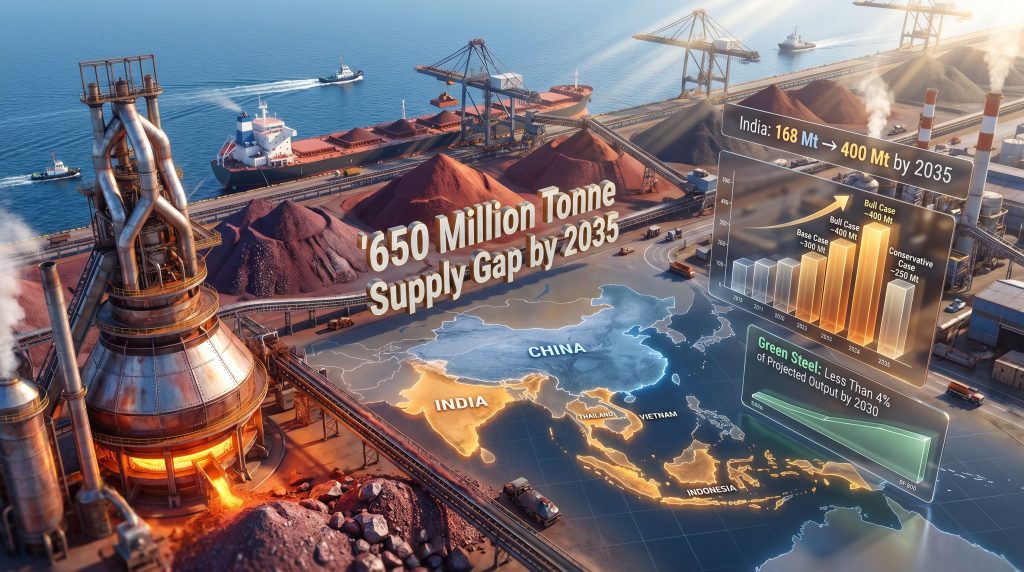
- India, producing approximately 168 million tonnes of crude steel per year, is accelerating toward an ambitious national target of 400 million tonnes per annum by 2035, more than doubling current output.
- Southeast Asia, including Vietnam, Indonesia, and Thailand, represents an awakening frontier where new steelmaking capacity is being constructed at scale for the first time.
Each tier presents a distinct demand profile, but all three converge on a single input requirement: imported iron ore.
China's Structural Shift and What It Means for Ore Quality
How Is China's Steel Sector Changing?
China's steel sector is not collapsing, but it is changing in ways that matter deeply for iron ore producers. As Chinese mills face pressure to improve operational efficiency and reduce emissions at the margin, procurement decisions are shifting toward higher-grade iron ore, which produces less slag per tonne of steel and reduces energy consumption per heat.
This quality-over-volume transition has important implications for the seaborne market. Producers of high-grade ore, typically above 62% iron content, are increasingly positioned to command a meaningful price premium. Lower-grade material faces growing discounts as Chinese steelmakers optimise their blast furnace burdens. The grade premium dynamic is not a new phenomenon, but it is intensifying as Chinese mills confront tighter environmental compliance requirements.
There is also the question of scrap substitution. China's accumulated steel stock — the sum total of steel embedded in its buildings, bridges, and machinery — is growing large enough to feed a meaningful electric arc furnace sector over time. However, this transition is slower than headline commentary suggests. Scrap collection infrastructure, quality sorting, and EAF capital investment all constrain the pace at which scrap can displace primary iron ore as a steelmaking input. Furthermore, China steel and iron ore market dynamics suggest the substitution effect, while real, is far from sufficient to fundamentally alter China's import dependency within the current decade.
India's Steel Ambition: The Defining Demand Story of the 2030s
If China represents the known quantity in iron ore demand modelling, India represents the variable with the largest potential to reshape the global supply balance. The scale of India's steel production ambition is extraordinary, and the iron ore arithmetic that underpins it is not widely appreciated.
India currently sits in a modest net export position for iron ore, with exports of approximately 28.62 million tonnes recorded in 2025 against imports of 13.87 million tonnes, according to data compiled by commodity analysts Kpler. That balance, however, masks a critical structural constraint: India's domestic iron ore deposits are not uniformly high enough in grade to support the enormous volumes required by a steel industry twice or more its current size.
India's iron ore resources are substantial in tonnage terms, but a significant proportion of recoverable reserves carry iron grades that create processing inefficiencies at scale. As domestic steelmaking output expands, the viability of relying exclusively on domestic ore becomes progressively more questionable, particularly when beneficiation costs and logistical constraints are factored in.
The demand scenario table below illustrates how import requirements shift depending on the pace of India's steel expansion:
| Scenario | Steel Output Target (2035) | Estimated Iron Ore Import Requirement | Key Assumption |
|---|---|---|---|
| Base Case | ~300 Mt | Moderate import growth | Domestic mines partially scaled |
| Bull Case | ~400 Mt | Significant structural import dependency | Domestic supply constrained by ore grade |
| Conservative Case | ~250 Mt | Limited import growth | Slower industrial capex cycle |
India's infrastructure spending pipeline, spanning railways, highways, urban housing, and port development, serves as a powerful steel demand multiplier. The country's per capita steel consumption remains well below the global average, meaning the structural runway for demand growth extends well beyond 2035 regardless of which scenario materialises.
Southeast Asia: The Emerging Iron Ore Import Frontier
Vietnam, Indonesia, and Thailand are building new steelmaking capacity at a pace that has not received proportionate attention from Western commodity markets. These economies are at an earlier stage of the industrialisation cycle than China or India, meaning their steel intensity per unit of GDP growth remains on an upward trajectory rather than plateauing.
Critically, virtually all new capacity being added across Southeast Asia uses the blast furnace-basic oxygen furnace (BF-BOF) method, the same proven technology that underpins Chinese and Indian steelmaking. The reason is straightforward: BF-BOF is cost-competitive and commercially proven at scale, while alternative production methods remain prohibitively expensive for emerging market operators working with thinner margins.
Unlike China, where decades of industrialisation have accumulated a steel stock large enough to eventually support meaningful scrap-based electric arc furnace production, Southeast Asian economies are working from a near-zero base of embedded steel. That structural reality anchors new capacity to blast furnace methods and, by extension, to seaborne iron ore imports, for the foreseeable future.
This point is underappreciated in decarbonisation discussions that treat EAF adoption as a near-term global phenomenon. In Southeast Asia, it is not. According to Asia-focused iron ore research, the region's growth trajectory continues to underpin the long-term case for seaborne supply investment.
Quantifying the Supply Gap: 650 Million Tonnes by 2035
Rio Tinto Chief Commercial Officer Bold Baatar, speaking at the Singapore Iron Ore and Steel Forum, outlined a projected supply shortfall of approximately 650 million tonnes of iron ore by 2035. This figure already accounts for new project completions, including the Simandou development in Guinea, which is projected to reach a capacity of approximately 120 million tonnes per annum upon full ramp-up.
The supply gap thesis rests on several compounding dynamics:
- Mine depletion rates at existing operations are accelerating as long-producing assets approach end-of-life.
- New project development timelines consistently trail demand growth curves, with permitting, capital allocation, and construction phases absorbing years that demand does not wait for.
- Replacement tonnage from greenfield and brownfield expansions is insufficient to offset losses from retiring operations, even before accounting for demand growth from India and Southeast Asia.
The table below maps the key variables that will determine whether the shortfall widens or narrows:
| Variable | Bullish for Gap Widening | Bearish for Gap Widening |
|---|---|---|
| India steel ramp-up speed | Faster than projected | Slower policy execution |
| Simandou ramp-up timeline | Delays persist | On-schedule production |
| Chinese output trajectory | Stabilises at current levels | Significant further decline |
| New mine approvals | Regulatory constraints tighten | Permitting accelerates |
| Scrap substitution in Asia | Slower adoption | Faster EAF transition |
In addition, iron ore surplus concerns in the near term should not obscure the longer-duration structural supply deficit that underpins the decade-level demand outlook.
The next major ASX story will hit our subscribers first
The Cost Reality of BF-BOF Versus Green Steel
The dominance of BF-BOF technology across Asian steelmaking capacity is not simply a matter of inertia or environmental indifference. It is a rational economic response to a cost structure that makes alternatives commercially unviable without significant external intervention.
According to data presented by the World Steel Association, the current cost of producing steel using the conventional blast furnace method sits at approximately $400 per tonne. Switching to green iron production using renewable hydrogen as the reductant and renewable electricity as the power source lifts that cost to between $500 and $850 per tonne, depending on geography and the local cost of clean energy.
That is a cost premium of $100 to $450 per tonne, a gap so large that no commercially rational steelmaker operating in a competitive Asian market can absorb it without either carbon pricing penalties on conventional production or direct production subsidies for greener alternatives. Neither mechanism exists at meaningful scale across Asia today.
Green Steel: Aspirational Arithmetic in a Coal-Fired Reality
Steel production accounts for approximately 8% of global carbon emissions, making it one of the most critical sectors in any credible decarbonisation pathway. The industry is keenly aware of this and regularly articulates ambitions around green steel adoption. The gap between rhetoric and capital commitment, however, is striking.
According to Zhong Shaoliang, Deputy Secretary-General of the World Steel Association, only approximately $20 billion has been invested globally in green steel production capacity to date. That investment is projected to yield approximately 70.8 million tonnes of green steel production capacity by 2030, with the overwhelming majority of that capacity located in Europe rather than Asia.
The arithmetic is stark: with global steel output expected to approach two billion tonnes per annum by 2030, planned green steel capacity represents less than 4% of total projected production. Even if every announced project is delivered on schedule, which historical precedent suggests is optimistic, the decarbonisation of the global steel sector by 2030 exists almost entirely on paper.
The Regulatory Gap That Keeps Green Steel on the Drawing Board
Europe has taken the most substantive regulatory step toward incentivising green steel through the Carbon Border Adjustment Mechanism (CBAM), which imposes a carbon cost on imports of steel and other carbon-intensive goods. While imperfect and still in its early implementation phase, CBAM creates a financial incentive for producers supplying European markets to reduce emissions. The IEEFA has noted that Australia's iron ore sector faces a similar crossroads when weighing conventional production against greener alternatives.
No equivalent mechanism exists across Asia. The comparison between European and Asian policy postures illustrates the scale of the challenge:
| Dimension | Europe | Asia |
|---|---|---|
| Carbon pricing mechanism | CBAM active | Limited or no equivalent |
| Green steel investment concentration | Majority of planned 70.8 Mt capacity | Minimal committed capacity |
| Government policy posture | Regulatory push underway | Predominantly market-led |
| BF-BOF retirement timeline | Accelerating | Extending |
| Green steel cost competitiveness | Improving with subsidies | Commercially unviable at scale |
Without carbon taxation, production subsidies, or regulatory mandates directing Asian steelmakers toward lower-emission methods, the financial logic of BF-BOF investment will continue to prevail. The three levers capable of closing the green steel cost gap — namely carbon taxation, production subsidies, and technology cost reduction through scale — are either absent or insufficiently developed across the region's dominant steel-producing economies.
Grade Premiums, Supply Strategy, and Long-Duration Capital Allocation
For iron ore producers and investors, the demand picture that emerges from this analysis has several practical implications. First, the shift toward higher-grade ore in China creates a strategic premium for producers capable of consistently delivering iron content above the 62% benchmark, while lower-grade producers face structural discount pressure. China demand prospects consequently remain a central variable in any forward-looking supply strategy. Second, the geographic diversification of Asian steel capacity rewards producers with established logistics chains across multiple markets. Third, the multi-decade capital commitment required to develop new iron ore mines must be sized against a demand outlook that, on balance, supports long-duration investment in seaborne supply capacity.
Iron ore demand in Asia, however, is not uniform in its quality requirements, pace of growth, or policy environment. Producers, investors, and policymakers who treat the region as a monolithic demand bloc risk mispricing both opportunity and risk.
Disclaimer: This article contains forward-looking projections and scenario-based analysis drawn from industry sources and publicly available data. These projections are inherently uncertain and should not be construed as financial advice. Readers should conduct their own due diligence before making any investment decisions.
Frequently Asked Questions: Iron Ore Demand in Asia
What is driving iron ore demand growth in Asia?
Iron ore demand across Asia is being driven by expanding steelmaking capacity, particularly in India and Southeast Asia, underpinned by infrastructure investment, urbanisation, and industrialisation cycles. While China's demand is maturing, incremental growth from emerging Asian economies is sustaining overall regional consumption.
How much iron ore does Asia consume relative to the rest of the world?
Asia Pacific accounted for approximately 70% of global iron ore market revenue share in 2024 to 2025, reflecting the region's outsized contribution to global crude steel output.
Will India become a major iron ore importer?
If India achieves its stated goal of producing approximately 400 million tonnes of steel per year by 2035 — more than double its current output of around 168 million tonnes — domestic ore supply would likely be insufficient to meet demand, making India a structural net importer of iron ore, particularly given constraints on the iron grade of available domestic reserves.
Why is green steel adoption so slow in Asia?
The primary barriers are cost and policy. Green steel production using renewable hydrogen and electricity costs between $500 and $850 per tonne, compared to approximately $400 per tonne for conventional blast furnace production. Without carbon pricing mechanisms or government subsidies comparable to those emerging in Europe, there is limited financial incentive for Asian steelmakers to transition.
What is the projected iron ore supply gap by 2035?
Rio Tinto's Chief Commercial Officer cited a potential supply shortfall of approximately 650 million tonnes by 2035, accounting for new projects such as Simandou in Guinea but reflecting the pace at which existing mines are reaching end-of-life relative to demand growth.
Which Southeast Asian countries are expanding steel capacity?
Vietnam, Indonesia, and Thailand are among the most active markets building new steelmaking capacity, predominantly using blast furnace-basic oxygen furnace technology, which requires imported iron ore as a primary input.
Want to Track ASX Stocks Positioned for Asia's Iron Ore Supercycle?
Discovery Alert's proprietary Discovery IQ model delivers real-time alerts on significant ASX mineral discoveries — instantly cutting through complex data to surface actionable opportunities before the broader market reacts. Explore historic discoveries and the returns they generated, then start your 14-day free trial at Discovery Alert to position yourself ahead of the next major find.