June 18, 2026
The Geometry of Dependence: Why Global Energy Markets Cannot Escape the Hormuz Question
Every major energy supply crisis in modern history has been shaped less by the volume of oil lost and more by the architecture of dependency that made that loss so consequential. The 1973 Arab oil embargo did not cripple Western economies because it destroyed production capacity — it did so because consuming nations had constructed their entire import infrastructure around a narrow set of suppliers and routes with no viable alternatives. That structural fragility, built over decades of optimised but brittle supply chains, is precisely the dynamic now being exposed at an entirely new scale in the debate over the Strait of Hormuz reopening without conditions.
Understanding why the current reopening debate is so contested requires stepping back from the immediate ceasefire diplomacy and examining how the strait functions as a physical and geopolitical mechanism — and why the phrase without conditions carries a meaning that diverges sharply between the parties negotiating its future.
When big ASX news breaks, our subscribers know first
The Strait as a System, Not Just a Shipping Lane
Why There Is No Viable Alternative at Scale
The Strait of Hormuz is approximately 21 miles wide at its narrowest navigable point, yet through those two-mile-wide shipping channels passes roughly 20 to 21 million barrels per day of petroleum liquids under normal operating conditions, according to the U.S. Energy Information Administration (EIA). That figure represents close to one-fifth of total global petroleum consumption moving through a single geographic pinch point.
What makes this dependency so structurally durable is the absence of any credible large-scale bypass option for the majority of Gulf producers. Furthermore, global crude shipments through the region depend almost entirely on Hormuz. Two partial alternatives exist:
- Saudi Arabia's East-West Pipeline, which can route approximately 5 million barrels per day of Saudi crude to Red Sea terminals, bypassing the strait entirely for that volume only
- Abu Dhabi's Crude Oil Pipeline (ADCOP), which carries roughly 1.5 million barrels per day of UAE crude to the Fujairah terminal on the Gulf of Oman, also avoiding Hormuz
The combined bypass capacity of these two routes represents only a fraction of normal strait throughput. For the remaining GCC producers, and for the broader global market, the strait remains structurally irreplaceable.
The Scale of the 2026 Disruption in Historical Context
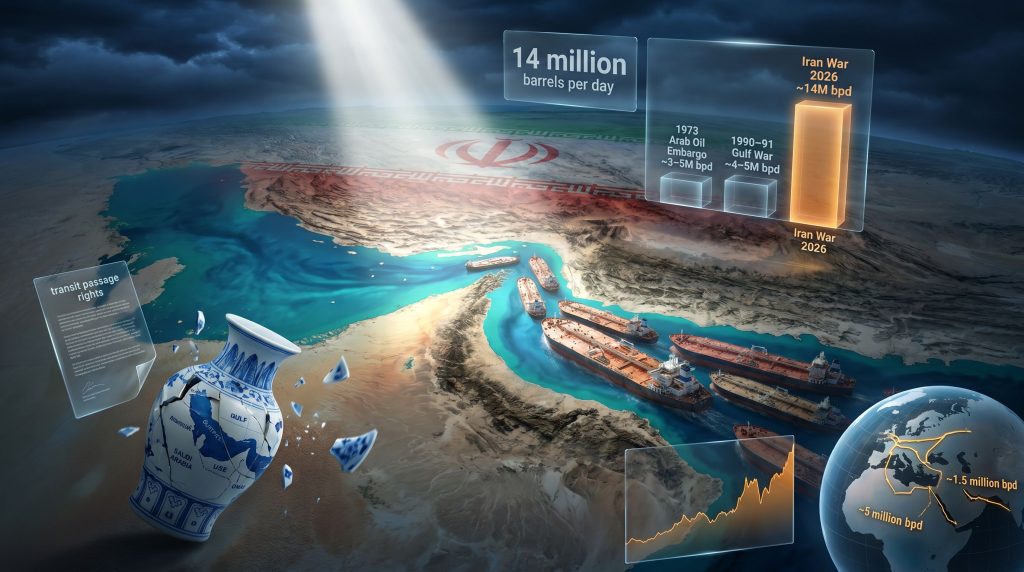
The conflict that began with U.S.-Israeli strikes on Iran on February 28, 2026, resulted in what the International Energy Agency (IEA) has characterised as the largest oil supply disruption in history. IEA data indicates that the closure blocked more than 14 million barrels per day of Middle Eastern oil output — a figure that dwarfs every previous supply disruption event by a considerable margin.
| Disruption Event | Estimated Supply Impact (bpd) | Duration |
|---|---|---|
| 1973 Arab Oil Embargo | ~3–5 million bpd | ~5 months |
| 1990–91 Gulf War | ~4–5 million bpd | ~7 months |
| 2019 Abqaiq Attack | ~5.7 million bpd | Days |
| Iran War (2026) | ~14 million bpd | Ongoing at time of report |
The scale of this disruption has not merely elevated oil prices in the short term. It has fundamentally restructured how insurers price war risk clauses on tanker hull coverage, how long-term supply contracts are written with respect to force majeure and alternative routing provisions, and how governments across Asia and Europe are reassessing their strategic petroleum reserve (SPR) targets. In addition, the oil geopolitical risk factors at play here are unlike anything previously modelled in mainstream energy forecasting.
Is the Strait of Hormuz Actually Reopening Without Conditions?
The Policy Fault Line Nobody Is Advertising
The interim ceasefire agreement reported in June 2026 includes two core operational commitments: Iran agrees to reopen the strait to commercial traffic, and the United States agrees to lift its naval blockade of Iran. On the surface, this appears to represent a clean exchange. In practice, the operational meaning of reopening remains deeply contested, as S&P Global Ratings notes that the framework represents an important but fragile first step toward normalisation.
The phrase Strait of Hormuz reopening without conditions has been advanced most explicitly by IEA Executive Director Fatih Birol, who stated at an event in Istanbul that the waterway must be reopened in a manner that gives all parties confidence it is genuinely safe and accessible. Birol simultaneously acknowledged that the crisis has compelled multiple countries to begin reviewing their national energy security frameworks, precisely because the demonstrated vulnerability of the strait has permanently altered the risk calculus.
The divergence in negotiating positions maps out as follows:
- The IEA and Western position holds that all commercial shipping, regardless of flag state, must have unrestricted transit passage without navigational controls, routing requirements, or tolls imposed by any single sovereign actor
- Iran's reported framework ties full reopening to the removal of the U.S. naval blockade and involves a coordinated routing structure managed through Iranian maritime authorities
- The U.S. position demands immediate and unconditional access, with no unilateral Iranian control over navigational parameters
Based on available reporting as of June 2026, the Strait of Hormuz reopening without conditions has not been fully achieved. The post-ceasefire framework involves reciprocal commitments and contested operational terms, with the UN noting that whether full freedom of navigation will be restored under international maritime law remains unclear.
The UNCLOS Dimension: Rights Without Enforcement
Under the United Nations Convention on the Law of the Sea (UNCLOS), the Strait of Hormuz is subject to transit passage rights — a legal standard that guarantees all states the right to continuous and expeditious passage through international straits used for international navigation. Iran is a signatory to UNCLOS, and both the Iranian and Omani coastlines border the strait.
The critical limitation of UNCLOS in this context is enforcement. The convention establishes rights but provides no independent mechanism to compel compliance when a bordering state asserts sovereign security prerogatives. This legal gap is precisely what allows Iran to construct a coordinated routing framework and present it as consistent with security obligations, even as the U.S. and IEA characterise such controls as incompatible with genuine freedom of navigation.
| Condition Category | Reported Requirement | Status |
|---|---|---|
| U.S. Naval Blockade Removal | Required by Iran | Partially addressed |
| Coordinated Routing Compliance | Iranian maritime authority oversight | Reportedly active |
| Transit Fee Framework | Iran's position disputed | Unresolved |
| Independent Verification Mechanism | Not confirmed | Pending |
| Freedom of Navigation for All Flags | Demanded by U.S. and IEA | Contested |
The Permanent Repricing of Chokepoint Risk
Trust as Market Infrastructure
IEA Executive Director Birol's characterisation of the crisis in Istanbul cut to something rarely articulated explicitly in energy policy discourse: trust itself functions as a form of market infrastructure. When trust in a critical trade route's reliability is destroyed, financial actors reprice exposure not just during the disruption but permanently, embedding a structural risk premium that persists even after physical access is restored.
Once a critical trade route has been demonstrably closed by a sovereign actor, the repricing by insurers, energy buyers, and financial markets becomes structural rather than temporary. This premium does not reset to zero on reopening — it recalibrates to a new, permanently elevated baseline reflecting the demonstrated possibility of future closure.
This dynamic reshapes four distinct domains simultaneously:
- Shipping insurance markets — War risk clauses and hull coverage premiums are recalibrated to reflect a demonstrated threat, not merely a theoretical one
- Long-term supply contract structures — Force majeure provisions and alternative routing clauses become standard inclusions rather than negotiating exceptions
- Strategic reserve targets — Importing nations face pressure to hold SPR volumes above IEA minimum thresholds as a buffer against future closures
- Infrastructure investment decisions — Capital allocation toward alternative pipeline capacity, LNG terminals, and distributed storage accelerates as buyers seek structural supply chain resilience
Saudi Aramco's Storage Pivot as a Strategic Signal
Saudi Aramco's reported consideration of expanding worldwide storage capacity in the aftermath of the Iran conflict is not simply a corporate logistics decision. It represents a strategic signal from the world's largest oil producer that distributed, geographically diversified storage is now viewed as a necessary hedge against chokepoint vulnerability — not an optional operational efficiency measure.
If the region's dominant producer is actively reassessing how and where it holds inventory globally, that assessment cascades across every other GCC producer's strategic planning framework. Consequently, the OPEC influence on oil over long-term pricing and capacity allocation decisions is being reassessed in parallel. The implication for long-term GCC supply chain architecture is significant: the conflict has shifted storage from a cost centre to a strategic insurance asset.
Scenario Analysis: Three Pathways Forward
Scenario 1: Full Unconditional Reopening
Probability assessment: Low in the near term
All parties accept freedom of navigation under UNCLOS transit passage standards with no unilateral Iranian routing controls. Oil prices normalise toward pre-conflict baselines, war risk insurance classifications are lifted, and IEA emergency coordination protocols are suspended. This scenario requires a level of mutual trust and verified compliance that the current diplomatic architecture does not yet support.
Scenario 2: Conditional Partial Reopening (Base Case)
Probability assessment: Most likely near-term outcome
Commercial shipping resumes under a framework that involves some degree of Iranian navigational coordination. Periodic delays, elevated insurance premiums, and residual uncertainty persist. Oil prices remain structurally above pre-conflict baselines, and long-term buyers accelerate supply chain diversification. This is broadly consistent with the reported state of the ceasefire agreement. However, the oil price trade war impact adds further downward pressure on producer revenues during this fragile interim period.
Scenario 3: Ceasefire Breakdown
Probability assessment: Tail risk, but non-trivial
Negotiations collapse over the specifics of blockade removal, routing compliance, or a third-party trigger event. The strait re-closes partially or fully. Global SPR drawdowns are activated, oil markets absorb a renewed shock, and investment in non-Gulf energy alternatives — U.S. LNG, African producers, Central Asian pipeline corridors — accelerates sharply.
The GCC Economic Recovery and Its Preconditions
Growth Forecasts and the Strait as a Prerequisite
Forecasts projecting GCC economic growth exceeding 8% in 2027 are explicitly contingent on the normalisation of energy flows through the strait. The UAE's post-OPEC+ expansion trajectory, which targets oil output above 5 million barrels per day, cannot materialise without consistent, unimpeded access to export routes through Hormuz. ADCOP's 1.5 million barrels per day bypass capacity is useful but insufficient to support an expansion program of that scale.
The broader regional infrastructure picture is similarly qualified:
| Alternative Route/Infrastructure | Capacity (bpd equivalent) | Hormuz Bypass Capability |
|---|---|---|
| Saudi East-West Pipeline | ~5 million bpd | Partial (Saudi crude only) |
| Abu Dhabi ADCOP Pipeline | ~1.5 million bpd | Partial (UAE crude only) |
| Qatar LNG (non-oil) | N/A (gas) | Partial substitute |
| Extended Cape of Good Hope routing | Unlimited (cost premium) | Full but economically costly |
The Cape of Good Hope routing option is instructive. Technically, any tanker can reroute around the southern tip of Africa, bypassing the strait entirely. In practice, the additional voyage distance adds significant time and fuel costs to delivered energy prices for Asian buyers, effectively functioning as a permanent landed cost premium rather than a genuine substitute for Hormuz access. WTI and Brent futures have continued to reflect this cost differential in their respective spreads throughout the disruption period.
The next major ASX story will hit our subscribers first
Frequently Asked Questions: Strait of Hormuz Reopening Without Conditions
What does reopening without conditions actually mean?
It refers to the restoration of unrestricted transit passage for all commercial vessels of all flag states, free from navigational controls, routing mandates, or toll structures imposed by any single sovereign actor. The contrast with the current reported framework, which involves Iranian maritime coordination and reciprocal U.S. concessions, illustrates why this standard has not yet been met.
Has the strait been formally closed before?
Prior to 2026, the strait had been threatened and partially disrupted during the Iran-Iraq tanker wars of the 1980s and during a series of tanker attacks in 2019, but had never experienced a confirmed full-scale closure in the modern era. The 2026 Strait of Hormuz crisis therefore represents a genuine historical precedent that permanently recalibrates risk models for every actor with exposure to Hormuz-dependent supply chains.
Why do oil prices fall after a peace agreement before the strait fully reopens?
Energy markets operate on forward-pricing mechanisms that embed anticipated future supply conditions into current prices. A credible peace agreement triggers immediate price relief because market participants price in the expected restoration of supply, even before physical tanker movements confirm it. However, prices typically settle above pre-conflict baselines because the risk premium for potential future disruption does not return to zero — it recalibrates to a new elevated floor reflecting demonstrated vulnerability.
The Path to Genuine Normalisation
For energy markets to fully recover confidence in the strait as a reliable trade route, the conditions required extend well beyond a ceasefire declaration. Analysts and policymakers broadly point to the following benchmarks:
- Verified resumption of full-volume tanker movements confirmed through independent shipping data
- Removal of all war risk insurance classifications applying to Hormuz-transiting vessels
- Confirmation that no single actor retains unilateral navigational control over routing or access
- IEA declaration that emergency coordination protocols have been formally suspended
- A multilateral diplomatic framework addressing Iran's long-term posture on strait access as a sovereign leverage instrument
The longer-term structural legacy of the 2026 disruption will extend across sovereign credit assessments for Middle Eastern energy states, project financing conditions for regional upstream developments, and the pace of global LNG and strategic storage infrastructure investment. The question of whether the Strait of Hormuz reopening without conditions is achievable is not a diplomatic formality — it is the foundational test of whether the post-conflict energy order returns to a rules-based framework or settles into a new era of managed, conditional access governed by regional power dynamics. That answer will shape energy investment strategy and geopolitical risk pricing for years to come.
Readers seeking ongoing coverage of GCC energy market developments and related economic analysis can follow Zawya's energy and economy reporting at zawya.com.
Disclaimer: This article contains forward-looking analysis, scenario projections, and references to reported diplomatic developments. All forecasts and scenario assessments are speculative in nature and should not be construed as financial or investment advice. Supply disruption figures and capacity data referenced herein are drawn from publicly available IEA and EIA reporting. Readers should conduct independent verification of all statistics and consult qualified advisers before making investment decisions.
Want to Capitalise on the Market Volatility Created by Major Geopolitical Energy Disruptions?
Discovery Alert's proprietary Discovery IQ model delivers real-time alerts on significant ASX mineral discoveries, instantly identifying actionable opportunities across more than 30 commodities — including those most exposed to global energy supply shocks — so subscribers can act ahead of the broader market. Explore how historic discoveries have generated substantial returns and begin a 14-day free trial today to position yourself at the forefront of the next major find.