August 5, 2026
The Hidden Architecture of LME Aluminium Price Recovery
Most commodity market observers focus on price direction, but the real story in aluminium is told through the mechanics beneath the surface. When cash prices recover sharply while long-dated futures soften simultaneously, the market is communicating something more nuanced than simple optimism or pessimism. It is describing a physical world that is tight right now, against a financial world that expects relief later. Understanding the interplay between LME aluminium price movements and inventory drawdowns requires reading both signals at once, rather than treating them as separate phenomena.
The LME aluminium price and inventory decline narrative unfolding through mid-June 2026 is a textbook case study in how physical tightness transmits through exchange pricing, warrant mechanics, and forward curve structure. Unpacking it properly requires starting with how the LME actually functions before examining what the numbers are saying.
When big ASX news breaks, our subscribers know first
How the LME Aluminium Market Actually Works
The London Metal Exchange operates on a prompt-date pricing system that differs fundamentally from most financial exchanges. Unlike equity markets where a single price governs all transactions, the LME publishes distinct price points for the cash (spot) date, the three-month forward contract, and a series of longer-dated carry positions extending years into the future.
The cash price reflects the cost of metal available for immediate settlement, typically two business days from the trade date. The three-month price is the LME's benchmark contract and the most actively traded tenor, representing the price of aluminium delivered three calendar months forward. Longer-dated contracts like the December 2027 position reflect market expectations about supply-demand balance well beyond the current cycle.
The spread between cash and three-month prices is one of the most instructive signals in base metals trading. Furthermore, understanding these spreads in the context of aluminum and alumina markets is essential for interpreting true market direction:
- When cash prices trade above three-month prices, the market is in backwardation, indicating near-term tightness where buyers are willing to pay a premium for immediate metal.
- When three-month prices trade above cash prices, the market is in contango, signalling adequate near-term supply and a carrying cost being priced into deferred delivery.
- The magnitude of the spread, not just its direction, determines how urgently the physical market is absorbing available inventory.
LME warehouses operate through a warrant system. A live warrant represents a tonne of metal sitting in a certified warehouse, available for delivery against an LME contract. A cancelled warrant represents metal that has been earmarked for physical withdrawal but has not yet left the warehouse. The volume of cancelled warrants is therefore a leading indicator of imminent stock reductions, not a lagging one.
LME Aluminium Price Snapshot: Where the Market Stands
The June 17, 2026 trading session produced a clear recovery in near-term aluminium prices following a period of consolidation after the market's earlier peak. The table below captures the full price structure across contract tenors:
| Contract Type | Previous Close (USD/t) | Latest Close (USD/t) | Change |
|---|---|---|---|
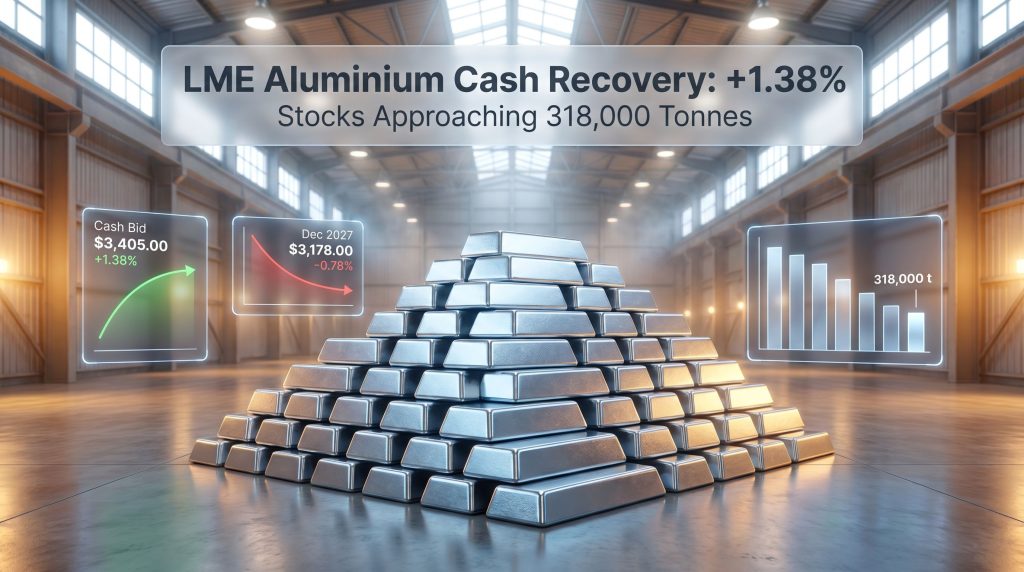
| Cash Bid | $3,358.50 | $3,405.00 | +1.38% |
| Cash Offer | $3,359.00 | $3,405.50 | +1.38% |
| 3-Month Bid | $3,388.50 | $3,408.00 | +0.58% |
| 3-Month Offer | $3,389.50 | $3,410.00 | +0.60% |
| Asian Reference (3M) | $3,388.50 | $3,410.50 | +0.65% |
| Dec 2027 Bid | $3,203.00 | $3,178.00 | -0.78% |
| Dec 2027 Offer | $3,208.00 | $3,183.00 | -0.78% |
The divergence embedded in this table is instructive. Cash prices gained 1.38% in a single session, outpacing the three-month contract's 0.58-0.60% gain. Meanwhile, December 2027 contracts fell by 0.78%. This is not a contradictory signal; it is a coherent one. Immediate physical metal is scarce enough to command a stronger bid, while the market believes supply conditions two years out will be materially more relaxed.
The LME Asian Reference Price settling at $3,410.50 per tonne is particularly worth noting. This price is calculated during Asian trading hours and serves as a benchmark for regional physical premiums across Japan, South Korea, and Southeast Asian markets. Its 0.65% gain relative to the prior session suggests that downstream demand in Asia is actively supporting prices during a period when Western trading desks might otherwise be pulling back. For broader context on LME aluminium price data, the exchange publishes daily settlement figures that underpin physical transactions globally.
How Far Prices Have Fallen From the 2026 Peak
Context matters enormously when interpreting a single-session price recovery. The June 17 rebound to the $3,405-$3,410 range follows a significant correction from the market's recent high.
LME aluminium cash prices reached a four-year high of approximately $3,795.50 per tonne on 1 June 2026, before retreating to around $3,498.50 per tonne by mid-June, representing a correction of roughly 8% in under two weeks. The partial recovery back toward the $3,405-$3,410 range signals the market is finding an interim floor rather than resuming a sustained downtrend.
This kind of sharp pullback from a multi-year high is common in commodity markets and does not automatically signal a structural shift in demand. Several dynamics help distinguish technical correction from fundamental deterioration:
- Speculative positioning unwinding after an aggressive rally frequently produces sharp short-term price retreats without any change in physical fundamentals.
- Options expiry and margin calls on leveraged long positions can amplify selling pressure during corrective phases, overstating the degree of fundamental pessimism.
- Physical offtake continuing at pace even as financial participants reduce exposure is consistent with what the inventory data is currently showing.
The LME aluminium market has experienced multiple cycles of this type. The 2021-2022 energy crisis triggered a rally to above $3,800 per tonne before a subsequent correction, and the market's longer-term trend has consistently been shaped more by smelter cost structures and bauxite supply dynamics than by short-term financial flows. In addition, aluminium tariff impacts introduced in recent years have added complexity to how price corrections unfold across different regions.
Why LME Aluminium Inventories Keep Falling
The Drawdown in Numbers
The inventory picture across the most recent tracking period tells a story of sustained physical absorption:
| Date | Opening Stock (tonnes) | Cancelled Warrants (tonnes) | Live Warrants (tonnes) |
|---|---|---|---|
| Recent High (approx.) | ~338,000 | – | – |
| 11 June 2026 | 322,000 | – | – |
| 16 June 2026 | 319,500 | 70,400 | 247,600 |
| 17 June 2026 | 318,000 | 68,925 | 247,600 |
Total LME aluminium stocks have declined from approximately 338,000 tonnes at a recent high to 318,000 tonnes as of June 17, a reduction of roughly 20,000 tonnes over a relatively short period. On June 17 alone, opening stocks fell by 1,500 tonnes or 0.47% day-on-day.
What makes this drawdown particularly notable is the behaviour of live warrants. They held steady at 247,600 tonnes even as total stocks declined and cancelled warrants fell from 70,400 to 68,925 tonnes (a 2.1% reduction). This relationship reveals important structural information:
- The decline in cancelled warrants does not mean withdrawal demand has eased; it means some of the previously earmarked metal has already physically left LME warehouses.
- Live warrants remaining unchanged suggests no new metal is being deposited to replace what is leaving.
- The ratio of cancelled warrants to total stock remains elevated, meaning the pipeline of imminent withdrawals continues to pressure headline inventory figures.
What Is Pulling Metal Out of Warehouses?
Several converging forces drive the ongoing drawdown in LME aluminium stocks.
Regional premium arbitrage is one of the most powerful and least discussed mechanisms. When physical aluminium premiums in regions like Japan, Europe, or the US Midwest widen relative to the LME cash price, it becomes financially rational for traders to withdraw metal from LME warehouses, ship it to premium-paying destinations, and capture the spread. This physical arbitrage is invisible in LME price data alone but shows up unmistakably in the warrant cancellation figures.
Downstream demand from key consuming industries including automotive manufacturing, construction, and flexible packaging has maintained resilience in key markets. Aluminium's role as a lightweighting material in electric vehicle production creates a structural demand floor that did not exist in previous cycles. Each electric vehicle platform uses significantly more aluminium than its internal combustion equivalent, which means EV production ramp-ups directly translate into sustained physical demand for primary metal.
Chinese production dynamics add another layer of complexity. China accounts for more than 55% of global primary aluminium output, and any disruption to smelter operations due to hydropower availability, environmental compliance cycles, or energy cost pressures can rapidly tighten global exchange-accessible supply. Metal that might otherwise flow into LME-certified warehouses instead gets absorbed by China's domestic fabrication sector, reducing the replenishment rate for exchange stocks globally.
Is a Falling Inventory Bullish or Bearish?
In commodity markets, the direction of exchange inventories and the direction of prices must be read together, not in isolation. Declining inventories alongside stable or rising prices indicate that physical demand is absorbing available supply faster than new production can replace it. This is structurally different from a scenario where both prices and inventories fall, which would signal genuine demand destruction.
The current LME aluminium situation fits the bullish inventory drawdown template, but two divergent scenarios are possible from here:
Scenario A: Continued drawdown with price support (Bullish)
- Physical tightness persists through Q3 2026 as seasonal demand in construction and automotive sectors peaks.
- Regional premiums widen further as spot availability in LME-certified locations shrinks.
- The cash-to-three-month spread maintains a backwardation structure, incentivising physical holders to capture premium rather than carry metal.
- LME stocks approaching or breaching psychological thresholds below 300,000 tonnes could trigger accelerated short-covering.
Scenario B: Inventory stabilisation triggers a price ceiling (Neutral to Bearish)
- New primary production volumes from Middle Eastern smelter expansions or Chinese output recovery restock exchange warehouses.
- Demand softness in the construction sector, particularly in European markets facing high financing costs, reduces offtake.
- Long-dated contracts already pricing in supply normalisation: the December 2027 contract trading at approximately $3,178-$3,183 per tonne implies the market expects a $225-$230 per tonne discount to current cash prices within 18 months.
The December 2027 contango is the market's built-in hedge against present bullishness. It signals that professional participants believe current tightness is cyclical, not permanent, and that supply eventually catches up. Investors and procurement teams ignoring this signal risk overpaying for forward cover. Consequently, among the top aluminium producers, strategic responses to this cycle vary considerably depending on their cost positions and hedging arrangements.
The next major ASX story will hit our subscribers first
What LME Alumina Prices Reveal About Upstream Costs
The LME alumina Platts price settling at $307.48 per tonne on June 17, up from $305.57 per tonne, represents a 0.63% single-session gain that warrants attention beyond its surface simplicity.
Alumina is the intermediate product refined from bauxite ore before being smelted into primary aluminium. Approximately four to five tonnes of bauxite are required to produce two tonnes of alumina, which in turn yields roughly one tonne of primary aluminium. This ratio means that movements in alumina pricing amplify through the value chain disproportionately.
The alumina-to-aluminium price ratio serves as an early warning system for smelter margin compression. When alumina prices rise faster than aluminium prices, smelter profitability tightens, which can eventually lead to production curtailments that feed back into tighter primary aluminium supply. Conversely, when aluminium prices outpace alumina costs, smelter margins improve and production incentives strengthen.
A less commonly discussed aspect of the alumina market is the management of bauxite residue, also known as red mud. For every tonne of alumina produced, approximately 1.0 to 1.5 tonnes of highly alkaline red mud is generated as a byproduct. The cost and regulatory complexity of residue storage increasingly affects the full-cycle cost of alumina production, particularly in regions with stringent environmental regulations. Furthermore, interest in low-carbon metals production is reshaping how refiners account for these sustainability costs over the long term.
Price Transmission Through the Aluminium Value Chain
The LME price is not the price that any single buyer actually pays for aluminium. It is the benchmark upon which all physical transactions are priced. Understanding price transmission requires mapping how LME movements flow through each layer of the supply chain:
| Supply Chain Stage | How LME Price Feeds Through | Key Variable |
|---|---|---|
| Primary smelter | LME cash price minus production cost = smelter margin | Energy cost per tonne |
| Trader/warehouse | LME + regional premium = physical delivery price | Regional supply balance |
| Downstream fabricator | Physical price + conversion premium = input cost | Order book visibility |
| End-user manufacturer | Fabricated product price + supply chain hedge | Contract duration |
For automotive OEMs and construction firms operating on multi-quarter procurement cycles, a 1.38% single-session price movement may appear insignificant. However, compounded across annual volumes measured in thousands of tonnes, the cumulative impact of sustained price recovery directly affects product cost structures and competitive positioning.
The Carbon Border Dimension
The European Union's Carbon Border Adjustment Mechanism (CBAM) introduces an additional cost layer that is reshaping how aluminium buyers in Europe evaluate LME-priced imports. Under CBAM, importers of aluminium into the EU must account for the embedded carbon content of their purchases, paying a carbon price on any gap between the emissions intensity of imported metal and EU domestic production standards.
For high-carbon aluminium produced using coal-powered smelters, particularly from certain Central Asian and Chinese producers, the effective landed cost in Europe is now meaningfully higher than the LME cash price plus regional premium alone would suggest. This creates a structural premium for low-carbon aluminium from hydropower-intensive smelters in Norway, Iceland, Canada, and parts of the Middle East. Initiatives such as aluminium operations repowering are directly relevant here, as producers transitioning to renewable energy improve their competitive standing under CBAM. The mechanism therefore does not simply add cost; it restructures competitiveness across the entire global supply base.
Frequently Asked Questions: LME Aluminium Price and Inventory Decline
What does it mean when LME aluminium inventories fall while prices rise?
It indicates that physical demand is actively withdrawing metal from exchange-accessible storage faster than new production is depositing replacement metal. This is typically a constructive signal for prices in the near term.
What is the difference between live warrants and cancelled warrants?
Live warrants represent metal available for delivery against an LME contract. Cancelled warrants represent metal that has been earmarked for physical removal but has not yet left the warehouse. Cancelled warrants are a leading indicator of future inventory declines.
Why do long-dated LME aluminium futures trade at a discount to spot prices?
When long-dated contracts trade below spot, the market is in backwardation, reflecting an expectation that near-term tightness will ease as new supply enters the market. The December 2027 contract trading approximately $225 per tonne below current cash levels reflects exactly this forward-looking assessment.
How does the LME Asian Reference Price differ from the standard three-month contract?
The Asian Reference Price is calculated during Asian trading hours and serves as a benchmark for physical aluminium transactions across East and Southeast Asian markets. It reflects regional demand conditions and is often used in Japanese quarterly premium negotiations.
What level of LME aluminium inventory is considered critically low?
While no universal threshold exists, market participants generally regard LME aluminium stocks below 200,000 tonnes as indicative of genuine physical stress. The current level of approximately 318,000 tonnes is declining but not yet at critical levels historically associated with significant supply disruption premiums.
How quickly can LME aluminium stocks be replenished if prices rise sufficiently?
New primary aluminium production requires substantial lead time, but metal already in transit or held off-warrant can be deposited into LME-certified warehouses relatively quickly. Typically, a sustained premium of sufficient magnitude above all-in production costs can begin attracting new warrant registrations within weeks to months, depending on logistics and certification requirements.
Key Takeaways for Market Participants
The combination of a 1.38% single-session cash price recovery, total LME stocks declining toward 318,000 tonnes, and a 2.1% reduction in cancelled warrants collectively points to a market engaged in active physical absorption rather than one drifting into structural oversupply. The simultaneous softening of December 2027 contracts by 0.78% confirms that the market views current tightness as cyclical rather than permanent.
For traders and speculators: Near-term price momentum is supported by physical drawdown dynamics, but the negative carry implied by long-dated contango sets a ceiling on how aggressively the market can reprice. Momentum strategies carry elevated reversal risk if Chinese production data surprises to the upside.
For physical buyers and procurement teams: The combination of falling LME stocks and a four-year price high reached just weeks ago creates a challenging environment for spot purchasing. Buyers with the contractual flexibility to lock in volumes at current levels may find the risk-reward more favourable than waiting for a price normalisation that long-dated contracts suggest is 12 to 18 months away.
For producers and smelters: The margin environment at current cash prices around $3,405 per tonne is supportive for most low-to-mid cost producers, particularly those with alumina supply secured below spot market levels. The rising alumina price at $307.48 per tonne is a monitoring point, but the alumina-to-aluminium ratio remains within ranges that preserve meaningful smelter profitability for efficient operators.
The LME aluminium price and inventory decline story in mid-June 2026 is ultimately one of structural tension: a physically tight present being priced against an expected future where supply catches up. How quickly that catch-up materialises will determine whether the June 1 peak of $3,795.50 per tonne was the beginning of a new sustained range or the high-water mark of a cycle already turning. For ongoing historical price data and trend analysis, West Metal's LME aluminium tables provide a comprehensive reference for tracking cash price movements over time.
Want To Capitalise on the Next Major ASX Mineral Discovery Before the Broader Market?
Discovery Alert's proprietary Discovery IQ model delivers real-time alerts on significant ASX mineral discoveries, transforming complex data across more than 30 commodities into clear, actionable insights for both traders and long-term investors — explore historic discoveries and their extraordinary returns to understand what early positioning can mean, then begin your 14-day free trial at Discovery Alert to secure your market-leading edge.