July 17, 2026
Ontario's LCT Pegmatite Belt and the Science of Finding World-Class Lithium
Lithium exploration in hard-rock terrains operates according to a fundamentally different logic than most investors realise. Unlike gold, where high-grade surface grab samples translate relatively directly into mineralisation potential, spodumene-bearing pegmatites require a more nuanced geochemical reading. The fertility of a lithium pegmatite system is often best understood not from lithium concentrations alone, but from a suite of trace elements that fingerprint how far a granitic magma has evolved during crystallisation. This distinction sits at the heart of what Critical Resources Ltd (ASX: CRR) has uncovered at the Mavis Lake Lithium Project in Ontario, Canada, and it explains why the Critical Resources Mavis Lake lithium drill targets carry considerably more weight than a surface headline grade might suggest.
Ontario's Superior Province is one of the world's most geologically productive settings for lithium-caesium-tantalum pegmatites, a deposit classification abbreviated in exploration geology as LCT. These pegmatites form through a process of magmatic differentiation, where granitic melts progressively concentrate incompatible elements, including lithium, caesium, rubidium, and tantalum, into late-stage crystalline bodies. The more extreme this differentiation process, the more enriched the resulting pegmatite becomes in economically important minerals like spodumene, the primary lithium silicate ore mineral targeted by hard-rock vs brine lithium producers globally.
When big ASX news breaks, our subscribers know first
How Geochemists Identify a Fertile Lithium Pegmatite
The LCT Classification System and Magmatic Fractionation
Understanding why certain pegmatites host economic lithium concentrations while others do not requires grasping the concept of fractional crystallisation. As a granitic magma cools and minerals precipitate, the remaining melt becomes progressively enriched in elements that don't easily fit into early-forming crystal structures. Lithium, rubidium, caesium, and tantalum behave this way, accumulating in the residual melt until the final crystallisation stage produces a coarse-grained, mineralogically complex pegmatite.
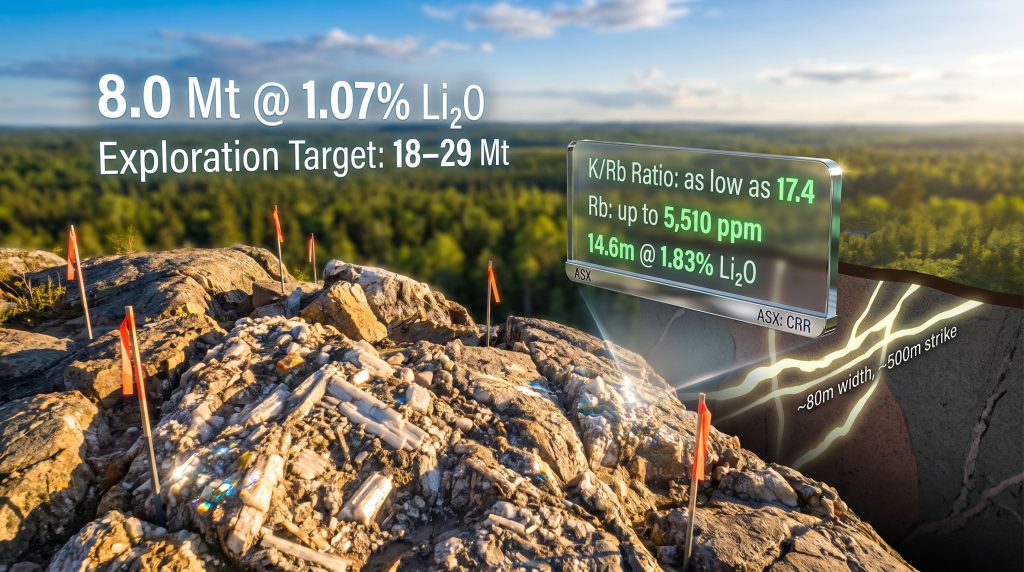
The degree of this evolution is measurable through the ratio of potassium to rubidium (K/Rb). In relatively primitive, unfractionated granites, this ratio is typically high, often exceeding 150 to 200. As differentiation proceeds, rubidium preferentially partitions into the melt relative to potassium, driving the ratio progressively lower. Exploration geologists widely regard a K/Rb ratio below approximately 20 as a definitive marker of a highly evolved LCT system, one with genuine potential to host economic spodumene mineralisation at depth.
Key Geochemical Indicators and What the Mavis Lake Results Mean
The 2026 field program at Mavis Lake returned whole-rock geochemistry that clearly satisfies the most stringent fractionation criteria used in LCT exploration. The significance of each indicator is summarised below:
| Geochemical Indicator | Exploration Significance | Mavis Lake Northern Prospects Result |
|---|---|---|
| Potassium-to-Rubidium (K/Rb) Ratio | Values below 20 indicate highly evolved LCT system | As low as 17.4 |
| Rubidium (Rb) concentration | Elevated values confirm advanced fractionation | Up to 5,510 ppm |
| Caesium (Cs) concentration | Diagnostic of LCT pegmatite classification | Up to 221 ppm |
| Tantalum (Ta) concentration | Confirms tantalum enrichment typical of LCT systems | Up to 53 ppm |
Technical Insight: A K/Rb ratio of 17.4 places the Northern Prospects firmly within the upper tier of globally documented LCT pegmatite fractionation signatures. For context, many economically productive Canadian lithium pegmatites, including those in the James Bay region of Quebec, share comparable or only marginally lower ratios at their most evolved zones.
Why Low Surface Lithium Grades Are Not a Red Flag
A counterintuitive but critically important aspect of LCT exploration is that surface grab samples from pegmatite margins frequently return subdued lithium values, even in systems that ultimately prove highly economic at depth. This occurs because:
- Spodumene crystals tend to concentrate in the core zones of evolved pegmatites, not at their margins or contacts with host rock
- Surface sampling campaigns often deliberately target non-spodumene-bearing zones to assess the broader geochemical fertility signature
- Weathering and alteration at surface can transform primary spodumene into secondary lithium-bearing clays, obscuring the primary mineralisation signal
- Pathfinder elements such as rubidium, caesium, and tantalum are far more uniformly distributed across a pegmatite body than spodumene itself
Furthermore, spodumene extraction from core zones typically yields far better grade outcomes than margin sampling would suggest. Drilling remains the only method capable of intersecting these core zones where spodumene concentrations, and therefore lithium grades, reflect the true economic potential of the system. This is precisely why the Critical Resources Mavis Lake lithium drill targets now carry such strategic importance following the Northern Prospects geochemical confirmation.
Inside the 2026 Mavis Lake Field Program
Systematic Coverage of the Northern Corridor
The 2026 field campaign was structured as a 10-day systematic reconnaissance of the Corona Pegmatite Field and the adjacent Northern Prospects Area, located approximately 4 kilometres north of Mavis Lake's existing mineral resource. The program generated a substantial dataset from a previously undercharacterised part of the project:
- 106 representative whole-rock samples collected across 14 distinct pegmatite bodies
- 6 previously unrecognised pegmatite occurrences identified within the northern claim package
- 161 outcrop observations recorded across the survey area
- 74 structural measurements captured to define pegmatite orientation and host rock controls
This level of systematic coverage transforms what was previously a conceptual exploration target into a data-rich environment suitable for quantitative drill target ranking.
Fractionation Ranking Across the Project
One of the most practically valuable outcomes of the program was establishing a comparative fractionation hierarchy across different parts of the Mavis Lake tenure. This ranking directly determines where limited exploration capital should be deployed first.
| Project Area | Fractionation Level | Exploration Priority | Key Observation |
|---|---|---|---|
| Northern Prospects (northern claims) | Highly fractionated | Priority 1 – drill targeting | Acquired August 2025; strongest geochemical signature |
| Corona Pegmatite Field | Slight to moderate fractionation | Priority 2 – further mapping | Lower fractionation; warrants continued but secondary focus |
The fact that the strongest geochemical signals are concentrated within claims acquired as recently as August 2025 is a particularly noteworthy outcome. It demonstrates that disciplined, geologically motivated land package expansion can rapidly generate high-quality exploration targets rather than simply adding speculative acreage.
The geological vector identified through the 2026 program is also meaningful: the most prospective pegmatites appear to be spatially associated with granitic host rocks within the northern claim area. This structural relationship provides an interpretive framework for prioritising future mapping and drilling, allowing exploration teams to focus mechanised stripping and scout drilling on the most geologically favourable corridors.
The Critical Resources Mavis Lake Lithium Drill Target Portfolio
How the 28 Drill Targets Were Generated
The translation of surface geochemistry into a ranked drill target list follows a multi-dataset integration process that draws on five distinct information streams:
- Geochemical fertility screening – K/Rb ratios, pathfinder element concentrations, and spatial distribution of fractionation anomalies
- Structural interpretation – pegmatite orientation, dip measurements, and relationship to host rock lithology
- Geophysical correlation – identifying subsurface continuity and geometry beyond the limits of surface outcrop
- Historical data reconciliation – integrating legacy drilling results and historical assay records with modern datasets
- Final target ranking and drill-hole planning – prioritising targets by technical merit and accessibility for the approved drilling program
In addition, 3D geological modelling plays an increasingly important role in refining how these datasets are integrated into coherent subsurface interpretations. This methodology has produced a portfolio of 28 identified lithium drill targets across the project, with 11 classified as high-priority based on the combined litho-structural and geophysical interpretation.
The Priority Drill Target Breakdown
| Target | Priority Tier | Exploration Target | Li₂O Grade Range | Current Status |
|---|---|---|---|---|
| Tot Pegmatite | High – drill-ready | 3 to 5 Mt | 0.8 to 1.2% | Fully permitted; surface spodumene confirmed |
| Gullwing | High – drill-ready | 7 to 10 Mt | 0.3 to 1.2% | ~80m width, ~500m strike; drilling to ~200m depth |
| Main Zone Extension | Infill and expansion | 8 to 14 Mt | 1.0 to 1.2% | Building on 8.0 Mt @ 1.07% Li₂O inferred resource |
| Pegmatite 9 | High priority – untested | Not yet defined | Not yet defined | Surface spodumene mapped; no drilling completed |
| Little Wing, Coates, Drope, Corona | Priority follow-up | Not yet defined | Not yet defined | 6 new pegmatite bodies identified in 2026 program |
The Gullwing pegmatite represents the largest standalone exploration target on the project at 7 to 10 Mt at 0.3 to 1.2% Li₂O. Its physical dimensions of approximately 80 metres width and 500 metres of mapped strike length support a substantial drilling campaign targeting depths of around 200 metres. At this scale, Gullwing alone could contribute meaningfully to any future resource update, particularly if drilling confirms grade continuity through the pegmatite core zones.
The Tot Pegmatite carries a slightly smaller but higher-confidence exploration target of 3 to 5 Mt at 0.8 to 1.2% Li₂O, with the advantage of confirmed surface spodumene mineralisation and full permit status. The 2026 drilling program represents the first time this target will be tested by diamond core drilling, making it one of the most significant near-term catalysts for the Mavis Lake lithium project.
Mavis Lake's Resource Base Versus Its Exploration Upside
The Scale Gap Between Current Resources and Exploration Targets
The contrast between Mavis Lake's current JORC-compliant inferred resource and the project-wide exploration target illustrates the scale of potential value creation that systematic drilling could unlock:
| Metric | Current Status |
|---|---|
| Inferred Mineral Resource | 8.0 Mt at 1.07% Li₂O |
| Project-Wide Exploration Target | 18 to 29 Mt at 0.8 to 1.2% Li₂O |
| Gullwing Standalone Target | 7 to 10 Mt at 0.3 to 1.2% Li₂O |
| Tot Pegmatite Target | 3 to 5 Mt at 0.8 to 1.2% Li₂O |
| Main Zone Extension Target | 8 to 14 Mt at 1.0 to 1.2% Li₂O |
| Recent High-Grade Drill Intercept | 14.6m at 1.83% Li₂O (MF24-267, Main Zone) |
Investor Note: Exploration targets are conceptual in nature and are insufficient to define a mineral resource under the JORC Code. They should not be relied upon as a definitive estimate of mineralisation. Converting these targets to JORC-compliant resources requires systematic drilling and geological modelling that remains in progress.
The gap between the 8.0 Mt inferred resource and the 18 to 29 Mt exploration target implies a potential two to three-fold expansion in total project tonnage if drilling successfully converts exploration targets to mineral resources. The recent high-grade intercept of 14.6 metres at 1.83% Li₂O from drill hole MF24-267 in the Main Zone confirms that the existing resource contains zones of above-average grade not yet fully captured by the current resource model.
The 2026 Summer Drilling Campaign Objectives
With 8,617 metres completed of an approved 10,000-metre program as of the most recent reporting period, the 2026 drilling campaign has clear technical objectives across multiple target areas:
- First-ever diamond drill testing of the Tot pegmatite in the Northern Prospects Area
- Infill drilling in the Main Zone at 50-metre spacing to support upgrades from inferred to indicated resource categories
- Testing approximately 3 kilometres of potential strike length toward Pegmatite 18
- Advancing the information base needed to support a JORC-compliant resource that reflects the broader exploration target range
Mavis Lake Within Canada's Hard-Rock Lithium Landscape
The Competitive Advantages of Ontario-Hosted LCT Projects
Hard-rock spodumene projects occupy a structurally different position in the global lithium supply chain compared to brine-hosted deposits in South America's lithium triangle. Techniques such as direct lithium extraction are reshaping brine processing, however spodumene concentrate from pegmatite operations can be processed through established chemical conversion pathways to produce battery-grade lithium hydroxide, the preferred precursor for high-nickel cathode chemistries used in electric vehicle batteries.
Ontario specifically offers several characteristics that matter to exploration-stage project development:
- Established regulatory framework with defined permitting pathways for junior mining companies
- Existing infrastructure including road access and grid power in many parts of the province
- Skilled geoscience workforce concentrated in mining centres including Thunder Bay and Sudbury
- Geological productivity underpinned by the Superior Province's Archean basement, which hosts some of Canada's most significant pegmatite-hosted lithium mineralisation
Why North American Supply Chain Dynamics Matter for Project Economics
The broader context for lithium exploration in Ontario is shaped by accelerating North American battery manufacturing investment, with gigafactory capacity under construction or in planning across the United States and Canada. The structural preference for regionally sourced, traceable critical minerals creates a commercial environment in which Canadian hard-rock lithium projects with genuine scale potential attract genuine strategic interest, though this should be understood as a macro sector dynamic rather than any project-specific advantage or government designation.
The next major ASX story will hit our subscribers first
Frequently Asked Questions: Critical Resources Mavis Lake Lithium Drill Targets
What is the Mavis Lake Lithium Project?
Mavis Lake is a 100% owned hard-rock lithium project in Ontario, Canada, operated by Critical Resources Ltd (ASX: CRR). It holds an inferred mineral resource of 8.0 Mt at 1.07% Li₂O and a project-wide exploration target of 18 to 29 Mt at 0.8 to 1.2% Li₂O across multiple pegmatite bodies.
What geochemical results confirmed the Northern Prospects as the top priority?
Whole-rock sampling returned K/Rb ratios as low as 17.4, rubidium values up to 5,510 ppm, caesium up to 221 ppm, and tantalum up to 53 ppm. These figures are collectively consistent with highly evolved LCT pegmatite systems and place the Northern Prospects above the Corona Field in the project's fractionation ranking.
How many drill targets has Critical Resources identified at Mavis Lake?
The company has delineated 28 lithium drill targets across the project, of which 11 are classified as high-priority based on integrated litho-structural and geophysical interpretation. Consequently, interpreting drill results from this campaign will be central to determining the next phase of resource development.
Why were lithium values low in the surface grab samples?
Sampling was strategically focused on pegmatite margins and zones lacking visible spodumene. This approach is standard practice in LCT fertility screening because pathfinder elements provide a more reliable indicator of system evolution than grab-sample lithium grades, which are heavily dependent on sample location within the pegmatite architecture.
What is the status of the 2026 drilling program?
As of the most recent reporting period, 8,617 metres of an approved 10,000-metre campaign has been completed, with ongoing drilling targeting the Tot pegmatite and Main Zone infill objectives. Critical Resources' project portfolio provides further detail on the broader suite of assets under exploration.
Near-Term Catalysts and the Long-Term District Development Vision
Milestones Worth Monitoring in the 2026 Exploration Cycle
Several catalysts have the potential to materially shift the technical understanding of Mavis Lake over the coming months:
- Tot pegmatite drill results representing the first systematic diamond drilling of this target
- Completion of the 10,000-metre approved drilling program and subsequent resource modelling update
- Integration of 2026 geochemical assays with geophysical and structural datasets to produce the refined ranked target list
- Mechanised stripping and scout drilling across Gullwing, Little Wing, Coates, Drope, and Corona pegmatite bodies
- Potential maiden resource incorporation of Northern Prospects data into a revised JORC-compliant estimate
Building a Multi-Deposit Lithium District
The strategic logic underpinning Critical Resources' approach to Mavis Lake centres on a multi-deposit district development model rather than single-pegmatite optimisation. The named targets across the northern corridor, including Gullwing, Tot, Little Wing, Coates, Drope, and Corona, represent the foundation of an exploration pipeline designed to progressively convert the 18 to 29 Mt exploration target into a defined resource base.
Managing director Tim Wither has described the 2026 field program as having successfully identified the most prospective targets for the next phase of exploration, with granitic-hosted pegmatites displaying geochemical characteristics consistent with highly evolved LCT systems forming the clear framework for drill targeting and follow-up prospecting across the northern Mavis Lake corridor.
The project's near-term trajectory will be shaped by how efficiently drilling can resolve the key unknowns: grade continuity at depth in previously untested targets, the true three-dimensional geometry of the Gullwing system, and whether the newly identified Northern Prospects pegmatites deliver the spodumene-bearing core zones that their fractionation signatures suggest are present. Each drill result has the potential to either validate or recalibrate the current exploration model, making the coming months a technically important period for the Critical Resources Mavis Lake lithium drill targets and the broader Mavis Lake project.
This article contains references to exploration targets that are conceptual in nature. There has been insufficient exploration to define a mineral resource for these targets, and it is uncertain whether further exploration will result in the determination of a mineral resource. This article does not constitute financial advice. Readers should conduct their own due diligence before making any investment decisions.
Want to Be First When the Next Major Lithium Discovery Hits the ASX?
Discovery Alert's proprietary Discovery IQ model scans ASX announcements in real time, instantly identifying significant mineral discoveries — including hard-rock lithium pegmatite projects — and delivering actionable alerts before the broader market has time to react. Explore how historic discoveries have generated extraordinary returns on Discovery Alert's dedicated discoveries page, then begin your 14-day free trial to position yourself ahead of the next major find.