July 17, 2026
When the Geological Floor Drops: Understanding Basement Copper in Northern Chile
Conventional wisdom in manto copper exploration has long treated the base of the sedimentary host column as the practical limit of economic interest. For decades, the industry's mental model of these systems placed the floor of mineralisation at the transition between the sedimentary sequence and the underlying basement complex. Understanding Marimaca Copper Pampa Medina basement mineralisation, and what happens when that assumption proves wrong, has significant consequences — not just for individual projects, but for how the entire deposit class is understood and valued.
Northern Chile's Antofagasta Region hosts some of the world's most important sediment-hosted copper systems, and the geological architecture across this belt is now being reread through a more expansive lens. The emergence of basement-hosted copper intersections at Pampa Medina, the sulphide-dominant project operated by Marimaca Copper (TSX: MARI | ASX: MC2), is one of the more consequential developments reshaping that reading. Broader copper market trends suggest that discoveries of this nature will attract increasing attention from major producers and investors alike.
When big ASX news breaks, our subscribers know first
The Mechanics of Manto Systems and Why Basement Contacts Were Overlooked
Manto-style copper deposits form when copper-bearing hydrothermal fluids migrate laterally through permeable sedimentary horizons, precipitating sulphide or oxide minerals where favourable redox, temperature, or structural conditions exist. The term manto is Spanish for blanket or sheet, reflecting the tabular, stratabound geometry these mineralised zones typically adopt.
Historically, exploration targeting in manto systems has followed the sedimentary architecture upward and outward, chasing permeable beds, tuff horizons, and carbonaceous shale contacts within the defined column. The basement contact beneath these sequences was treated as a boundary condition rather than a prospective domain, primarily because:
- Basement metamorphic rocks were assumed to lack the permeability required for lateral fluid migration.
- Most copper precipitation models focused on redox boundaries within the sedimentary pile rather than structural traps in the basement.
- Drilling programmes were designed to delineate known hosts, not to test lithologies beneath them.
This created a systematic blind spot. When basement units carry their own structural permeability through fracturing, faulting, or original sedimentary fabric preserved through low-grade metamorphism, they can act as both conduit and trap for mineralising fluids. Furthermore, the mineral exploration importance of testing previously ignored lithological boundaries is precisely what has yielded this new frontier at Pampa Medina.
Pampa Medina's Three-Unit Stratigraphic Architecture
The geological column at Pampa Medina is composed of three distinct units, each representing a different metallurgical and exploration opportunity.
| Stratigraphic Unit | Rock Types | Mineralisation Domain | Previous Target Status |
|---|---|---|---|
| Upper Andesitic Volcanics | Volcanic flows, tuffs | Oxide (atacamite, chrysocolla, azurite) | Active target |
| Middle Rencoret Sediments | Sandstones, shales, conglomerates, tuffs | Primary sulphide (bornite, chalcopyrite) | Primary target |
| Upper Paleozoic Basement | Metasediments, meta-volcanics, intrusions | Sulphide (bornite, chalcopyrite) | Newly confirmed |
The oxide assemblage in the upper volcanic unit, comprising atacamite, chrysocolla, azurite, and secondary chalcocite, reflects near-surface oxidation of a previously deeper sulphide system. The primary sulphide assemblage in the Rencoret unit, dominated by bornite and chalcopyrite with variable covellite, chalcocite, and pyrite, is characteristic of high-temperature, copper-rich hydrothermal mineralisation. Bornite, in particular, carries a copper content of approximately 63% by weight, making bornite-dominant intervals among the highest-grade copper mineral assemblages in primary sulphide systems.
Post-mineral dykes oriented west-northwest intrude all three units, creating barren intervals between mineralised zones. These dykes are a critical interpretive consideration: their presence between economic-grade intersections does not signal absence of mineralisation, but rather structural disruption of a broader continuous system. Post-mineral normal faulting further complicates the geometric reconstruction of the deposit.
The Oxide-Sulphide Vertical Stack: A Rare Configuration
One of the less-discussed but geologically significant features of Pampa Medina is the vertical coexistence of a near-surface oxide horizon directly above a deep primary sulphide system. This configuration is relatively uncommon across the Chilean copper belt, where most manto deposits are predominantly one domain or the other.
The stacked oxide-sulphide geometry introduces meaningful optionality for future development planning, including the potential for phased extraction beginning with the shallower, simpler oxide zone while the deeper primary resource is further delineated.
Drill Hole SPRD-08B: What the Deepest Drilling Returned
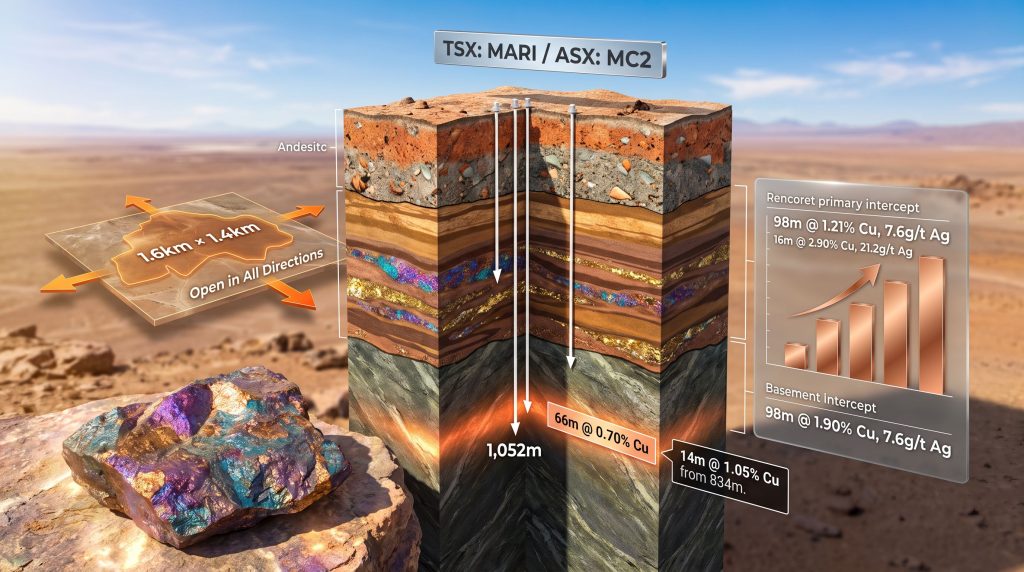
The July 2026 step-out results included results from the deepest drilling completed at Pampa Medina to date, with one hole reaching a total depth of 1,052 metres. Collared approximately 150 metres south of reference hole SMRD-16, the drill profile tracked mineralisation through all three stratigraphic units on its descent.
Key Intercept Summary: SPRD-08B
| Domain | From (m) | Interval (m) | Cu Grade | Ag Grade | Notes |
|---|---|---|---|---|---|
| Mixed Domain | 386m | 98m | 1.21% Cu | 7.6g/t Ag | Includes high-grade bornite manto |
| High-Grade Sub-Interval | ~386m | 16m | 2.90% Cu | 21.2g/t Ag | Peak grade within mixed domain |
| Basement Metasediments | 802m | 66m | 0.70% Cu | Not reported | First basement intersection |
| Basement High-Grade Sub-Interval | 834m | 14m | 1.05% Cu | Not reported | Within basement unit |
The 16-metre sub-interval grading 2.90% copper and 21.2g/t silver within the mixed domain is particularly notable. In the context of bulk-tonnage manto systems, intersections exceeding 2% copper over meaningful widths are exceptional, typically reflecting the core of a bornite-dominant mineralised sheet rather than peripheral or transitional grades. Those interpreting drill results of this calibre should weigh both the grade and the geological context carefully.
The basement intersection itself — 66 metres at 0.70% copper from 802 metres depth, including 14 metres at 1.05% copper from 834 metres — may appear modest relative to the higher grades in the overlying sedimentary column. However, its geological significance lies not in its absolute grade but in what it confirms: economic-grade copper occurring in a lithological unit that had never previously been considered a target at this project. Cut-off grade economics will ultimately determine how much of this basement horizon contributes to a formal resource.
"The intersection of economic-grade copper in basement metasediments at depths exceeding 800 metres fundamentally alters the vertical extent of the Pampa Medina system. Prior resource models were constrained to the sedimentary column; the basement now represents an additive exploration frontier."
The Southern Step-Out: 300 Metres of Strike Confirmation
A separate hole collared 300 metres south of previously released drilling confirmed that the bornite-manto zone maintains both grade and width at distance from the known centre. Results from this step-out included:
- 30 metres at 1.26% copper and 2.6g/t silver from 440 metres depth
- 32 metres at 0.85% copper and 4.4g/t silver from 506 metres depth
- Multiple barren dyke intervals separating stacked manto horizons
- A deeper basement intersection at 1,006 metres depth: 6 metres at 1.05% copper and 8.3g/t silver
The silver credits in these intersections, while secondary to the copper value, are economically meaningful. At current silver prices, 8.3g/t silver over 6 metres represents a non-trivial byproduct contribution that improves the net smelter return per tonne compared to a copper-only calculation.
Cachorro and the District-Scale Geological Precedent
The most important contextual framework for interpreting the Marimaca Copper Pampa Medina basement mineralisation result comes from a nearby analogue deposit. Cachorro, a copper discovery owned by Antofagasta Minerals, is hosted primarily in basement tuffs and metasediments at the base of the Rencoret sedimentary sequence and extending downward into the metasediment package.
The stratigraphic equivalence between the two systems is direct.
| Feature | Cachorro (Antofagasta Minerals) | Pampa Medina (Marimaca Copper) |
|---|---|---|
| Primary Host Rock | Basement tuffs and metasediments | Metasediments (newly confirmed) |
| Stratigraphic Position | Base of Rencoret + into metasediments | Base of Rencoret + into metasediments |
| Mineralisation Style | Sediment-hosted sulphide | Sediment-hosted sulphide |
| Ownership | Antofagasta Minerals | Marimaca Copper (TSX: MARI / ASX: MC2) |
Cachorro is regarded within the district as a copper discovery of potentially significant scale. The fact that Pampa Medina's new basement intersection occupies an identical stratigraphic position provides geological justification for continued deep drilling. This is not a guarantee of equivalent scale, but it is a meaningful district-level precedent that transforms a speculative basement-targeting thesis into one grounded in a demonstrated nearby model.
Antofagasta Minerals is one of the world's largest copper producers, with operations and projects anchored in northern Chile's Antofagasta Region. Consequently, the fact that a tier-one copper producer holds a basement-hosted discovery in the same geological corridor as Pampa Medina is itself an important signal about the prospectivity of this stratigraphic setting. The large manto copper system now taking shape at Pampa Medina is being watched closely by industry observers for precisely this reason.
The Spatial Footprint: Scale Metrics and What Remains Open
Beyond the vertical dimension revealed by basement drilling, the lateral extent of the Pampa Medina system provides additional context for scale assessment.
- The high-grade sedimentary-hosted sulphide system currently spans approximately 1.6 kilometres by 1.4 kilometres in lateral extent.
- Economic widths and grades have been confirmed across more than 2 square kilometres of the footprint.
- The system remains open along strike, at depth, and laterally in all tested directions.
- Two drill rigs are actively extending the mineralised horizon along the northeast-southwest strike orientation.
- Current infill drilling is progressing at 150-metre by 150-metre spacing, moving toward the tighter delineation needed for resource estimation.
- The 30,000-metre step-out and delineation programme continues through 2026.
A mineralised footprint of this lateral dimension, combined with a now-confirmed vertical range extending from near-surface oxide mineralisation to basement sulphide intersections below 1,000 metres, places Pampa Medina in a category of deposit geometry that demands a full three-dimensional resource model rather than a simple tabular extrapolation.
The next major ASX story will hit our subscribers first
The Maiden MRE: A Baseline, Not a Ceiling
Marimaca Copper has targeted a maiden inferred Mineral Resource Estimate for Pampa Medina, designed to cover a relatively limited subset of the central area of the deposit. Understanding the scope of that estimate is essential for contextualising how it should be interpreted when released.
What the maiden MRE will include:
- Central area of the Pampa Medina deposit only
- Preliminary economics and mining method assessments
- Inferred resource category, reflecting the current drilling density
What the maiden MRE will not include:
- The full lateral extent of the mineralised system
- The basement metasediment horizon confirmed in July 2026
- Open strike extensions to the northeast and southwest
- Satellite targets including Mercedes, Robles, Cindy, and Madrugador
"A maiden MRE covering only the central area of Pampa Medina should be interpreted as a baseline, not a ceiling. The basement intersection, the open strike extensions, and the satellite oxide targets all represent incremental resource upside beyond the initial estimate."
For investors, the practical implication is that the maiden MRE establishes a minimum resource floor. Its primary utility is to enable financing discussions, partnership negotiations, and preliminary scoping work — not to represent the total economic potential of the system. In addition, resource additions from basement drilling, strike extensions, and satellite targets would all flow through subsequent resource updates. Those developing copper investment strategies should factor this staged resource-building approach into their assessments.
Satellite Targets and the Broader Sierra de Medina Land Package
The Pampa Medina central deposit sits within a much larger exploration holding. The Sierra de Medina land package encompasses 12 concessions owned by SCM Elenita, over which Marimaca Copper holds an option to acquire. This broader package provides a pipeline of exploration targets that extend the programme well beyond the current central delineation work.
Key targets within and adjacent to the Sierra de Medina package include:
- Madrugador — An oxide target within the Sierra de Medina package, earmarked for geophysical surveying and drill testing following completion of central delineation at Pampa Medina.
- Mercedes — A satellite oxide target situated in close proximity to the Marimaca Oxide Deposit, approximately 28 kilometres west of Pampa Medina.
- Robles — A second satellite oxide target in the same western cluster near the Marimaca Oxide Deposit.
- Cindy — A third satellite oxide target within the immediate Marimaca Oxide Deposit corridor.
The geographic separation between the eastern Pampa Medina sulphide system and the western oxide satellite targets near the Marimaca Oxide Deposit reflects the district-scale potential of the broader land package. Each target, furthermore, represents a distinct exploration opportunity with its own geological model and development pathway.
Frequently Asked Questions: Marimaca Copper Pampa Medina Basement Mineralisation
What is basement mineralisation, and why is it significant at Pampa Medina?
Basement mineralisation refers to copper intersections occurring within the Upper Paleozoic metamorphic basement rocks that sit beneath the primary Rencoret sedimentary host sequence. At Pampa Medina, this unit was previously considered outside the defined mineralisation targets. Confirming economic-grade copper in this horizon adds a new vertical dimension to the deposit, expanding the total prospective stratigraphy beyond the original geological model.
How deep did drilling reach to confirm the basement intersection?
The deepest hole drilled at Pampa Medina to date reached a total depth of 1,052 metres. The basement metasediment intersection commenced at 802 metres depth, returning 66 metres at 0.70% copper, including a higher-grade sub-interval of 14 metres at 1.05% copper from 834 metres.
What is bornite and why does its presence matter?
Bornite is a copper iron sulphide mineral containing approximately 63% copper by weight, making it one of the richest copper minerals found in primary sulphide systems. Bornite-dominant mineralisation is characteristic of high-temperature, high-grade copper deposits and its prevalence at Pampa Medina distinguishes the deposit from lower-grade chalcopyrite-only systems.
How does the Cachorro deposit relate to Pampa Medina's basement potential?
Cachorro, a copper deposit owned by Antofagasta Minerals, is hosted primarily in basement tuffs and metasediments at the base of the Rencoret sequence — the same stratigraphic position now confirmed as mineralised at Pampa Medina. The geological equivalence between the two settings provides a district-scale precedent for basement-hosted copper mineralisation.
What is the current size of the Pampa Medina mineralised footprint?
The high-grade sulphide system currently covers approximately 1.6 kilometres by 1.4 kilometres in lateral extent, with confirmed economic widths and grades across more than 2 square kilometres. The system remains open along strike, at depth, and laterally.
When is the maiden Mineral Resource Estimate expected, and what will it include?
The maiden inferred MRE is targeted as a snapshot of the central area of Pampa Medina, accompanied by preliminary economics and mining method assessments. It will not encompass the full deposit extent, including the newly confirmed basement horizon or the open strike extensions.
Key Takeaways: Marimaca Copper Pampa Medina Basement Mineralisation and What It Changes
The confirmation of copper mineralisation in the Upper Paleozoic basement metasediments at Pampa Medina represents a structural inflection point in how the deposit's scale potential is assessed. Prior to these results, the vertical extent of the system was understood to terminate at the base of the Rencoret sedimentary sequence. That constraint no longer applies.
- Three stratigraphic units are now confirmed as mineralised: upper volcanics, middle Rencoret sediments, and basement metasediments
- Basement intersection at 802 to 868 metres depth adds a new vertical dimension to the stacked manto model
- Southern step-out confirms bornite-manto continuity 300 metres beyond previously released drilling
- Cachorro analogue provides district-level geological precedent for basement-hosted copper at scale
- Mineralised footprint of 1.6km by 1.4km remains open in all directions
- 30,000-metre drill programme continuing through 2026 with two active rigs on strike extensions
- Maiden MRE represents a minimum baseline; basement and strike extensions sit outside initial scope
This article is for informational purposes only and does not constitute financial or investment advice. Mining exploration involves significant uncertainty, and drill results, resource estimates, and development timelines are subject to material risks and changes. Readers should conduct their own due diligence and consult a qualified financial adviser before making investment decisions.
Further context on Marimaca Copper's Pampa Medina project, including additional geological and investment perspectives, is available at Crux Investor.
Want to Be First When the Next Major Copper Discovery Hits the ASX?
Discovery Alert's proprietary Discovery IQ model scans ASX announcements in real time, instantly identifying significant mineral discoveries — including high-grade copper systems like those reshaping the northern Chile exploration landscape — and delivering actionable alerts directly to subscribers. Explore historic discoveries and the exceptional returns they've generated, then begin your 14-day free trial at Discovery Alert to position yourself ahead of the broader market.