
May 22, 2026
Croatia's approach to hydrocarbon permitting represents a distinctive model within this regional context, combining specialized petroleum legislation with multi-tiered approval mechanisms that separate technical oversight from strategic policy decisions. Understanding these frameworks becomes increasingly important as European energy diversification strategies drive renewed exploration activity across previously mature basins, particularly when considering grade king permitting approaches in the broader resource sector.
What Makes Croatia's Exploration Permit System Unique in Southeast Europe?
Dual-Track Regulatory Architecture
Croatia operates under a sophisticated dual regulatory framework that distinguishes hydrocarbon exploration from general mineral extraction activities. The Law on Sustainable Use of Oil and Gas Resources (ZSOIEU), enacted in 2014, establishes dedicated protocols for exploration permits in Croatia, while the Mining Law governs other mineral commodities. This separation creates a specialized regulatory environment where petroleum operations receive tailored oversight rather than generic permitting approaches.
The ZSOIEU framework applies the legal principle of lex specialis, ensuring that oil and gas operations operate under dedicated regulatory protocols with technical requirements specifically designed for petroleum systems. This approach recognizes the unique technical, environmental, and economic characteristics of hydrocarbon exploration compared to traditional mining activities.
| Permit Type | Governing Law | Duration | Key Requirements |
|---|---|---|---|
| Hydrocarbon Exploration | ZSOIEU (2014) | 30 years maximum | 3D seismic, exploration wells, PSA negotiation |
| General Mineral | Mining Law | Variable | Environmental assessment, extraction plans |
| Overlapping Jurisdiction | Both frameworks | Case-by-case | Hydrocarbon permits take precedence |
When hydrocarbon exploration overlaps with critical minerals energy security considerations, such as lithium projects, parallel permits under both regulatory frameworks may be required. However, the system specifies that hydrocarbon permits maintain precedence in designated oil and gas exploration areas.
Multi-Authority Governance Structure
Croatia's permit administration involves three distinct levels of authority, creating a governance structure that separates strategic policy from operational oversight. The Ministry of Economy, Entrepreneurship and Crafts maintains strategic oversight and ultimate permit issuance authority, while the Croatian Hydrocarbon Agency handles operational management and technical supervision. Final approval for major permit awards and Production Sharing Agreement (PSA) negotiations rests with the Government of the Republic of Croatia.
This multi-tiered approach aims to reduce conflicts of interest by separating policy direction from technical evaluation. The Croatian Hydrocarbon Agency focuses on geological assessment, work program evaluation, and ongoing compliance monitoring, while ministerial oversight ensures alignment with broader energy policy objectives.
The governance structure also provides mechanisms for coordinating with EU regulatory frameworks while maintaining national sovereignty over strategic resource decisions. This balance has become increasingly important as European energy security concerns drive policy attention toward domestic production capabilities.
When big ASX news breaks, our subscribers know first
How Do Croatia's Hydrocarbon Exploration Permits Function in Practice?
The 30-Year Concession Framework
Croatian exploration permits in Croatia operate within a comprehensive 30-year maximum concession period, designed to provide sufficient time for exploration, development, and production phases. The framework begins with an initial 5-year exploration phase, though recent permits have utilized shorter initial periods to manage risk exposure.
The concession structure provides two consecutive 6-month extension opportunities, totalling one additional year beyond the initial phase. Upon successful exploration and commerciality demonstration, permits automatically convert to exploitation status without requiring separate applications.
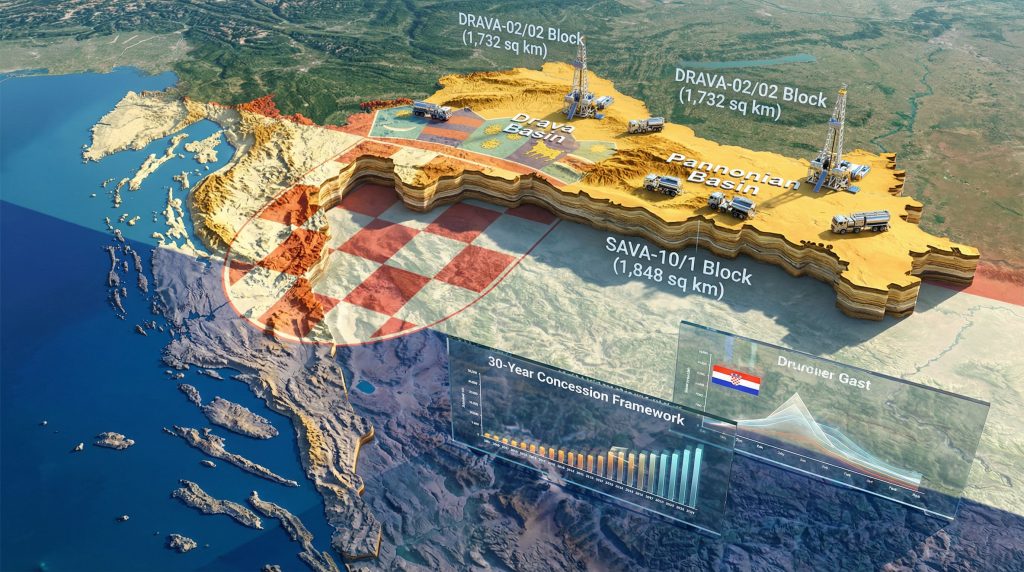
Recent examples demonstrate flexible application of this framework. INA's newly awarded SAVA-10/1 and DRAVA-02/02 permits feature 3-year initial exploration phases rather than the full 5-year maximum, suggesting a risk-based approach where initial commitments are scaled to reduce exploration exposure before larger drilling investments are undertaken.
This phased structure allows operators to:
- Complete comprehensive geological evaluation before major capital commitment
- Demonstrate technical and financial capability through initial work programmes
- Secure automatic conversion to production rights upon commercial discovery
- Manage risk through shorter initial commitment periods
Public Tender Competition Dynamics
All onshore exploration blocks in Croatia are awarded through competitive public tender processes, with evaluation criteria documented in tender specifications. The bidding system requires operators to demonstrate multiple competency areas:
Technical Competency Assessment:
- Geological expertise and seismic interpretation capability
- Previous exploration success and operational track record
- Drilling technology and completion techniques
- Environmental management and safety protocols
Financial Guarantee Requirements:
- Performance bonds covering estimated work programme costs
- Demonstrated financial capacity for multi-year exploration commitments
- Insurance coverage for operational and environmental liabilities
- Parent company guarantees for subsidiary operators
The competitive process evaluates both technical proposals and commercial terms, including revenue-sharing arrangements and work programme commitments. Furthermore, successful bidders must typically exceed minimum work requirements to demonstrate competitive advantage.
Production Sharing Agreement (PSA) Negotiations
Following permit award, operators negotiate detailed PSAs with the Croatian government to establish revenue-sharing mechanisms and operational parameters. These agreements define:
- Revenue Distribution: Government participation in production revenues through negotiated percentage shares
- Operational Control: Primary operational responsibility remains with the operating company
- Performance Milestones: Seismic completion deadlines, drilling commitments, and reporting requirements
- Cost Recovery: Mechanisms for recovering exploration and development investments before profit-sharing calculations
The PSA framework ensures government participation in successful projects while maintaining private sector operational expertise and risk capital. Specific revenue percentages vary by project but are negotiated based on geological risk, expected production volumes, and development costs.
What Are the Geographic and Geological Opportunities Across Croatia?
Eastern Croatia's Pannonian Basin Potential
The SAVA-10/1 block represents one of Croatia's most significant recent exploration permits in Croatia awards, covering 1,848 square kilometres across Brod-Posavina, Osijek-Baranja, and Vukovar-Srijem counties. This exploration area lies within the eastern extension of the Pannonian Basin, a proven petroleum system with established hydrocarbon accumulations across the broader regional context.
SAVA-10/1 Block Technical Specifications:
| Parameter | Details |
|---|---|
| Total Area | 1,848 sq km |
| Geographic Coverage | Brod-Posavina, Osijek-Baranja, Vukovar-Srijem counties |
| Basin Context | Pannonian Basin eastern extension |
| Exploration Phase | 3 years initial, 2-year extension option |
| Primary Work Commitments | 3D seismic surveys, exploration well drilling |
The Pannonian Basin geological framework features Tertiary-age petroleum systems with established source rock intervals in Miocene and Pliocene sequences. Structural traps are related to wrench-fault geometries and anticlinal fold structures, with seal rocks provided by claystones and shales. Reservoir intervals consist primarily of sandstone formations deposited during Miocene and Pliocene periods.
Seismic penetration in this region typically targets depths of 1,500-3,500 metres, where established petroleum systems demonstrate commercial potential. In addition, the proximity to existing oil and gas infrastructure, including pipeline systems and production facilities, provides significant advantages for future exploitation phase development.
Northwestern Croatia's Drava Basin Prospects
The DRAVA-02/02 block spans 1,732 square kilometres across Koprivnica-Križevci, Bjelovar-Bilogora, and Virovitica-Podravina counties, positioning it within the proven Drava Basin petroleum system. This block benefits from proximity to INA's existing DRAVA-03 operated block, enabling integrated exploration strategies and potential shared infrastructure development.
Drava Basin Geological Framework:
- Structural Configuration: Combination of anticlinal and fault-related trap structures
- Seal Integrity: Well-documented shale intervals providing hydrocarbon containment
- Reservoir Quality: Established in Miocene-age sandstone formations
- Trap Geometry: Multiple stacked pay horizons potential across vertical intervals
- Infrastructure Access: Proximity to Drava River transportation corridor
The Drava Basin has demonstrated both oil and gas accumulations, with proven Tertiary-age petroleum systems and established commercial production history. The geological understanding from adjacent DRAVA-03 operations provides valuable stratigraphic context for interpreting DRAVA-02/02 exploration potential.
Comparative Regional Analysis
Following the March 2026 permit awards, INA has consolidated the largest exploration and production acreage position in Croatia. The company's expanded portfolio includes:
- SAVA-10/1: 1,848 sq km (newly acquired, operated)
- DRAVA-02/02: 1,732 sq km (newly acquired, operated)
- DRAVA-03: Existing operated position
- SAVA-07: Existing non-operated interest
This combined acreage position exceeds 3,580 square kilometres in active exploration, representing strategic consolidation across both the Pannonian and Drava basin systems. The portfolio provides geological continuity and enables integrated seismic data interpretation across adjacent blocks, offering valuable exploration licenses insights for the regional industry.
The strategic positioning allows for:
- Shared infrastructure development across multiple permits
- Integrated geological interpretation and risk assessment
- Operational efficiencies through regional expertise concentration
- Diversified exploration risk across proven petroleum systems
What Technical and Operational Requirements Define Successful Applications?
Seismic Survey Mandates and 3D Data Acquisition
Modern exploration permits in Croatia mandate comprehensive 3D seismic data acquisition across entire block areas as primary work programme commitments. Both SAVA-10/1 and DRAVA-02/02 permits require full 3D seismic coverage utilising current industry standards for subsurface imaging and interpretation.
Technical Seismic Specifications:
- Data Coverage: Full 3D grid across entire block with consistent bin spacing (typically 25m × 25m or finer)
- Processing Standards: Post-stack time migration minimum requirement with velocity model development
- Quality Assurance: Fold stacking minimum of 1,200-1,500 fold for Pannonian basin target depths
- Environmental Compliance: Source selection with minimal ground vibration impact and noise monitoring
- Integration Requirements: Correlation with existing seismic libraries from adjacent blocks
The regulatory framework requires seismic data submission to the Croatian Hydrocarbon Agency within specified timelines, with anonymised data becoming available for government research and licensing purposes following confidentiality periods. This data sharing requirement ensures that exploration investments contribute to broader geological understanding through data-driven operations.
Exploration Well Drilling Specifications
Exploration well drilling commitments represent the highest-risk and highest-cost components of Croatian exploration programmes. Both new INA permits require exploration well drilling during their initial 3-year phases, though specific well counts remain confidential pending detailed work programme finalisation.
Critical Drilling Requirements:
- Target Selection: Seismic-defined trap geometries with volumetric risk assessment
- Well Design Specifications: Surface casing and intermediate casing programmes meeting EU safety standards
- Geological Monitoring: Real-time well log data collection including gamma ray, resistivity, and density measurements
- Environmental Protocols: Well site remediation and decommissioning obligations upon completion
- Safety Compliance: Adherence to Croatian onshore drilling regulations and emergency response procedures
Estimated drilling depths for typical Pannonian and Drava basin objectives range from 2,000-4,000 metres, targeting established petroleum system intervals. Well designs must accommodate both oil and gas potential, with completion programmes capable of handling multiple hydrocarbon types.
Reserves Assessment and Commerciality Thresholds
Upon successful exploration drilling, operators must demonstrate commercial viability through independent reserves evaluation and economic assessment. The regulatory framework requires:
- Independent Assessment: Third-party reserves evaluation using industry-standard methodologies
- Economic Viability Demonstration: Net present value calculations and development cost estimates
- Exploitation Design Approval: Detailed development plans including production facilities and infrastructure
- Environmental Impact Assessment: Comprehensive EIA for transition from exploration to production phase
Commercial thresholds are evaluated case-by-case based on reservoir characteristics, development costs, and infrastructure requirements. The automatic conversion pathway from exploration to exploitation permits incentivises thorough exploration while ensuring only commercially viable projects proceed to development.
How Do Environmental and Regulatory Compliance Frameworks Impact Operations?
Environmental Impact Assessment (EIA) Integration
Croatian exploration permits in Croatia operate within comprehensive Environmental Impact Assessment frameworks that integrate EU environmental standards with national regulatory requirements. EIA processes are mandatory for all exploration activities involving seismic surveys and drilling operations.
EIA Scope Requirements:
- Biodiversity Protection: Assessment of impacts on protected species and habitats
- Water Resources: Groundwater protection measures and surface water quality monitoring
- Air Quality: Emission controls and atmospheric impact assessment
- Noise Management: Community impact mitigation and monitoring protocols
- Public Consultation: Stakeholder engagement and community feedback integration
The EIA process requires detailed baseline environmental characterisation before exploration activities commence, ongoing monitoring during operations, and post-activity remediation planning. This comprehensive approach ensures exploration activities meet EU environmental standards while maintaining social licence to operate.
Safety and Technical Standards Enforcement
Croatia's State Inspectorate maintains active supervision of exploration operations through regular compliance monitoring and safety assessments. Technical standards enforcement covers:
Operational Safety Protocols:
- Equipment certification and maintenance requirements
- Personnel training and qualification verification
- Emergency response planning and capability demonstration
- Incident reporting and investigation procedures
Technical Compliance Monitoring:
- Drilling fluid management and disposal protocols
- Well integrity testing and pressure management
- Completion design approval and implementation oversight
- Production equipment installation and commissioning
Operators must maintain continuous compliance with safety standards throughout exploration phases, with regular inspections and reporting requirements ensuring adherence to approved work programmes and environmental commitments.
Property Rights and Land Access Considerations
Croatian exploration operations require careful management of surface rights and landowner relationships, particularly in agricultural and populated areas. The regulatory framework provides:
- Land Access Rights: Legal frameworks for accessing exploration areas while respecting property rights
- Compensation Mechanisms: Standardised approaches for compensating landowners for surface use and crop damage
- Archaeological Protections: Cultural heritage assessment and protection requirements
- Community Relations: Stakeholder engagement protocols and grievance mechanisms
Multi-county exploration blocks like SAVA-10/1 and DRAVA-02/02 require coordination across different local jurisdictions, adding complexity to land access negotiations but enabling staged development approaches that can minimise community impacts.
What Investment and Market Dynamics Shape Croatia's Exploration Sector?
Foreign Investment Participation Rules
Croatia's exploration permit system welcomes foreign investment while maintaining regulatory oversight through structured eligibility criteria. International operators must meet specific requirements to participate in Croatian exploration opportunities:
| Requirement Category | Specific Criteria |
|---|---|
| Legal Entity Status | Croatian entity registration mandatory |
| Technical Capability | Demonstrated geological and drilling expertise |
| Financial Capacity | Performance bonds and parent company guarantees |
| Compliance Record | Clean criminal record and tax compliance verification |
| Insurance Coverage | Operational and environmental liability protection |
Foreign companies cannot apply directly for exploration permits in Croatia but must establish Croatian subsidiaries or partner with existing Croatian entities. This requirement ensures local regulatory compliance while enabling international technical expertise and capital access.
The partnership structure has proven effective in attracting international investment while maintaining Croatian regulatory control. Many successful exploration programmes involve joint ventures between Croatian entities and international operators, combining local knowledge with global technical capabilities.
Market Concentration and Competitive Landscape
INA's recent permit acquisitions demonstrate the concentrated nature of Croatia's exploration sector, with the national oil company now holding the largest exploration acreage position in the country. This market structure reflects several dynamics:
Market Concentration Factors:
- Technical Expertise: INA's established geological knowledge of Croatian basins
- Infrastructure Access: Existing pipeline and processing facility ownership
- Financial Capability: Ability to fund multi-year exploration commitments
- Regulatory Familiarity: Deep understanding of Croatian permitting and compliance requirements
While INA dominates the exploration landscape, the regulatory framework remains open to international participation through competitive bidding processes. However, foreign operators can compete effectively by demonstrating superior technical approaches or more aggressive work programme commitments, reflecting broader trends in mining industry evolution.
Critical Minerals Integration Opportunities
Croatia's dual regulatory framework creates unique opportunities for integrated exploration programmes targeting both hydrocarbons and critical minerals. The recent focus on lithium exploration across Europe has highlighted potential synergies between petroleum and battery metals exploration.
Integration Opportunities:
- Shared Infrastructure: Seismic surveys providing data for both hydrocarbon and mineral exploration
- Geological Synergies: Similar basin analysis techniques applicable to both resource types
- Regulatory Efficiency: Coordinated permitting under both ZSOIEU and Mining Law frameworks
- EU Strategic Alignment: Critical Raw Materials Act creating policy support for domestic mineral production
The regulatory framework's recognition of overlapping exploration interests enables operators to pursue diversified resource strategies, potentially improving project economics through multiple revenue streams.
The next major ASX story will hit our subscribers first
What Are the Future Prospects for Croatia's Exploration Permit System?
Regulatory Evolution and EU Harmonisation
Croatia's exploration permit framework continues evolving to align with EU energy transition objectives while maintaining competitiveness for hydrocarbon exploration investment. Anticipated regulatory developments include:
Future policy changes are expected to integrate green transition compliance requirements, carbon capture and storage project coordination, and renewable energy development alignment within existing petroleum regulatory frameworks.
The regulatory evolution reflects broader European energy security priorities following recent geopolitical developments. Croatia's strategic position as a potential gas transit corridor and its proven petroleum basins make regulatory stability and investment attraction critical policy objectives.
Expected Regulatory Changes:
- Enhanced environmental monitoring and reporting requirements
- Carbon capture and storage integration with existing petroleum infrastructure
- Renewable energy project coordination mechanisms
- Digital reporting and real-time monitoring system implementation
Technology Integration and Digital Transformation
Croatian exploration operations are increasingly adopting advanced technologies for improved geological understanding and operational efficiency. Technology integration trends include:
- Advanced Seismic Interpretation: Machine learning applications for complex geological interpretation
- Real-Time Monitoring Systems: Digital drilling and production monitoring with remote oversight capability
- Artificial Intelligence Applications: Automated pattern recognition for geological and geophysical analysis
- Integrated Data Management: Cloud-based systems for multi-block exploration data integration
These technological advances enhance exploration success rates while reducing operational costs and environmental impacts. The regulatory framework supports technology adoption through modernised data submission requirements and digital compliance protocols.
Strategic Positioning Within Regional Energy Security
Croatia's exploration permit system operates within broader regional energy security considerations that influence both regulatory policy and investment attractiveness. Key strategic factors include:
Regional Energy Independence Objectives:
- Balkan peninsula energy diversification away from single-source dependency
- Natural gas supply route diversification through Croatian pipeline infrastructure
- Cross-border exploration collaboration with neighbouring countries
- Emergency supply capability development for regional energy security
The strategic importance of domestic hydrocarbon production has increased following recent European energy supply disruptions. Croatia's proven petroleum basins and existing infrastructure position the country as a potential regional energy supplier, making exploration permit success increasingly important for both national and regional energy security.
Frequently Asked Questions About Croatian Exploration Permits
How Long Does the Permit Application Process Take?
The Croatian exploration permit application process varies in duration based on block complexity, environmental considerations, and competitive bidding dynamics. While specific timelines are not publicly disclosed, the process typically involves:
- Tender Publication: 3-6 months for preparation and submission
- Technical Evaluation: 6-12 months for proposal assessment and due diligence
- PSA Negotiation: 3-6 months for commercial terms finalisation
- Final Approval: 1-3 months for government authorisation
Factors affecting approval duration include environmental assessment complexity, public consultation requirements, and technical proposal evaluation thoroughness. For instance, expedited processing may be available for straightforward applications in well-understood geological areas.
What Happens If Exploration Discovers Commercial Reserves?
Croatian exploration permits include automatic conversion pathways to exploitation rights upon commercial discovery demonstration. The transition process involves:
- Independent Reserves Assessment: Third-party evaluation confirming commercial viability
- Development Plan Submission: Detailed exploitation design and timeline
- Environmental Impact Assessment: Comprehensive EIA for production phase activities
- Infrastructure Planning: Transportation and processing facility development coordination
- PSA Amendment: Revenue-sharing terms adjustment for production phase
The automatic conversion mechanism eliminates separate permit application requirements for successful exploration projects, providing investment certainty and streamlined development pathways.
Can Foreign Companies Apply Directly for Croatian Exploration Permits?
Foreign companies cannot apply directly for exploration permits in Croatia but must establish local presence through Croatian entity registration or partnership structures. Available options include:
Croatian Subsidiary Establishment:
- Full subsidiary registration with Croatian corporate law compliance
- Local management and technical staff requirements
- Direct permit holding and operational responsibility
Partnership with Croatian Entities:
- Joint venture structures with existing Croatian operators
- Shared technical expertise and regulatory compliance responsibility
- Flexible partnership terms based on technical and financial contributions
The local entity requirement ensures regulatory compliance and local knowledge integration while enabling international technical expertise and capital access. Most successful international exploration projects utilise partnership structures combining global capabilities with Croatian market knowledge.
Disclaimer: This analysis is based on publicly available information and industry reports. Exploration investments involve significant geological, technical, and commercial risks. Readers should conduct independent due diligence and consult qualified advisors before making investment decisions. Regulatory frameworks and permit requirements may change, and this article should not be considered as investment advice or regulatory guidance.
Ready to Capitalise on International Energy Exploration Opportunities?
Discovery Alert's proprietary Discovery IQ model delivers real-time alerts on significant energy and mineral discoveries across global markets, turning complex exploration data into actionable investment insights. Stay ahead of major discoveries that could transform regional energy landscapes by exploring Discovery Alert's historic returns from major discoveries and begin your 14-day free trial today to position yourself at the forefront of international resource opportunities.