
May 15, 2026
Understanding the Strategic Framework Behind Cross-Border Energy Sanctions
Market volatility in global energy networks intensifies as geopolitical tensions reshape traditional supply chains. Advanced enforcement mechanisms targeting secondary participants create cascading effects across multiple jurisdictions, forcing energy market participants to recalibrate risk assessment frameworks. The intersection of economic warfare and energy security reveals fundamental vulnerabilities in interconnected trading systems that have operated for decades under different strategic assumptions. The recent US sanctions Chinese entities with Venezuelan oil links demonstrate how enforcement actions can disrupt traditional energy partnerships and create new compliance challenges for global market participants.
Economic Warfare Through Energy Control Mechanisms
Economic sanctions targeting energy infrastructure represent sophisticated leverage tools that exploit dependency relationships between nations. The Trump administration's targeting of Chinese entities operating in Venezuelan oil markets demonstrates how secondary sanctions expand enforcement reach beyond primary targets. When the Treasury Department's Office of Foreign Assets Control designated four Chinese companies in January 2026, including Zhejiang-based Corniola Ltd. and three Hong Kong-based entities, the action signalled a strategic escalation in sanctions enforcement methodology. These actions are closely connected to broader tariffs and inflation policies that affect global trade relationships.
Secondary sanctions create vulnerability matrices by threatening third-party actors with exclusion from US financial systems. This mechanism forces non-US entities to choose between maintaining business relationships with sanctioned regimes or preserving access to dollar-denominated banking networks. The designation of Aries Global Investment Ltd., Krape Myrtle Co, and Winky International Ltd. alongside associated vessels Della, Nord Star, Rosalind, and Valiant illustrates how enforcement agencies target entire operational networks rather than isolated transactions.
The strategic framework operates through financial system isolation, where designated entities face immediate asset freezes and transaction prohibitions. OFAC designation automatically triggers cascading effects through correspondent banking relationships, insurance markets, and trade finance mechanisms. These systemic disruptions create operational friction that extends far beyond the immediate targets, affecting entire supply chain networks.
Shadow Fleet Operations and Evasion Networks
Shadow fleet operations represent sophisticated maritime networks designed to circumvent sanctions through vessel ownership obfuscation and cargo identity manipulation. The Treasury Department characterised these operations as critical to regime financing, noting that Venezuelan oil production and exports continue to decline as enforcement mechanisms become more sophisticated. The Venezuelan government increasingly depends on worldwide vessel networks to facilitate sanctionable activities and generate revenue for destabilising operations.
Technical evasion methods include transponder manipulation and cargo misidentification schemes. Of the four vessels sanctioned in January 2026, only the Rosalind showed recent transponder data indicating Venezuelan coastal activity, while three vessels operated without transmitting automatic identification system signals. This suggests systematic use of dark sailing periods or transponder spoofing techniques to avoid detection by maritime surveillance systems.
Product masking represents another critical evasion technique, with Venezuelan crude oil systematically disguised as bitumen mix through unofficial trading channels. This commodity misclassification complicates origin verification through standard documentation procedures, allowing sanctioned crude to enter international markets under alternative product categories.
Insurance and financing challenges create additional operational barriers for shadow fleet operations. Furthermore, sanctioned vessels typically cannot obtain standard marine liability coverage or traditional trade financing, forcing operators to utilise alternative risk management and payment mechanisms that increase operational costs and regulatory exposure.
When big ASX news breaks, our subscribers know first
What Are the Immediate Market Impacts of Venezuelan Oil Trade Restrictions?
Supply Chain Disruption Analysis
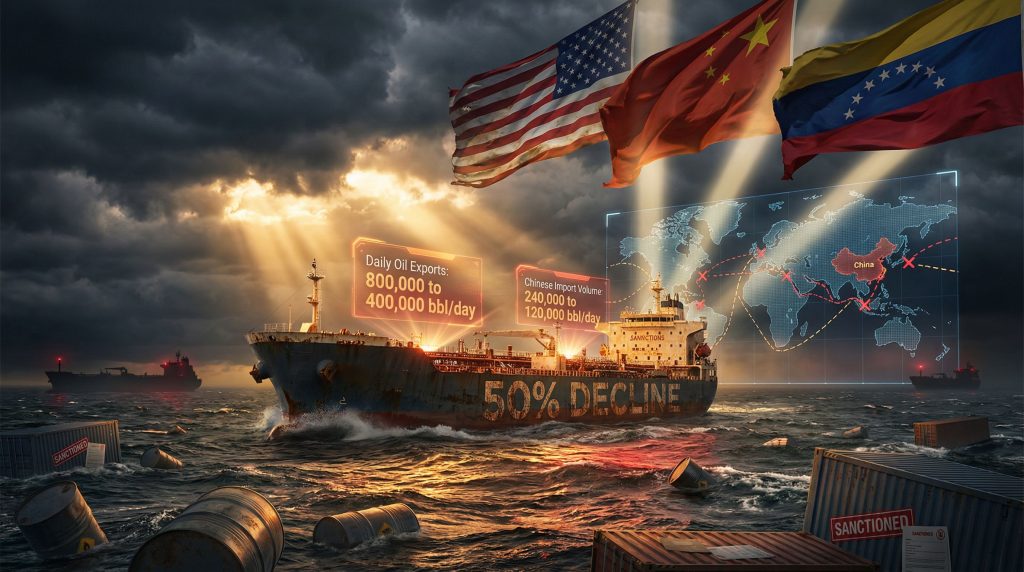
Venezuelan oil export capacity experienced significant contraction under sanctions pressure, with daily export volumes declining from approximately 800,000 barrels per day to 400,000 barrels per day, representing a 50% reduction in export capacity. This supply constraint operates through dual mechanisms: physical transport capacity limitations and financial system exclusions that prevent normal commercial operations. These disruptions contribute to broader oil price movements that affect global energy markets.
Active tanker fleet reductions compound export limitations, with operational vessel counts declining from 45 ships to 23 ships, representing a 49% contraction in available maritime transport capacity. This physical constraint creates bottlenecks in cargo movement even when demand and financing remain available through unofficial channels.
Alternative routing strategies emerge through third-country transshipment operations and product blending facilities that obscure cargo origins. Venezuelan crude reaches international markets through intermediate processing in countries with less stringent sanctions compliance frameworks, creating complex supply chains that increase transportation costs and delivery timeframes.
Regional price differentials develop as supply restrictions create scarcity premiums in specific markets while reducing competition in global crude pricing. Moreover, Chinese importers face higher procurement costs due to limited supplier alternatives and increased compliance risks associated with Venezuelan crude transactions.
| Metric | Pre-Sanctions | Current Level | Percentage Change |
|---|---|---|---|
| Daily Oil Exports | 800,000 bbl/day | 400,000 bbl/day | -50% |
| Active Tanker Fleet | 45 vessels | 23 vessels | -49% |
| Chinese Import Volume | 240,000 bbl/day | 120,000 bbl/day | -50% |
Chinese Refinery Adaptation Strategies
Chinese teapot refineries, representing approximately 20% of China's total refining capacity, demonstrated resilience in maintaining Venezuelan crude procurement despite official sanctions compliance. These private independent refiners established themselves as reliable purchasers of Venezuelan crude through unofficial channels, even as larger state-owned enterprises suspended formal import relationships.
China's official resumption of Venezuelan crude imports in February 2024 marked a strategic recalibration after a sanctions-induced suspension beginning in 2019. However, unofficial import channels operated continuously throughout this period, with crude oil masked as bitumen mix to avoid sanctions detection mechanisms. The broader implications of US tariffs impact on various industries parallel similar challenges facing Chinese refiners.
Substitution challenges create operational constraints for refineries optimised for Venezuelan extra-heavy crude grades. These facilities require specialised hydrocracking and desulfurisation equipment configured for high-sulphur, low-API gravity crude oil. Transitioning to alternative crude sources demands significant capital investment and operational modifications that many refiners cannot implement cost-effectively.
Financial exposure concentrates amongst Hong Kong-based trading entities that facilitate Chinese refinery crude sourcing. Consequently, the January 2026 designation of three Hong Kong companies represents direct targeting of financial intermediaries critical to unofficial trade relationships, creating banking and insurance disruptions throughout the supply chain.
How Do Maritime Enforcement Actions Affect Global Shipping Networks?
Vessel Tracking and Compliance Monitoring
Maritime enforcement relies on sophisticated vessel tracking systems that monitor automatic identification system transponders, satellite imagery, and port activity databases. The identification of sanctioned vessels demonstrates how enforcement agencies utilise multiple data sources to establish operational patterns and ownership relationships across complex maritime networks.
Transponder manipulation techniques include signal disconnection, identity spoofing, and dark sailing periods where vessels operate without electronic identification. The Rosalind maintained transponder signals showing Venezuelan coastal activity, while three other sanctioned vessels operated without recent transponder data, suggesting systematic efforts to avoid surveillance detection.
Port access restrictions create cascading effects throughout global shipping networks as sanctioned vessels face exclusion from major commercial ports. These restrictions force shadow fleet operations to utilise smaller, less-regulated facilities with limited cargo handling capacity and higher operational costs.
Insurance market responses to sanctions risk create additional compliance pressures as marine liability providers exclude sanctioned vessels and high-risk cargo operations. In addition, standard maritime insurance policies typically include sanctions clauses that void coverage for designated entities, forcing shadow fleet operators to seek alternative risk management mechanisms at significantly higher costs.
International Waters Jurisdiction Challenges
Legal frameworks governing high-seas enforcement create jurisdictional complexities when sanctions enforcement occurs outside territorial waters. US forces intercepted multiple carriers in recent weeks, with one vessel retreating to the Atlantic Ocean after being pursued by enforcement assets, demonstrating the geographic scope of enforcement operations.
Coast Guard interdiction protocols operate under international maritime law provisions that permit vessel inspection and seizure under specific circumstances. However, enforcement actions against foreign-flagged vessels in international waters require careful legal justification to avoid diplomatic incidents with flag states and vessel operators.
Diplomatic tensions arise from vessel seizures as affected countries characterise enforcement actions as violations of international law. For instance, China's Foreign Ministry criticised US enforcement operations as unilateral bullying, establishing formal diplomatic friction over maritime jurisdiction and sanctions enforcement scope.
What Economic Vulnerabilities Drive Sanctions Effectiveness?
Revenue Dependency Analysis for Resource-Based Economies
Venezuela's extreme dependence on oil revenue creates critical vulnerability to export restrictions, with petroleum exports representing approximately 95% of government revenue. This revenue concentration eliminates fiscal diversification options and makes the government highly susceptible to oil market disruptions and sanctions enforcement. Such dependencies are compounded by broader energy transition challenges facing resource-dependent economies globally.
Currency stability implications of export restrictions create inflationary pressures and foreign exchange shortages that compound economic isolation effects. Reduced oil export earnings limit the government's ability to import essential goods and service external debt obligations, creating broader economic instability beyond the energy sector.
Alternative revenue generation proves challenging under comprehensive sanctions as traditional economic activities require access to international banking systems and trade finance mechanisms. The designation of Venezuelan entities across multiple sectors limits opportunities for economic diversification and revenue replacement.
Financial System Isolation Mechanisms
SWIFT network exclusions and payment routing restrictions create operational barriers for sanctioned entities attempting to conduct international transactions. Designated companies face immediate disconnection from standard correspondent banking relationships, forcing reliance on alternative payment mechanisms with higher costs and compliance risks.
Cryptocurrency adoption for sanctions evasion represents an emerging trend as traditional banking exclusions drive demand for alternative payment systems. However, cryptocurrency transactions face increasing regulatory scrutiny and technical limitations that prevent full replacement of traditional banking services for large-scale commercial operations.
Banking sector compliance costs increase significantly as financial institutions implement enhanced due diligence procedures to avoid sanctions violations. These compliance investments create operational friction throughout the global financial system, affecting transaction processing times and costs for all market participants.
How Do Regional Powers Navigate Competing Sanctions Regimes?
China's Strategic Response Framework
China's approach to US sanctions balances energy security requirements against diplomatic relationship preservation through carefully calibrated compliance strategies. The resumption of official Venezuelan crude imports in February 2024 after a five-year suspension demonstrates strategic flexibility in managing competing pressures from energy dependence and sanctions risk.
State-owned versus private sector compliance variations create operational distinctions in how different Chinese entities approach sanctioned markets. While large state-owned enterprises maintain stricter sanctions compliance to protect broader business relationships, private teapot refiners demonstrate greater willingness to accept regulatory risks for competitive procurement advantages.
Belt and Road Initiative implications for sanctioned regions create strategic tensions as infrastructure investment commitments conflict with sanctions compliance requirements. China must balance geopolitical alliance obligations against economic relationships with sanctioned regimes whilst maintaining access to US financial systems.
Third-Country Transit and Blending Operations
Oil product mixing operations obscure origin identification through sophisticated blending techniques that combine sanctioned and non-sanctioned crude grades. Venezuelan crude masked as bitumen mix represents systematic commodity misclassification designed to circumvent documentation verification procedures used by sanctions enforcement agencies.
Free trade zone utilisation for sanctions circumvention creates legal grey areas where cargo processing and ownership transfers occur outside standard customs oversight. These facilities provide operational flexibility for cargo manipulation and documentation modification that complicates sanctions enforcement efforts.
Documentation fraud and cargo certification challenges proliferate as shadow fleet operations require legitimate-appearing paperwork for port access and commercial transactions. Falsified bills of lading, origin certificates, and cargo manifests create systematic documentation integrity problems throughout affected supply chains.
What Are the Long-Term Geopolitical Implications?
Energy Security Recalibration Trends
Diversification strategies for import-dependent economies accelerate as sanctions demonstrate the vulnerability of concentrated supply relationships. Countries with significant Venezuelan crude dependence develop alternative sourcing strategies to reduce exposure to sanctions-related supply disruptions. This trend mirrors how an oil price rally can prompt strategic energy planning adjustments.
Strategic petroleum reserve policies evolve under sanctions pressure as governments recognise the importance of emergency stockpiles for maintaining energy security during supply disruptions. Enhanced reserve management becomes critical for countries operating in sanctions-affected markets or maintaining relationships with sanctioned suppliers.
Alternative energy transition acceleration factors include sanctions-driven supply uncertainty that increases renewable energy investment attractiveness. Countries seeking to reduce sanctions exposure through energy independence accelerate domestic renewable energy development and reduce petroleum import dependence.
International Law Evolution in Economic Warfare
Precedent-setting aspects of maritime enforcement escalation create new frameworks for sanctions implementation that extend beyond traditional diplomatic and financial measures. The integration of military assets in sanctions enforcement represents an expansion of economic warfare capabilities with implications for international maritime law.
Multilateral sanctions coordination challenges increase as unilateral sanctions create compliance conflicts for multinational corporations and allied governments. The targeting of Chinese entities for Venezuelan oil trade creates tensions between US sanctions policy and broader international trade relationships.
Trade dispute resolution mechanism strain develops as sanctions enforcement conflicts with World Trade Organisation principles and bilateral trade agreements. Furthermore, the expansion of secondary sanctions creates systemic tensions between sanctions objectives and international trade law frameworks.
The next major ASX story will hit our subscribers first
Measuring Sanctions Impact Through Economic Indicators
Enforcement Action Summary
Recent enforcement activities demonstrate escalating sanctions implementation across multiple dimensions. The US sanctions Chinese entities with Venezuelan oil links represent part of a broader pattern of enforcement escalation that includes:
- Vessel interdictions: 15+ incidents during Q4 2025
- Entity designations: 8 companies across 3 jurisdictions
- Financial asset freezes: $2.3 billion estimated value
- Military strikes: 5 separate operations targeting alleged trafficking vessels
The January 1, 2026 OFAC designation represented the latest escalation in a sustained pressure campaign that included targeting 10 additional individuals and firms based in Iran and Venezuela for alleged weapons trading. This enforcement pattern demonstrates systematic expansion of sanctions scope beyond petroleum trade to encompass broader commercial relationships.
US Southern Command operations against alleged drug trafficking vessels created additional enforcement precedents, with strikes on December 30 sinking three vessels and killing three individuals. These military actions represent direct enforcement escalation beyond traditional sanctions mechanisms.
Production and Export Metrics Verification
Venezuelan oil production and export data require careful verification due to limited official reporting and deliberate obfuscation efforts by shadow fleet operations. Independent analysis suggests export capacity reductions align with vessel availability constraints and financial system exclusions, but exact figures remain subject to estimation uncertainty.
Important Note: Production and export statistics in this analysis are based on third-party tracking data and industry estimates. Official Venezuelan government production figures are not consistently available, and shadow fleet operations deliberately obscure cargo movements. Readers should exercise caution in relying on specific numerical claims without independent verification from multiple sources.
Chinese import volume calculations face similar verification challenges as unofficial procurement channels operate outside standard trade reporting mechanisms. The masking of Venezuelan crude as bitumen mix creates systematic underreporting in official trade statistics.
Strategic Risk Assessment for Energy Markets
Scenario Planning for Escalation Pathways
Complete embargo implementation probability increases as enforcement mechanisms expand beyond financial sanctions to include maritime interdiction and military strikes. The integration of military assets in sanctions enforcement suggests potential for further escalation if diplomatic pressure fails to achieve policy objectives.
Third-party sanctions expansion potential creates systemic risks for global energy markets as secondary sanctions targeting spreads beyond Chinese entities to include other major importing countries. European and Indian companies with Venezuelan exposure face increasing compliance risks as enforcement scope expands.
Market volatility projections under various enforcement levels indicate significant price impacts if sanctions achieve substantial supply reductions. However, Venezuelan heavy crude represents irreplaceable feedstock for certain refineries, creating potential supply shocks if alternative sources cannot provide adequate substitution.
Investment Decision Framework Under Sanctions Uncertainty
Due diligence requirements for energy sector exposure demand enhanced compliance procedures that evaluate sanctions risks across complex supply chains and ownership structures. Investment managers must assess both direct and indirect exposure to sanctioned entities through trading relationships and joint venture partnerships.
Compliance cost integration in project valuations requires sophisticated risk assessment methodologies that account for sanctions enforcement uncertainty and escalation probability. These costs include enhanced due diligence, alternative banking arrangements, and operational modifications required for sanctions compliance.
Exit strategy planning for sanctioned jurisdiction operations becomes critical as enforcement escalation creates unpredictable regulatory environments. Companies operating in sanctions-affected markets must maintain flexibility to cease operations rapidly if compliance risks become unmanageable.
Investment Disclaimer: This analysis contains forward-looking statements and speculative assessments regarding sanctions enforcement and market conditions. Investment decisions should not be based solely on this information. Sanctions regimes can change rapidly, and enforcement actions may create unexpected market disruptions. Investors should conduct independent due diligence and consult qualified legal and financial advisors before making investment decisions in sanctions-affected markets.
Navigating the New Paradigm of Economic Sanctions Warfare
Key Takeaways for Energy Market Participants
Sanctions effectiveness ultimately depends on enforcement consistency and international cooperation across multiple jurisdictions. The latest round where US sanctions Chinese entities with Venezuelan oil links demonstrates willingness to accept diplomatic tensions in pursuit of sanctions objectives, but long-term effectiveness requires sustained political commitment and multilateral support.
Shadow fleet operations create systemic risks that extend beyond targeted regimes to affect broader maritime commerce and international trade. Insurance market disruptions, documentation fraud, and vessel tracking complications create operational challenges for legitimate commercial activities in affected shipping regions.
Economic isolation strategies require sustained political will and multilateral coordination to maintain effectiveness over extended periods. Consequently, unilateral sanctions face inherent limitations as targeted regimes develop alternative trading relationships and evasion mechanisms that reduce sanctions impact over time.
Forward-Looking Strategic Considerations
Technology's role in both sanctions evasion and enforcement continues evolving as digital tracking capabilities improve whilst cryptocurrency and alternative payment systems provide evasion opportunities. The balance between surveillance technology advancement and evasion technique sophistication will determine future sanctions effectiveness.
Climate transition policies intersecting with sanctions regimes create complex policy interactions as renewable energy development potentially reduces demand for sanctioned fossil fuel exports. Long-term energy transition trends may achieve sanctions objectives through market mechanisms rather than enforcement actions.
Regional power dynamics reshape global energy trade patterns as sanctions force development of alternative supply relationships and payment mechanisms. These structural changes may persist beyond current sanctions regimes, creating permanent alterations in global energy trade flows and geopolitical relationships.
The integration of military enforcement with economic sanctions represents a significant escalation in economic warfare capabilities that establishes precedents for future conflicts. The ongoing pattern where US sanctions Chinese entities with Venezuelan oil links signals that market participants must prepare for continued evolution in sanctions implementation methodologies and enforcement scope expansion.
Could the Next Market-Moving Discovery Be Hidden in Tomorrow's ASX Announcements?
Discovery Alert's proprietary Discovery IQ model delivers instant notifications on significant ASX mineral discoveries, empowering subscribers to identify actionable opportunities ahead of broader market movements. Begin your 30-day free trial today and position yourself to capitalise on market-leading insights before they reach mainstream investors.