July 9, 2026
The True Cost of Crude: Why Loading Location Now Matters More Than the Price Tag
In global energy markets, the difference between a competitive crude offer and an uncompetitive one rarely comes down to the headline price alone. Sophisticated refinery procurement teams evaluate crude purchases through a layered framework that incorporates benchmark differentials, freight costs, insurance premiums, geopolitical risk adjustments, and inventory timing. This multi-variable calculation has never been more consequential than it is right now, as Gulf oil producers fight for market share in Asia with a ferocity not seen in over two decades.
The convergence of Hormuz disruption, record Chinese inventory buffers, and an intra-Gulf pricing war has produced a market structure where the official selling price is only one variable among many, and often not the most decisive one. Understanding the crude oil market dynamics at play helps explain why pricing strategy alone cannot determine which producers win in Asia.
When big ASX news breaks, our subscribers know first
Asia's Crude Import Market: The Prize Worth Fighting Over
Asia absorbs approximately 85% of all Middle Eastern crude exports, making it the singular commercial priority for every Gulf producer. The region's concentration of refining capacity outside North America is unmatched globally, with China, India, Japan, South Korea, and the broader ASEAN bloc collectively representing a structural demand floor that is unlikely to erode through the 2030s.
China's consumption growth curve has flattened relative to the explosive trajectory of the previous decade. However, this has been partially offset by accelerating demand in India and Southeast Asia, where industrialisation and rising middle-class energy consumption are creating new long-cycle demand centres. India's power consumption is projected to expand at approximately 6% annually through 2030, providing a medium-term demand anchor that every Gulf exporter is competing to supply.
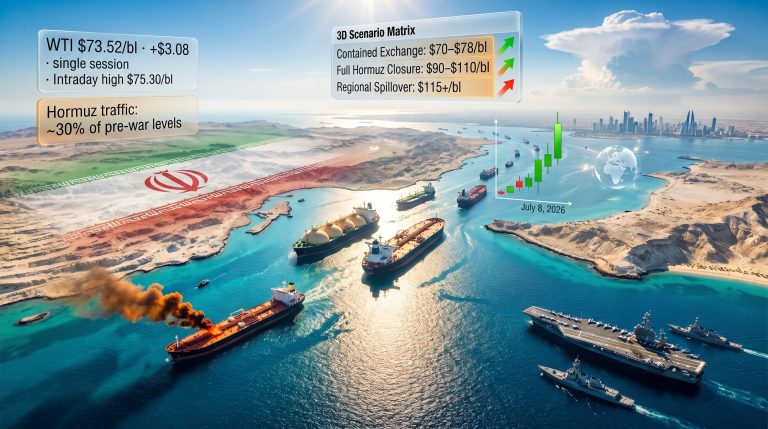
The Strait of Hormuz disruption following the Iran conflict fundamentally altered the buyer-seller power balance in this market. An estimated 63 million barrels of crude became stranded at sea as tanker traffic froze, Gulf producers were forced to curtail upstream output, and a significant inventory backlog accumulated in floating storage within the Persian Gulf. The partial reopening of the Strait triggered an immediate race by all major Gulf exporters to monetise stranded supply, recapture market share, and restore shut-in production, all simultaneously.
The Hormuz disruption did not simply pause trade flows. It restructured negotiating leverage across the entire Asian crude market, handing buyers a degree of pricing power that is typically only available during demand collapses or OPEC supply surges.
Saudi Arabia's Historic Price Cut: What an $11 Reduction Actually Signals
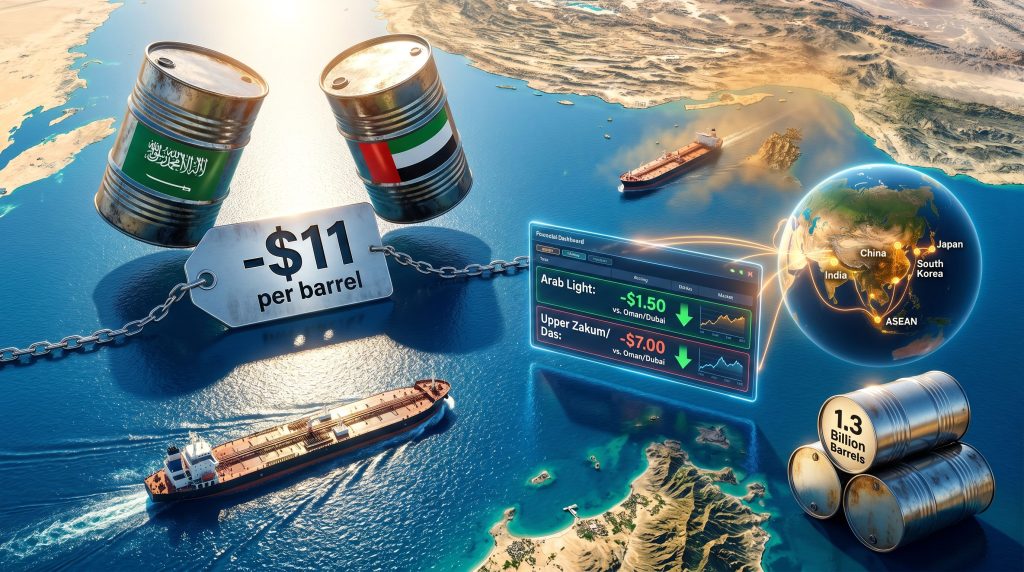
Saudi Arabia's decision to reduce its official selling price (OSP) for August Asian loadings by $11 per barrel relative to July represents the largest single month-over-month adjustment in more than two decades, according to Bloomberg data. The move positions Arab Light, the Kingdom's flagship export grade, at $1.50 per barrel below the Oman/Dubai benchmark average.
Selling at a discount to the Dubai/Oman benchmark is an extraordinarily rare posture for the world's largest crude exporter. Furthermore, the historical precedent for this pricing position is narrow:
| Historical Episode | Year | Market Trigger | Saudi Benchmark Position |
|---|---|---|---|
| OPEC Market Share Defence | 2015 | U.S. shale competition | Below benchmark discount |
| COVID-19 Price War | March 2020 | Demand collapse and Russia standoff | Below benchmark discount |
| Post-Hormuz Competition | 2026 | Iran conflict, buyer leverage, intra-Gulf rivalry | $1.50 below Oman/Dubai |
Each of these episodes shares a common characteristic: Saudi Arabia only abandons its typical above-benchmark pricing when it perceives an existential threat to its volume position in key markets. The 2026 move therefore carries a structural signal beyond its tactical dimensions.
It reflects an acknowledgement that Asian buyers have accumulated genuine optionality, that competing Gulf producers are offering more attractive terms, and that volume recovery now takes priority over margin protection. In this context, OPEC's market influence appears to be weakening as individual member states pursue divergent commercial strategies.
Analysts interpret benchmark discounting by Saudi Arabia as a leading indicator of broader pricing pressure across multiple Gulf grades and regional markets, not merely a one-month competitive adjustment.
The UAE Advantage: Why Freight Economics Are Reshaping the Competition
Despite the scale of Saudi Arabia's price reduction, Asian refiners and trading desks are concluding that the $11 cut may be insufficient to overcome a structural competitive disadvantage rooted in logistics, not just price.
The UAE is currently offering key grades including Upper Zakum and Das at discounts of approximately $7 per barrel below the Dubai/Oman benchmark, significantly exceeding Saudi Arabia's concession on a headline basis. More critically, UAE cargoes can be loaded at Sohar in Oman and at Fujairah, both located outside the Strait of Hormuz, with supertanker charter rates estimated at $4 to $5 per barrel for delivery to Asian destinations.
By contrast, Saudi Arabia's primary export terminal at Ras Tanura sits inside the Strait, and tanker charter rates from that loading point are reported to exceed double the UAE's outside-Hormuz freight cost. An Indian refinery source, as reported by Reuters, noted that when Upper Zakum and Das are available at a $7 discount, the economic case for purchasing Saudi crude becomes difficult to construct regardless of the OSP reduction.
The total delivered cost comparison across competing Gulf producers illustrates the challenge clearly:
| Producer | Grade | OSP vs. Dubai/Oman | Loading Terminal | Freight Estimate | Hormuz Risk |
|---|---|---|---|---|---|
| Saudi Arabia | Arab Light | -$1.50/bbl | Ras Tanura (inside Hormuz) | High (2x UAE estimate) | Elevated |
| UAE | Upper Zakum, Das | -$7.00/bbl | Sohar/Fujairah (outside Hormuz) | ~$4-5/bbl | Minimal |
| Iraq | Basra Light | Reduced OSP | Mixed exposure | Moderate | Moderate |
| Kuwait | Kuwait Export Crude | Reduced OSP | Inside Hormuz | High | Elevated |
This table illustrates why loading location has emerged as a decisive competitive variable that headline OSP comparisons alone cannot capture. A buyer evaluating total landed cost — inclusive of freight, insurance, and risk-adjusted premiums for Hormuz transit — may find that a shallower UAE discount produces a lower all-in cost than Saudi Arabia's deeper official price reduction. For further context, the geopolitical and logistical factors shaping these decisions extend well beyond the Gulf itself.
The UAE's OPEC+ Exit: A New Intra-Gulf Competitive Dynamic
The UAE's departure from OPEC+ production agreements in May 2026 removed the internal constraints that had previously aligned Abu Dhabi's volume and pricing behaviour with Saudi Arabia's coordinated framework. UAE oil production is approaching record highs following that exit, providing the supply base to simultaneously undercut competitors on price, volume, and logistics.
This creates a structural tension that extends beyond the current pricing episode. Saudi Arabia historically anchors OPEC+ price discipline, while the UAE is now operating as an independent volume maximiser. The competitive dynamic between these two producers in Asian markets may prove more durable than any single monthly OSP cycle.
China's Strategic Patience: The 1.3 Billion Barrel Buffer
Understanding why Gulf oil producers fight for market share in Asia with such intensity requires examining the demand side of the equation with equal rigour.
Prior to the outbreak of hostilities affecting Hormuz, China accumulated an estimated 1.3 billion barrels of crude in strategic and commercial storage, one of the largest inventory buffers the country has assembled. This stockpile was constructed as a supply security hedge, but it now functions as a demand suppression mechanism of considerable strategic power.
Chinese crude imports declined across four consecutive months during the conflict period, reflecting both the physical disruption to Hormuz traffic and a deliberate decision by major state refiners to draw down existing inventory rather than compete for expensive spot cargoes. This behaviour pattern is consistent with sophisticated market timing rather than passive demand weakness.
The logic is straightforward: the larger the inventory buffer, the greater the operational runway available to delay purchases while Gulf producers compete to offer deeper discounts. Chinese state refiners appear to be applying exactly this calculus, withholding large-scale buying commitments until competitive intensity among exporters reaches its maximum point. According to recent analysis on China's buying strategy, Beijing is deliberately exploiting the global oil glut to extract maximum concessions from competing exporters.
If Chinese buyers delay bulk purchasing decisions by an additional four to six weeks, Gulf producers facing mounting storage costs and shut-in production backlogs may be compelled to extend discounts well beyond current levels, potentially pushing Arab Light pricing toward $3.00 or more below the Dubai/Oman benchmark.
This scenario is speculative and depends on continued Hormuz instability preventing a rapid normalisation of supply flows, but the structural incentives for Chinese buyer patience remain compelling as long as the inventory buffer holds.
India as the Swing Buyer: Price Sensitivity Overrides Geopolitical Caution
While China exercises strategic patience, India has demonstrated a different risk tolerance. India has resumed importing Iraqi crude despite ongoing Hormuz shipping risks, signalling that for price-sensitive Asian refiners, competitive economics can override geopolitical caution under the right conditions.
This distinction matters for Gulf exporters attempting to model near-term demand recovery. India's willingness to accept Hormuz transit risk in exchange for favourable pricing creates a potential swing buyer dynamic that could partially offset delayed Chinese purchasing.
However, India's downstream picture is more nuanced than import volumes alone suggest. India's fuel consumption has shown signs of softening despite record crude import levels, indicating that refinery throughput and downstream demand are not uniformly aligned. Gulf producers cannot assume that high import volumes automatically translate into sustained purchasing appetite at current discount levels.
The next major ASX story will hit our subscribers first
How Asian Refiners Are Actually Evaluating Gulf Crude Offers
The procurement decision-making process for large Asian refiners has become substantially more complex in the current environment. A simplified version of the evaluation framework used by sophisticated buyers involves the following sequential steps:
- Benchmark OSP Assessment — Compare official selling prices against the Dubai/Oman average for each competing grade and producer.
- Loading Location Risk Adjustment — Apply a risk premium to any cargo requiring Hormuz transit, calibrated to current geopolitical conditions and tanker insurance costs.
- Freight Cost Modelling — Calculate supertanker charter rates from each available loading terminal to the destination refinery, including potential STS transfer costs.
- Total Delivered Cost Aggregation — Combine OSP differential, freight cost, insurance premium, and risk adjustment to determine true landed cost per barrel.
- Inventory Position Review — Assess current storage utilisation and operational drawdown capacity before committing to incremental spot purchases.
- Strategic Timing Assessment — Evaluate whether further competitive intensity among Gulf exporters justifies delaying purchase commitments to extract deeper concessions.
This framework explains why a $7 UAE discount with low freight costs and no Hormuz risk can be more compelling than an $11 Saudi price reduction burdened by double the charter rate and elevated geopolitical exposure.
The Russia Factor and the Longer-Term Market Structure
The competitive landscape for Gulf crude in Asia is further complicated by the presence of Russian Urals, which has collapsed to approximately $42 per barrel following the erosion of its earlier revenue windfall. At that price level, Russian crude represents a genuinely competitive alternative for price-sensitive buyers, particularly those with refinery configurations capable of processing heavier, higher-sulphur grades.
Gulf producers have so far avoided a direct all-out price war targeting Russian crude specifically. Partly, this is because European LNG and crude export opportunities provide an alternative revenue stream that reduces the existential pressure to win every Asian barrel at any cost. Qatar, Oman, and the UAE are all expanding LNG commitments to European buyers seeking to replace Russian pipeline gas, providing commodity and geographic revenue diversification.
ADNOC's recently signed 15-year LNG supply agreement with Japan's Inpex illustrates the broader strategic logic of building long-term Asian energy partnerships across multiple commodity streams rather than competing solely on spot crude pricing. Saudi Aramco, ADNOC, and Kuwait Petroleum Corporation have each pursued refinery stakes, joint ventures, and long-term supply agreements across China, India, and Southeast Asia, constructing downstream competitive moats that transcend any single pricing cycle.
Meanwhile, broader geopolitical trade tensions and the oil market trade war impact are adding further layers of complexity to an already volatile pricing environment. Saudi Arabia's exploration of a major Red Sea pipeline expansion to bypass the Strait of Hormuz reflects a long-term infrastructure response to the chronic transit vulnerability that is currently costing the Kingdom competitive ground in Asian markets. However, industry analysts warn that rising Gulf output may intensify market share battles well before any such infrastructure comes online.
Frequently Asked Questions
Why did Saudi Arabia cut crude prices for Asia by so much?
Saudi Arabia reduced its August OSP for Asian loadings by $11 per barrel — the largest monthly reduction in over twenty years — in response to weakened Chinese demand following four months of declining imports. Intensified competition from UAE, Iraqi, and Kuwaiti producers offering deeper discounts and superior loading logistics, combined with the urgency of monetising stranded supply accumulated during the Hormuz disruption, all contributed. The resulting position, with Arab Light priced at $1.50 below the Oman/Dubai benchmark, mirrors discount positions last seen during the 2015 and 2020 OPEC price wars.
Why does UAE crude compare so favourably to Saudi crude on a delivered-cost basis?
UAE grades such as Upper Zakum and Das are currently offered at approximately $7 per barrel below the Dubai/Oman benchmark and can be loaded at Sohar and Fujairah outside the Strait of Hormuz. Supertanker charter rates from those terminals are estimated at $4 to $5 per barrel, roughly half or less of the freight cost associated with Saudi loadings at Ras Tanura inside the Strait. The combined effect of a deeper OSP discount and lower freight costs produces a meaningfully lower total delivered cost for Asian buyers.
What is driving China's reluctance to increase crude purchases despite record-low prices?
China entered the current period with an estimated 1.3 billion barrels of crude in storage, accumulated prior to the Hormuz disruption as a supply security hedge. This inventory buffer provides Chinese refiners with the operational flexibility to delay spot market re-entry while Gulf oil producers fight for market share in Asia and compete to offer progressively deeper discounts. The strategic calculus favours patience: the longer Chinese buyers wait, the greater the pricing concessions they are likely to extract.
Disclaimer: This article is intended for informational purposes only and does not constitute financial or investment advice. Forecasts, price projections, and scenario analyses involve inherent uncertainty and should not be relied upon as predictions of future market conditions. Readers should conduct independent research before making any investment or commercial decisions.
Want to Stay Ahead of the Next Major Resource Discovery?
While geopolitical shifts reshape global commodity markets, Discovery Alert's proprietary Discovery IQ model scans ASX announcements in real time, instantly identifying significant mineral discoveries and delivering actionable insights for both short-term traders and long-term investors — explore the historic returns major discoveries have generated, then begin your 14-day free trial at Discovery Alert to position yourself ahead of the market.