August 7, 2026
The Strait of Hormuz: Why No Other Waterway Carries This Much Risk
US launches new strikes against Iran has become the defining geopolitical event reshaping global energy markets in mid-2026. Every generation or so, the global energy system faces a structural stress test severe enough to expose how fragile its assumptions truly are. The post-Cold War consensus that maritime trade routes would remain commercially neutral is now being dismantled in real time.
The Strait of Hormuz, long treated as a managed vulnerability in global supply chains, has become the central theatre of a military confrontation whose economic consequences extend far beyond crude oil benchmarks. Furthermore, the crude oil geopolitical tensions now converging on this single chokepoint represent an unprecedented stress test for global supply chains.
At its narrowest point, the Strait of Hormuz measures approximately 33 kilometres across the navigable channel, yet it carries a disproportionate share of the world's energy burden. Roughly 20 to 21 million barrels of oil per day transited this passage in the years leading up to the current conflict, representing somewhere between 20% and 21% of total global petroleum liquids consumption.
Add LNG volumes from Qatar, the world's largest LNG exporter, and the figure's systemic importance becomes even more pronounced. The global LNG supply outlook is consequently under severe pressure, with Qatar routing approximately 22% of globally traded LNG through this single passage.
What makes the strait uniquely dangerous from a market architecture perspective is the absence of sufficient bypass infrastructure. Saudi Arabia's East-West pipeline carries around 5 million barrels per day at maximum capacity, and the UAE's Habshan-Fujairah pipeline can move approximately 1.5 million barrels per day around the strait. Combined, these alternatives cover less than a third of normal Hormuz throughput.
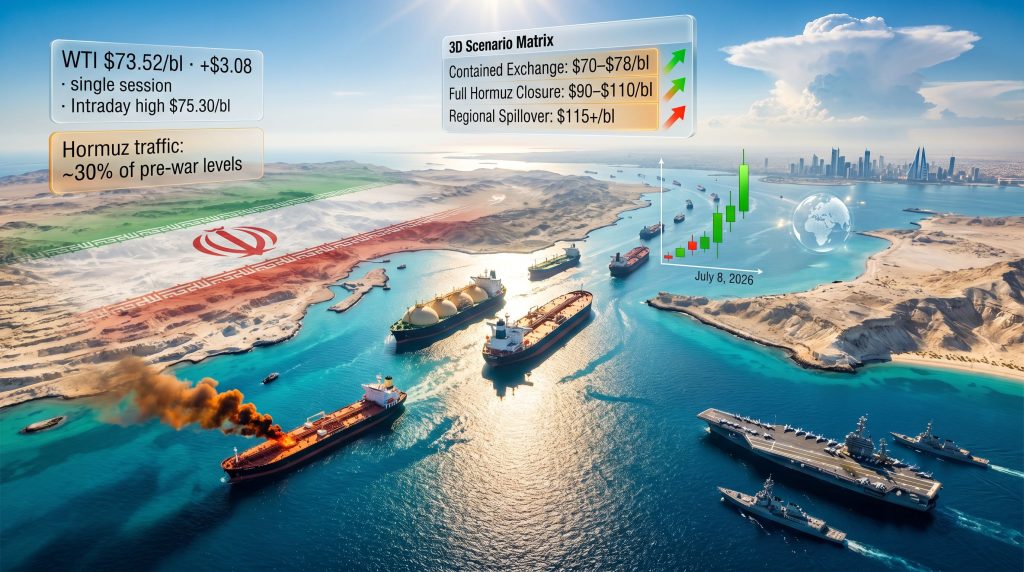
By the week immediately preceding the July 7 Iranian vessel attacks, traffic through the strait had already fallen to approximately 30% of pre-war levels. That figure alone represents one of the most significant sustained disruptions to a single energy transit corridor in the modern era.
When big ASX news breaks, our subscribers know first
How the June 18 Ceasefire Was Constructed, and Why It Collapsed
The interim memorandum of understanding signed on June 18, 2026 was structured around a straightforward quid pro quo. Iran committed to progressively reopening the Strait of Hormuz to commercial shipping, while the United States extended limited sanctions relief on Iranian crude, refined products, and petrochemical exports.
A 60-day window was built into the framework to negotiate a comprehensive peace agreement, with an August 21 deadline set for finalising the broader terms, including the contested question of Iran's nuclear programme. As a confidence-building measure, the United States agreed to remove the naval blockade it had imposed earlier in the conflict.
The Three Structural Failures That Unravelled the Deal
The agreement's collapse did not arrive suddenly. Three distinct fault lines had been widening for weeks before either government formally declared the deal void:
-
Continued Iranian interdiction activity in the strait's southern corridor, targeting vessels transiting near the Omani coastline, in the precise zone designated as the recommended safe passage route.
-
Rhetorical escalation from Washington, including President Trump's July 5 statement that the United States had passed on an opportunity to assassinate the Iranian leadership during the funeral for former Supreme Leader Ali Khamenei, killed in a US strike on February 28.
-
The unresolved nuclear question, which both governments had deferred to the August 21 deadline but which neither side had shown meaningful willingness to compromise on during the intervening weeks.
Escalation Timeline: From Signing to Active Combat
| Date | Event | Market Impact |
|---|---|---|
| June 18, 2026 | US-Iran interim deal signed | WTI crude futures decline |
| July 5, 2026 | Trump references missed assassination opportunity | Diplomatic tension spikes |
| July 7, 2026 | Iran attacks three commercial vessels in Hormuz | UKMTO raises threat level to "severe" |
| July 7-8, 2026 | US CENTCOM launches successive waves of strikes | WTI rises sharply |
| July 8, 2026 | Trump declares ceasefire "over" at NATO summit in Ankara | Oil markets surge |
Structural fragility note: The ceasefire's deterioration was underway well before either government formally declared it dead. Energy markets appear to have underpriced this fragility throughout the late June and early July period, leaving participants exposed to the July 8 price shock.
What US Military Strikes Actually Targeted in Southern Iran
US launches new strikes against Iran marked a significant operational escalation, with CENTCOM carrying out successive strike waves against Iranian military infrastructure concentrated in the country's southern reaches. The operational scope was substantial:
- More than 80 sites struck across southern Iran
- Targets included air defence networks, command-and-control nodes, and coastal radar installations
- Anti-ship missile batteries were specifically prioritised
- More than 60 Islamic Revolutionary Guard Corps (IRGC) small naval vessels were destroyed or disabled
- Strike activity concentrated near Bandar Abbas, Sirik, and Minab
- The first wave of operations lasted approximately four hours
For a visual breakdown of the initial strike operations, this CNN report provides detailed coverage of how the strikes unfolded.
Why This Strike Set Differs from Previous Iran Operations
Analysts familiar with US strike doctrine in the Gulf region should note a meaningful shift in targeting philosophy. Earlier strike packages focused heavily on nuclear-adjacent infrastructure and ballistic missile storage facilities. The July 7-8 operations, however, represent a deliberate pivot toward dismantling Iran's maritime denial capability specifically.
This shift carries significant long-term implications. Degrading IRGC coastal naval capacity does not remove Iran's ability to threaten Hormuz through ballistic missile attacks on tankers at range. However, it materially reduces the threat posed by swarm tactics, which Iranian military doctrine has long identified as its primary method for enforcing strait closure.
IRGC Small-Boat Doctrine: The Underappreciated Threat
The IRGC Navy operates a fundamentally different strategic model than conventional blue-water naval forces. Rather than capital ships, it deploys large numbers of fast attack craft, mini-submarines, and armed speedboats capable of swarming individual tankers. This doctrine allows Iran to impose navigational risk at relatively low cost and with high deniability. The US decision to target more than 60 such vessels in a single operational sequence represents a direct attempt to degrade the numerical advantage this doctrine depends upon.
Iranian Retaliation and the Escalation Pathway Map
Iran's response followed an established pattern of calibrated retaliation designed to impose costs without triggering unmanageable escalation:
- The IRGC claimed drone and missile strikes against US Fifth Fleet headquarters in Bahrain
- Attacks were also reported at Ali al-Salem air base in Kuwait
- Iranian state media reported damage to civilian infrastructure at Sirik commercial pier
- Iran claimed engagement with 85 US military sites and the downing of at least one US drone
Critically, Iranian retaliation has thus far avoided targeting neighbouring Gulf state energy infrastructure, including Saudi Arabian oil facilities, UAE export terminals, and Qatari LNG installations. This restraint is strategically significant, as attacking Gulf Cooperation Council energy assets would almost certainly trigger a broader coalition response.
Three Escalation Scenarios and Their Probability Weighting
| Scenario | Description | Estimated Probability | WTI Price Implication |
|---|---|---|---|
| Contained Exchange | Strikes remain limited to military targets; shipping partially resumes | Moderate | $70–$78/bl range |
| Full Hormuz Closure | Iran executes threatened full navigation shutdown | Lower-Moderate | $90–$110/bl range |
| Regional Spillover | Gulf state energy infrastructure targeted; broader coalition response | Lower | $115+/bl |
The full closure scenario deserves particular attention. Iran has formally declared its intention to close the strait entirely in response to continued US strikes. Whether it possesses the operational capacity to enforce that threat following the degradation of its coastal naval assets remains an open question.
Oil and Gas Market Reaction: Reading the Price Signal Correctly
The crude oil market's response to the July 8 escalation was sharp but arguably still conservative from a scenario-weighting perspective:
- August Nymex WTI settled at $73.52 per barrel on July 8, a $3.08/bl single-session gain
- Intraday the contract reached $75.30/bl, representing approximately a 7% surge
- Pre-conflict baseline had WTI trading above $72/bl before US strikes commenced on July 7
The settlement price still sits well below the levels that would reflect a full Hormuz closure scenario. Markets appear to be pricing a contained exchange as the base case, with a partial risk premium attached to the closure scenario. This positioning could be vulnerable to rapid repricing if Iranian actions signal a genuine attempt at full navigational interdiction.
LNG and Tanker Freight: The Overlooked Exposure Layer
Crude oil prices receive most of the analytical attention during Hormuz disruptions, but the LNG and freight markets carry their own distinct risk profiles:
- An LNG tanker was among the three vessels attacked by Iran in the southern Hormuz corridor on July 7
- A very large crude carrier (VLCC) was also targeted, with at least one vessel reported on fire near Oman
- War risk insurance premiums across the Mideast Gulf are repricing materially
- Qatar's 22% share of globally traded LNG routes entirely through the strait, a concentration risk not yet fully incorporated into spot markets
The Administration's Domestic Fuel Price Problem
The political economy of the conflict creates an uncomfortable contradiction for the Trump administration. The president had publicly highlighted the decline in crude futures following the June 18 deal as evidence of its economic benefit. However, retail gasoline prices had not fallen proportionally, prompting a federal investigation into potential consumer price gouging by oil companies.
The July 8 escalation directly reverses the crude price trend the administration had been promoting. This asymmetry, where consumers feel price rises faster than they benefit from price falls, creates a politically volatile environment regardless of how the military situation develops.
Sanctions Reimposition: The Supply Shock Multiplier
Compounding the transit disruption, the United States formally revoked authorisation for purchases of Iranian crude, refined products, and petrochemicals on Tuesday, July 8. This dual-shock structure, a simultaneous supply reduction and a bottleneck affecting non-Iranian barrels, creates compounding downward pressure on available global supply that the single-market price move on July 8 may not yet fully reflect.
Furthermore, the oil price trade war impact analysis becomes increasingly relevant as sanctions reimposition amplifies the existing supply shock beyond what transit disruption alone would produce.
The next major ASX story will hit our subscribers first
IMF Growth Forecasts and the Hormuz Assumption
The IMF's July 2026 World Economic Outlook projected global growth at 3.0% in 2026 and 3.4% in 2027. The forward-looking recovery scenario was explicitly built on the assumption that Hormuz energy exports would begin normalising in July 2026 and achieve full recovery by March 2027.
IMF Deputy Head of Research Petya Koeva Brooks had characterised the global economy as having weathered the conflict shock with limited evidence of second-round effects, a characterisation that predated the July 8 escalation. If the strait remains disrupted beyond the July normalisation window, both projections face material downside risk.
The Russia-Ukraine Dimension: A Compounding Supply Shock
The Hormuz crisis does not exist in isolation. Simultaneously, Ukrainian drone strikes on Russian oil refineries have created domestic motor fuel shortages inside Russia, prompting Moscow to ban diesel exports and restrict gasoline and jet fuel exports. This broader geopolitical trade disruption pattern is compounding pressure across multiple energy corridors simultaneously.
| Disruption Combination | Estimated Supply Impact | Price Range Projection |
|---|---|---|
| Hormuz at 30% + Russia export bans only | ~2–3 mb/d reduction | $75–$85/bl |
| Full Hormuz closure + Russian restrictions | ~6–8 mb/d reduction | $95–$120/bl |
| Full Hormuz closure + broader Gulf conflict | 10+ mb/d at risk | $120+/bl |
NATO's Position and the Ankara Summit Signals
The NATO summit provided several revealing signals about allied positioning. NATO Secretary General Mark Rutte characterised the US military response as "absolutely necessary", providing political cover for the escalation without committing alliance resources.
Iranian Foreign Minister Abbas Araghchi condemned the strikes as a violation of sovereignty, while IRGC-affiliated Iranian state media formally declared the memorandum of understanding "dead on both logical and rational grounds." For further context on the diplomatic backdrop, Reuters coverage of the strikes provides detailed reporting on the military and political dimensions.
The Naval Blockade Variable: The Single Most Consequential Policy Decision
Trump indicated at the NATO summit that he may re-establish the US naval blockade of Iranian trade, which had been removed as part of the June 18 deal. Its reimposition would close off virtually all remaining diplomatic off-ramps and signal a return to maximum-pressure strategy.
The administration's stated position has also shifted markedly. As recently as the prior month, Trump had publicly acknowledged that military force alone could not reopen Hormuz. The July 8 posture, oriented around "finishing the job", represents a rhetorical and strategic pivot whose underlying logic investors and energy market participants need to track closely. In addition, OPEC market influence will be a critical variable in determining whether any supply gap can be bridged if disruption deepens.
Key Takeaways for Energy Market Participants
- The June 18 ceasefire framework has effectively collapsed, with both governments on record declaring it void
- US launches new strikes against Iran signals a pivot toward dismantling Iran's maritime interdiction capability, a broader mandate with longer-term implications
- Crude markets remain positioned closer to the contained exchange scenario than to full closure
- The IMF's global growth outlook for both 2026 and 2027 carries material downside risk if Hormuz normalisation is delayed
- A dual supply shock combining Hormuz disruption and Russian export restrictions represents the most underpriced tail risk in current energy market positioning
- Iran's continued restraint in sparing Gulf state energy infrastructure is a strategic choice that could reverse rapidly if escalation intensifies
- The naval blockade reimposition decision remains the single most consequential near-term policy variable for both oil prices and diplomatic resolution prospects
Disclaimer: This article contains forward-looking analysis, scenario projections, and price range estimates based on publicly available information as of July 8, 2026. These projections involve significant uncertainty and should not be construed as financial advice. Energy markets are subject to rapid and unpredictable change. Readers should conduct independent due diligence before making any investment or commercial decisions based on geopolitical risk assessments.
Want to Identify ASX Mining Opportunities Amid Global Energy Volatility?
Discovery Alert's proprietary Discovery IQ model delivers real-time alerts on significant ASX mineral discoveries, cutting through market noise to surface actionable investment opportunities — explore historic discoveries and their returns to understand the potential, then begin a 14-day free trial at Discovery Alert to position yourself ahead of the broader market.