June 12, 2026
The Geopolitical Risk Premium: How Conflict Cycles Embed Themselves Into Crude Oil Futures
Energy markets possess a peculiar psychological architecture. Long before a single barrel of oil is physically disrupted, the mere credibility of a threat rewrites the price discovery mechanism entirely. This is the geopolitical risk premium at work, a forward-pricing phenomenon where traders essentially buy conflict insurance through futures contracts, inflating spot and forward prices in anticipation of supply events that may never fully materialise.
Understanding this mechanism is essential context for interpreting why oil extends losses as Trump calls off planned strikes on Iran, and why the subsequent price correction, while significant, remained measured rather than dramatic. Furthermore, crude oil price trends in recent months have made this kind of geopolitical sensitivity increasingly apparent to market participants.
The risk premium is not simply a knee-jerk emotional response. It reflects a rational probabilistic adjustment. Traders assign increasing weight to supply disruption scenarios as geopolitical signals intensify, and that weighting gets priced into contracts across the forward curve. When de-escalation signals emerge, the probability-weighted supply risk declines, and prices correct.
However, if the underlying dispute remains unresolved, the premium never fully deflates. That residual risk floor is what keeps markets structurally elevated even during apparent diplomatic pauses.
When big ASX news breaks, our subscribers know first
The Strait of Hormuz: A 33-Kilometre Passage That Controls Global Energy Security
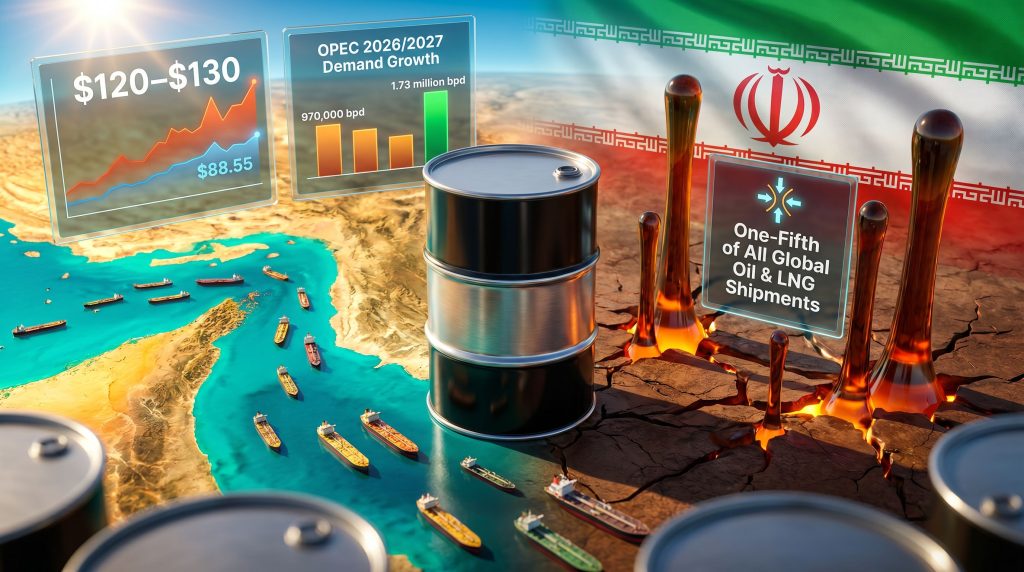
Few geographic features carry the systemic weight of the Strait of Hormuz. This narrow maritime chokepoint, connecting the Persian Gulf to the Gulf of Oman at its narrowest point of roughly 33 kilometres, is responsible for facilitating approximately one-fifth of all global oil and liquefied natural gas shipments. No other single maritime corridor concentrates this level of energy exposure.
The numbers behind this vulnerability are striking:
- Roughly 17 to 21 million barrels of crude oil and petroleum products transit the strait daily under normal conditions
- Qatar, the world's largest LNG exporter, routes the overwhelming majority of its gas shipments through Hormuz, creating dual commodity exposure for European and Asian buyers
- The primary importing nations most exposed to a Hormuz disruption include China, Japan, South Korea, and India, each of which depends heavily on Persian Gulf crude to sustain industrial output
- Alternative routing options, such as the East-West Pipeline in Saudi Arabia or the Abu Dhabi Crude Oil Pipeline, exist but carry capacity well below normal Hormuz throughput volumes
Key Structural Reality: A full Hormuz closure is not required to produce a supply shock. Sustained restrictions that reduce throughput by even 20 to 30 percent are sufficient to exhaust strategic petroleum reserves within weeks for heavily exposed importers, triggering demand destruction and economic stress across multiple continents simultaneously.
What makes the current cycle particularly complex is the contested operational picture. Iran formally announced the closure of the strait, with state forces reporting the interception of at least one tanker attempting transit without coordination. Simultaneously, the U.S. military stated through official channels that commercial vessels continued navigating the waterway.
These divergent narratives mean markets must price both the declared blockade and the incomplete enforcement of that blockade at the same time, an analytically unusual position that makes clean scenario modelling difficult. In addition, geopolitical tensions reshaping trade patterns globally have made such contested situations more commonplace in recent years.
Price Mechanics: How Brent and WTI Responded to the Diplomatic Shift
The immediate market response to signals of a potential diplomatic pause was both rapid and directionally clear. According to reporting on the situation, Brent crude futures declined by $1.83, or approximately 2%, to settle at $88.55 per barrel, while WTI crude fell $1.60, or roughly 1.8%, to $86.11 per barrel in the same session. These moves reflected a partial unwinding of the conflict premium that had been embedded during the preceding period of elevated hostilities.
The table below maps Brent and WTI pricing across the key scenario states currently in play:
| Scenario State | Brent Crude (Approx.) | WTI Crude (Approx.) | Market Interpretation |
|---|---|---|---|
| Active escalation / strike threat active | Above $90 | Above $88 | Full conflict premium priced |
| Diplomatic pause / strikes called off | ~$88.55 | ~$86.11 | Partial premium unwound |
| Confirmed ceasefire / Hormuz reopening | Low $80s support zone | Correlated decline | Risk premium largely removed |
| Ceasefire collapse / renewed hostilities | Potential $120 to $130 | Correlated surge | Full premium plus supply deficit |
IG market analyst Tony Sycamore characterised the market's reaction to the diplomatic pause as both swift and decisive, while cautioning that the downward correction remained bounded. His assessment pointed to the low $80s as a critical technical and fundamental support level for Brent, with upside risks remaining firmly intact so long as the Hormuz situation stays operationally unresolved.
Why the Asymmetry in Price Moves Matters
This asymmetry is a defining feature of the current cycle. Bearish catalysts, such as ceasefire headlines and diplomatic progress signals, tend to produce measured, single-digit percentage corrections. Bullish catalysts, particularly any confirmation of physical supply disruption, carry the potential for violent multi-dollar upside moves that compress into very short trading windows.
Investors positioned symmetrically around fair value are, consequently, systematically underexposing themselves to the skewed payoff structure this environment produces.
Why the False Dawn Pattern Persists in U.S.-Iran Conflict Cycles
A recurring feature of U.S.-Iran diplomatic cycles over the past decade has been the rapid market repricing of de-escalation signals that ultimately fail to produce durable agreements. ING analysts explicitly flagged this risk in a note, stressing that assuming any ceasefire extension represents a concluded deal would be premature. Their framework emphasised that even if a short-term agreement materialises, its durability depends on the parallel progression of nuclear talks, a negotiation track with a historically poor completion rate.
Iran's semi-official Fars news agency further complicated the diplomatic picture by reporting that Tehran had not formally endorsed any agreement text, directly contradicting the optimistic framing that had driven the price correction. This divergence between the signals coming from Washington and the signals coming from Tehran introduces substantial re-escalation risk that markets may be underweighting in the immediate aftermath of the diplomatic headline.
Three Scenarios for Hormuz and Their Oil Price Implications
Scenario-based thinking provides the most analytically useful framework for positioning around the current cycle, given the binary nature of the Hormuz situation.
Scenario A: Diplomatic Resolution and Hormuz Reopening
A functioning peace framework is finalised and Hormuz access is formally restored. Under this outcome, Brent corrects toward the low-to-mid $80s as the risk premium fully deflates. However, this scenario carries significant fragility risk. Any breakdown in the associated nuclear talks, which historically have proven extremely difficult to advance, could reverse the correction within days. This remains an uncertain base case rather than a high-confidence central projection.
Scenario B: Prolonged Stalemate and Extended Restrictions
No agreement materialises. Shipping through the strait remains severely constrained through the northern hemisphere summer. ING analysts project this pathway drives prices toward $120 to $130 per barrel as global inventory drawdowns accelerate and seasonal demand peaks converge. The analysts specifically identified late July as the critical inflection point, at which stockpile depletion and peak consumption demand create a self-reinforcing upward price dynamic that fundamentally differs from the geopolitical risk premium currently priced.
Scenario C: Re-escalation and Active Conflict
Military action resumes. Tanker traffic through Hormuz is actively disrupted beyond the current contested picture. Brent could breach the $130 threshold, with LNG markets facing simultaneous pressure given Qatar's routing dependency. The inflationary consequences of this scenario would extend well beyond energy markets, feeding through to transportation costs, manufacturing inputs, and central bank policy frameworks globally.
ING analysts noted that the market approaches a structural inflection in late July if oil flows do not resume by that point. The convergence of depleted inventory buffers and seasonally elevated demand creates the conditions for a significant price move toward the $120 to $130 per barrel range. (ING Think, June 2026)
OPEC's Consecutive Demand Downgrades: Reading the Signal Beneath the Revision
Against this backdrop of supply-side uncertainty, OPEC delivered a demand-side signal that adds analytical complexity to the market outlook. The OPEC demand revisions have seen the organisation lower its 2026 global oil demand growth forecast down to 970,000 barrels per day, compared to a prior estimate of 1.17 million barrels per day. Critically, this represents the second consecutive downward revision, a sequential pattern that markets typically interpret as an evolving consensus view rather than a one-time adjustment.
| Forecast Horizon | Previous Estimate | Revised Estimate | Change |
|---|---|---|---|
| 2026 demand growth | 1.17 million bpd | 970,000 bpd | Down ~200,000 bpd |
| 2027 demand growth | ~1.54 million bpd | 1.73 million bpd | Up ~190,000 bpd |
The drivers behind the 2026 downgrade are multifaceted. Elevated energy prices resulting from the Hormuz disruption have themselves suppressed consumption growth in price-sensitive importing economies. Broader macroeconomic headwinds, including trade war oil impact and softer industrial output in major economies, compound the demand softness. These are not temporary shocks but structural headwinds that reduce the ceiling on near-term consumption growth.
However, the simultaneous upward revision to 2027 demand growth of approximately 190,000 bpd to 1.73 million bpd introduces a medium-term dynamic that deserves equal analytical weight. OPEC market influence on this sequencing — near-term weakness followed by an anticipated rebound — creates a 12 to 18 month window of demand uncertainty that complicates investment decision-making for producers, refiners, and traders alike. Supply infrastructure decisions made against a 2026 demand downturn could leave markets structurally underprepared for the 2027 rebound OPEC projects.
Historical Precedent: How This Cycle Compares to Previous U.S.-Iran Price Shocks
Contextualising the current disruption against historical U.S.-Iran conflict episodes reveals an important distinction: previous spikes were sharp but brief, resolving within days to weeks. The current cycle has produced sustained elevated pricing over a period of months, a materially different supply-risk profile.
| Event | Brent Price Response | Duration | Resolution |
|---|---|---|---|
| 2019 Abqaiq/Khurais attacks | ~15% spike, rapid reversal | Days to weeks | Saudi production restored |
| 2020 Soleimani assassination | ~4% spike, rapid reversal | Days | Both sides de-escalated |
| 2026 Hormuz blockade cycle | Sustained elevation | Months, ongoing | Unresolved diplomatic process |
The key structural difference in the current cycle is that the disruption is not an isolated event but a sustained operational condition. Tehran's months-long restriction of Hormuz traffic represents a fundamentally different supply risk scenario than a single-event spike. It has allowed inventory drawdowns to accumulate progressively, setting up the late July inflection point that ING analysts have identified as the threshold beyond which price discovery shifts from geopolitical premium pricing to pure supply-deficit fundamentals.
The next major ASX story will hit our subscribers first
Investor Positioning Frameworks for a Contested Geopolitical Cycle
Navigating oil market exposure during an active geopolitical disruption cycle requires a different analytical framework than standard supply-demand modelling. Furthermore, the oil extends losses as Trump calls off planned strikes on Iran dynamic illustrates precisely why positioning must account for both directions of potential repricing.
Key considerations for energy market participants include:
- Treat diplomatic headlines as repricing opportunities, not resolution signals. The historical pattern of false dawns in this conflict cycle suggests that corrections following ceasefire headlines provide entry points rather than exit confirmations for long crude exposure
- Monitor the late July inventory threshold. If Hormuz flow restrictions persist into mid-July without resolution, the probability of testing the $120 to $130 range increases materially
- Watch for OPEC+ production discipline signals. Below the low $80s support level, the probability of OPEC+ cutting production to defend price floors rises, providing a natural downside buffer
- Assess LNG exposure independently. European and Asian gas market participants face compounding pressure from Hormuz restrictions that operate in parallel to but distinct from crude oil pricing dynamics
Disclaimer: This article contains forward-looking projections and scenario analysis drawn from third-party analyst commentary, including ING Think and market analyst Tony Sycamore. These projections are not investment advice and do not constitute a reliable forecast of future market conditions. Oil markets are subject to rapid and unpredictable change. Readers should conduct independent research and consult qualified financial advisers before making investment decisions.
FAQ: Oil Prices, Iran Tensions, and What Traders Need to Know
Why did oil prices fall when Trump called off planned strikes on Iran?
The decision to stand down from planned military action reduced the near-term probability of a direct supply-disrupting escalation. Markets had priced a conflict premium into futures contracts, and a portion of that premium unwound on the diplomatic signal. The correction was measured rather than dramatic, however, because the underlying Hormuz situation remained operationally unresolved. This is precisely why oil extends losses as Trump calls off planned strikes on Iran has become such a closely watched market dynamic.
What makes the Strait of Hormuz so critical to global energy prices?
Approximately one-fifth of all global oil and LNG shipments transit the strait under normal conditions. Because there is no viable full-capacity alternative routing for Persian Gulf exports, any credible restriction on Hormuz access immediately affects global supply expectations. Qatar's LNG exports, which feed European and Asian gas markets, face the same chokepoint vulnerability as crude oil flows.
What is the key technical support level for Brent crude in this cycle?
Multiple analyst frameworks converge on the low $80s as the critical support zone. Below this level, OPEC+ production discipline would likely intensify, creating a natural price floor mechanism. This level represents the threshold at which fundamental production economics and cartel behaviour reinforce each other.
What conditions would drive oil toward $120 to $130 per barrel?
ING analysts project that if Hormuz oil flows do not resume before late July, the combination of progressive inventory depletion and peak seasonal demand creates conditions for a sustained move toward the $120 to $130 range. This scenario assumes continued physical supply restrictions without diplomatic resolution.
Why did OPEC lower its 2026 demand forecast twice in a row?
The consecutive downward revisions reflect a combination of macroeconomic headwinds, demand softness in major importing economies, and the consumption-suppressing effect of elevated energy prices caused by the Hormuz disruption itself. The 2027 upward revision suggests OPEC views the weakness as cyclical rather than structural.
Does Iran's internal disagreement on any agreement affect market pricing?
Substantially. Reports indicating Tehran had not formally approved any agreement text introduce significant re-escalation risk into a market that had begun pricing in a diplomatic resolution. Any subsequent breakdown in negotiations would likely trigger a sharp upward repricing, given the supply constraints already embedded in the system.
Want to Position Ahead of the Next Major ASX Mineral Discovery?
While crude oil markets grapple with geopolitical risk premiums and supply disruption scenarios, Discovery Alert's proprietary Discovery IQ model is scanning ASX announcements in real time, delivering instant notifications on significant mineral discoveries so subscribers can identify actionable opportunities ahead of the broader market — explore the historic returns major discoveries have generated and begin a 14-day free trial to secure a market-leading edge.