June 6, 2026
What Drives Crude Oil Futures Price Volatility in Global Markets?
The global energy landscape continues to face unprecedented uncertainty as crude oil futures slip across major trading platforms worldwide. Market participants are grappling with complex US economic signals that extend far beyond traditional supply and demand fundamentals, creating a challenging environment for both institutional and retail investors seeking exposure to energy commodities.
Understanding the intricate mechanisms driving oil price movements requires analyzing multiple interconnected factors that influence market sentiment. When crude oil futures slip, as demonstrated by recent market activity, the ripple effects extend across regional exchanges from New York to Mumbai, affecting everything from refinery economics to currency markets.
Understanding Futures Contract Mechanisms
Crude oil futures operate fundamentally differently from spot market transactions, serving as standardized contracts for future delivery at predetermined prices. The April delivery contracts on exchanges like India's Multi Commodity Exchange (MCX) represent binding agreements that facilitate price discovery months in advance of physical delivery.
Furthermore, the relationship between futures and spot prices creates opportunities for arbitrage while simultaneously reflecting market expectations about future supply and demand conditions. When futures prices trade in contango, where longer-dated contracts command higher prices than near-term contracts, storage economics become profitable for market participants with access to tank capacity.
Contract month selection significantly impacts trading dynamics, as different delivery periods reflect varying seasonal demand patterns and geopolitical risk assessments. The concentration of trading activity in specific contract months often indicates where market participants expect the greatest price volatility or where commercial hedging needs are most pronounced.
Key Economic Indicators Affecting Oil Pricing
Global demand patterns demonstrate strong correlations with macroeconomic growth indicators, particularly in major consuming regions where industrial production directly impacts petroleum consumption. Economic slowdowns in key markets create cascading effects that reduce transportation fuel demand and industrial feedstock requirements.
In addition, currency fluctuations, especially US dollar strength, create additional complexity for international oil markets since crude oil contracts are predominantly dollar-denominated. When the dollar strengthens against other major currencies, oil becomes more expensive for non-dollar economies, potentially reducing demand from price-sensitive consumers.
Supply chain disruptions continue affecting global oil markets through multiple channels, from transportation bottlenecks that limit crude oil movement to refinery outages that alter demand patterns for specific crude grades. These disruptions often create temporary price premiums that sophisticated traders attempt to capture through futures positioning.
Global Crude Oil Benchmark Comparison
| Benchmark | Current Price Range | Primary Trading Exchange | Key Characteristics |
|---|---|---|---|
| Brent Crude | $82-85/barrel | ICE Futures Europe | North Sea blend, global pricing reference |
| WTI Crude | $75-80/barrel | NYMEX | Light sweet crude, US domestic marker |
| MCX Crude (India) | ₹7,150-7,200/barrel | Multi Commodity Exchange | Rupee-denominated, regional pricing |
When big ASX news breaks, our subscribers know first
How Do Regional Markets React to Global Oil Price Movements?
Regional crude oil markets demonstrate varying degrees of sensitivity to global price movements, influenced by local currency dynamics, regulatory frameworks, and domestic energy policies. The interconnected nature of modern energy markets ensures that price signals transmit rapidly across geographic boundaries, though regional factors can amplify or dampen these effects.
Asian Market Dynamics and Price Discovery
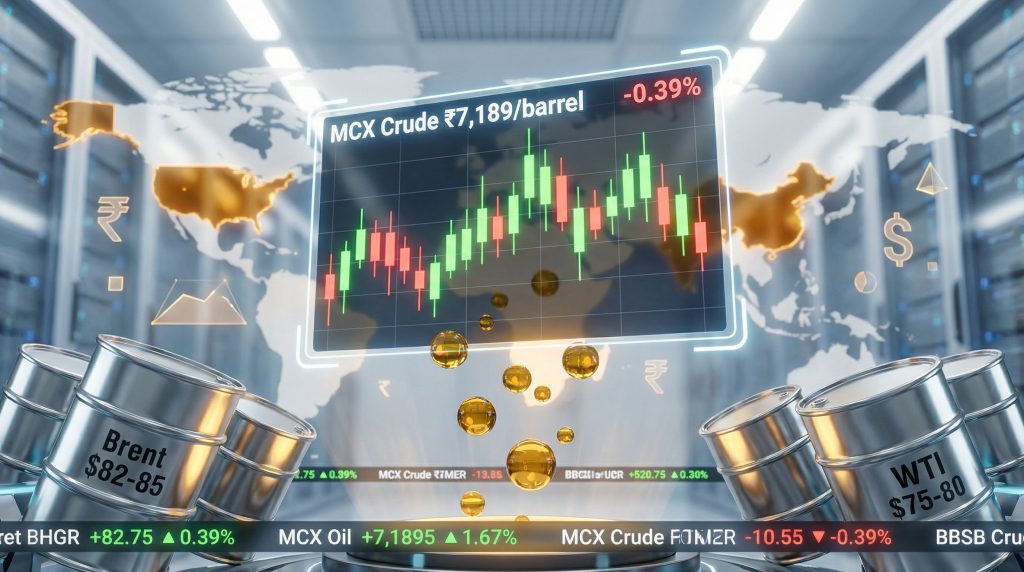
Asian crude oil markets, particularly India's MCX, serve as critical price discovery mechanisms for regional consumers and producers. The April 2026 contract performance, settling at ₹7,189 per barrel with a decline of ₹28, reflects broader market uncertainty affecting participant behavior across the region.
Regional demand patterns in emerging economies often exhibit different seasonality compared to developed markets, creating opportunities for sophisticated traders who understand these cyclical variations. Industrial demand from manufacturing centres, combined with transportation fuel consumption patterns, creates unique supply and demand dynamics that influence regional pricing.
Currency hedging strategies become essential for oil importers operating in volatile exchange rate environments. Indian refineries and trading companies must navigate both crude oil price volatility and rupee-dollar exchange rate fluctuations, creating complex risk management requirements that affect futures market participation.
Arbitrage Opportunities Between Global Benchmarks
Price differentials between major crude oil benchmarks create arbitrage opportunities for market participants with the infrastructure and expertise to execute cross-market trades. The typical premium that Brent commands over West Texas Intermediate reflects transportation costs, quality differences, and regional supply-demand imbalances.
However, transportation costs and quality premiums significantly impact the profitability of arbitrage strategies. Crude oil quality specifications, including density and sulfur content, determine processing costs at different refineries, creating value differentials that sophisticated traders monitor continuously.
Refinery processing capabilities vary significantly across regions, affecting demand for specific crude grades and creating regional price premiums. Refineries optimised for heavy crude processing may pay premiums for suitable feedstock, while those designed for light sweet crude exhibit different pricing preferences.
Market Insight: Recent market weakness reflects participant risk reduction strategies as traders respond to deteriorating spot market fundamentals and global economic uncertainty signals.
What Are the Primary Factors Behind Recent Oil Market Weakness?
The recent decline in crude oil futures across multiple markets signals fundamental shifts in supply and demand dynamics that extend beyond temporary volatility. Understanding these underlying factors provides crucial insights for market participants seeking to navigate current uncertainty and position for future price movements.
Demand-Side Pressures Across Major Economies
Economic slowdown indicators in key consuming regions have created significant downward pressure on oil demand forecasts. Industrial production data from major economies suggests weakening manufacturing activity, which directly correlates with reduced energy consumption across multiple sectors.
Transportation sector demand evolution reflects changing consumer behaviour and economic activity levels. Reduced business travel, supply chain optimisation efforts, and shifts toward remote work arrangements continue affecting fuel consumption patterns in ways that may persist beyond current economic uncertainty.
The relationship between economic growth and oil demand remains strong despite efficiency improvements and alternative energy adoption. When major economies experience synchronised slowdowns, the cumulative impact on global oil consumption creates substantial selling pressure in futures markets.
Supply-Side Dynamics and Production Strategies
Production decisions by major oil producers continue influencing market balance, though demand-side factors currently dominate price formation. Recent developments regarding oil production decline require careful timing to avoid exacerbating oversupply conditions during periods of weak demand.
Non-OPEC supply growth projections indicate continued production increases from various sources, including US shale formations and other unconventional resources. These supply additions create additional complexity for market participants attempting to forecast medium-term price trajectories.
Strategic petroleum reserve activities by major consuming nations can create temporary supply and demand imbalances that affect futures pricing. Release announcements or purchase programs often generate immediate market reactions that create trading opportunities for prepared participants.
Inventory Management and Storage Economics
Commercial crude oil inventory levels serve as key indicators of market balance, with inventory builds typically pressuring prices while draws provide support. Current inventory dynamics reflect both supply-demand fundamentals and strategic storage decisions by commercial participants.
Storage costs and contango market structures create economic incentives for inventory accumulation when future prices exceed current prices plus carrying costs. These storage arbitrage opportunities can temporarily absorb excess supply, though storage capacity constraints limit the market's ability to accommodate sustained oversupply.
Seasonal demand patterns affecting stock builds create predictable elements within otherwise volatile markets. Understanding typical seasonal inventory cycles helps market participants distinguish between temporary stock variations and fundamental supply-demand imbalances.
How Do Futures Market Participants Navigate Current Uncertainty?
Market participants employ sophisticated strategies to manage risk and capitalise on opportunities during periods of heightened volatility. The recent pattern of position reduction, evidenced by participants offloading holdings amid weak spot market demand, demonstrates active risk management across the crude oil futures complex.
Institutional Trading Strategies
Large institutional participants utilise diverse approaches to navigate uncertain market conditions, from reducing overall position sizes to implementing more complex hedging structures. The moderate trading volume of 1,514 lots on MCX during the recent price decline suggests measured position adjustments rather than panic-driven liquidation.
Portfolio managers often respond to fundamental uncertainty by reducing correlation risk across their energy holdings. This approach involves not just position sizing adjustments but also temporal diversification through spread strategies that capture relative value opportunities between different contract months.
Algorithmic trading systems increasingly influence crude oil price discovery, particularly during periods of high volatility when human traders may step away from markets. These systems often amplify price movements as they respond to technical signals and momentum indicators.
Risk Management Techniques for Volatile Markets
Options strategies provide essential downside protection for market participants concerned about further price declines. Put option purchases, collar strategies, and other derivative structures allow traders to limit losses while maintaining upside participation potential.
Spread trading between different contract months offers opportunities to profit from changing market structure while reducing directional price risk. Skilled traders monitor contango and backwardation patterns to identify mispriced temporal relationships in the futures curve.
Cross-commodity hedging with refined products allows sophisticated participants to capture processing margins while reducing crude oil price exposure. This approach requires understanding complex refinery economics and product demand patterns across different markets.
Technical Analysis and Market Sentiment Indicators
Technical analysis provides valuable insights into market psychology and potential price inflection points, though fundamental factors currently dominate crude oil price formation. Chart patterns and momentum indicators help identify key support and resistance levels that influence trader behaviour.
Chart Patterns and Support/Resistance Levels
Current price levels for major crude oil benchmarks reflect testing of important technical support zones. Brent crude at $84.45 per barrel and WTI at $79.93 per barrel represent significant price points that traders monitor for potential breakdown or bounce scenarios.
Volume analysis reveals important information about market participation during price declines. The relatively modest volume during recent weakness suggests controlled selling rather than panic liquidation, though this could change if fundamental conditions deteriorate further.
Momentum indicators help traders identify whether current price weakness represents temporary correction or the beginning of a more sustained downtrend. Multiple timeframe analysis provides perspective on whether short-term weakness contradicts or confirms longer-term trends.
Sentiment Surveys and Positioning Data
Market sentiment indicators often provide contrarian signals, with excessive bearishness potentially marking price bottoms and extreme optimism warning of potential tops. Current sentiment appears cautiously negative, reflecting uncertainty rather than capitulation.
Positioning data from regulatory reports helps identify potential squeeze scenarios where heavily positioned traders may be forced to cover positions. Understanding commercial versus speculative positioning provides insights into likely market behaviour during stress periods.
The relationship between retail and institutional positioning often reveals important market dynamics. When these two groups move in opposite directions, it frequently signals potential market turning points.
What Are the Long-Term Implications for Energy Markets?
Long-term structural changes in global energy markets continue evolving alongside cyclical price movements, creating complex investment considerations for market participants. Understanding these secular trends helps inform strategic positioning decisions that extend beyond current volatility.
Structural Changes in Global Oil Demand
Energy transition dynamics create long-term headwinds for oil demand growth, though the timing and magnitude of these changes remain subject to significant uncertainty. Electric vehicle adoption rates, renewable energy deployment, and efficiency improvements all contribute to potential demand destruction over time.
Petrochemical sector growth partially offsets declining transportation fuel demand, creating new sources of oil consumption that may prove more resilient to electrification trends. This sector transformation affects both demand patterns and price relationships between crude oil and refined products.
Geographic shifts in oil consumption toward emerging markets with different price sensitivities and demand patterns create new market dynamics. Understanding these evolving consumption patterns helps market participants identify future growth opportunities and risks.
Investment Flows and Capital Allocation Trends
Upstream investment levels significantly influence future production capacity and long-term price trajectories. Current investment patterns suggest potential supply constraints in future years, though demand uncertainty complicates investment decision-making across the energy sector.
ESG considerations increasingly affect oil sector financing, potentially constraining capital availability for traditional energy projects while directing investment toward renewable alternatives. These financing constraints may create supply shortages during periods of strong demand recovery.
Alternative energy investment growth represents both competition for capital and potential demand destruction for oil products. The pace of this transition affects long-term oil price assumptions and investment return expectations across energy markets.
Price Forecast Scenarios (2026-2027)
| Scenario | Brent Price Range | Key Assumptions | Probability |
|---|---|---|---|
| Base Case | $55-65/barrel | Moderate demand growth, stable supply | 60% |
| Bearish | $45-55/barrel | Economic recession, oversupply | 25% |
| Bullish | $70-85/barrel | Supply disruptions, strong demand | 15% |
The next major ASX story will hit our subscribers first
How Should Investors Position for Oil Market Volatility?
Strategic positioning for oil market volatility requires balancing potential opportunities against significant downside risks in an environment characterised by fundamental uncertainty. Successful navigation demands understanding both cyclical price patterns and secular industry changes that affect long-term investment returns.
Portfolio Diversification Strategies
Energy sector allocation within broader commodity exposure helps manage concentration risk while maintaining participation in potential price recovery. Implementing market volatility hedging across different energy subsectors, from upstream production to midstream infrastructure, provides exposure to various industry value chains.
Geographic diversification across oil-producing regions reduces political and regulatory risks while capturing different market dynamics. Understanding regional cost structures, production profiles, and government policies helps optimise geographic allocation decisions.
Integration with renewable energy investments creates balanced exposure to energy transition themes while hedging against different outcome scenarios. This approach requires careful attention to correlation patterns during different market environments.
Timing Considerations for Market Entry/Exit
Seasonal patterns in oil price movements provide structural opportunities for tactical positioning adjustments. Understanding typical demand seasonality, refinery maintenance schedules, and inventory cycles helps identify advantageous entry and exit points.
Economic cycle positioning requires monitoring leading indicators that predict demand changes before they manifest in price movements. Industrial production data, transportation activity, and consumer spending patterns all provide early signals of demand shifts.
Inflation protection through commodity exposure becomes particularly relevant during periods of monetary expansion and supply chain disruption. Oil futures provide direct inflation hedging while offering potential capital appreciation during economic recovery phases.
Navigating the Complex Oil Futures Landscape
The current environment in crude oil futures markets reflects a complex interplay of fundamental, technical, and sentiment factors that challenge traditional analysis frameworks. Recent price declines across major benchmarks demonstrate how global uncertainty can override short-term supply disruptions and geopolitical tensions.
Key Takeaways for Market Participants
Successful navigation requires understanding that current weakness stems primarily from demand-side concerns rather than supply disruptions. This fundamental distinction affects both the likely duration of price weakness and the most effective risk management strategies for different market participants.
Risk management becomes paramount during periods of elevated uncertainty, with position sizing and hedging strategies taking precedence over directional price speculation. The moderate trading volumes observed during recent declines suggest that prudent risk management is already influencing participant behaviour.
Long-term structural changes in energy markets create investment opportunities that extend beyond current cyclical concerns. Understanding these secular trends helps identify positioning opportunities that may prove profitable despite near-term volatility.
Market Outlook and Monitoring Framework
Critical economic indicators requiring continuous monitoring include industrial production data from major economies, inventory reports from key consuming regions, and currency movements that affect international oil trade competitiveness. These indicators provide early warning signals of fundamental shifts that drive sustained price movements.
Geopolitical developments continue requiring attention despite current demand-driven weakness, as supply disruptions can quickly alter market dynamics even during periods of weak consumption. The upcoming OPEC production meeting will be crucial in determining whether crude oil futures slip further or find support.
Technical levels and sentiment measures provide timing guidance for entry and exit decisions, particularly when combined with fundamental analysis. The convergence of technical support levels with oversold sentiment conditions often marks attractive risk-adjusted entry points for patient investors.
According to recent market analysis, oil prices have experienced significant volatility as geopolitical tensions compete with demand concerns in determining market direction.
This analysis is provided for informational purposes only and should not be considered as financial advice. Crude oil futures markets involve substantial risk and may not be suitable for all investors. Past performance does not guarantee future results, and all investments carry the risk of loss. Readers should consult with qualified financial advisors before making investment decisions.
Want to Capitalise on Energy Market Volatility?
With crude oil futures experiencing significant price swings and market participants reducing positions amid uncertainty, identifying profitable opportunities in energy commodities becomes increasingly challenging. Discovery Alert's proprietary Discovery IQ model helps investors navigate volatile markets by providing real-time insights into actionable trading opportunities across multiple sectors, including energy and resource companies that benefit from commodity price movements.