July 7, 2026
When the Pipes Reopen But Nobody Turns on the Tap
Few moments in commodity market history are as analytically complex as the aftermath of a major supply shock. The disruption itself is dramatic and visible. The recovery, however, is where the real complexity lives. Supply chains do not simply spring back to life. Demand patterns that adapted during scarcity do not automatically reverse. Inventories drawn down under duress are not immediately rebuilt. And prices, which are supposed to reflect all of this simultaneously, often tell a story that lags the physical reality by weeks or months.
That is precisely the situation confronting global crude oil markets today. Following more than 100 days of conflict that effectively shut down one of the world's most critical energy corridors, the Strait of Hormuz is reopening. But the oil market system reboot that analysts are now describing is far more intricate than a simple restoration of flows. The mechanical reconnection of supply chains is only the first chapter of a process that will play out across quarters, not weeks.
When big ASX news breaks, our subscribers know first
The Scale of What Actually Happened
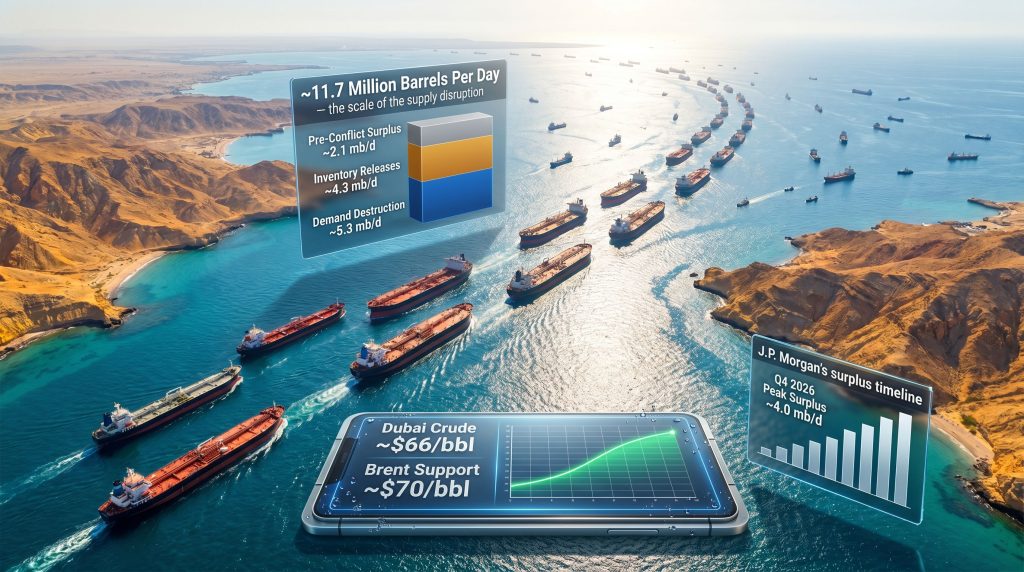
To understand where the market is heading, it is essential to first absorb the true scale of what occurred during the disruption period. According to analysis from J.P. Morgan's Global Commodities Strategy team, the conflict removed approximately 11.7 million barrels per day of supply from global circulation at its peak. To place that figure in context, that volume is roughly equivalent to two full weeks of worldwide oil consumption disappearing from the system overnight.
The global market did not collapse under that weight, but only because of an extraordinary and simultaneous deployment of multiple shock-absorption mechanisms. Furthermore, breaking those mechanisms down reveals just how close to the edge the system operated:
| Adjustment Mechanism | Estimated Volume (mb/d) | Share of Total Gap |
|---|---|---|
| Inventory Releases (Global) | ~4.3 | ~37% |
| of which U.S. Strategic Petroleum Reserve | ~1.4 | ~12% |
| Demand Destruction (Global) | ~5.3 | ~45% |
| Pre-Conflict Surplus Buffer | ~2.1 | ~18% |
| Total Supply Gap Absorbed | ~11.7 | 100% |
What this table reveals is that demand destruction, not supply substitution, carried the heaviest load. Roughly 45% of the entire supply gap was absorbed not by finding alternative barrels, but by consuming fewer of them. That is an extraordinary demand response, and it did not happen uniformly across the globe. Understanding the crude oil market dynamics behind these shifts is essential for gauging what comes next.
China's Role as an Involuntary Shock Absorber
The single most consequential demand adjustment came from China, which accounted for nearly one-third of the entire global reduction. China's impact on oil markets proved to be an outsized force during the peak disruption phase, with Chinese crude imports falling to their lowest levels since late 2016. This was driven by a combination of policy-driven and market-driven responses:
- Refinery run rates were cut sharply as input costs became prohibitive
- Coal-to-chemicals substitution was accelerated across the petrochemical sector
- Petroleum product exports were curtailed to preserve domestic supply
- Commercial stockpiles were drawn down to bridge the gap between reduced imports and domestic consumption needs
Underlying Chinese oil demand is estimated to have contracted by as much as 10%, or approximately 1.7 million barrels per day, with the petrochemical sector bearing the heaviest structural burden. Ethylene plants and propane dehydrogenation facilities faced widespread shutdowns as feedstock availability collapsed under the weight of elevated prices and supply constraints.
The indirect consequence of China absorbing this level of demand destruction was significant. By effectively subsidising its own demand destruction, China created sufficient slack in the global system to allow countries like Japan and Australia to maintain comparatively stable fuel access throughout the disruption period. This dynamic is rarely acknowledged in mainstream market commentary, but it represents one of the more important structural features of how the crisis unfolded.
The Paradox at the Heart of the Oil Market System Reboot
With Hormuz reopening, the instinct might be to expect a straightforward market recovery. Stranded barrels return, prices normalise, demand resumes. The reality is considerably more complicated, and the J.P. Morgan commodities strategy team has framed this complexity with a systems-level analogy: the oil market is attempting a reboot after a major crash, but rebooting a complex system rarely produces immediate stability. Memory lingers. Processes restart unevenly. Residual imbalances accumulate before they are resolved.
The mechanical phase of this reboot is already underway. Average crude exports from the Persian Gulf, including re-routed volumes, have recovered to approximately 19 million barrels per day, sitting around 3 million barrels per day below pre-war levels. Floating storage has declined sharply to roughly 20 million barrels, with a further 10 million barrels held in onshore tanks awaiting export. A growing queue of ballast Very Large Crude Carriers (VLCCs) is converging on the Gulf, a clear logistical signal that the physical supply chain is reconnecting.
However, here lies the central paradox of the oil market system reboot: the wave of oil preparing to enter the market is heading toward a demand structure that has already adapted to its absence. Refiners across Asia and Europe spent months securing alternative supply arrangements. July and August cargo programmes were filled using inventory releases and non-Gulf sources. When stranded Persian Gulf barrels now begin flowing in volume, the primary natural destination is China. And China, as of early July 2026, is not buying at meaningful scale.
The collision between returning supply and a market that has already restructured around reduced imports creates conditions for a temporary but potentially significant crude glut, even before any assessment of longer-term demand trajectories is attempted.
Mapping the Surplus: How Big and How Long?
The J.P. Morgan analysis projects a surplus trajectory that accelerates materially through the second half of 2026 and into 2027. These current crude price trends reflect not just supply restoration, but the lagged nature of demand recovery:
| Timeframe | Projected Oversupply (mb/d) |
|---|---|
| Initial Emergence (from ~August 2026) | ~1.2 |
| Q4 2026 Peak Surplus | ~4.0 |
| 2027 Annual Average Surplus | ~3.0 |
Strait of Hormuz flows are expected to recover to approximately 93% of pre-war levels by August, at which point the first visible surplus signals are anticipated to emerge. The progression from 1.2 million barrels per day of initial oversupply to a peak of 4.0 million barrels per day by Q4 2026 reflects not just the pace of supply restoration, but the lagged nature of demand recovery.
Ole Hansen, Head of Commodity Strategy at Saxo Bank, has pointed to the re-emergence of prompt contango across major crude benchmarks as a structural market signal worth paying close attention to. Contango, where futures prices trade above nearby spot contracts, communicates something specific and important:
- Reduced urgency among buyers to secure prompt delivery barrels
- Improved storage economics for traders willing to buy spot crude and sell it forward
- A market psychology shift from scarcity anxiety to surplus management
- A de facto price ceiling as persistent contango suppresses flat price recovery even as physical flows normalise
Hansen notes that this curve structure shift helps explain both the collapse in flat crude prices and the speed with which market sentiment has pivoted from fears of immediate scarcity to concerns about near-term oversupply. Brent crude has found support approaching the $70 per barrel level, which the market appears to be treating as a near-term floor reflecting residual geopolitical risk, rather than a price reflecting balanced fundamentals.
The Two Variables That Control Everything
Will China Return to the Market?
Dubai crude, the benchmark grade preferred by Chinese refiners, was trading near $66 per barrel in early July 2026. Historically, that price level would be considered irresistibly attractive for Chinese importers running depleted commercial inventories. Yet buying has remained subdued, reflecting a more complex set of forces than simple price sensitivity.
J.P. Morgan's base case is that China will ultimately return to the market, with crude imports expected to recover as the September loading cycle begins in August. Persian Gulf producers are anticipated to lower official selling prices for Asian deliveries to incentivise restocking. Preliminary data cited by Sparta Commodities' Head of Research Neil Crosby suggests the trough in Chinese crude imports may have already occurred approximately one month prior to early July, with tentative signs of refining interest for Arabian Gulf barrels beginning to emerge.
The J.P. Morgan demand forecast for China carries significant implications for the global price outlook:
- 2026 forecast: Chinese oil demand declines by approximately 600,000 barrels per day year-on-year
- 2027 forecast: Demand rebounds by approximately 800,000 barrels per day, leaving consumption modestly above 2025 levels
However, there is a structurally important risk embedded in that forecast. Chinese policymakers themselves are reportedly examining whether the dramatic demand contraction observed during the conflict period reflects a temporary price response or a more durable shift in consumption patterns. Record electric vehicle adoption rates and accelerated energy substitution in the industrial sector may have compressed a multi-year structural transition into a single demand shock event. If that is the case, China's future import trajectory will be permanently lower than pre-conflict assumptions implied, materially altering global oil price dynamics through 2027 and beyond.
How Fast Will Inventories Be Rebuilt?
The second critical variable is the pace of global inventory replenishment. Strategic and commercial reserves were drawn down aggressively during the conflict to maintain supply continuity. The United States alone released approximately 1.4 million barrels per day from strategic reserves. Rebuilding those buffers represents a potential source of demand that could absorb a meaningful portion of returning surplus supply.
The challenge is timing. J.P. Morgan analysts expect most buyers to defer broad-based restocking until prices become materially more compelling, with significant replenishment activity most likely commencing in early 2027 once the surplus becomes both visible and persistent enough to make storage economics genuinely attractive. Some critically depleted markets will begin restocking earlier, but widespread institutional restocking is not expected to be an immediate feature of the market's response.
Geopolitical Risk: Priced Down but Not Priced Out
One dimension of the current market situation that deserves specific attention is the incomplete resolution of the geopolitical factors that triggered the disruption in the first place. U.S.-Iran negotiations remain ongoing with multiple unresolved issues, meaning the risk premium embedded in crude pricing has diminished but not disappeared. Consequently, oil market disruptions of this magnitude rarely resolve cleanly, and the current situation is no exception.
Crosby of Sparta Commodities has identified several near-term unknowns that could materially alter the supply picture:
- Whether the recent pace of Hormuz exits is physically sustainable into July and August at the field production level
- Whether Persian Gulf field supply can maintain the exit pace observed in late June and early July
- How U.S.-Iran negotiations evolve on a lasting diplomatic framework
- What long-term U.S. strategic intentions in the region ultimately look like
The conflict has also prompted broader policy discussions around strategic reserve adequacy and supply chain diversification that were largely dormant before the disruption. The vulnerability demonstrated by a single chokepoint controlling the flow of roughly 20% of globally traded crude is unlikely to be ignored by energy security planners across importing nations. In addition, OPEC's market influence in managing the post-disruption supply environment will be critical to watch as the surplus builds through Q4 2026.
The next major ASX story will hit our subscribers first
Recovery Timelines: Mechanical vs. Structural
| Recovery Phase | Estimated Timeline | Key Milestone |
|---|---|---|
| Physical supply chain reconnection | Weeks | VLCC queue clearing; Hormuz at ~93% capacity |
| Initial surplus emergence | August 2026 | ~1.2 mb/d oversupply visible |
| Peak surplus pressure | Q4 2026 | ~4.0 mb/d oversupply |
| Broad inventory restocking begins | Early 2027 | Surplus persistent and economics compelling |
| Chinese demand recovery | H2 2026 to 2027 | +800,000 mb/d rebound projected |
| Full market equilibrium | Uncertain | Dependent on structural demand evolution |
The mechanical phase of the oil market system reboot, the physical reconnection of logistics and supply chains, is measured in weeks. True price equilibrium, which requires demand absorption, inventory normalisation, and geopolitical risk repricing, is measured in quarters to years. That gap between functional and balanced is where market participants now find themselves navigating.
What to Watch: The Market Signals That Matter Most
For investors and market observers tracking the progression of this recovery, the EIA's short-term energy outlook provides a useful macro context alongside these leading signals of how the reboot is unfolding:
- Chinese crude import volumes for August and September loading cycles, as the clearest near-term indicator of demand recovery momentum
- Hormuz flow sustainability at or above 93% of pre-war export levels through July and August
- Contango curve structure across Brent and WTI, where flattening or inversion would signal faster-than-expected surplus absorption
- Official selling price adjustments from Saudi Arabia and UAE for Asian deliveries, which would confirm producers are competing aggressively for market share
- U.S.-Iran diplomatic developments, where any deterioration would reintroduce meaningful scarcity risk premium into pricing
The oil market system reboot is progressing mechanically. The harder work, rebuilding demand confidence, normalising inventory levels, and repricing geopolitical uncertainty, is only beginning. As J.P. Morgan's strategy team has noted, finding true equilibrium after a system-level shock often takes considerably longer than restoring basic functionality. The market is reconnected. It is not yet rebalanced.
This article contains forward-looking projections and analytical commentary sourced from publicly available market research. All supply, demand, and price forecasts referenced are subject to significant uncertainty and should not be construed as financial advice. Readers should conduct their own due diligence before making any investment decisions based on commodity market outlooks.
Want to Stay Ahead of Major Commodity Discoveries Before the Broader Market Reacts?
While crude oil markets navigate a complex post-disruption reboot, significant mineral discoveries on the ASX continue to create substantial opportunities for well-positioned investors — Discovery Alert's proprietary Discovery IQ model delivers real-time alerts the moment significant ASX mineral discoveries are announced, transforming complex data across 30+ commodities into clear, actionable insights. Explore Discovery Alert's discoveries page to understand the historic returns major mineral discoveries have generated, and begin your 14-day free trial today to secure a market-leading edge.