July 7, 2026
The Geology Is Not the Problem: Why South America's Critical Minerals Promise Keeps Running Into a Wall
The history of commodity cycles is filled with regions that looked, on paper, like the answer to the world's resource needs. Vast reserves, favourable geology, growing project pipelines. Yet time and again, the distance between what lies beneath the ground and what reaches global markets proves far wider than any resource estimate can capture. South America's copper and lithium story is following a familiar arc, one where geological abundance and execution reality are pulling in opposite directions.
Understanding why requires looking beyond the headline numbers and into the structural forces that govern how South America copper and lithium supply execution challenges are actually playing out on the ground.
When big ASX news breaks, our subscribers know first
A Resource Base That Should Be Enough, But Is Not
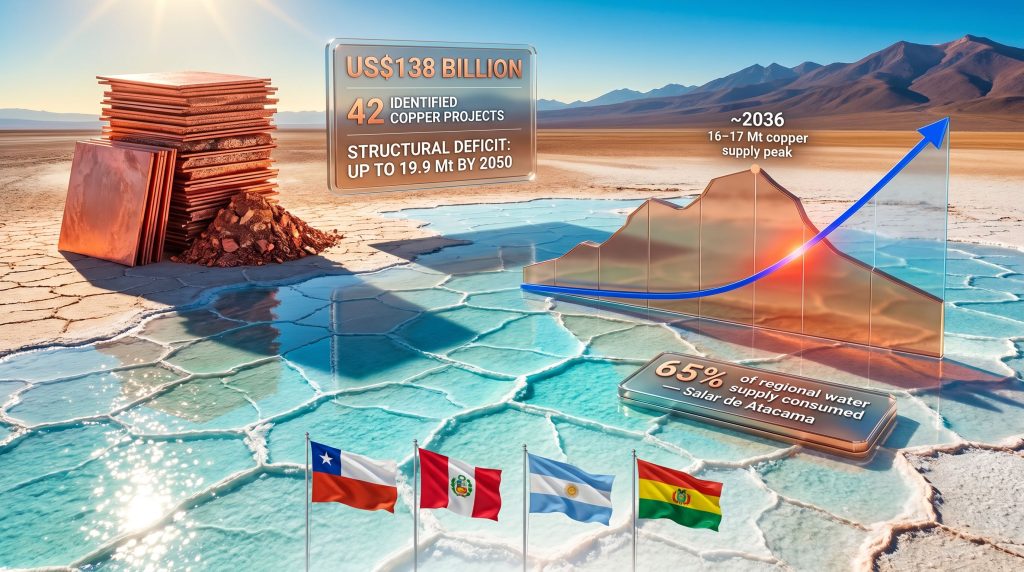
The arithmetic of South America's critical minerals position is genuinely impressive. Chile, Peru, and Argentina collectively host 42 identified copper projects representing roughly US$138 billion in projected capital investment, with a combined production potential exceeding 6 million additional tonnes of copper output. Chile alone holds the world's largest copper reserves, while the Lithium Triangle formed by Chile, Argentina, and Bolivia contains the highest known concentrations of lithium brine on the planet.
Projections presented at CESCO Week 2025 placed South America's share of global copper supply at somewhere between 34% and 48% over the coming decades. These figures position the region as structurally irreplaceable within the global energy transition, which continues demanding both copper and lithium at accelerating rates across electric vehicles, renewable infrastructure, grid modernisation, and AI-driven data centre buildouts. The scale of critical minerals demand only reinforces why execution matters as much as reserves.
Yet even if every one of those 42 identified copper projects were fully financed, permitted, constructed, and operational on schedule, analysts still project a structural global copper deficit of between 16.8 Mt and 19.9 Mt by 2050. The resource base is not the constraint. The ability to mobilise it in time is.
The 2036 Ceiling and What It Actually Means
Perhaps the most underappreciated dynamic in current copper market analysis is the convergence of the supply peak with accelerating demand growth. South American copper production is forecast to reach its ceiling at approximately 16 to 17 Mt around 2036, after which a gradual structural decline is projected through 2050. Global copper supply is expected to follow a near-identical trajectory, peaking at roughly 35 to 36 Mt before contracting.
What makes this inflection point particularly consequential is the demand side of the equation. Electrification timelines, battery manufacturing scale-up, and grid expansion programmes globally are all concentrated in the same decade. The industry effectively has a single window of roughly ten years to convert its project pipeline into stable, bankable production before the supply curve begins moving against demand rather than with it.
The 2036 horizon is not a distant planning problem. For projects with discovery-to-production timelines averaging 17 years for copper, a project initiated today does not enter production until 2042 at the earliest under conventional timelines. Many of the projects needed to meet peak supply projections are already behind schedule before construction has begun.
Production Is Growing, But the Mix Is Shifting in Uncomfortable Ways
One of the more technically significant trends within South America's copper sector is the divergence between total output growth and the declining quality of that output's processing pathway.
Data from Cochilco, Chile's national copper commission, shows that total South American copper production increased by approximately 10.4% over the last decade. On the surface, that looks positive. However, the composition of that growth tells a more complicated story.
| Production Category | Directional Trend (Last Decade) |
|---|---|
| Total South American copper output | +10.4% |
| Copper concentrate exports | +43.6% |
| Refined copper and SXEW cathodes | -28.5% |
| Chile SXEW production specifically | -31.2% |
| Chile copper smelting output | -28.0% |
| Chile total copper production since 2018 | Broadly stagnant |
The shift is structural. Solvent extraction-electrowinning, or SXEW, is a hydrometallurgical process suited to oxide copper ores, producing refined cathode copper directly without smelting. As Chile's higher-grade, near-surface oxide deposits exhaust themselves, the industry is being forced deeper into sulphide ore bodies that require concentrator circuits and flotation processing. This transition:
- Increases capital intensity substantially per tonne of copper recovered
- Raises energy and water consumption per unit of output
- Demands more sophisticated ore characterisation and classification at the front end of processing plants
- Compresses operating margins as ore grades decline and processing complexity increases
This trend signals ageing asset bases and declining ore grades across the region, not simply a shift in product form. Furthermore, it has real consequences for project economics and for the overall efficiency of the supply response. The copper supply crunch that analysts have long warned about is no longer a theoretical future event — it is already manifesting in production data.
The Execution Bottlenecks That Market Models Underestimate
Permitting: The Invisible Timeline Tax
The average time from copper discovery to first production globally is approximately 17 years, with permitting processes consuming a disproportionately large share of that span. For lithium brine projects in South America, the timeline from final investment decision to first production averages around 7 years, driven by multi-jurisdictional brine licensing frameworks, water rights adjudication, and environmental impact assessment processes that frequently interact with indigenous consultation requirements.
The practical consequence is a strong bias in the industry toward brownfield expansions over greenfield discoveries. Brownfield projects inherit existing environmental approvals and community relationships. Greenfield projects carry the full permitting burden. As capital increasingly allocates toward lower-risk brownfield paths, the long-term greenfield pipeline that would sustain supply beyond 2036 is being systematically underfunded.
Water Scarcity: The Physical Constraint That Cannot Be Engineered Away Cheaply
Lithium brine extraction is extraordinarily water-intensive, consuming approximately 500,000 gallons of water per tonne of lithium produced. In Chile's Salar de Atacama, the cumulative draw from lithium operations has consumed an estimated 65% of the region's available water supply. This has placed significant strain on local agricultural communities, fragile wetland ecosystems, and the water rights of indigenous communities whose livelihoods depend on the same aquifers.
Copper operations in the high Atacama and Andean zones face parallel pressures. The progressive depletion of freshwater sources in these arid environments is forcing producers to invest in desalination infrastructure as an operational necessity. This is capital that does not appear in the ore body, does not increase recoveries, and exists purely to sustain the physical conditions under which mining can continue.
Social Licence: The Risk That Feasibility Studies Cannot Fully Price
Research tracking mining conflict across Latin America identified that 68% of 284 recorded mining conflicts through 2020 were concentrated in South America. These conflicts share common structural drivers:
- Inadequate early community engagement that creates adversarial rather than collaborative relationships
- Unresolved indigenous land rights that intersect directly with resource concession boundaries
- Absence of enforceable community benefit-sharing agreements backed by legal remedies
- Weak environmental enforcement capacity that leaves communities without recourse when standards are breached
Communities across the Lithium Triangle have consistently raised concerns about the adequacy of consultation processes, the distribution of economic benefits, and the permanence of environmental impacts on water systems their economies depend on. These disputes translate directly into project delays, injunction applications, and investor uncertainty that is extremely difficult to model within conventional discounted cash flow frameworks. As the IEA has noted, Latin America's critical minerals opportunity is real but contingent on resolving precisely these governance and social dimensions.
Country-Level Risks Are Not Created Equal
Understanding South America copper and lithium supply execution challenges requires recognising that the region is not a monolithic risk environment. Each major jurisdiction carries a distinct risk profile.
| Country | Primary Risk Dimension | Critical Constraint |
|---|---|---|
| Chile | Productivity erosion and ore grade decline | Projected labour shortfall of ~34,000 workers by 2032; energy security for processing |
| Peru | Social conflict and political instability | Persistent community opposition; permitting uncertainty |
| Argentina | Infrastructure and regulatory fragmentation | Provincial-level regulatory inconsistency; logistics gaps in Puna lithium zones |
| Bolivia | Governance discount and technical processing barriers | High magnesium-to-lithium ratios in deposits; distances exceeding 300 miles to nearest port; absence of bankable contract frameworks |
Bolivia's Particular Problem: Contracted But Not Bankable
Bolivia occupies a unique and frustrating position in the lithium supply narrative. The country holds significant lithium brine resources, but its deposits carry high magnesium-to-lithium ratios that substantially complicate processing. Magnesium and lithium behave similarly in brine chemistry, making selective extraction technically demanding and expensive.
Beyond the mineralogical challenge, Bolivia's lithium agreements are widely regarded by international project finance practitioners as commercially unresolvable under current frameworks. Lenders extending project finance to resource developments typically require enforceable dispute resolution mechanisms, structured drawdown protections, escrowed revenue arrangements, political risk insurance coverage, and step-in rights in the event of government default on agreed terms. Bolivia's current governance environment cannot consistently provide these conditions, leaving projects in a state of being contractually agreed but financially unexecutable.
The 300-plus mile distance to the nearest export port further erodes project economics, adding logistics costs that must be absorbed against already-challenged processing margins. In addition, technologies such as direct lithium extraction may eventually offer a technical pathway for high-magnesium deposits, though commercial scale-up remains in early stages.
Chile's Productivity Paradox
Chile presents a different kind of risk. The country's institutional framework is relatively strong by regional standards, and its copper sector is the most mature in the world. Yet it faces a structural productivity erosion that is quietly compressing output despite significant capital investment. The Chile copper outlook reflects this tension between structural strength and operational headwinds.
Declining ore grades mean that more rock must be mined and processed to yield each tonne of copper. Increasing ore hardness raises grinding energy requirements and accelerates wear on comminution equipment. Water constraints are pushing capital toward desalination. A projected skilled labour deficit of approximately 34,000 workers by 2032 threatens the sector's capacity to operate existing assets at full capacity, let alone bring new projects online.
Energy security for the power-intensive processing circuits that concentrator-based production requires remains an unresolved strategic exposure, particularly as the grid transitions toward intermittent renewable generation and the mining sector's baseload requirements do not diminish. Furthermore, Argentina's growing challenge to Chile for lithium supremacy adds a competitive dynamic that may influence where capital ultimately flows across the region.
The next major ASX story will hit our subscribers first
Why Processing Performance Is Becoming the New Competitive Moat
A fundamental reorientation is taking place in how sophisticated mining investors and operators assess project quality. For much of the industry's history, resource size and grade were the primary inputs into asset valuation. A larger resource at a higher grade almost always translated to a better project.
That framework is losing explanatory power. The new competitive variable is operational execution capability: the ability to recover a high percentage of the target mineral from increasingly complex ore, to classify and screen feed material accurately, to minimise water consumption within tight regulatory constraints, and to sustain plant throughput stability under variable mineralogical conditions.
Recovery rates, which measure the proportion of target mineral successfully extracted from feed material, are directly linked to project economics in a way that is often underappreciated. A processing plant operating at 82% copper recovery versus 87% copper recovery on the same ore body produces meaningfully different economic outcomes over a mine life measured in decades. At declining ore grades, that difference compounds.
This operational reality is reshaping the role that equipment and process technology suppliers play within the mining ecosystem. The most valuable relationships are no longer purely transactional procurement arrangements. They are operational partnerships where supplier expertise in classification efficiency, screening performance, dense media separation, and tailings water recovery contributes directly to plant performance metrics that determine whether a project achieves its production targets.
Operational performance gaps, not geological limitations, are increasingly the primary driver of production shortfalls across South America's copper and lithium sectors.
Three Scenarios for How the Supply Gap Could Play Out
The trajectory of South America copper and lithium supply execution challenges will ultimately resolve across a spectrum of outcomes. Three plausible scenarios frame the range:
Scenario A: Accelerated Execution
Full permitting reform compresses approval timelines by 30 to 40%. Regional desalination and water recycling infrastructure is scaled collaboratively across producers. Indigenous consultation frameworks are standardised and legally enforced prior to project approval. Under this scenario, South America approaches the upper boundary of the 48% global copper supply share projection, and the structural deficit narrows meaningfully.
Scenario B: Status Quo Continuation
Permitting timelines remain broadly unchanged. The brownfield bias persists as the path of least resistance for capital. Water conflicts continue delaying lithium development in the Atacama and Puna. Bolivia remains commercially isolated. Supply peaks around 2036 as projected, and the structural deficit widens toward 19.9 Mt by 2050.
Scenario C: Execution Deterioration
Escalating social conflict triggers project suspensions across Peru and northern Chile. Labour shortfalls and energy insecurity push Chilean output below current levels. Political risk repricing accelerates capital withdrawal. Consequently, the structural copper deficit materialises earlier and more severely than current projections anticipate, with demand continuing to grow against a supply base that contracts ahead of schedule.
Most credible industry analysts currently assign the highest probability weight to Scenario B, with directional drift toward Scenario C if the governance, water, and labour constraints identified above are not systematically addressed within the current decade.
Frequently Asked Questions
Why is South America unable to convert its resource base into stable production?
The barriers are primarily structural rather than geological. Permitting timelines, water scarcity in arid extraction zones, social conflict concentrated heavily in the region, declining ore grades requiring more complex processing, and governance instability across key jurisdictions collectively constrain the region's ability to translate resource scale into consistent, bankable production.
What is the projected copper supply deficit by 2050?
Even under aggressive investment scenarios involving full development of all 42 identified copper projects across Chile, Peru, and Argentina, the projected structural global copper deficit ranges between 16.8 Mt and 19.9 Mt by 2050, according to projections presented at CESCO Week 2025.
How water-intensive is lithium brine extraction?
Lithium brine extraction consumes approximately 500,000 gallons of water per tonne of lithium produced. In Chile's Salar de Atacama, this has translated to consumption estimated at up to 65% of the region's available water supply, creating significant ecological, agricultural, and indigenous rights pressures.
When is South American copper supply expected to peak?
Current modelling projects peak South American copper supply at approximately 16 to 17 Mt around 2036, followed by a gradual structural decline through 2050 even as global demand continues accelerating.
Why are Bolivia's lithium resources considered difficult to commercialise?
Bolivia faces a combination of high magnesium content in its lithium brine deposits that increases processing costs significantly, export logistics disadvantages with distances exceeding 300 miles to the nearest port, and an absence of the legally certain, lender-bankable contract frameworks that international project finance requires.
Disclaimer: This article contains forward-looking projections and scenario-based analysis drawn from industry data and publicly available research. These projections involve inherent uncertainty and should not be interpreted as investment advice. Readers should conduct independent due diligence before making any investment or commercial decisions related to the mining sector.
Want to Stay Ahead of the Next Major Mineral Discovery?
Discovery Alert's proprietary Discovery IQ model scans ASX announcements in real time, instantly identifying significant mineral discoveries across copper, lithium, and more than 30 other commodities — turning complex data into clear, actionable opportunities for investors at every level. Explore how historic discoveries have delivered substantial returns and begin your 14-day free trial at Discovery Alert to position yourself ahead of the market.