July 7, 2026
The Geopolitical Pricing Equation: Why India's Crude Procurement Calculus Is More Complex Than It Appears
Crude oil markets do not operate on price alone. For the world's third-largest oil importer, every procurement decision layers commercial logic on top of compliance obligations, diplomatic signalling, and forward planning constraints that most market observers underestimate. India Iran oil waivers sit at the heart of this complexity — when a sanctions waiver lands on the desk of a state refiner's procurement team, the first question is rarely "how cheap is it?" The first question is: "how long does the window stay open, and what happens if it closes while we're mid-shipment?"
This is precisely the dynamic unfolding across India's state refining sector as of July 2026, where a new 60-day US waiver covering Iranian crude has triggered exploratory talks but no active purchase contracts. Understanding why requires moving beyond the headline discount figures and into the structural mechanics of how India actually manages its crude portfolio. Furthermore, crude oil volatility adds another layer of unpredictability that procurement teams must constantly navigate.
When big ASX news breaks, our subscribers know first
India Iran Oil Waivers: A Timeline That Explains the Current Standoff
The 2026 waiver sequence did not emerge in isolation. It is the latest chapter in a supply relationship that was abruptly severed in May 2019, when the Trump administration allowed previously granted waivers to expire, effectively ending commercial Iranian crude flows to India. At their peak in 2018, Iranian barrels accounted for roughly 10 to 11 percent of India's total crude imports, making Tehran one of New Delhi's most significant suppliers and a meaningful counterweight to Gulf pricing power.
The road back to even limited engagement has been uneven:
| Waiver Period | Duration | Key Terms | India's Response |
|---|---|---|---|
| March 2026 (Stop-Gap) | 30 days | Post-Hormuz emergency access | Approximately 530,000 tonnes imported in April |
| April 2026 (Expiry) | N/A | No renewal issued | Imports halted; reverted to pre-war position |
| July 2026 (Current) | 60 days (ends Aug 21) | USD payment permitted; full supply chain coverage | Exploratory talks underway; no active contracts |
The July 2026 waiver introduced a meaningful structural change compared to its predecessor: US dollar-denominated payment terms are now explicitly permitted. This matters considerably for Indian state refiners, which operate under institutional treasury frameworks that historically struggled with the rupee or barter-style settlement mechanisms that characterised earlier Iran trade arrangements. Dollar clearing removes one layer of operational friction, but it does not resolve the deeper constraints.
The ministerial dimension of this story should not be overlooked. Iran's Petroleum Minister Mohsen Paknejad travelled to New Delhi for the BRICS Energy Summit, where he met directly with India's Oil Minister Hardeep Singh Puri. According to reporting on the waiver developments, the two sides discussed potential bilateral energy cooperation opportunities. Diplomatic engagement at that level typically precedes commercial activity, but it rarely substitutes for it.
The Competitive Discount Problem: Why Iranian Crude Is Losing the Price War
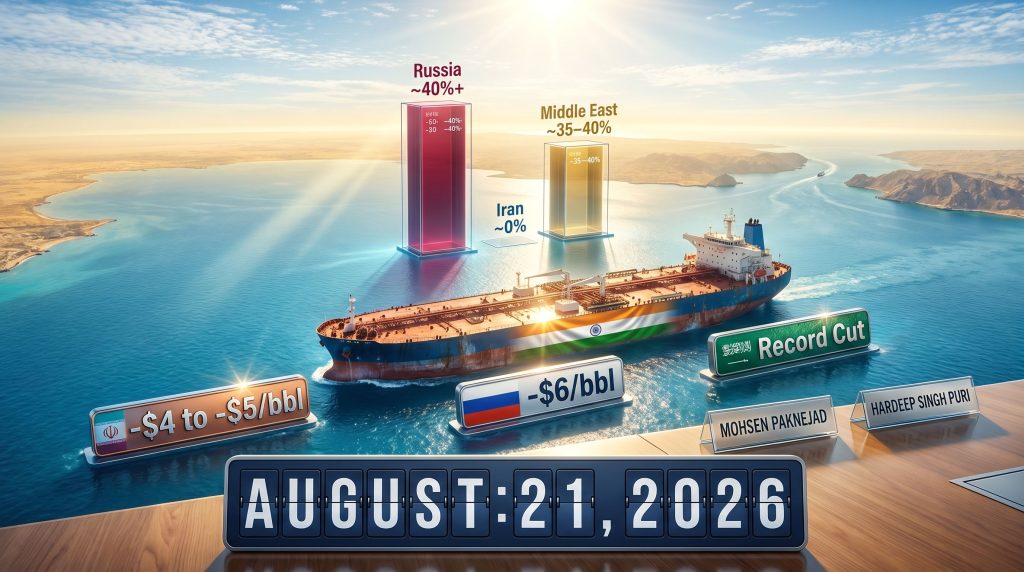
At the heart of India's hesitancy sits a straightforward arithmetic problem. Iranian crude is currently being marketed at a discount of $4 to $5 per barrel below Brent. Russian Urals, India's dominant supply source since 2023, is trading at approximately $6 per barrel below Brent. That $1 to $2 per barrel differential may appear narrow, but when multiplied across millions of barrels and weighted against compliance risk, it decisively tilts procurement decisions toward Moscow.
The competitive environment has worsened for Tehran in ways that extend beyond Russia. The ceasefire that ended hostilities around the Strait of Hormuz resolved the physical supply disruption that had briefly elevated risk premiums across Persian Gulf grades. Once freight lanes reopened, prices of crudes from both inside and outside the Gulf fell sharply, compressing the discount advantage that Iranian barrels would otherwise enjoy.
Crude Discount Comparison (July 2026)
| Origin | Discount to Brent | Sanctions Risk | Freight Cost to India | Effective Competitiveness |
|---|---|---|---|---|
| Iranian Crude | -$4 to -$5/bbl | High | Moderate | Low to Medium |
| Russian Urals | -$6/bbl | Low to Medium | Low (established routes) | High |
| Saudi Arab Light | Reduced (record monthly cut) | None | High | Low (freight-adjusted) |
| Other Middle East Grades | -$3 to -$5/bbl | None | Moderate to High | Medium |
Saudi Arabia's response to this competitive environment has been striking. The kingdom implemented its largest single monthly reduction in official selling prices since at least the year 2000, an extraordinary move that underscores just how intensely Asian crude market share is being contested. However, even with that reduction, Indian buyers reportedly find Saudi grades unattractive on a delivered-cost basis because freight rates from the Arabian Peninsula to Indian refineries erode much of the discount at the point of arrival.
"Market insight: The post-ceasefire repricing of Middle Eastern crude grades reveals a structural vulnerability in Iran's sanctions-era marketing strategy. When geopolitical risk premiums collapse, the discount that sanctioned crude must offer to compensate for compliance risk suddenly looks inadequate. Iran's pricing power is partly a function of regional instability, which creates an uncomfortable dependency."
Three Structural Barriers Blocking Immediate Procurement
Even if Iranian crude were priced at parity with Russian Urals today, Indian state refiners face a set of operational and institutional constraints that would prevent rapid uptake. These barriers are less visible than the headline discount comparison but are arguably more determinative of actual purchasing behaviour. The trade war and oil markets dynamic further complicates these procurement decisions at every level.
Barrier 1: Forward Booking Has Already Consumed Refinery Capacity
India's state-owned processors moved aggressively to pre-book crude shipments when the West Asia conflict created genuine supply uncertainty. That defensive procurement strategy was rational at the time, but it produced a consequence that now limits flexibility: refinery intake schedules are fully contracted through August 2026. Indian crude imports from Russia surged to a record 2.7 million barrels per day in June 2026, with July volumes forecast by Kpler at approximately 2.6 million barrels per day.
The record May 2026 intake of 2.3 million barrels per day under a separate Russian crude waiver further entrenched existing supply chains. Physical storage and processing constraints at refineries are finite. When berths and tank farms are allocated months in advance, a new cargo, however attractively priced, has nowhere to go.
Barrier 2: The 60-Day Window Creates a Planning Horizon Mismatch
Refinery procurement does not operate on a week-to-week basis. Standard planning cycles for state refiners run two to three months forward, covering shipping schedules, cargo nominations, letters of credit, and discharge programming. A waiver that expires on August 21, 2026 offers insufficient lead time to negotiate, execute, and schedule September delivery contracts with confidence.
This is not a trivial operational detail. It means that even refiners interested in Iranian crude are effectively waiting on two conditions before committing: either the current waiver gets formally extended, or a more durable diplomatic framework emerges that removes the August 21 cliff edge from their planning assumptions.
Barrier 3: Compliance Risk Requires Institutional Certainty
Indian Oil Corporation, Bharat Petroleum Corporation, and Hindustan Petroleum Corporation are publicly listed entities operating under institutional governance frameworks, not private trading houses. Their legal and compliance departments require a threshold of regulatory certainty before approving transactions with counterparties subject to US secondary sanctions.
The absence of a permanent Iran-US nuclear or peace agreement means that every Iranian crude purchase carries residual exposure. Bank financing for such transactions remains constrained because international correspondent banks, even those not US-domiciled, are sensitive to secondary sanctions risk. The USD payment permission in the July waiver helps at the transaction level, but it does not eliminate the underlying legal architecture that creates compliance uncertainty. In addition, the broader impact of sanctions on Russian oil trading has already demonstrated how rapidly these frameworks can reshape procurement decisions.
"Industry context: The divergence between China's expected high uptake of Iranian crude and India's measured response is not simply a reflection of differing crude preferences. It reflects a fundamental difference in how each country's state refining sector is governed. Chinese state refiners operate under a political and legal framework that explicitly accepts non-compliance with US secondary sanctions as a strategic posture. Indian state refiners, by contrast, maintain closer alignment with international financial system norms, which constrains their freedom of action even when a formal waiver technically permits procurement."
What Would Actually Shift India's Position: Four Conditions
Understanding what India is waiting for is as analytically important as understanding its current hesitancy. The following conditions, individually or in combination, would likely shift Indian state refiners from exploratory talks to active procurement:
- A formal waiver extension beyond August 21, 2026 providing sufficient planning runway for September and Q4 delivery contracts.
- Iranian pricing at or beyond the Urals threshold, meaning discounts of $6 per barrel or deeper against Brent, closing the risk-adjusted gap with Russian crude.
- Demonstrable progress on a permanent Iran-US diplomatic framework, reducing the compliance tail risk that currently deters institutional procurement sign-off.
- A government-to-government energy cooperation framework formalised between New Delhi and Tehran, building on the BRICS Energy Summit engagement and potentially providing political cover for state refiner procurement decisions.
If the waiver is extended through Q4 2026 and Iran offers crude at $7 to $8 below Brent, credible analyst estimates suggest Indian refiners could resume imports at somewhere between 200,000 and 400,000 barrels per day. That would fall well short of the 2018 peak when Iran supplied roughly one in ten barrels flowing into Indian refineries, but it would represent a commercially meaningful reentry for Tehran and a genuine diversification move for New Delhi.
India's Supplier Concentration Risk: The Strategic Backdrop
The India Iran oil waivers discussion does not occur in a vacuum. It is inseparable from a broader strategic challenge that India's energy planners have been grappling with since Russia became the country's dominant crude supplier in 2023. Concentration risk in any supply portfolio is a concern; when that concentration is centred on a supplier whose export access depends on continuing US waiver arrangements, the risk becomes acute.
The US has signalled intent to curtail the separate waiver mechanism that enabled India's record Russian crude intake in June 2026. If that waiver is tightened or removed, India would need to replace a substantial volume of supply rapidly, at a moment when Middle Eastern grades have become more expensive on a delivered-cost basis and spot market alternatives carry their own premium. Reviewing the current crude market overview makes clear just how competitive and pressured this environment has become.
India's Approximate Crude Import Supplier Concentration (Mid-2026)
| Supplier | Approximate Share | Key Risk Factor |
|---|---|---|
| Russia | 40%+ | US sanctions pressure on waiver continuity |
| Middle East (Saudi, UAE, Iraq) | 35 to 40% | High delivered freight cost; intense pricing competition |
| Iran | ~0% (exploratory) | Active sanctions framework; waiver uncertainty |
| Others (West Africa, Americas) | 15 to 20% | Spot market exposure; freight variability |
Historically, Iran served a specific strategic function within India's import portfolio: it provided leverage. When New Delhi could credibly threaten to redirect volume toward Iranian barrels, Gulf producers were more willing to negotiate on price and payment terms. The seven-year absence of Iranian crude from India's supply mix has degraded that leverage, allowing Saudi Arabia, Iraq, and the UAE to operate with greater pricing confidence in their largest Asian market.
The National Iranian Oil Company has proactively re-engaged Indian state refiners precisely because Tehran understands its own strategic vulnerability: an over-reliance on Chinese buyers reduces Iran's room to negotiate and creates the kind of monopsony dynamic that structurally disadvantages any commodity seller. Consequently, restoring even partial Indian volumes would diversify Tehran's customer base and improve its negotiating position with Beijing. Traders have confirmed that middlemen are actively approaching Indian refiners with Iranian crude offers under the current waiver framework.
The next major ASX story will hit our subscribers first
FAQ: India Iran Oil Waivers Explained
What is the current status of India's Iran oil waiver in 2026?
A 60-day US waiver issued in July 2026 permits Iranian crude production, delivery, and sale through August 21, 2026. Indian state refiners are in preliminary discussions with Iranian crude marketers but have not executed active purchase contracts under this window.
Why did India stop buying Iranian oil?
India halted Iranian crude imports in May 2019 following the expiry of a US waiver under the Trump administration's maximum pressure sanctions policy. A brief resumption occurred in early 2026 following the Strait of Hormuz closure, but imports ceased again when the March 2026 stop-gap waiver expired in April without renewal.
Is Iranian crude currently cheaper than Russian oil for Indian refiners?
No. As of July 2026, Iranian crude is offered at a $4 to $5 per barrel discount to Brent, while Russian Urals trades at approximately $6 per barrel below Brent. The wider Russian discount, combined with established logistics and lower institutional compliance risk, makes Urals the preferred option for Indian state refiners at current pricing levels.
Which Indian refiners are involved in Iran crude talks?
India's three major state-owned processors — Indian Oil Corporation, Bharat Petroleum Corporation, and Hindustan Petroleum Corporation — are all understood to be monitoring the situation and engaged in preliminary market discussions. None have publicly confirmed active procurement negotiations.
Could India resume Iranian oil imports on a permanent basis?
A permanent resumption would require either a long-duration US waiver or a comprehensive Iran-US diplomatic agreement that removes the sanctions framework. Absent that, Indian refiners are likely to treat any Iranian crude purchases as opportunistic and volume-limited, governed by waiver windows rather than structured as a long-term supply relationship.
The Broader Signal: What India's Caution Reveals About Sanctions Architecture
India's measured response to the July 2026 waiver carries implications that extend well beyond bilateral crude trade. The shifting geopolitical trade tensions reshaping global energy flows make this case study particularly instructive. Several structural observations emerge for energy market participants:
- The post-ceasefire compression of Iranian crude discounts demonstrates how rapidly geopolitical risk premiums can unwind once physical disruptions ease, removing a key pillar of sanctioned crude's competitive appeal.
- Saudi Arabia's record official selling price reduction reflects the structural oversupply dynamic now characterising Asian crude markets, where multiple suppliers are competing aggressively for a finite pool of refinery capacity.
- Sanctions compliance behaviour at India's state refiners illustrates that legal and institutional frameworks shape procurement decisions as powerfully as price signals, a reality that pure market-price analysis consistently underestimates.
- The divergence between Chinese and Indian responses to available Iranian crude reveals that the effectiveness of US secondary sanctions is not uniform but is mediated by each importing country's relationship with the international financial system.
- For Tehran, the inability to recapture meaningful Indian market share — even when a waiver technically permits it — represents the compounding cost of prolonged sanctions exposure: eroded commercial infrastructure, broken financial correspondent relationships, and a supplier credibility deficit that discount pricing alone cannot repair quickly.
Disclaimer: This article contains forward-looking analysis, market estimates, and scenario projections based on publicly available information as of July 2026. Crude pricing, waiver conditions, and procurement decisions are subject to rapid change. Nothing in this article constitutes financial or investment advice. Readers should conduct independent research before making any investment or commercial decisions.
Want to Stay Ahead of the Next Major Resource Discovery Before the Market Moves?
While geopolitical forces reshape global energy procurement and commodity flows, Discovery Alert's proprietary Discovery IQ model scans ASX announcements in real time — delivering instant alerts on significant mineral discoveries across more than 30 commodities so subscribers can act before the broader market catches on. Explore Discovery Alert's discoveries page to see how historic finds have generated extraordinary returns, and begin your 14-day free trial today to secure a genuine market-leading edge.