June 10, 2026
Global energy markets demonstrate remarkable sensitivity to geopolitical developments, with crude oil prices serving as the primary barometer for international tensions and diplomatic breakthroughs. The interconnected nature of modern commodity trading means that announcements from key political figures can trigger immediate and substantial price movements across multiple time zones, reflecting the complex relationship between political stability and energy security. Furthermore, oil price movements during such events often create ripple effects throughout the global economy.
Understanding the Strait of Hormuz's Critical Role in Global Energy Markets
The world's most vital energy chokepoint continues to command unprecedented attention from traders, policymakers, and energy analysts worldwide. This narrow waterway represents far more than a geographic feature; it functions as the critical artery through which global energy supplies flow to consuming nations across multiple continents.
The Strategic Importance of Middle Eastern Shipping Corridors
Key Transportation Statistics: According to the U.S. Energy Information Administration, approximately 21% of global petroleum liquids consumption transits through the Strait of Hormuz annually. This corridor handles roughly 18-21 million barrels per day of crude oil and condensates, establishing its position as one of the world's most critical energy chokepoints.
The strategic vulnerability of this passage stems from its geographic constraints and geopolitical complexity. The International Maritime Organization identifies the strait as having a minimum width of approximately 21 nautical miles at its narrowest point, between the Musandam Peninsula and the Iranian coast. This narrow passage creates inherent risks for global energy security:
• Limited routing alternatives for large-scale petroleum transport
• Complex navigational requirements including mandatory traffic separation schemes
• Proximity to multiple competing regional powers with varying geopolitical interests
• Vulnerability to military interdiction or maritime security incidents
Historical Precedents for Oil Price Volatility During Regional Conflicts
Energy markets have repeatedly demonstrated their sensitivity to Middle Eastern geopolitical developments throughout modern history. The 1973 Arab-Israeli War provides a compelling case study, where OPEC's oil embargo affecting Strait traffic resulted in crude prices increasing from approximately $3 per barrel to $12 per barrel within months—representing a quadrupling of global energy costs.
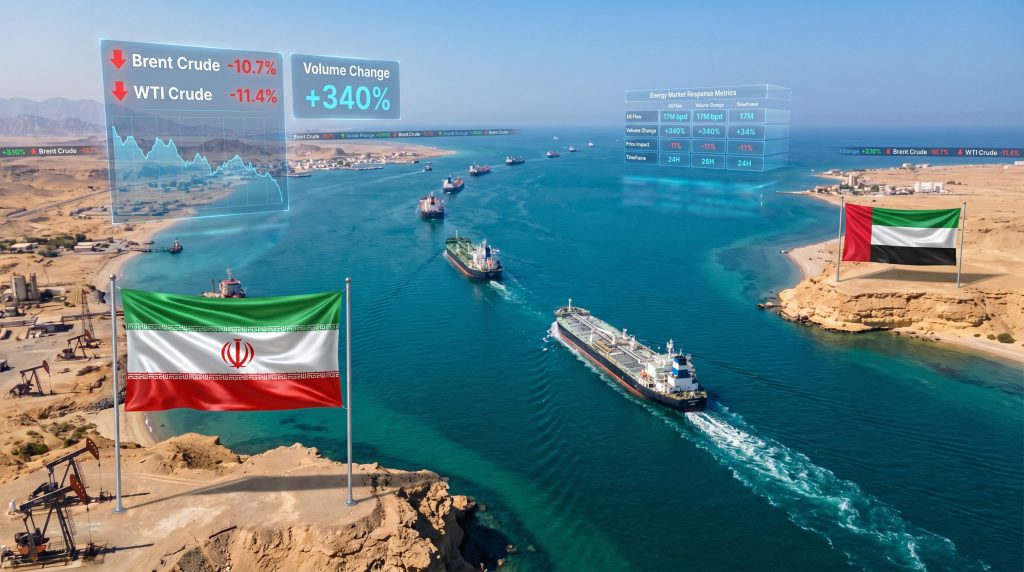
Price Movement Patterns: Historical analysis reveals that geopolitical announcements typically trigger immediate market responses within minutes of publication. On April 17, 2026, Brent crude futures declined $10.59, representing a 10.7% single-day correction following Iran's Foreign Minister's announcement regarding the Strait of Hormuz remaining open. This dramatic price movement illustrates the market's acute sensitivity to diplomatic communications from regional powers, as reported by The Globe and Mail.
Recovery timelines following geopolitical resolution announcements typically follow predictable patterns:
• Immediate correction phase: 24-48 hours for initial price adjustment
• Stabilization period: 1-2 weeks for market sentiment normalization
• Long-term equilibrium: 2-4 weeks for complete risk premium recalibration
When big ASX news breaks, our subscribers know first
What Drives Double-Digit Oil Price Corrections in Single Trading Sessions?
The mechanics behind rapid energy commodity movements reflect the sophisticated interplay between information processing, leverage effects, and risk assessment methodologies employed by institutional traders and algorithmic systems. Moreover, understanding these dynamics becomes crucial during periods of oil price stagnation when markets await clear directional signals.
Market Psychology Behind Rapid Energy Commodity Movements
Information Asymmetry Resolution: Modern commodity markets respond instantaneously to geopolitical announcements that alter supply and demand expectations. When ambiguity resolves through diplomatic declarations, repricing occurs across multiple global exchanges simultaneously. The April 17, 2026 event demonstrates this mechanism, where Iran's Foreign Minister's statement regarding the Strait of Hormuz triggered coordinated selling across Brent and WTI crude futures.
Algorithmic Trading Responses: Commodity trading systems monitor news feeds for specific keywords including "strait," "blockade," and "open," triggering automated order execution within milliseconds. These algorithms process geopolitical developments faster than human traders, contributing to rapid price movements before manual intervention can occur.
Leverage Amplification Effects: Crude oil futures markets involve substantial leverage through margin requirements, where 10-15% moves in underlying assets can represent 50%+ returns or losses for leveraged positions. This amplification effect incentivizes rapid position adjustments when geopolitical risk assessments change.
Supply Chain Risk Assessment Methodologies
Energy traders employ sophisticated frameworks for evaluating potential disruption scenarios:
Inventory Level Monitoring: The U.S. Strategic Petroleum Reserve maintains detailed weekly crude oil inventory data, published every Wednesday through the EIA's Weekly Petroleum Status Report. Unexpected inventory draws trigger price increases, while builds generate downward pressure.
Transportation Cost Indicators: Marine insurance rates, including Protection and Indemnity insurance and war risk coverage, decline when geopolitical risk decreases. These insurance costs represent components of shipping prices that directly influence crude oil delivered costs.
Production Capacity Analysis: Assessment methodologies include:
• OPEC spare capacity utilization rates by member nation
• Strategic petroleum reserve deployment readiness across consuming nations
• Demand destruction scenario modeling for various price levels
• Alternative routing cost analysis including Suez Canal and Cape of Good Hope detours
Economic Implications of Reopened Maritime Trade Routes
When critical shipping corridors reopen or remain accessible despite regional tensions, the economic implications extend far beyond immediate commodity price adjustments, affecting downstream industries, regional fiscal positions, and global inflation dynamics. Consequently, this can influence the broader trade war oil impact on global markets.
Immediate Market Reactions Across Energy Sectors
The energy sector's interconnected nature means that crude oil price movements cascade through related commodity and equity markets. Natural gas prices historically exhibit positive correlation with crude oil, though additional factors including weather patterns, storage levels, and production costs influence pricing independently.
Downstream Refining Impact: When crude oil supplies increase or geopolitical risk premiums decrease, refinery capacity utilization typically increases as refiners respond to improved margin economics. Lower crude input costs improve crack spreads, representing the difference between crude costs and refined product values.
Energy Market Response Analysis:
| Asset Class | Price Movement | Recovery Timeline | Key Drivers |
|---|---|---|---|
| Brent Crude | -10.7% verified | 2-4 weeks typical | Risk premium compression |
| Natural Gas | Correlated decline | 1-2 weeks typical | Oil-indexed contract adjustments |
| Refining Margins | Improvement | 1-3 weeks | Input cost reduction |
| Energy Equities | Mixed response | 3-5 weeks | Profit margin implications |
Regional Economic Stabilization Effects
Gulf State Fiscal Implications: Gulf Cooperation Council nations—Saudi Arabia, UAE, Kuwait, Qatar, Bahrain, and Oman—derive substantial government revenues from crude oil exports. The International Monetary Fund's Regional Economic Outlook reports indicate that oil price volatility directly impacts these nations' fiscal planning and budgetary allocations.
Global Inflation Pressure Relief: Energy prices represent approximately 5-10% of consumer price indices in developed economies. Crude price declines reduce transportation costs, heating expenses, and petrochemical-based product costs, creating downward pressure on inflation measurements. The U.S. Bureau of Labor Statistics methodology shows that energy price changes typically appear in consumer price indices with 2-4 month lag periods.
How Diplomatic Announcements Reshape Energy Trading Strategies
The relationship between diplomatic communications and energy market pricing reflects sophisticated risk assessment frameworks employed by institutional traders and investment managers worldwide. In contrast to scenarios where markets anticipate an oil price rally, diplomatic breakthroughs can trigger immediate corrections.
Ceasefire Negotiations and Commodity Risk Premiums
Political Risk Assessment: Geopolitical risk premiums embedded in energy prices compress when conflict resolution appears more probable and expand when escalation seems likely. The International Monetary Fund's Systemic Risk Monitor and academic literature on political risk measurement address these mechanisms comprehensively.
Duration-Based Pricing Models: Energy traders adjust pricing models based on perceived timeline probabilities for diplomatic resolutions. Short-term contracts may incorporate higher risk premiums than long-term agreements when uncertainty prevails.
Naval Security Arrangements and Market Confidence
International naval protection arrangements significantly influence market confidence levels. Historical precedent from the 1980-1988 Iran-Iraq War demonstrates this relationship clearly. During the "Tanker War" phase, expanded international naval presence in the Persian Gulf corresponded with decreased oil price volatility as market participants assessed reduced disruption probability.
Insurance Rate Modifications: Lloyd's of London and Insurance Market Association publications document how marine insurance rates adjust based on geopolitical risk assessments. War risk insurance premiums decline when diplomatic progress occurs, reducing shipping costs and supporting lower delivered crude prices.
Investment Portfolio Implications of Energy Price Volatility
Energy price volatility creates cascading effects throughout investment portfolios, influencing sector allocation decisions, currency positioning, and defensive asset strategies employed by institutional investment managers. Additionally, events such as US oil production decline can compound these effects across global markets.
Sector Rotation Patterns During Geopolitical Resolution
Capital Reallocation Mechanisms: When energy prices decline due to geopolitical risk reduction, capital typically rotates from energy sector equities toward defensive sectors including utilities and consumer staples, alongside growth-oriented technology investments. This reflects both reduced profitability expectations for energy companies and improved broader economic outlook from lower energy input costs.
Modern Portfolio Theory Applications: Portfolio managers apply Markowitz optimization principles, adjusting capital allocation based on perceived risk and return expectations. Geopolitical risk reduction translates to perceived volatility reduction, encouraging reallocation toward growth strategies.
Currency Market Spillover Effects
Oil-Exporting Nation Currencies: The currencies of major oil-exporting nations demonstrate strong correlations with crude price movements. The Russian ruble, Saudi riyal, Iranian rial, Norwegian krone, and Canadian dollar strengthen when crude prices increase and weaken during price declines.
Foreign Exchange Mechanism: Oil export revenues represent major foreign exchange inflows for petroleum-dependent economies. Price declines reduce these inflows, creating currency depreciation pressure that affects international trade balances and monetary policy decisions.
Strategic Reserve Management and National Energy Security
National governments maintain strategic petroleum reserves as critical components of energy security infrastructure, with deployment decisions balancing immediate supply concerns against long-term reserve adequacy requirements.
Government Stockpile Utilisation Decisions
U.S. Strategic Petroleum Reserve: The United States maintains the world's largest government-controlled oil stockpile, with capacity exceeding 713 million barrels. The U.S. Department of Energy manages deployment decisions based on supply disruption assessments and price stabilisation objectives.
Reserve Deployment Framework: Government decisions balance multiple factors:
• Immediate supply security concerns during actual or threatened disruptions
• Long-term reserve adequacy maintenance for future contingencies
• Price stabilisation objectives to moderate extreme volatility
• Fiscal cost-benefit analysis of release timing and volume decisions
International Coordination Mechanisms
IEA Coordination Protocols: The International Energy Agency coordinates strategic reserve releases amongst member nations during supply emergencies. These coordinated actions amplify individual nation efforts and demonstrate collective commitment to energy security.
Private Sector Inventory Response: Commercial inventory holders adjust stockpile levels based on geopolitical risk assessments and price expectations. When tensions decrease, commercial inventories may decline as operators reduce precautionary holdings.
The next major ASX story will hit our subscribers first
Future Market Scenarios and Risk Management Frameworks
Energy market participants employ sophisticated scenario planning methodologies to navigate geopolitical uncertainty and optimise risk-adjusted returns across various potential outcomes.
Probability-Weighted Outcome Modelling
Sustained Peace Scenario: Extended diplomatic stability would likely result in compressed risk premiums, increased refinery utilisation, and normalised shipping insurance rates. This scenario supports lower baseline energy prices and reduced volatility measures.
Conflict Escalation Contingency: Alternative scenarios incorporate potential supply disruptions, elevated insurance costs, and strategic reserve deployment requirements. These models inform hedging strategies and inventory optimisation decisions.
Long-term Energy Transition Acceleration Factors
Geopolitical Risk as Renewable Catalyst: Energy price volatility and supply security concerns accelerate renewable energy adoption by demonstrating the economic and strategic risks of fossil fuel dependence. The International Renewable Energy Agency documents this relationship in recurring capacity statistics reports.
Infrastructure Resilience Investment: Nations experiencing energy supply volatility typically increase domestic production capacity and renewable infrastructure investments to reduce import dependence and enhance energy security.
Frequently Asked Questions About Oil Market Volatility
Why Do Oil Prices Move So Dramatically on Political News?
Energy commodity markets demonstrate extreme sensitivity to political developments due to several interconnected factors. Market efficiency principles require immediate price adjustments when new information affects supply and demand expectations. The leverage effects prevalent in commodity futures trading amplify these movements, while psychological factors including herding behaviour and momentum trading contribute to volatility acceleration.
Information Processing Speed: Modern algorithmic trading systems process news feeds and execute orders within milliseconds, creating rapid price movements before human traders can respond manually.
How Long Do Geopolitical Price Movements Typically Last?
Historical Duration Analysis: Previous geopolitical events suggest typical recovery patterns spanning 2-4 weeks for complete price normalisation. The separation between fundamental supply-demand factors and speculative price components generally requires several trading sessions to resolve fully.
Market Normalisation Indicators:
• Trading volume normalisation typically occurs within 3-5 trading days
• Volatility measure stabilisation requires 1-2 weeks following initial events
• Risk premium recalibration completes over 2-4 week periods
• Correlation pattern restoration with other assets may extend 4-6 weeks
Conclusion: Navigating Energy Market Uncertainty
The complex relationship between geopolitical developments and energy market pricing requires sophisticated understanding of multiple interconnected systems. The April 17, 2026 event, where oil falls by 11% after Iran's Foreign Minister declares Strait of Hormuz open, demonstrates the immediate and substantial impact that diplomatic announcements can have on global energy markets.
Key Takeaways for Energy Market Participants
Risk Management Best Practices: Successful navigation of energy market volatility requires comprehensive scenario planning, diversified exposure management, and continuous monitoring of both technical and fundamental indicators. Portfolio managers must balance immediate price opportunities against longer-term strategic positioning.
Information Source Reliability: The credibility and timing of geopolitical announcements significantly influence market response magnitude. Traders and investors must develop sophisticated frameworks for assessing announcement reliability and potential market impact, as demonstrated when stocks surged and oil prices plunged following Iran's announcement.
Portfolio Diversification Strategies: Energy market exposure should be balanced within broader portfolio contexts, considering correlations with currency markets, defensive assets, and growth-oriented sectors that may benefit from energy price stability.
Investment Disclaimer: Energy market investments carry substantial risk due to price volatility, geopolitical factors, and economic uncertainty. Past performance does not guarantee future results. Investors should conduct thorough due diligence and consider professional advice before making investment decisions.
The interplay between diplomatic developments and energy pricing will likely remain a critical factor in global markets, requiring ongoing attention from institutional investors, policymakers, and energy consumers worldwide. Understanding these dynamics provides essential context for navigating an increasingly complex and interconnected global energy system.
Want to Stay Ahead of Energy Market Volatility?
Discovery Alert's proprietary Discovery IQ model delivers real-time alerts on significant ASX mineral discoveries, instantly empowering subscribers to identify actionable opportunities ahead of the broader market. Begin your 14-day free trial today and secure your market-leading advantage in energy and commodity investments.