June 8, 2026
Understanding Crude Oil Price Spread Mechanics in Global Markets
Energy markets operate through complex pricing mechanisms that reflect both immediate supply conditions and future expectations. Within this intricate system, crude oil price spreads serve as critical barometers of market stress, revealing tensions that may not be immediately apparent through headline pricing alone. Furthermore, these oil price movements provide essential insights into global energy security dynamics.
What Are Prompt Price Spreads and Why They Matter
Prompt price spreads represent the differential between immediate delivery contracts and forward-month settlements, functioning as sophisticated early warning systems for supply chain disruptions. These spreads capture trader sentiment regarding near-term availability versus future delivery expectations, creating a real-time assessment of market conditions that extends far beyond simple price movements.
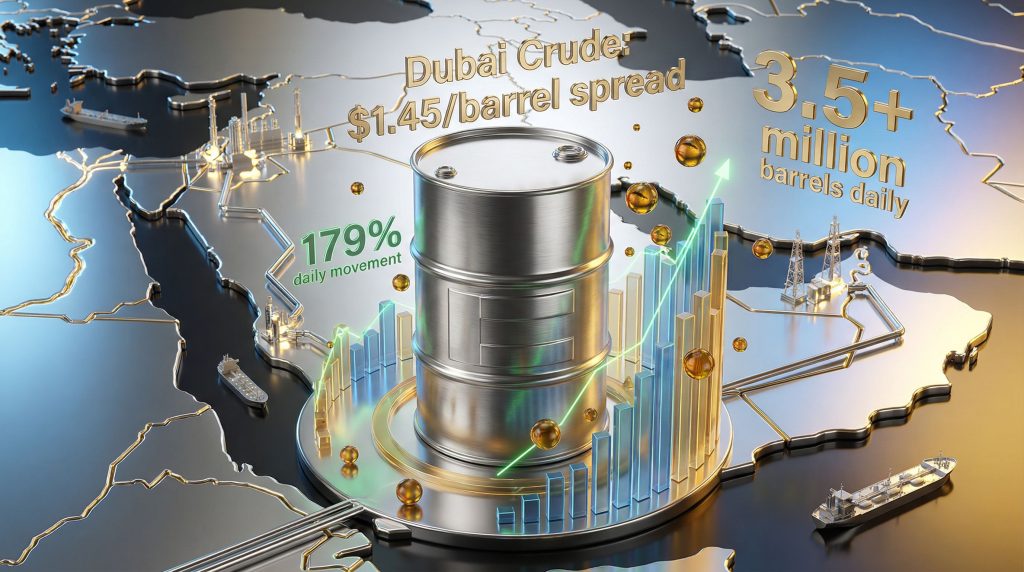
When the prompt Dubai crude price spread widens dramatically, as occurred on March 2, 2026, with the March/April spread expanding to $1.45/barrel from $0.52/barrel, markets signal acute concern about immediate supply availability. This 179% single-day increase placed the movement in the 95th percentile for daily Dubai crude spread volatility, indicating extreme market stress perception.
The mechanism operates through backwardation structures, where prompt delivery commands premiums over deferred contracts. This inverted curve reflects either immediate physical supply constraints or exceptional current demand that incentivises immediate settlement over future delivery. Unlike normal market conditions where future prices typically exceed spot prices due to storage and carrying costs, backwardation indicates urgent supply concerns.
Key Factors Driving Spread Volatility
Market dynamics behind spread movements operate through multiple interconnected channels that amplify volatility during periods of uncertainty. In addition, these factors demonstrate how oil price rally insights can help explain broader market behaviour patterns:
• Supply disruption expectations create risk premiums as traders assess probability of production losses
• Storage capacity constraints limit market participants' ability to arbitrage temporal price differences
• Trading volume patterns shift dramatically during geopolitical events, with risk-averse participants reducing exposure
• Insurance cost transmission directly impacts spread calculations as shipping premiums increase during conflict periods
The March 2026 event demonstrated how geopolitical escalation between the United States and Iran triggered immediate spread widening, as markets priced in potential supply disruption risks affecting Middle East crude exports to Asian refining centres.
When big ASX news breaks, our subscribers know first
Why Middle East Crude Benchmarks Drive Global Energy Pricing
Dubai Crude's Strategic Position in International Markets
Middle East crude benchmarks maintain outsized influence in global energy markets due to their strategic positioning within Asian demand centres and their representation of typical crude characteristics available from the region. Dubai crude specifically serves approximately 350,000-400,000 barrels per day of production, though its pricing influence extends far beyond its physical volume.
The benchmark's relevance stems from its role as the primary pricing reference for Middle Eastern crude exports to Asian refining centres, which process approximately 45% of global crude oil. This positioning creates asymmetric market effects during regional conflicts, where supply disruption risks in the Persian Gulf disproportionately widen Middle East crude spreads relative to North Sea Brent or U.S. WTI benchmarks.
Technical specifications differentiate Dubai crude from other global benchmarks:
- API Gravity: 29-32° (medium sour classification)
- Sulphur Content: 2.0-2.5% by weight
- Price Discovery: Cash-traded balance-of-month contracts via S&P Global Platts electronic platform
- Assessment Timing: Daily publication at 4:30 PM Singapore time
Regional Production Portfolio Analysis
Middle East crude production encompasses diverse grade characteristics serving distinct market functions across the global refining system. However, understanding WTI vs. Brent dynamics provides additional context for regional benchmark variations:
| Crude Grade | Daily Production | API Gravity | Sulphur Content | Primary Markets |
|---|---|---|---|---|
| Dubai | 350,000 bpd | 29-32° | 2.0-2.5% | Asian refineries |
| Oman | 950,000 bpd | 34° | <0.9% | Global markets |
| Murban | 1.4-1.6M bpd | 34-38° | <0.8% | Premium markets |
Each crude grade serves specific refining configurations: light, sweet crudes like Murban command premium pricing and serve global markets including the United States, while medium sour crudes like Dubai optimise processing economics for Asian secondary conversion refineries. This differentiation creates distinct trading patterns and spread sensitivities during market stress events.
Geopolitical Risk Assessment in Energy Markets
How Regional Conflicts Amplify Price Volatility
Geopolitical events in energy-producing regions create disproportionate market impacts through their effect on critical transportation chokepoints and production infrastructure. The Persian Gulf region's strategic importance extends beyond its production volumes to encompass shipping route vulnerability, with approximately 21 million barrels per day of crude oil transiting the Strait of Hormuz annually.
Historical analysis reveals consistent patterns in spread behaviour during Middle East tensions. For instance, research from Kpler's arbitrage analysis shows how geopolitical risks directly impact Brent-Dubai EFS (Exchange of Futures for Swaps) spreads:
• September 2019 Abqaiq attacks: Dubai spreads reached approximately $1.50/barrel
• 2011 Libya conflict: Comparable backwardation levels emerged across Middle East benchmarks
• 2022 Russia-Ukraine spillover: Regional supply concerns created sustained spread premiums
The March 2026 spread widening to $1.45/barrel follows this established pattern, reflecting supply disruption premium pricing in response to U.S.-Iran conflict escalation. Markets assessed immediate supply risks to Middle East exports through probability-weighted scenarios incorporating potential production losses and shipping delays.
Risk Premium Calculation Methodologies
Crude oil risk premiums operate through multiple transmission channels that collectively determine spread magnitudes during crisis periods. Consequently, these factors contribute to what analysts describe as oil price crash analysis during volatile market conditions:
- Supply disruption probability assessment incorporates estimated likelihood of production losses over specific time horizons
- Duration expectations affect forward curve structure based on conflict resolution timeline assumptions
- Insurance cost transmission reflects shipping premiums directly in spread calculations
- Alternative sourcing costs factor in procurement expenses from non-affected regions
War Risk Insurance rates typically increase 50-200 basis points during escalation periods, with these premiums reflected in crude spreads within 24-48 hours of geopolitical developments. Transit times through affected regions extend by 5-10 days during heightened tensions, creating additional carrying costs that support backwardation structures.
What $1+ Spread Widening Reveals About Market Fundamentals
Technical Analysis of Spread Movements
The magnitude of spread movement on March 2, 2026, provides crucial insights into market functioning under stress conditions. Moreover, these developments highlight concerns about US oil production decline and its broader market implications:
Critical Market Metrics:
- March/April Spread: $1.45/barrel (vs. $0.52 previous close)
- Single-Day Change: +$0.93/barrel absolute increase
- Percentage Movement: 179% daily expansion
- Volatility Context: Exceeds 95th percentile for daily Dubai crude spread movements
This spread level indicates extreme backwardation territory, where traders willingly pay significant premiums for immediate physical delivery over deferred settlement. The pricing mechanism reflects collective market assessment of supply disruption likelihood in the 2-4 week forward horizon corresponding to March/April delivery windows.
Supply Chain Stress Indicators
Spread widening of this magnitude typically accompanies broader supply chain adjustments as market participants anticipate inventory dynamics. According to S&P Global's latest analysis, tighter spot crude supply conditions contribute to prompt backwardation patterns:
• Refinery run rate increases as processors accelerate crude procurement ahead of potential supply disruptions
• Strategic inventory building by major consumers seeking supply security during uncertainty periods
• Alternative sourcing activation as buyers diversify supply sources away from affected regions
• Shipping route adjustments incorporating longer transit times and higher insurance costs
The prompt Dubai crude price spread widens in direct response to these fundamental supply chain adjustments, creating price signals that coordinate market participant behaviour during crisis periods.
Market Structure Evolution and Pricing Mechanisms
How Price Discovery Works in Crude Oil Markets
Modern crude oil pricing operates through sophisticated electronic platforms that integrate physical and financial market participants in real-time price formation. The Dubai crude benchmark utilises S&P Global Platts' assessment methodology, incorporating cash-traded transactions, bids, offers, and other market information to establish daily reference prices.
Price Discovery Components:
- Physical transactions reflecting actual crude delivery commitments
- Paper trading volume providing liquidity and price efficiency
- Bid/offer spreads indicating market depth and participant confidence
- Cross-commodity arbitrage linking crude prices to refined product markets
During volatile periods like March 2026, bid/offer spreads typically widen as market makers reduce position sizes and demand higher compensation for market-making activities. This reduced liquidity amplifies price movements and contributes to extreme spread volatility.
Comparative Benchmark Analysis
Dubai crude's market structure differs fundamentally from other global benchmarks in ways that affect spread behaviour. Furthermore, these differences become more pronounced during periods when the prompt Dubai crude price spread widens significantly:
Dubai vs. Brent Comparison:
- Production Base: Dubai represents 350,000 bpd vs. Brent's 750,000 bpd from North Sea fields
- Market Focus: Asian demand centres vs. European/global markets
- Crude Quality: Medium sour vs. light sweet characteristics
- Trading Mechanisms: Cash-settled balance-of-month vs. ICE futures contracts
These structural differences create distinct spread sensitivities, with Dubai crude showing greater volatility during Middle East tensions due to direct supply exposure, while Brent maintains relative stability through diversified sourcing options.
Investment and Trading Strategy Implications
Portfolio Risk Management During Spread Volatility
Energy-exposed investment portfolios face multifaceted risks during periods of extreme spread volatility that extend beyond simple commodity price movements. In addition, these risk factors require sophisticated hedging approaches:
Primary Risk Factors:
- Refining margin compression as crude cost volatility exceeds refined product price adjustments
- Transportation cost escalation affecting integrated energy companies with shipping exposure
- Currency correlation shifts as energy price volatility impacts producer country exchange rates
- Sector rotation effects as investors reallocate between energy sub-sectors based on risk profiles
Hedging Strategies during volatile periods typically incorporate:
- Spread trading to capture relative value between crude benchmarks
- Calendar spread positions exploiting backwardation/contango structures
- Cross-commodity hedging using refined product futures to offset crude exposure
- Geographic diversification across multiple crude benchmarks and production regions
Sector-Specific Impact Assessment
Different energy sector participants face varying exposure profiles during spread volatility events. However, all sectors must adapt when the prompt Dubai crude price spread widens beyond normal trading ranges:
| Sector | Primary Impact | Risk Mitigation |
|---|---|---|
| Refiners | Margin squeeze from crude cost volatility | Product price pass-through, inventory optimisation |
| Integrated Oil | Production/refining offset effects | Geographic diversification, hedging programmes |
| Shipping | Insurance cost increases, route changes | Freight rate adjustments, alternative routing |
| Petrochemicals | Feedstock cost volatility | Long-term supply contracts, vertical integration |
The next major ASX story will hit our subscribers first
Future Outlook and Market Resilience Factors
Scenario Planning for Continued Volatility
Market participants must prepare for extended periods of elevated spread volatility as geopolitical tensions continue affecting global energy trade patterns:
Base Case Scenario (60% probability):
- Gradual spread normalisation over 4-6 week period
- Return to $0.30-0.50/barrel typical backwardation levels
- Maintained regional risk premiums of 10-15%
Stress Case Scenario (25% probability):
- Sustained spreads above $1.00/barrel for 2-3 months
- Alternative supply route development acceleration
- Strategic petroleum reserve coordination among consuming nations
Extreme Case Scenario (15% probability):
- Supply disruption actualisation with spreads exceeding $2.00/barrel
- Emergency demand destruction through coordinated policy response
- Fundamental restructuring of global crude trade patterns
Long-term Market Structure Evolution
Several structural trends will influence crude oil spread behaviour and market resilience over the coming decade. Consequently, these developments will reshape how markets respond when the prompt Dubai crude price spread widens during future crises:
Technology Integration:
- Enhanced real-time monitoring systems for supply chain visibility
- Automated trading algorithms incorporating geopolitical risk models
- Blockchain-based trade finance reducing settlement times and costs
Supply Diversification:
- Renewable energy transition reducing overall crude demand growth
- Emerging market production capacity additions outside traditional regions
- Strategic stockpile optimisation through AI-driven inventory management
Regulatory Evolution:
- Enhanced market transparency requirements for commodity trading
- Coordinated policy responses to supply disruption events
- Climate policy integration affecting long-term crude demand patterns
Frequently Asked Questions About Crude Oil Spreads
What Does Backwardation Signal About Market Conditions?
Backwardation indicates immediate supply tightness or exceptionally strong current demand, where market participants willingly pay premiums for immediate delivery over future contracts. This pricing structure typically emerges during supply disruption fears, inventory drawdowns, or seasonal demand peaks. The March 2026 Dubai crude backwardation reflected market concern about potential Middle East supply interruptions affecting near-term availability.
How Do Geopolitical Events Typically Affect Oil Spreads?
Regional conflicts generally widen prompt spreads as markets incorporate supply disruption risk premiums, with effects typically persisting for 2-4 weeks depending on conflict resolution prospects. The magnitude depends on affected production volumes, strategic route vulnerability, and alternative supply availability. Middle East tensions disproportionately impact Dubai and Oman crude spreads compared to Brent or WTI due to direct regional exposure.
Why Is Dubai Crude More Relevant Than Brent for Some Markets?
Dubai crude better reflects Middle East production costs and Asian refinery configurations, making it more relevant for regional market participants. Its medium sour characteristics match typical processing requirements of Asian secondary conversion refineries, while its cash-settled trading mechanism provides flexibility for physical market participants. Approximately 60-70% of Asian refining capacity uses Dubai-linked pricing for crude procurement contracts.
The prompt Dubai crude price spread widens serve as sophisticated market indicators that extend far beyond simple commodity pricing, revealing complex interactions between geopolitical risk, supply chain dynamics, and global energy security concerns. Understanding these mechanisms provides crucial insights for navigating volatile energy markets and assessing broader economic implications of regional conflicts.
Disclaimer: This analysis contains forward-looking statements and market projections that involve inherent risks and uncertainties. Commodity markets are subject to volatile price movements influenced by numerous factors including geopolitical events, weather conditions, economic data, and regulatory changes. Past performance does not guarantee future results, and investors should conduct thorough due diligence before making investment decisions.
Looking to Capitalise on Energy Market Volatility?
Discovery Alert's proprietary Discovery IQ model delivers real-time alerts on significant ASX mineral discoveries, including energy and commodity plays that benefit from market volatility like crude oil spread movements. Subscribers receive instant notifications on actionable trading opportunities, ensuring they can respond quickly to market-moving announcements before the broader market catches up. Begin your 14-day free trial today to gain a market-leading edge in identifying the next major discovery.