June 8, 2026
Gulf Capital Moves South: Understanding the Architecture Behind the UAE–SADC Trade Corridor
Global trade corridors rarely announce themselves with fanfare. They emerge gradually, built from port concessions, bilateral frameworks, commodity flows, and patient capital deployment over years or even decades. The UAE–SADC trade corridor fits this pattern precisely. What looks from the outside like a series of unrelated commercial deals is, on closer examination, a coherent and accelerating economic architecture connecting Gulf capital to one of the world's most resource-rich regional blocs.
Understanding what is driving this convergence requires stepping back from individual transactions and examining the structural logic underneath them. The UAE has spent the past two decades repositioning itself not merely as a hydrocarbon exporter but as a global trade intermediary, logistics platform, and capital allocator. Southern Africa, meanwhile, holds some of the planet's most significant critical minerals demand, agricultural capacity, and underdeveloped infrastructure corridors. The intersection of these two trajectories is not coincidental. It is strategic.
When big ASX news breaks, our subscribers know first
What the UAE–SADC Trade Corridor Actually Is
One important distinction worth establishing early is that the UAE–SADC trade corridor does not exist as a single signed agreement or formally ratified treaty. It is better understood as an evolving commercial ecosystem assembled from multiple components operating simultaneously:
- Port concessions and operational agreements secured by DP World and Abu Dhabi Ports across Indian Ocean and Atlantic-facing African gateways
- Bilateral investment frameworks negotiated between UAE state-linked entities and SADC member governments
- Commodity trade flows channelling gold, diamonds, minerals, and agricultural products into Dubai's refining and re-export infrastructure
- Renewable energy transactions positioning UAE capital at the centre of Africa's clean energy transition
- Financial structures routed through the Dubai International Financial Centre (DIFC) and Abu Dhabi Global Market (ADGM), which serve as investment vehicles for cross-border transactions
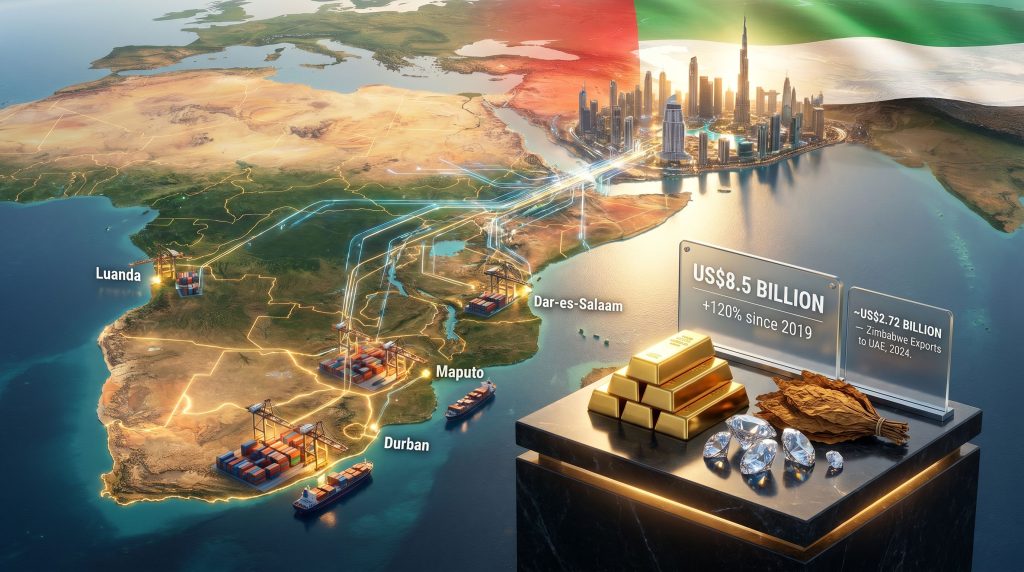
The corridor's physical backbone runs through SADC's established transport arteries. The Maputo Development Corridor, the North-South Corridor linking South Africa to Zambia and the DRC, and the Dar-es-Salaam Corridor connecting Tanzania's coast to landlocked East-Central African economies all function as the internal roads along which UAE-linked trade flows inland. UAE port interests in South Africa, Tanzania, Mozambique, and the DRC are strategically positioned at the entry points of these routes, enabling Gulf capital to act as the gateway through which Southern Africa's interior connects to global markets.
The Scale of the Relationship: Trade Numbers That Demand Attention
The aggregate scale of UAE engagement across Africa has reached a level that places the Gulf state in a category of its own among non-traditional trade partners on the continent. Total UAE–Africa trade reached approximately US$80 billion in 2022, a figure that reflects decades of deliberate commercial expansion and positions the UAE as the Gulf's dominant commercial force across African markets.
Furthermore, within that broader relationship, two SADC nations have risen to particular prominence. The table below captures the key data points that define the current state of the corridor:
| Metric | Figure | Period |
|---|---|---|
| UAE total trade with Africa | ~US$80 billion | 2022 |
| UAE–South Africa non-oil bilateral trade | US$8.5 billion | 2024 |
| Year-on-year growth (South Africa) | +14% | 2023–2024 |
| Growth since 2019 (South Africa) | +120% | 2019–2024 |
| South Africa's share of UAE Africa non-oil trade | 7.6% | 2024 |
| Mid-year bilateral flows (South Africa) | US$3.93 billion | H1 2025 |
| Zimbabwe exports to UAE | ~US$2.72 billion | 2024 |
| UAE share of Zimbabwe exports (ZimTrade) | ~35.7% | 2024 |
| UAE share of Zimbabwe exports (ZIMSTAT updated) | >50% | Post-2024 |
| UAE investment into South Africa | >US$1.3 billion | 2024 |
"The UAE has become South Africa's second-largest non-oil trade partner across Africa, with bilateral non-oil trade reaching US$8.5 billion in 2024 — representing a 120% increase since 2019. South Africa accounts for 7.6% of the UAE's total Africa non-oil trade."
South Africa's Model: Investment Depth and Export Diversification
Why Structure Matters More Than Scale Alone
South Africa's position within the UAE–SADC trade corridor is distinguished not simply by transaction volume but by the breadth and institutional depth of the relationship. Its export basket to the UAE spans precious metals, edible fruits, automotive vehicles and components, beverages, and organic chemicals. This diversification separates South Africa from the commodity-dependent export profiles common among African trading partners and signals a bilateral relationship with genuine long-term stability.
The +120% growth in non-oil trade since 2019 is particularly significant when placed in context. That period encompassed a global pandemic, commodity price cycles, South Africa's own electricity supply crisis, and shifting global supply chain realignments. The fact that trade volumes more than doubled through that turbulence indicates structural commercial linkages, not opportunistic commodity surges.
UAE Capital Flowing Into South African Assets
The investment dimension of the South Africa corridor is where the relationship most clearly transcends a transactional framework. UAE foreign direct investment into South Africa exceeded US$1.3 billion in 2024, deployed across three principal strategic areas:
- Energy sector positioning via ADNOC, which has expanded its downstream engagement and broader energy sector footprint in South Africa
- Port and logistics infrastructure through DP World, which manages critical port operations connecting South African trade to global supply chains
- Renewable energy through the Masdar-backed Infinity Power platform, including the landmark acquisition of Lekela Power
The Lekela Power transaction deserves particular attention. Completed through Masdar, the UAE's clean energy developer, the deal is broadly recognised as Africa's largest renewable energy transaction on record. Its significance goes beyond the financial headline. It signals a deliberate repositioning of UAE–Africa investment away from commodity extraction and toward renewable energy infrastructure ownership. For South Africa, which has faced persistent electricity generation shortfalls, the entry of UAE institutional capital into the renewable sector creates a pathway toward energy security that carries long-term macroeconomic consequences.
South Africa's credit profile also improved materially in this period. A Fitch ratings upgrade to BB in June 2026 reduced the sovereign risk premium facing institutional investors and is expected to improve conditions for further UAE capital deployment into the country.
Zimbabwe's Model: Commodity Velocity and the Re-Export Mechanism
How Zimbabwe Became the UAE's Fastest-Rising African Partner
Zimbabwe's trajectory within the UAE–SADC trade corridor represents one of the more underreported commercial stories in Southern Africa. Its exports to the UAE reached approximately US$2.72 billion in 2024, a figure comparable in raw scale to South Africa's export volumes despite Zimbabwe's substantially smaller formal economy.
The UAE has become Zimbabwe's single largest export destination, absorbing more than half of the country's total export value according to updated ZIMSTAT data. ZimTrade figures place the UAE's share at approximately 35.7% of Zimbabwe's total exports in 2024, with subsequent revisions pushing that figure above 50%. Both figures point in the same direction: an extraordinary concentration of export dependency on a single Gulf partner.
The Three Commodities Driving Zimbabwe's UAE Relationship
Zimbabwe's export profile to the UAE is concentrated in three categories that align precisely with Dubai's established role as a global trading and refining hub:
- Gold — Zimbabwe has been expanding artisanal and small-scale gold production alongside formal mine output. Raw and semi-refined gold flows into Dubai's precious metals ecosystem, where it is processed and redistributed across Asian, European, and North American markets. Dubai's gold refining infrastructure makes it structurally attractive as a destination for African gold producers seeking liquidity and global market access.
- Diamonds — Zimbabwe's Marange diamond fields have produced significant volumes of gem-quality and industrial diamonds. Dubai functions as a cutting, polishing, and re-export hub for these stones, channelling them toward final consumption markets in Asia and beyond.
- Tobacco — Zimbabwe remains one of Africa's leading tobacco producers, and the crop finds consistent demand within Gulf distribution networks connected to regional and Asian consumer markets.
A critical but underappreciated aspect of this flow is Dubai's role as an intermediary rather than a final market. When Zimbabwe's gold or diamonds arrive in Dubai, they are entering a sophisticated commodity processing and redistribution system, not a domestic consumption market. This has implications for how the economic value generated by Zimbabwe's resource wealth is distributed globally. The refining margin, the financial structuring fees, and the re-export spread predominantly accumulate within the UAE system rather than within Zimbabwe itself.
The Structural Risk Embedded in Zimbabwe's Position
High export concentration in three commodities creates meaningful vulnerabilities that deserve careful analysis:
- Price cycle exposure: Gold, diamonds, and tobacco are subject to distinct but sometimes correlated demand cycles. A simultaneous downturn in precious metal prices and soft commodity demand could significantly compress Zimbabwe's export revenue
- Refining margin leakage: Because Zimbabwe exports largely raw or semi-processed commodities, the value-addition premium is captured downstream in Dubai rather than domestically
- Single-market dependency: With the UAE absorbing more than half of total exports, Zimbabwe's trade revenues are disproportionately exposed to policy or regulatory shifts in a single partner jurisdiction
- Absence of reciprocal investment: Unlike South Africa, Zimbabwe has not yet attracted meaningful UAE foreign direct investment flows. The relationship is commercially asymmetric in ways that limit Zimbabwe's capacity to leverage corridor participation for broader economic development
Comparing the Two Corridor Models
| Dimension | South Africa | Zimbabwe |
|---|---|---|
| 2024 Export Value to UAE | US$8.5B (non-oil bilateral) | ~US$2.72B |
| Export Diversification | High | Low (3 commodities) |
| UAE FDI Presence | >US$1.3B | Minimal documented |
| Relationship Depth | Structural and investment-backed | Transactional and commodity-driven |
| UAE Share of Their Exports | 7.6% of UAE Africa non-oil total | >50% of Zimbabwe's total exports |
| Institutional Anchors | Dubai Chamber, ADNOC, DP World, Masdar | ZimTrade, ZIMSTAT monitoring |
| Growth Since 2019 | +120% | Rapid but concentration-dependent |
| Value-Addition Potential | High and partially realised | Significant but largely unrealised |
The next major ASX story will hit our subscribers first
The Infrastructure Layer: How Port Concessions Anchor the Corridor
The physical foundations of the UAE–SADC trade corridor are most clearly visible at the port level. DP World and Abu Dhabi Ports have secured operational interests across multiple SADC-adjacent maritime gateways, including positions in South Africa, Tanzania, Mozambique, the DRC, and Angola's Port of Luanda. These are not passive financial investments. They represent operational control over the physical chokepoints through which Southern Africa's exports reach global markets.
The strategic logic becomes clearer when mapped against the inland corridors these ports feed. UAE-managed coastal infrastructure connects directly to the North-South Corridor, the Dar-es-Salaam Corridor, and the Maputo Development Corridor. Landlocked SADC economies including Zambia, Botswana, Malawi, and Eswatini sit within reach of these UAE-anchored logistics chains.
Analysts who track Gulf trade strategy have noted that the UAE views its African logistics investments as complementary to Red Sea connectivity frameworks and emerging trade corridors, including the India–Middle East–Europe Economic Corridor architecture, rather than as standalone bilateral initiatives. This integration into the geometry of global supply chains gives the UAE–SADC trade corridor a strategic significance that extends well beyond the bilateral trade volumes it currently generates. In addition, the metals and mining geopolitics of the region continue to shape how these investments are structured and prioritised.
What the Next Phase of the Corridor Requires
For Zimbabwe: The Value-Addition Imperative
The structural evolution Zimbabwe needs to make within the corridor is well understood by trade specialists, even if it remains politically and technically difficult to execute. The priority is clear: shift from raw commodity export to processed or semi-processed output before it reaches Dubai.
Practical pathways include:
- Developing domestic gold refining capacity so that refined gold rather than raw ore reaches UAE markets, capturing the refining margin within Zimbabwe
- Building diamond cutting and polishing infrastructure to add value before export, a model Botswana has pursued with notable success through its partnership with De Beers
- Expanding tobacco processing and brand-building to capture a greater share of the final product value chain
- Engaging DIFC and ADGM as structured financing platforms for infrastructure and agribusiness project development, shifting Dubai from a commodity destination to a capital source
For South Africa: Deepening the Clean Energy and Technology Mandate
South Africa's corridor maturity creates a different set of strategic opportunities. The Lekela Power acquisition establishes a template that could be replicated across green hydrogen development, battery storage infrastructure, and grid modernisation projects. Moreover, South Africa's improving sovereign credit profile following the Fitch upgrade to BB creates more favourable conditions for UAE institutional capital to enter longer-duration infrastructure projects.
Future growth vectors for the South Africa–UAE relationship include agribusiness value chains aligned with UAE food security priorities, logistics digitalisation across the port and freight rail network, and the potential for South Africa to function as a regional clean energy platform supplying neighbouring SADC economies through interconnected grids backed by UAE capital. The broader dynamics of energy transition minerals will also continue to shape investment priorities across the corridor.
For the Corridor as a Whole: The CEPA Question
Perhaps the most significant structural evolution available to the UAE–SADC trade corridor is formalisation through a framework agreement. The UAE's Comprehensive Economic Partnership Agreements (CEPAs) with India, Indonesia, and other major economies have demonstrated how converting informal trade relationships into governed frameworks can accelerate investment flows, reduce regulatory friction, and provide long-term confidence to institutional investors.
A SADC-level CEPA with the UAE remains speculative at this stage, but the precedent is established. Formalising the corridor through an institutionalised bilateral investment and trade framework would represent the single most powerful catalyst for scaling the relationship beyond its current commodity-and-logistics foundation. Furthermore, African mining finance trends suggest that corridor formalisation could unlock substantially larger flows of structured capital into the region's resource sectors.
Disclaimer: This article contains forward-looking analysis, scenario projections, and third-party trade data. Figures cited reflect the most recently available data at time of writing. Readers should independently verify all data points and should not treat this article as financial or investment advice. Trade statistics sourced from ZimTrade, ZIMSTAT, and Dubai Chamber publications may be subject to revision.
Frequently Asked Questions: UAE–SADC Trade Corridor
What is the UAE–SADC trade corridor?
The UAE–SADC trade corridor refers to the network of bilateral trade relationships, port concessions, logistics infrastructure investments, and commodity flows that connect the United Arab Emirates to the Southern African Development Community. It is not a single formal agreement but an evolving commercial architecture anchored by UAE state-linked entities including DP World, Abu Dhabi Ports, ADNOC, and Masdar.
Which SADC countries trade most with the UAE?
South Africa and Zimbabwe are the two dominant SADC partners in UAE trade. South Africa recorded US$8.5 billion in non-oil bilateral trade with the UAE in 2024, while Zimbabwe's exports to the UAE reached approximately US$2.72 billion in the same year, making the UAE Zimbabwe's single largest export market.
What does South Africa export to the UAE?
South Africa's export basket to the UAE includes precious metals, edible fruits, automotive vehicles and components, beverages, and organic chemicals — one of the most diversified export profiles among African nations trading with the Gulf.
What does Zimbabwe export to the UAE?
Zimbabwe's exports to the UAE are concentrated in gold, diamonds, and tobacco. Dubai serves primarily as a refining and re-export hub for these commodities rather than as the final consumption market.
Is UAE investment flowing into SADC countries?
Yes. UAE investment into South Africa alone exceeded US$1.3 billion in 2024, with ADNOC, DP World, and Masdar through Infinity Power as the primary investors. DP World and Abu Dhabi Ports also hold port concessions or operational interests in Tanzania, Mozambique, the DRC, and Angola.
What was the Lekela Power deal?
The acquisition of Lekela Power by Infinity Power, completed through Masdar, is recognised as Africa's largest renewable energy transaction to date. It represents a strategic shift in UAE–Africa investment from commodity trade toward clean energy infrastructure.
How does Dubai benefit from SADC commodity trade?
Dubai functions as a global refining, re-export, and financial intermediary hub. Gold, diamonds, and other commodities from SADC nations flow into Dubai's established trading ecosystem where they are refined, re-exported, or financially processed before reaching end markets across Asia, Europe, and beyond.
Want to Know Which ASX-Listed Miners Are Positioned in the Critical Minerals Driving This Trade Corridor?
Discovery Alert's proprietary Discovery IQ model instantly identifies significant ASX mineral discoveries — including the gold, diamonds, and critical minerals central to emerging trade corridors like UAE–SADC — delivering real-time alerts that transform complex geological data into actionable investment insights. Explore why major mineral discoveries have historically generated extraordinary returns on Discovery Alert's dedicated discoveries page, and begin your 14-day free trial today to position yourself ahead of the broader market.