June 8, 2026
When Chokepoints Become Catalysts: Understanding the 2026 Oil Price Surge
Energy markets have always been deeply sensitive to geography. The physical pathways through which crude oil moves from production zones to consuming nations represent concentrated points of systemic vulnerability. History has repeatedly demonstrated that when those pathways face disruption, price signals respond faster than any policy mechanism can intervene. In 2026, that principle is playing out with unusual intensity across the Middle East, where a cascading series of conflict escalations has produced one of the most structurally complex oil supply disruptions in recent decades.
The events of June 8, 2026 are not isolated. They are the latest expression of a conflict architecture that has been building since February, when US and Israeli strikes on Iranian territory triggered a blockade of the Strait of Hormuz. What followed was a chain of diplomatic attempts, partial pauses, and renewed escalations that have kept energy markets in a sustained state of elevated uncertainty. Furthermore, understanding the broader geopolitical oil price analysis helps contextualise why these disruptions carry such outsized market consequences.
When big ASX news breaks, our subscribers know first
The Lebanon Flashpoint and Its Connection to Global Oil Supply
To understand why oil prices rise on Israel strikes on Lebanon, it is necessary to map the connections between what appears to be a regional bilateral conflict and the broader architecture of global energy supply. Those connections are not incidental; they are structural.
Israel invaded Lebanon in March 2026 following sustained rocket and drone attacks across the border by Hezbollah, the Iran-backed militant group. A ceasefire was reached in April, but violence continued regardless. A second ceasefire was brokered on June 3, 2026, following negotiations in Washington. That agreement lasted less than a week before Israel launched fresh strikes on Lebanese territory on June 8.
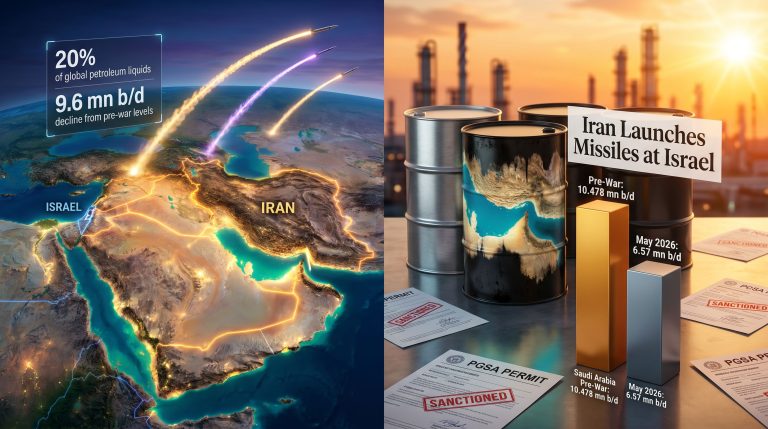
Iran's response was immediate. Tehran launched missiles toward Israel in retaliation for the strikes on Hezbollah positions in Beirut. US President Donald Trump publicly indicated he would press Israeli Prime Minister Benjamin Netanyahu to avoid retaliating against Iran, introducing a new layer of diplomatic complexity into an already volatile situation.
The market implications crystallised quickly:
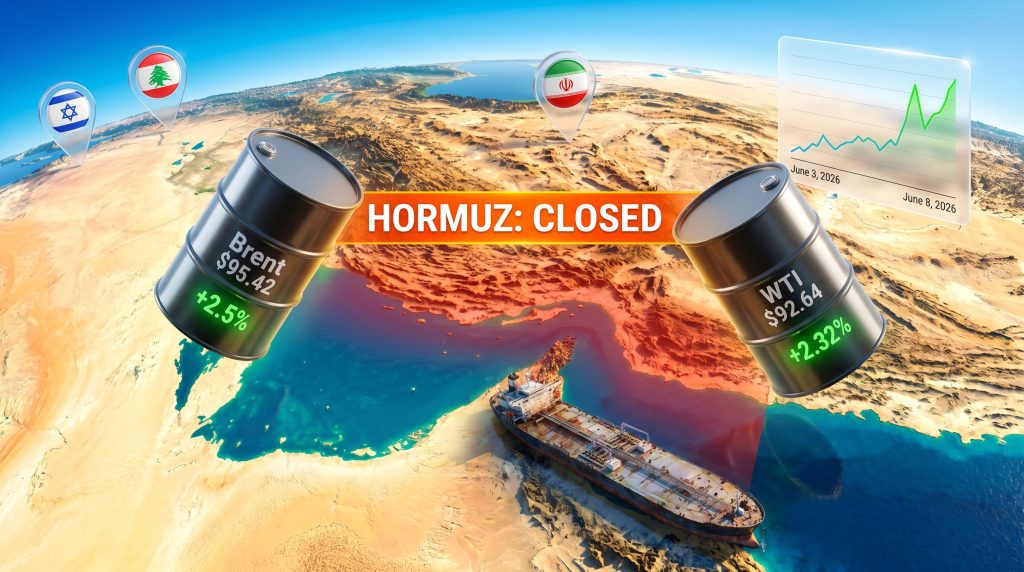
- Brent crude futures rose by $2.33 per barrel, reaching approximately $95.42, a gain of 2.5%
- WTI (West Texas Intermediate) futures climbed by $2.10 per barrel to approximately $92.64, a rise of 2.32%
- Monday's gains effectively erased most of the losses recorded on the previous Friday, when prices had retreated on optimism around potential US-Iran de-escalation
The speed and scale of the price response reflects something more specific than routine geopolitical anxiety. It reflects the market's understanding of a particular diplomatic linkage: Iran has formally conditioned any peace agreement with Washington on the achievement of a ceasefire in Lebanon. Every time the Lebanon ceasefire collapses, it resets the diplomatic timeline for a US-Iran agreement, which in turn resets the timeline for Hormuz reopening, sustaining the global crude supply disruption.
The Strait of Hormuz: A Chokepoint With No Easy Substitute
The Strait of Hormuz, the narrow maritime corridor connecting the Persian Gulf to the Gulf of Oman and onwards to global shipping lanes, handles a disproportionate share of the world's daily crude oil and liquefied natural gas flows. Its strategic importance is difficult to overstate.
Iran initiated restrictions on commercial shipping through the Strait following the US and Israeli strikes on Iranian territory in February 2026. That blockade has persisted throughout the partial conflict pause that began in early April, making it a multi-month supply constraint with no confirmed resolution timeline as of June 2026.
What makes the Hormuz closure particularly consequential is the absence of scalable short-term alternatives. In addition, the crude volatility trends observed throughout 2025 laid important groundwork for understanding how markets respond to prolonged chokepoint disruptions:
- The Suez Canal and Cape of Good Hope routing adds weeks to voyage times and significantly inflates shipping costs
- Insurance premiums for vessels operating in the region have escalated sharply, compounding the cost burden across supply chains
- Saudi Arabia's East-West pipeline (Petroline) provides a partial bypass capacity, but cannot absorb the full volume of Hormuz-dependent flows
- Existing strategic petroleum reserves in consuming nations provide a buffer measured in weeks, not months
Key Escalation Timeline Affecting Oil Markets in 2026
| Date | Event | Market Consequence |
|---|---|---|
| February 2026 | US and Israel strike Iranian territory | Hormuz blockade initiated by Tehran |
| Early April 2026 | US-Israel offensive operations against Iran halted | Partial conflict pause; Hormuz remains closed |
| April 2026 | First Lebanon ceasefire collapses | Renewed crude market volatility |
| June 3, 2026 | Second Lebanon ceasefire agreed in Washington | Oil prices soften on de-escalation hopes |
| June 8, 2026 | Israel launches fresh strikes on Lebanon | Brent +2.5%, WTI +2.32%; Hormuz resolution timeline pushed back |
Why OPEC+ Output Increases Are Failing to Anchor Prices
On Sunday June 8, 2026, the same day Israel resumed strikes on Lebanon, OPEC+ announced its fourth consecutive monthly increase in oil production. Under ordinary market conditions, such an announcement would be expected to exert meaningful downward pressure on crude prices. Instead, oil prices rose on Israel strikes on Lebanon, overriding the supply-side signal entirely.
The explanation lies in the structural disconnect between production quota decisions and physical supply delivery. Rystad Energy's head of geopolitical analysis assessed that the practical impact of the OPEC+ decision on physical market supply was close to zero under current conditions. That assessment reflects a broader analytical consensus built on two compounding constraints, and OPEC's market influence has demonstrably weakened when physical delivery infrastructure is compromised:
- The Hormuz effect: Member states whose export infrastructure depends on shipping lanes passing through or near the Strait of Hormuz cannot physically deliver incremental production to international buyers, regardless of what their quota agreements specify. Agreed volumes on paper do not translate into barrels in the water.
- Russian capacity erosion: Russia's ability to fulfil its production quota commitments has been materially reduced by infrastructure damage sustained during the ongoing conflict, limiting its contribution to any OPEC+ output expansion.
The practical result is that OPEC+ announcements have shifted from functioning as supply levers to functioning as signalling tools, and markets are increasingly discounting them as such.
Geopolitical variables, not production policy, are the primary price-setting mechanism in crude markets right now. OPEC+ quota mathematics become largely academic when the physical delivery infrastructure is compromised.
Compounding Risks: Three Structural Threats to Global Energy Security
The 2026 scenario differs from most historical oil price shocks in its multi-variable character. Rather than a single supply disruption event that markets can price, hedge against, and eventually discount, the current situation involves at least three compounding structural risks operating simultaneously.
Risk 1: Sustained Hormuz Closure
Each additional week the Strait remains closed extends the duration and economic depth of the global crude supply shock. Unlike a short-duration disruption that strategic reserves can buffer, a multi-month chokepoint closure progressively exhausts those buffers while simultaneously raising the cost of alternative routing.
Risk 2: US-Iran Diplomatic Deadlock
Iran's ceasefire-first condition for any Washington agreement means the diplomatic sequence is effectively inverted from what negotiators might prefer. Lebanon must stabilise before Hormuz can reopen, but Israel's resumed strikes have reset that stabilisation clock, pushing the entire negotiation framework further from resolution.
Risk 3: Escalation Contagion
Iran's missile retaliation following the June 8 Beirut strikes introduces the possibility of multi-front escalation. Should conflict spread to involve Saudi Arabian, Iraqi, or UAE production infrastructure, the global supply shock would expand dramatically in scope. Consequently, these oil price risk factors compound one another in ways that make traditional hedging strategies increasingly difficult to execute.
Historical Perspective: How Does This Compare to Past Geopolitical Oil Shocks?
Placing the current situation in historical context clarifies why analysts are treating it with particular caution.
| Conflict Event | Approximate Price Impact | Duration of Elevated Prices |
|---|---|---|
| 1973 Arab Oil Embargo | Approximately +300% | Around 6 months |
| 1990 Gulf War (Iraq invasion of Kuwait) | Approximately +100% short-term | Around 4 months |
| 2019 Saudi Aramco drone strikes | Around +15% intraday | Reversed within weeks |
| 2022 Russia-Ukraine war onset | Around +30% over several weeks | Sustained for months |
| 2026 Hormuz closure and Lebanon escalation | +2.5% to 3.5% per escalation event | Ongoing; structurally elevated |
What distinguishes the 2026 situation from events like the 2019 Aramco drone strikes, which produced a sharp intraday move that reversed quickly, is the structural persistence of the disruption. The Hormuz blockade is not a one-day event; it is a multi-month physical constraint. Each new escalation in Lebanon does not create the disruption; it delays the resolution of a disruption already underway.
The critical analytical distinction is between shock-and-recover oil price events and structurally sustained supply constraint scenarios. The 2026 disruption belongs firmly in the second category, which historically produces longer-duration price elevation and is more resistant to policy intervention.
The next major ASX story will hit our subscribers first
Market Psychology and the Demand Signal Being Ignored
A revealing feature of the current market environment is what is not driving prices. Both China and Europe have been generating softer economic data in 2026, signals that would ordinarily create downward pressure on crude demand expectations and, by extension, on prices. In most market cycles, weak demand-side data from the world's largest consuming regions would be a significant deflationary force on crude benchmarks.
Instead, those signals are being consistently overridden by Middle East supply risk. This reflects a specific dynamic in energy market psychology: when supply-side uncertainty is sufficiently severe and open-ended, demand-side data loses much of its price-setting influence. Traders and risk managers cannot afford to position for lower prices based on demand weakness when the potential for abrupt, large-scale supply loss remains structurally elevated.
The practical effect is a form of asymmetric pricing: bad news from the supply side creates immediate upward pressure, while moderating demand data fails to produce proportional downward pressure. This asymmetry tends to persist until the supply-side uncertainty is meaningfully resolved. For broader context on what has been driving the oil price rally in recent months, the interplay between geopolitical shock and demand-side softness has been a defining theme.
Scenarios That Could Shift Oil Prices in Either Direction
Understanding the current trajectory requires mapping the conditions under which prices might materially move from here.
Conditions that could push oil prices higher:
- Israel expands military operations further into Lebanese territory or targets Iranian-linked infrastructure beyond Hezbollah positions
- Iran escalates Hormuz restrictions beyond current levels or extends interference to Gulf state export infrastructure
- US-Iran diplomatic negotiations formally collapse, removing any near-term Hormuz reopening pathway
Conditions that could provide price relief:
- A durable and monitored Lebanon ceasefire takes hold, enabling Iran to enter preliminary Washington negotiations
- Partial restoration of Hormuz shipping access, even on a conditional or monitored basis
- A broader regional de-escalation framework involving Gulf state intermediaries and US diplomatic pressure
The asymmetry between these scenarios reflects where the current balance of risks sits. The upside scenarios require only continued conflict, which requires no new decisions from any party. The downside scenarios require multiple parties to make difficult diplomatic concessions simultaneously, representing a significantly higher coordination threshold. Indeed, reports on how oil prices ease following ceasefire agreements illustrate precisely how sensitive the market is to any hint of diplomatic progress.
Frequently Asked Questions
Why do oil prices rise specifically when Israel strikes Lebanon?
The mechanism is indirect but well-defined. Iran has formally linked any peace agreement with Washington to the achievement of a Lebanese ceasefire. When Israel strikes Lebanon and breaks that ceasefire, it delays the US-Iran diplomatic track, which in turn delays any potential Hormuz reopening. Since the Hormuz blockade represents the primary physical supply disruption in current markets, anything that delays its resolution is immediately priced as a supply-side risk event.
How long has the Strait of Hormuz been disrupted?
Iran initiated shipping restrictions following US and Israeli strikes on Iranian territory in February 2026. The blockade has persisted through the partial conflict pause that began in early April, making it a disruption spanning multiple months with no confirmed resolution timeline as of June 2026.
Does OPEC+ have the ability to offset the Hormuz disruption?
Under current conditions, analysts assess OPEC+ output decisions as having near-zero practical impact on physical supply. Member states dependent on Hormuz shipping routes cannot physically deliver incremental barrels to market, and Russia's production capacity has been reduced by infrastructure damage. Production quota increases on paper do not translate into additional supply reaching consuming nations.
What Would Cause Oil Prices to Fall From Current Levels?
The most direct catalyst for a reduction in the geopolitical risk premium currently embedded in crude prices would be a credible, monitored, and durable ceasefire in Lebanon, followed by Iran signalling willingness to enter preliminary peace negotiations with Washington. Any partial reopening of Hormuz to commercial shipping would also generate immediate downward price pressure, as it would reduce the core supply uncertainty that is currently driving the market. Oil prices rise on Israel strikes on Lebanon because of precisely this diplomatic linkage, meaning resolution of the Lebanese front remains the single most important variable for traders to monitor.
Disclaimer: This article is intended for informational purposes only and does not constitute financial or investment advice. Oil price figures and geopolitical event details referenced are based on reporting as of June 8, 2026. Energy market conditions can change rapidly, and readers should consult qualified financial professionals before making investment decisions.
Want to Capitalise on the Next Major Resource Discovery Before the Market Catches On?
While geopolitical tensions continue to drive volatility across global energy markets, Discovery Alert's proprietary Discovery IQ model scans ASX announcements in real time, delivering instant alerts on significant mineral discoveries so subscribers can identify actionable opportunities ahead of the broader market — explore historic discovery returns on Discovery Alert's discoveries page and begin your 14-day free trial today.