June 8, 2026
Beyond Buyer and Seller: Why India Is Embedding Itself Inside Russian Industry
Global supply chains have spent the better part of five years revealing their own fragility. From semiconductor shortages that idled automotive plants to pandemic-era fertiliser disruptions that threatened food security across developing nations, the lesson has been consistent: purchasing commodities on open markets provides no structural protection when supply becomes contested. The most resilient economies are not those that buy the most efficiently, they are those that own a piece of the production itself.
This is the quiet but consequential logic underpinning the Making in Russia for India model, a bilateral industrial concept that is gaining concrete momentum. Rather than continuing a buyer-seller dynamic that leaves India exposed to price volatility, geopolitical friction, and third-party logistics dependencies, the framework proposes something architecturally different: joint ventures established on Russian soil, owned jointly by Indian and Russian companies, with production output flowing back to India as a captive, pre-committed supply.
The concept was formally articulated at the St Petersburg International Economic Forum in June 2026, where India's ambassador to Moscow, Vinay Kumar, identified fertilisers, critical minerals and energy security, and mining as the priority sectors for this approach. The framing was deliberate: not a trade aspiration, but a structural redesign of how the two economies interact at the production level.
When big ASX news breaks, our subscribers know first
The Structural Case for Captive Manufacturing
India's import dependency across several strategic input categories is not a new problem, but its consequences have grown sharper as geopolitical fault lines have deepened. The country imports the majority of its fertiliser requirements, relies heavily on external sources for critical minerals required in clean energy and defence manufacturing, and has limited equity participation in the upstream production assets that determine long-term price outcomes.
The Making in Russia for India model addresses this vulnerability at its root. Rather than negotiating better spot prices or signing longer-term offtake contracts, the approach proposes co-ownership of production capacity. This distinction matters enormously in practice:
| Dimension | Traditional Trade Model | Making in Russia for India Model |
|---|---|---|
| Ownership Structure | Separate buyer/seller entities | Shared joint venture ownership |
| Supply Security | Market-dependent | Captive, pre-committed output |
| Price Exposure | Spot or short-term contracts | Long-term integrated pricing |
| Technology Transfer | Minimal | Embedded in JV structure |
| Third-Country Export Potential | Not applicable | Possible via shared JV output |
| Supply Chain Resilience | Moderate | High, de-risked by design |
The shift from transactional purchasing to co-production is not merely logistical. It reconfigures the incentive structure entirely. A joint venture partner has a commercial interest in ensuring output reaches the agreed destination at the agreed cost. A commodity seller has no such obligation once market conditions change.
Fertilisers First: The Urea Joint Venture as a Proof of Concept
Russia has become India's largest fertiliser supplier, a position that was significantly reinforced following the Western sanctions regime that reshaped global fertiliser trade flows after 2022. Russian producers, previously integrated into European distribution networks, pivoted aggressively toward Asian markets, and India was both willing and logistically positioned to absorb significant volumes.
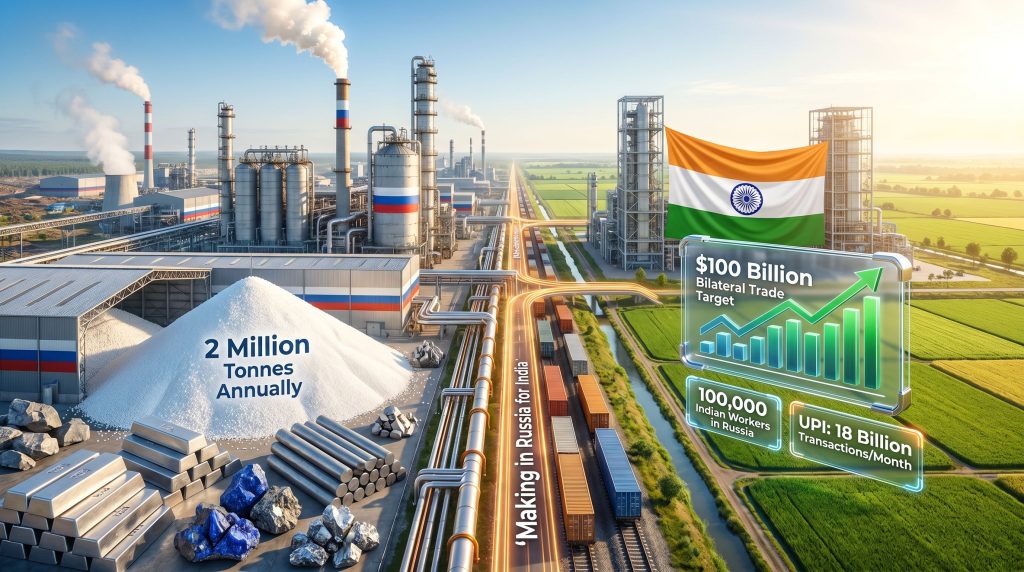
The anchor project within the Making in Russia for India framework is a joint venture urea plant currently in development on Russian territory. The facility is designed to produce 2 million tonnes of urea annually, with the entire output exclusively earmarked for Indian consumption. This is not a standard export arrangement. It is a captive production model where India effectively owns a guaranteed slice of Russian manufacturing capacity.
Snapshot: India-Russia Urea Joint Venture
- Annual Production Capacity: 2 million tonnes
- Export Destination: 100% allocated to India
- Strategic Purpose: Long-term fertiliser supply security
- Model Type: Captive export joint venture
Why does urea matter so specifically? India's agricultural sector is structurally dependent on nitrogen-based fertilisers, and domestic urea production has persistently lagged behind consumption requirements. India currently operates one of the world's largest urea subsidy programmes, making the delivered cost of fertiliser a direct fiscal concern for the central government. Locking in 2 million tonnes of annual supply from a co-owned facility insulates both the agricultural sector and the public budget from international price swings.
If the urea JV demonstrates operational and commercial viability, it creates a replicable template. The same ownership architecture, logistics design, and financial structure can theoretically be transposed onto critical mineral extraction, mining operations, and potentially pharmaceutical raw material production.
Critical Minerals: The Energy Transition Dependency No One Is Talking About
Fertilisers are an immediate priority, but critical minerals demand represents the longer-term strategic imperative. Russia holds substantial reserves of materials that are foundational to the global energy transition and to advanced defence manufacturing:
- Nickel is essential for high-energy-density lithium-ion battery chemistries used in electric vehicles
- Palladium is a key input in catalytic converters and hydrogen fuel cell systems
- Titanium is indispensable in aerospace, defence, and advanced medical applications
- Rare earth elements underpin permanent magnets used in wind turbines, EV motors, and missile guidance systems
- Cobalt and associated battery minerals remain critical for portable energy storage
India has identified critical mineral supply security as a core national priority, driven by its ambitions in electric vehicle manufacturing, solar infrastructure deployment, and defence sector indigenisation. The challenge is that current import structures leave India exposed to supply concentration risk, particularly given the dominant role of China in global rare earth supply chains.
Russia offers a geographically and politically distinct source of many of these same materials. Equity participation in Russian mining joint ventures, rather than simple commodity purchasing, would give Indian companies preferential supply priority, longer-term price visibility, and a degree of insulation from spot market volatility. It would also provide a supply source outside of Chinese-controlled processing networks, which is a significant strategic consideration given ongoing tensions in the Indo-Pacific.
Critical Insight: One underappreciated dimension of Russia's mineral endowment is the depth of its palladium reserves. Russia accounts for approximately 40% of global palladium production, a material with growing relevance not just in conventional automotive applications but in the emerging hydrogen economy. India's participation in palladium-producing JVs could position it advantageously as hydrogen fuel cell adoption accelerates globally.
The $100 Billion Target and Why Simple Trade Growth Cannot Achieve It
At their annual summit in Moscow in 2024, Russian President Vladimir Putin and Indian Prime Minister Narendra Modi set a bilateral trade target of $100 billion. This is an ambitious figure relative to current trade volumes, and the critical insight from India's diplomatic framing at St Petersburg is that commodity-level trade expansion alone cannot bridge the gap sustainably.
Expanding trade volumes through conventional channels exposes both countries to third-party friction, specifically Western sanctions architecture that affects payment systems, shipping insurance, and correspondent banking. The Making in Russia for India model partially sidesteps these frictions by restructuring economic engagement around joint ownership rather than cross-border transactions.
Ambassador Kumar's remarks at the St Petersburg forum highlighted three specific enablers that have been underweighted in bilateral trade discussions:
- Natural resources and manpower as foundational inputs for JV viability
- Digital payment infrastructure as a settlement alternative to dollar-denominated systems
- Supply chain resilience frameworks already agreed in principle but requiring active implementation
The reference to India's Unified Payments Interface is particularly notable. UPI currently processes over 18 billion transactions per month, making it one of the highest-volume real-time payment platforms operating globally. Its potential integration with Russia's Mir payment network as a bilateral trade settlement mechanism would reduce dependency on SWIFT-based flows and dollar-denominated clearing, a meaningful operational advantage for JV entities conducting regular intercompany transactions.
The 100,000-Worker Bridge: Labour Mobility as Industrial Infrastructure
One dimension of the India-Russia industrial relationship that receives insufficient analytical attention is the human capital layer. The number of Indian workers currently employed in Russia has grown to approximately 100,000, a figure that represents a significant and expanding bilateral workforce presence. However, it is worth noting that investigators have raised concerns about vulnerabilities facing some Indian workers in Russia, underscoring the need for robust, government-backed labour mobility frameworks.
This is not merely a labour statistic. A workforce of this scale embedded across Russian industrial operations creates operational familiarity, institutional knowledge transfer, and logistical know-how that are genuine prerequisites for successful joint venture manufacturing. JV operations require not just capital and regulatory alignment but people who understand both operational environments, and a 100,000-strong Indian workforce in Russia represents exactly that kind of embedded human infrastructure.
Labour mobility agreements that facilitate the continued expansion of this workforce, combined with structured skills transfer programmes at JV facilities, would deepen the operational foundations of the Making in Russia for India framework significantly. Furthermore, the Russian Labour Ministry has also weighed in on the scale of workforce mobilisation being discussed, signalling the complexity of managing expectations on both sides.
The next major ASX story will hit our subscribers first
Three Scenarios for How This Model Could Evolve
Scenario 1: The Replicable Template
If the urea JV reaches full production capacity and demonstrates logistical and financial viability, it becomes the architecture for a second and third generation of captive export joint ventures. Within a five-to-ten-year horizon, this could extend across:
- Critical mineral extraction and initial processing
- Pharmaceutical active ingredient manufacturing
- Defence component production under bilateral defence cooperation frameworks
- Mining operations targeting battery-grade nickel and rare earth elements
The key success conditions are regulatory alignment between Indian and Russian corporate law frameworks, financing structures that Indian public sector banks can support without triggering sanctions exposure, and logistics corridor development capable of handling captive export volumes reliably.
Scenario 2: Third-Country Export Optionality
A structural feature of the JV model that has not been widely discussed is its embedded export flexibility. Joint ventures sized for Indian demand could, at the margin, produce beyond India's immediate requirements and supply third-country markets. Ambassador Kumar's remarks at St Petersburg explicitly referenced the potential to develop supply chains that serve demand not only in India but in third countries.
This creates an asymmetric strategic advantage. Countries in South Asia, Africa, and Southeast Asia facing similar fertiliser and critical mineral supply constraints could become secondary customers for India-Russia JV output, effectively turning India into a supply hub for the broader Global South. This would elevate India's economic positioning well beyond a bilateral trade relationship. In addition, India's lithium supply strategy offers a useful parallel, demonstrating how New Delhi is simultaneously pursuing supply security across multiple geographies and material categories.
Scenario 3: Sanctions Friction and the Structuring Challenge
The significant structural headwind for this entire framework is the Western sanctions architecture applied to Russia. Indian companies with material exposure to Western capital markets, dollar-denominated debt, or export relationships with US and EU customers face real legal and financial risk in establishing equity positions in Russian industrial assets.
Strategic Risk Consideration: Any Indian corporate entity entering a Russian manufacturing JV will need careful legal structuring to ensure compliance with applicable sanctions frameworks, particularly where the company maintains listings, financing relationships, or commercial operations in Western jurisdictions. The risk profile differs substantially between Indian public sector enterprises and privately listed companies with international investor bases.
Rupee-rouble trade mechanisms and UPI-Mir integration offer partial mitigation but do not fully resolve the challenge of third-party sanctions exposure for global companies. The Indian government's approach of navigating this through public sector bank financing and state-adjacent enterprises is operationally logical but limits the private sector participation that would otherwise accelerate JV development.
India's Global Supply Diversification in Comparative Context
The Making in Russia for India model does not exist in isolation. It is one component of a broader Indian strategy of building supply security through embedded production partnerships across multiple geographies. Furthermore, strategic minerals deals elsewhere in the world illustrate just how intensely nations are competing to secure upstream resource positions.
| Partner Country | Sector Focus | Model Type | Strategic Objective |
|---|---|---|---|
| Russia | Fertilisers, Critical Minerals, Mining | Captive JV manufacturing | Supply security and cost stability |
| Australia | Critical Minerals (Lithium, Rare Earths) | Offtake agreements and equity stakes | Clean energy transition inputs |
| UAE | Energy, Trade Corridors | Free trade and logistics hubs | Regional trade facilitation |
| Africa (select nations) | Critical Minerals, Agriculture | Bilateral investment treaties | Resource access diversification |
What distinguishes the Russia component of this strategy is the depth of co-ownership proposed. Offtake agreements and equity stakes in Australian or African projects provide supply preference, but they do not deliver the same degree of operational integration as a jointly owned manufacturing facility producing exclusively for one partner's market.
Consequently, the Making in Russia for India model is, in this sense, the most structurally embedded supply security arrangement India has pursued anywhere in the world. Whether it becomes a template for India's broader resource diplomacy or remains a Russia-specific approach shaped by unique geopolitical circumstances will depend heavily on whether the urea JV delivers on its production and logistics commitments.
Key Takeaways
- The Making in Russia for India model reframes bilateral economic engagement from transactional trade to co-owned captive manufacturing
- A joint venture urea plant producing 2 million tonnes annually, entirely for Indian export, serves as the framework's anchor project
- Russia's reserves of nickel, palladium, titanium, rare earth elements, and other critical minerals make it strategically relevant to India's clean energy and defence ambitions
- The $100 billion bilateral trade target cannot be achieved through commodity volume expansion alone, it requires structural integration
- India's 100,000-strong workforce in Russia provides an underappreciated operational foundation for JV viability
- UPI's 18-billion-monthly-transaction scale positions it as a credible alternative settlement mechanism for bilateral JV transactions
- Sanctions navigation, logistics corridor development, and regulatory harmonisation represent the model's most significant implementation challenges
- Third-country export optionality embedded in the JV structure adds long-term strategic flexibility beyond India's own demand requirements
Disclaimer: This article contains forward-looking analysis, scenario projections, and strategic assessments based on publicly available information. It does not constitute financial or investment advice. Geopolitical and regulatory conditions affecting India-Russia economic cooperation are subject to change, and outcomes may differ materially from those described in scenario projections.
Want To Track the Next Major Critical Minerals Discovery Before the Market Moves?
As India's drive for critical mineral supply security accelerates demand for nickel, palladium, rare earths, and battery materials, Discovery Alert's proprietary Discovery IQ model instantly identifies significant ASX mineral discoveries in real time — explore historic discoveries that have delivered exceptional returns and begin your 14-day free trial at Discovery Alert to position yourself ahead of the market.