June 8, 2026
The Architecture of Dependence: Why the Strait of Hormuz Was Always a Structural Liability
Energy systems are rarely as resilient as they appear during periods of calm. The global oil trade, for all its complexity, has operated for decades with a single thread running through its centre: a narrow stretch of water at the mouth of the Persian Gulf, roughly 33 kilometres wide at its narrowest navigable point. For most of the past half-century, the risk of that thread snapping was treated as a theoretical tail event. The post-war oil trade after Hormuz closure has now transformed that theory into lived economic reality, and the consequences are proving to be anything but temporary.
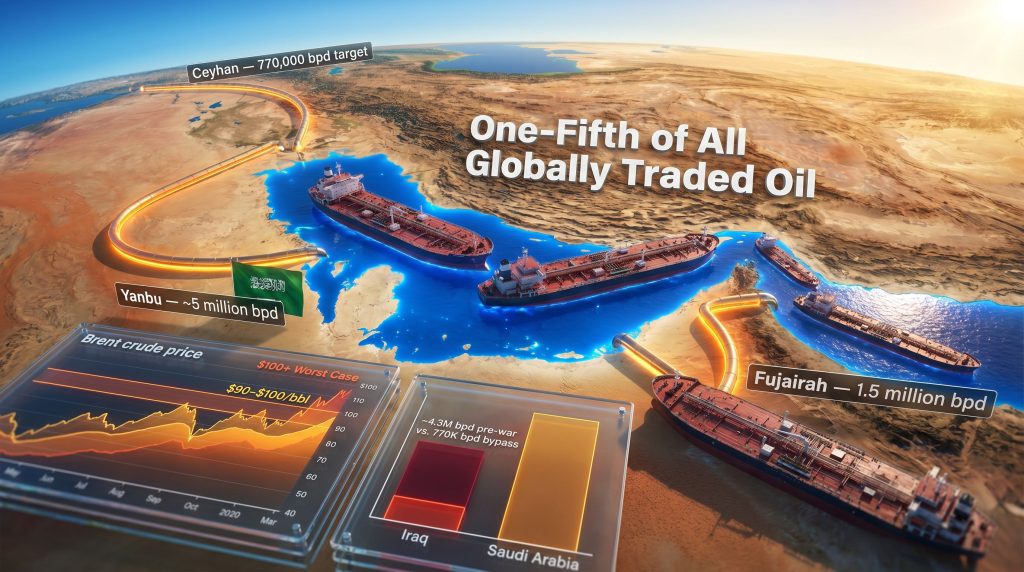
Approximately one-fifth of all globally traded oil moves through the Strait of Hormuz on any given day. A significant portion of global seaborne LNG, particularly from Qatar, takes the same route. For decades, that concentration of critical energy flow through a single maritime corridor was quietly accepted as a structural feature of the system rather than a flaw requiring correction. The closure of the Strait did not merely disrupt supply. It exposed the accumulated fragility of an architecture that had never been seriously stress-tested at scale.
When big ASX news breaks, our subscribers know first
The Uneven Impact Across Gulf Producers
Not every Gulf exporter entered the crisis with the same degree of vulnerability. The exposure map varied considerably depending on how much alternative export infrastructure each producer had developed in advance.
| Producer | Pre-War Export Volume | Available Pipeline Bypass Capacity | Vulnerability Level |
|---|---|---|---|
| Saudi Arabia | ~6–7 million bpd | ~5 million bpd (East-West Pipeline) | Moderate |
| UAE | ~3–4 million bpd | ~1.5 million bpd (Fujairah route) | Significant |
| Iraq (southern fields) | ~4.3 million bpd | ~770,000 bpd (Ceyhan target) | Severe |
| Kuwait | ~2–2.5 million bpd | Minimal | Critical |
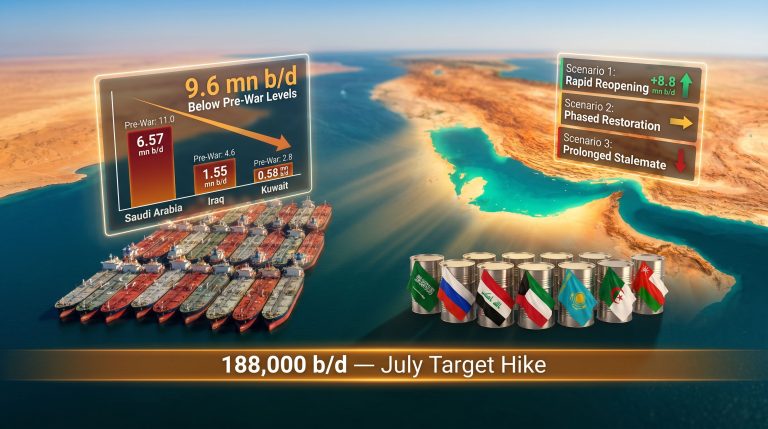
Iraq stands out as the most structurally exposed major producer in the Gulf. Its southern field output, which forms the backbone of national revenue, collapsed by roughly 70% following the onset of the conflict. Production fell from approximately 4.3 million barrels per day to around 1.3 million bpd, a supply loss of a magnitude rarely seen outside of outright conflict zones affecting production infrastructure directly. Kuwait, which has similarly thin bypass options, has acknowledged that oil output recovery will likely require 10 to 12 weeks after the Strait reopens, even under favourable conditions.
Saudi Arabia's comparative advantage was built deliberately. The kingdom's East-West Pipeline, running from the oil-rich Eastern Province to the Red Sea port of Yanbu, carries approximately 5 million bpd and became the primary export lifeline during the blockade period. That Saudi Arabia had this infrastructure ready was not accidental. It was decades of contingency investment materialising exactly when it was needed.
Why the Initial Consensus Was So Wrong
When the Strait first closed, the predominant analytical view held that the disruption would be brief. The assumption was grounded in historical patterns: previous moments of Hormuz tension had never escalated to an actual sustained closure. Markets priced in a short-term shock and waited for normalisation. Understanding current crude oil prices in this context became increasingly complex as the weeks passed.
That consensus proved deeply mistaken, for reasons that go beyond simple geopolitical miscalculation. The infrastructure required to route meaningful volumes of Gulf crude around the Strait simply did not exist in sufficient capacity at the time of closure. No pipeline network, no matter how urgently expanded, can be brought to full operational capacity in days or weeks. The gap between threatening to close the Strait and actually closing it is very different from the gap between having alternative routes planned and having them operational.
Furthermore, the oil trade and geopolitics dimension proved far more entangled than most market participants had modelled. As Bloomberg's analysis of the Hormuz closure scenario has demonstrated, the consequences of even a partial blockade ripple far beyond simple supply arithmetic.
"The Hormuz closure did not create the underlying vulnerability. It simply made visible what years of concentrated chokepoint dependence had quietly been building: a structural liability embedded at the heart of the global energy supply chain."
Dark tanker traffic surged as operators attempted to move semi-sanctioned barrels through adjacent waters. War-risk insurance premiums spiked to levels not seen in modern maritime history. Inventory drawdowns accelerated globally, and Strategic Petroleum Reserve releases were deployed across multiple consuming nations. Standard Chartered has warned that record SPR withdrawals are measurably tightening U.S. oil buffers, creating secondary risks downstream in the recovery phase.
The Infrastructure Race: Building Multiple Exits
The defining strategic response to the crisis has been a simultaneous rush by Gulf producers to develop what analysts and policymakers have begun calling an export network with multiple exits. The principle is straightforward: no single maritime chokepoint should hold an entire nation's export capacity hostage.
Iraq's ambition is among the most urgent. The country is targeting a tripling of pipeline export capacity within approximately three months of the closure, with a specific goal of routing 770,000 bpd through Turkey's Ceyhan terminal via the Iraq-Turkey Pipeline. Even if achieved on schedule, that figure represents a fraction of the southern field volumes lost. The gap between Iraq's bypass ambition and its actual bypass capacity remains severe by any measure.
The UAE's Fujairah expansion represents a more mature upgrade to an existing asset. The Fujairah terminal, located on the Gulf of Oman coast and therefore outside the Strait entirely, already had operational capacity of approximately 1.5 million bpd. The UAE is pushing to scale that route to align with its broader production capacity target of 5 million bpd by 2027.
As Sultan al-Jaber, CEO of ADNOC and UAE Energy Minister, stated in commentary reported by the Wall Street Journal, energy security in the modern era is no longer solely a question of production capacity. Routes, access, storage, and redundancy have become equally critical dimensions of a nation's energy security posture. (Wall Street Journal, 2026)
Commodities economist Hamad Hussain of Capital Economics framed the structural shift clearly, noting that the materialisation of the long-theorised Hormuz closure means the global oil trade will not return to its prior configuration regardless of how the conflict ultimately resolves. (Wall Street Journal, 2026)
What Happens to Prices After Reopening?
A widespread assumption among retail market participants is that when the Strait reopens, prices will fall sharply and quickly toward pre-war levels. However, the evidence from how energy markets recover after major supply disruptions suggests that assumption significantly underestimates the friction involved. Indeed, this oil price shock has already reshaped long-term planning frameworks for producers worldwide.
Several compounding factors will work against rapid price normalisation:
- War-risk insurance does not reset the moment a conflict ends. Underwriters apply elevated risk premiums for extended periods after hostilities cease, pending demonstrated operational safety on affected routes.
- Freight market inertia means tanker charter arrangements renegotiated during the crisis will not unwind overnight. Long-term contracts signed at crisis rates create structural cost floors.
- Buyer behaviour shifts are stickier than they appear. Asian refiners and European importers who secured alternative supply contracts during the closure have operational and contractual incentives not to immediately revert.
- Inventory rebuilding requires sustained above-demand production. Replenishing depleted strategic reserves is a multi-month process that keeps upward price pressure intact even as physical flows begin recovering.
- Infrastructure amortisation embeds the capital cost of new bypass pipelines into long-run supply economics, raising the structural floor price of Gulf crude delivery.
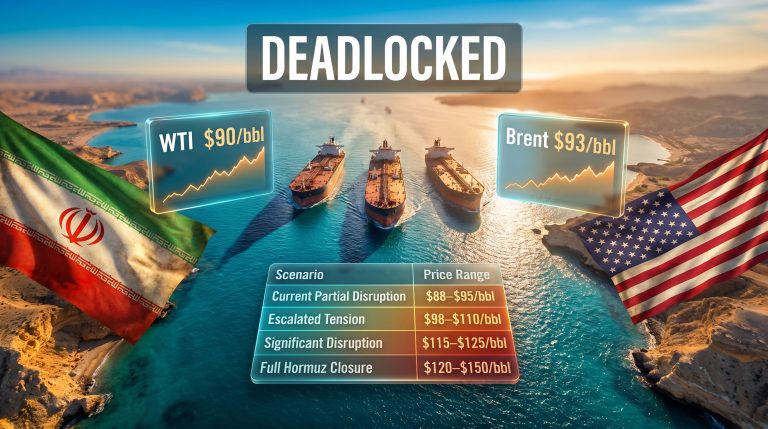
| Scenario | Brent Price Projection | Duration |
|---|---|---|
| Early reopening, rapid normalisation | ~$80–$90/bbl | 3–6 months post-reopening |
| Delayed reopening, slow inventory rebuild | ~$90–$100/bbl | 6–12 months post-war |
| Extended closure, partial bypass only | $100+/bbl | Potentially multi-year |
Goldman Sachs has cautioned that a sustained oil price shock of this magnitude carries the potential to fundamentally alter consumer behaviour across major economies, a demand-side effect with lasting implications for the structural ceiling of oil prices. The Bank of England has separately flagged that energy price inflation stemming from the crisis is complicating the interest rate outlook across major Western economies.
Disclaimer: Price projections and scenario forecasts represent analyst estimates and should not be interpreted as investment advice. Energy markets are subject to rapid and unpredictable change.
Demand Destruction as a Natural Price Governor
At sustained price levels above $100 per barrel, demand destruction begins functioning as a self-correcting mechanism. India, one of the world's largest and fastest-growing oil importers, has already cut its fuel demand growth projections by approximately 40% as a direct consequence of the supply shock. That is a pandemic-level revision in demand expectations from one of the markets expected to drive global consumption growth through the rest of the decade.
India's response has been particularly instructive. The country recently launched an 85% ethanol fuel blend as part of an explicit strategy to reduce oil import dependence, a structural policy shift that would not have accelerated at this pace without crisis-level price pressure. When sustained high prices force this kind of substitution behaviour into policy frameworks, the effects do not simply reverse when prices fall.
The next major ASX story will hit our subscribers first
The Unsanctioned Supply Paradox: Venezuela, Iran, and Russia
While the demand destruction dynamic is working to cap the price ceiling, relief is also emerging from a set of producers that were, until recently, operating outside or at the margins of the formal global oil trade system.
Venezuela's Role as a Relief Valve
Venezuela has emerged as the fastest-moving relief valve. Following the removal of the Maduro government and the subsequent lifting of U.S. sanctions, American energy operators have returned to Venezuelan fields. Output has recovered to approximately 1.25 million bpd, with projections suggesting a rise to 1.5 million bpd by year-end under favourable operational conditions.
A critical market dynamic here is the crude quality: Venezuelan production is predominantly extra-heavy, high-sulfur crude. This positions Venezuelan barrels in direct competition with Iranian and Russian heavy sour grades, creating downward price pressure specifically in the heavy sour market segment. Not all refineries can process these grades, which limits substitutability.
Iran and Russia: Sanctions and Supply
Iranian sanctions relief represents the single largest potential supply addition still sitting on the sidelines. Iran's oil exports had already collapsed to a six-year low during the blockade period. Analysts tracking the intersection of U.S. domestic economic pressure and diplomatic positioning argue that energy price inflation may ultimately compel the administration to consider sanctions relief as an indirect demand-management tool. Meaningful relief could, in principle, add 1 to 2 million bpd of Iranian crude back to global markets within a relatively short operational window.
Russia's position remains shaped by the waiver framework the U.S. has extended and repeatedly renewed on Russian crude purchases for certain buyers. The broader Russian oil trading sanctions landscape has, however, removed both the psychological and compliance barriers for Asian buyers, effectively normalising discounted Russian crude flows to Asia. Consequently, Iranian and Russian crude premiums have already begun softening as Chinese buyers pull back.
Buyer-Side Restructuring: South Korea as a Case Study
The transformation of the post-war oil trade after Hormuz closure is not happening solely on the producer side. Importing nations are simultaneously restructuring their supply chains in ways that will persist long after the conflict ends.
South Korea has moved aggressively to lock in long-term Canadian crude and LNG supply contracts, a sweeping overhaul of its import sourcing strategy driven directly by Middle East supply insecurity. This is not a temporary spot market adjustment. It represents a durable diversification of South Korea's supply base, a decision driven by risk management logic that will not simply be unwound when Gulf flows normalise.
Similar institutionalisation of supply diversification strategies is occurring across Asian importing nations. The crisis has functioned as a forcing event that compressed years of theoretical supply diversification planning into months of actual contract negotiation and infrastructure commitment. Kpler's analysis of how the US-Iran conflict has reshaped global oil markets further illustrates how deeply these buyer-side shifts are taking hold.
The Permanent Legacy: What Post-War Actually Means
The cyclical view of market disruption holds that supply shocks correct themselves. Physical flows normalise, prices fall, and trade patterns revert toward their most economically efficient configuration. The structural view argues that the Hormuz closure has permanently altered the risk calculus, investment logic, and behavioural patterns of both producers and importers in ways that preclude a simple return to the pre-war baseline.
The weight of evidence currently favours the structural interpretation. In addition to the pipeline and contract changes already underway, consider the full list of changes that will persist:
- Higher war-risk insurance floors embedded into all Persian Gulf maritime cargo pricing
- Expanded pipeline bypass capacity across Saudi Arabia, the UAE, and progressively Iraq
- Long-term supply contracts signed by Asian importers with non-Gulf producers
- Accelerated fuel substitution policies in major importing economies
- Larger strategic inventory buffers mandated by governments that were caught underprepared
- A more sophisticated contractual framework across the entire industry around force majeure and supply disruption provisions
None of these changes are easily reversed. They reflect decisions made under crisis conditions — decisions that have already been embedded into infrastructure, contracts, and policy frameworks with multi-year or multi-decade time horizons. Understanding the full impact on oil markets requires acknowledging that the post-war oil trade after Hormuz closure is unlikely to resemble what came before it. The physical chokepoint may reopen. The structural changes to how the world prices, routes, diversifies, and insures its energy supply will not simply close behind it.
FAQ: Post-War Oil Trade After Hormuz Closure
How long does it take for oil trade to normalise after the Strait of Hormuz reopens?
Full normalisation of oil trade flows typically takes anywhere from several months to over a year after reopening, depending on the duration of the original closure, the depth of global inventory drawdowns, and how quickly shipping insurance and freight markets recalibrate to post-conflict conditions.
Can Gulf producers fully replace Hormuz throughput with pipeline alternatives?
No. Saudi Arabia's East-West Pipeline and the UAE's Fujairah route can offset a meaningful share of lost export capacity, but no existing or near-term combination of pipeline infrastructure can fully replicate the Strait's throughput volumes. Iraq's bypass capacity gap is particularly severe, with its Ceyhan target of 770,000 bpd representing less than one-fifth of pre-war southern field output.
Which countries benefit most from a sustained Hormuz disruption?
Non-Gulf producers with diversified pipeline access to global markets, including the United States, Canada, and Norway, benefit from elevated pricing and increased demand for supply not routed through the Strait. Venezuela's recovering production also positions it as a key near-term beneficiary.
How does a Hormuz closure affect LNG markets?
A significant share of global seaborne LNG, particularly Qatari exports, transits the Strait. A closure forces LNG cargoes onto longer alternative shipping routes, raising transit costs and delivery times while tightening spot LNG availability globally. Nations like Pakistan and Japan have been forced to compete aggressively for non-Hormuz LNG cargoes.
Is Venezuela's crude a direct substitute for Gulf barrels?
Only partially. Venezuelan production is predominantly extra-heavy, high-sulfur crude, which requires specific refinery configurations to process. It competes directly with Iranian and Russian heavy sour barrels, but cannot substitute for the lighter Gulf grades that many Asian and European refineries are configured to handle.
Want to Stay Ahead of the Next Major Market-Moving Discovery?
While geopolitical shocks like the Hormuz closure reshape global commodity flows, the most significant investment opportunities often emerge closer to home — Discovery Alert's proprietary Discovery IQ model delivers real-time alerts on significant ASX mineral discoveries, instantly translating complex data across 30+ commodities into actionable insights for traders and investors at every level. Explore historic discoveries and their returns to understand the potential, then begin your 14-day free trial at Discovery Alert to position yourself ahead of the market.