August 5, 2026
When Oil Market Targets Become Fiction: Understanding the OPEC+ July Production Hike
Every few years, global oil markets enter a phase where the official numbers being published by the world's most powerful producer alliance bear almost no relationship to what is actually flowing through pipelines and onto tankers. The current period is one of the most extreme examples of this disconnect in modern oil market history. The OPEC+ July target hike of 188,000 barrels per day, agreed by the alliance's seven core members in June 2026, is technically a production increase. In practice, for the countries most affected by the ongoing US-Iran conflict, it is closer to an accounting entry than an operational instruction.
Understanding why requires looking at the mechanics of how oil markets work under geopolitical stress, and why quota decisions made in conference rooms can become entirely theoretical when a single stretch of water changes the global supply equation overnight. For broader context on the crude oil market overview, the current disruption is unlike anything witnessed in recent memory.
When big ASX news breaks, our subscribers know first
Why OPEC+ Output Targets No Longer Reflect Actual Production
The Strait of Hormuz is a narrow maritime corridor separating the Arabian Peninsula from Iran, and it is the single most consequential chokepoint in global energy logistics. Before the outbreak of the US-Iran conflict on 28 February 2026, the strait facilitated the transit of approximately 20 to 21 million barrels of crude oil per day, representing roughly one-fifth of global petroleum consumption. The effective closure of this waterway has rendered formal quota decisions by Gulf producers largely symbolic, because there is no viable alternative export route capable of absorbing that volume at speed.
Saudi Arabia, Iraq, and Kuwait, three of the seven core OPEC+ members who agreed to the July target increase, all depend on the Strait of Hormuz as their primary crude export corridor. Raising their collective production targets while the strait remains effectively closed is not a supply increase in any operational sense. It is a quota positioning exercise, establishing the legal entitlement to produce more once the physical means to export that production is restored.
Key Insight: When a critical export corridor is blocked, even a well-coordinated production increase announcement cannot translate into additional barrels reaching the market. The OPEC+ July target hike must be evaluated within this physical constraint framework before any other analysis is applied.
This dual-lens approach, separating stated policy intent from physical export capacity, is now the essential framework for interpreting every OPEC+ decision made during this conflict period. Furthermore, OPEC's market influence has rarely been tested as severely as it is under current conditions.
How Large Is the OPEC+ July 2026 Target Increase and Who Agreed to It
Breaking Down the 188,000 b/d vs. 411,000 b/d Discrepancy
A source of confusion in market reporting surrounds two different production increase figures being cited in relation to July 2026. The 188,000 b/d figure applies specifically to the seven-member core group: Saudi Arabia, Russia, Iraq, Kuwait, Kazakhstan, Algeria, and Oman. A larger figure of 411,000 b/d appearing in some earlier OPEC+ reporting reflected a broader eight-member scope that included the UAE before its formal exit from both OPEC and OPEC+ on 1 May 2026. According to reporting from CNBC, this larger figure was widely anticipated before the UAE's departure reshaped the alliance's arithmetic.
The UAE's departure was a structurally significant event for the alliance's quota arithmetic. By removing itself from the collective unwind schedule, the UAE mechanically reduced the group's aggregate monthly increase figure, which explains the step down from 206,000 b/d in the two preceding months to 188,000 b/d for June and July alike.
| Reporting Scope | July Target Increase | Members Included | Notes |
|---|---|---|---|
| Seven-member core group | 188,000 b/d | Saudi Arabia, Russia, Iraq, Kuwait, Kazakhstan, Algeria, Oman | Current active framework |
| Eight-member (pre-UAE exit) | 411,000 b/d | Above plus UAE | UAE exited 1 May 2026 |
| Previous two months (8-member) | 206,000 b/d | Eight members including UAE | Reflected higher combined baseline |
The July increase exactly mirrors the June increase at 188,000 b/d, a consistency that signals internal group cohesion rather than any disagreement over the pace of unwinding. Approximately 564,000 b/d of the original 1.65 million b/d April 2023 cut package still remains to be reversed. At the current monthly pace, full unwinding of those remaining cuts is projected to be completed by around September 2026.
What Is the Broader OPEC+ Production Unwinding Strategy
From April 2023 Cuts to a Structured Reversal Programme
The current sequence of target increases began in April 2024, when OPEC+ initiated a structured and gradual reversal of the 1.65 million b/d in voluntary cuts that the group had agreed to in April 2023. Since the outbreak of the US-Iran conflict in late February 2026, the seven-member core group has met and agreed to raise production targets on four consecutive occasions, continuing the unwind schedule even as actual output across the Mideast Gulf has collapsed.
This is not incoherence. There is a clear strategic logic driving the decision to keep raising targets during a period of actual output suppression:
- Establishing quota positions ahead of a potential Strait of Hormuz reopening, so that members can immediately scale up production without needing to renegotiate entitlements
- Preventing internal coalition fractures by maintaining the visible appearance of coordinated forward progress on the unwind schedule
- Signalling to oil markets that the group is ready to restore supply once physical export conditions allow, which exerts a degree of downward pressure on forward price curves
Strategic Context: A delegate-level understanding within the group holds that the ongoing quota unwind functions as preparation for post-conflict production restoration rather than as a near-term instruction to increase output. No member is expected to operate at full capacity or exceed targets to compensate for production lost during the war period.
The 2027 Baseline Reset: A Parallel Process Running Simultaneously
Alongside the monthly target decisions, OPEC+ is also advancing a comprehensive review of production baselines for all member states, with new output entitlements scheduled to take effect from 2027. The assessment of each member's maximum sustainable production capacity is being conducted by US-based consultancy DeGolyer and MacNaughton, a firm with deep expertise in independent petroleum reserve and capacity evaluations.
The assessment began in January 2026 and is scheduled for completion by September 2026, leaving a three-month window to calibrate and fine-tune individual country targets before the new framework takes effect. The outcome of this process could materially reshape the internal power dynamics of the alliance, as members with capacity assessments that differ significantly from their current quota entitlements may push for adjustments that alter the group's overall production ceiling.
Which Countries Are Most Affected by the Hormuz Closure
Mapping the Production Shortfall Across Core OPEC+ Members
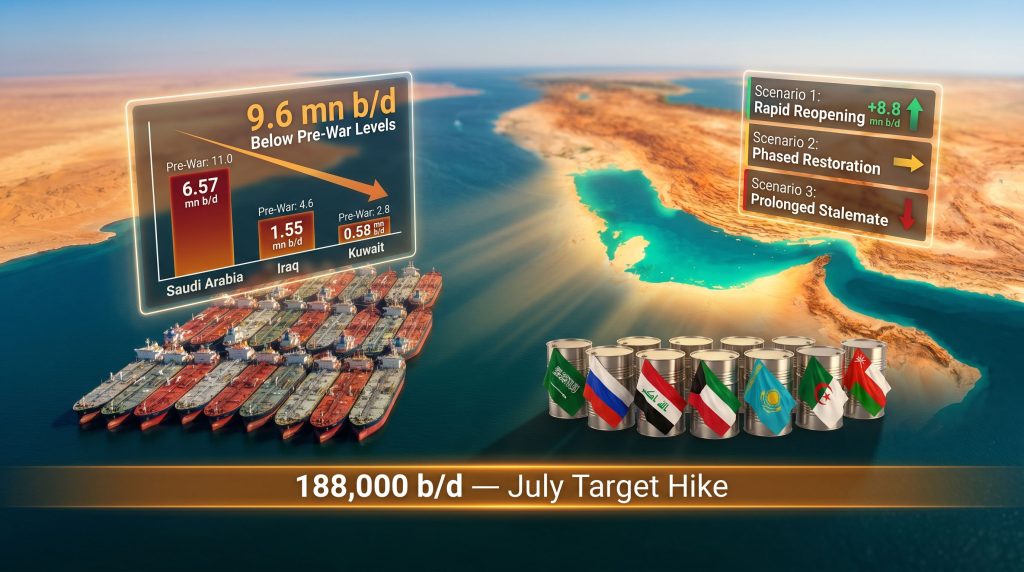
The scale of the output disruption across Mideast Gulf producers is difficult to overstate. According to Argus estimates, total OPEC+ production in May 2026 stood at 29.53 million b/d, representing a decline of approximately 9.6 million b/d from pre-war production levels. The three Mideast Gulf members within the core seven-member group, Saudi Arabia, Iraq, and Kuwait, were running a combined 8.5 million b/d below their collective production targets in May 2026.
| Country | May 2026 Actual Output | Pre-War Target | Estimated Shortfall |
|---|---|---|---|
| Saudi Arabia | 6.57 mn b/d | 10.23 mn b/d | ~3.66 mn b/d |
| Iraq | 1.55 mn b/d | 4.33 mn b/d | ~2.78 mn b/d |
| Kuwait | 0.58 mn b/d | 2.61 mn b/d | ~2.03 mn b/d |
| Russia | 9.00 mn b/d | 9.70 mn b/d | ~0.70 mn b/d |
| Iran* | 2.65 mn b/d | Exempt | ~0.30 mn b/d decline in May alone |
*Iran is exempt from OPEC+ production targets but faces accelerating output pressure from US port blockade measures
One detail that often goes unreported in mainstream coverage is the role of domestic power generation demand in the modest production increases recorded by Saudi Arabia and Iraq in May. Saudi Arabia added 250,000 b/d on the month, but this was primarily driven by elevated crude burn for domestic electricity generation during the peak summer cooling season, not by any improvement in export logistics. Iraq similarly added approximately 150,000 b/d, partly for the same reason.
This structural feature of Gulf producers means that domestic consumption can generate real output increases even when international exports remain constrained. Consequently, headline production figures can be misleading without this important distinction in mind.
Iran's Accelerating Output Decline and the US Port Blockade Effect
Iran's situation is evolving along a separate and increasingly severe trajectory. Iranian production fell by approximately 300,000 b/d in May 2026 alone, reaching 2.65 million b/d, as the US blockade of Iranian ports began producing measurable effects on output capacity. With onshore storage facilities approaching saturation limits, further involuntary production curtailments are considered likely in the near term.
Iran is exempt from OPEC+ production targets, but its declining output nevertheless contributes to the overall supply shortfall being felt in global markets. The Russian oil sanctions playbook offers a useful parallel for understanding how port-level enforcement measures can progressively erode a nation's export capacity over time.
Russia's Constrained and Largely Stable Position
Russian production held flat at 9.0 million b/d in May 2026, unchanged from April, but remained approximately 700,000 b/d below Russia's formal OPEC+ production target of 9.7 million b/d. Ongoing Ukrainian strikes against Russian oil infrastructure continue to suppress both production and export capacity, though the damage has been gradual rather than catastrophic.
Russia's situation is structurally different from the Gulf producers because its export routes are not dependent on the Strait of Hormuz, but the infrastructure attrition dynamic keeps Russian output in a persistently below-target position. In addition, the broader picture of oil geopolitics and OPEC makes clear that no single member's situation can be fully understood in isolation from the wider alliance dynamic.
What Would a Strait of Hormuz Reopening Look Like for Oil Supply
Scenario Modelling: Three Pathways for Post-Conflict Production Restoration
The critical question for oil markets is not whether supply will return, but how fast and through which pathway. Three broad scenarios frame the range of outcomes:
Scenario 1: Rapid Reopening (0 to 3 months post-agreement)
- Saudi Arabia could theoretically restore output toward 10.478 million b/d from a May 2026 base of 6.57 million b/d, representing a potential increase of nearly 3.9 million b/d
- Iraq could move from 1.55 million b/d toward 4.431 million b/d, adding approximately 2.88 million b/d
- Kuwait could expand from 580,000 b/d toward 2.676 million b/d, adding over 2 million b/d
- Combined theoretical uplift from these three countries alone: approximately 8.8 million b/d
- Global oil prices would face an enormous and rapid downward price shock under this scenario
Scenario 2: Phased Restoration (3 to 12 months)
- Infrastructure damage assessment and repair requirements delay full capacity restoration
- Production ramp-up proceeds at 20 to 30 percent of theoretical maximum per quarter
- Markets reprice progressively lower as forward curves reflect approaching supply normalisation
- Non-OPEC producers face margin compression as the supply deficit begins to close
Scenario 3: Prolonged Conflict Stalemate (12 months or more)
- The Strait of Hormuz remains effectively closed, with OPEC+ continuing symbolic quota hikes without physical output impact
- Non-OPEC producers accelerate capital investment to capture displaced market share on a potentially permanent basis
- Structural demand destruction begins to emerge in price-sensitive emerging markets
- Long-term energy security investment patterns shift, with accelerated development of alternative supply corridors
An important caveat cuts across all three scenarios. The group has explicitly retained full flexibility to increase, pause, or even reverse previously implemented target adjustments at any future meeting, meaning quota policy could move in either direction depending on how the conflict resolution trajectory unfolds. The oil price war impacts of a rapid reopening scenario would, however, be particularly severe for producers who have expanded output to fill the current gap.
The next major ASX story will hit our subscribers first
How Is the Rest of OPEC+ Performing Against Targets
Overproducers, Underperformers, and the Compliance Picture
While the Mideast Gulf drama dominates the headline numbers, the compliance picture among other OPEC+ members tells a more granular story about alliance discipline under stress.
| Member | May 2026 Output | Target | Variance |
|---|---|---|---|
| Kazakhstan | 1.86 mn b/d | 1.59 mn b/d | +270,000 b/d |
| Algeria | 0.98 mn b/d | 0.98 mn b/d | On target |
| Nigeria | 1.50 mn b/d | 1.50 mn b/d | On target |
| Oman | 0.83 mn b/d | 0.82 mn b/d | +10,000 b/d |
| Azerbaijan | 0.45 mn b/d | 0.55 mn b/d | -100,000 b/d |
Kazakhstan continues to be the alliance's most persistent compliance problem, producing 270,000 b/d above its assigned quota in May 2026. This is not a new phenomenon. Kazakhstan's Tengizchevroil expansion project, which increased overall production capacity significantly in recent years, has made it structurally difficult for the country to throttle output in line with OPEC+ obligations without imposing significant technical and commercial costs on the international joint-venture operators running its major fields.
This is an important market dynamic that casual observers often overlook: OPEC+ compliance is not purely a political decision for all members. For countries with large international oil company (IOC) participation in their upstream sector, quota compliance can require negotiating production limitations with foreign shareholders who have contractual rights to their equity share of output, creating a layer of commercial friction that makes perfect compliance genuinely difficult to achieve.
What Are the Geopolitical Triggers That Could Shift This Outlook
The PGSA, US Sanctions, and the Corridor Control Battle
Tehran's establishment of the Persian Gulf Strait Authority (PGSA) represents an attempt to formalise Iranian control over Hormuz transit in a way that creates leverage in any future negotiation. Since late April 2026, more than 300 non-Iranian vessels have contacted the PGSA to obtain permits for safe passage through the strait. The breakdown of applicant vessels is revealing:
- 42% oil tankers
- 27% bulk carriers
- 11% container ships
- 8% LNG carriers
- 77% seeking outbound passage from the Mideast Gulf
- 23% seeking inbound transit into the Mideast Gulf
Of the vessels seeking outbound passage, 28% were destined for China, 19% for India, and 23% for elsewhere in Asia, reflecting the overwhelming dependence of Asian economies on Mideast Gulf crude. European destinations accounted for 12% and African ports for 10%.
The US Treasury's Office of Foreign Assets Control (OFAC) responded by imposing sanctions against the PGSA, warning that cooperation with the authority could constitute support for Iran's Islamic Revolutionary Guard Corps and expose participants to sanctions risk. The practical effect was immediate: vessel crossings through the strait dropped from approximately seven per day in the week before the sanctions announcement to just over three per day in the period following it, according to data from shipping analytics firm Kpler.
Speculative but Informed Observation: The PGSA's vessel permitting database, if analysed systematically, would provide real-time intelligence on which countries and shipping companies are attempting to maintain Hormuz transit and at what frequency. The OFAC sanctions may have been motivated in part by a desire to prevent this permit-seeking behaviour from normalising into a de facto recognition of Iranian maritime authority over the strait.
The US-Iran Negotiation Variable
US President Donald Trump has on multiple occasions characterised a deal with Iran as imminent, yet a formal agreement has not materialised throughout the conflict period. The gap between presidential optimism and diplomatic reality has itself become a market-moving variable, with each round of positive rhetoric followed by price softness and each diplomatic setback prompting renewed upward pressure on crude benchmarks.
A successful US-Iran agreement that reopens the strait would represent the single largest short-term supply shock in recent oil market history. According to analysis from Reuters, OPEC+ is likely to continue raising output targets even in the face of ongoing Hormuz disruptions, underscoring the alliance's commitment to its unwinding schedule regardless of near-term physical constraints. Potentially releasing close to 9 million b/d of suppressed production capacity back into global markets within a relatively compressed timeframe, the speed and sequencing of that restoration would determine whether the price impact is orderly or destabilising.
Frequently Asked Questions: OPEC+ July Target Hike
What exactly did OPEC+ agree to for July 2026?
The seven core members of the OPEC+ alliance collectively agreed to raise their combined production target by 188,000 barrels per day for July 2026. This matches the increase agreed for June and continues the phased unwinding of voluntary cuts that began in April 2024.
Will the July target hike actually increase oil supply?
Not in the immediate term. The three Mideast Gulf members most affected by Strait of Hormuz disruptions cannot physically export additional barrels until the waterway reopens. The OPEC+ July target hike is best understood as a quota positioning exercise rather than a near-term supply expansion.
How much of the original OPEC+ cut remains to be unwound?
As of the July agreement, approximately 564,000 b/d of the original 1.65 million b/d April 2023 cut package remains to be reversed. At the current pace of 188,000 b/d per month, full unwinding is projected to occur by around September 2026.
Why did OPEC+ monthly increases shrink from 206,000 b/d to 188,000 b/d?
The reduction reflects the UAE's formal exit from both OPEC and OPEC+ on 1 May 2026, which removed its quota contribution from the collective unwind calculation and mechanically reduced the group's aggregate monthly increase figure.
When does OPEC+ next meet to decide August 2026 production levels?
The seven-member core group is scheduled to convene on 5 July 2026 to determine August production targets.
What happens to OPEC+ quotas from 2027 onward?
The alliance is undertaking a comprehensive baseline production review, with independent capacity assessments by DeGolyer and MacNaughton expected to conclude by September 2026, with new production baselines taking effect from 2027.
Key Takeaways: OPEC+ July Hike in Context
- 188,000 b/d July target increase agreed by seven core OPEC+ members, mirroring the June decision exactly
- Approximately 564,000 b/d of cuts remain to be unwound, with full reversal projected by September 2026 at current pace
- Total OPEC+ output remains approximately 9.6 million b/d below pre-US-Iran war levels as of May 2026
- The three Mideast Gulf members most exposed to the Strait of Hormuz closure are running a combined 8.5 million b/d below their collective target
- Saudi Arabia alone could theoretically add nearly 3.9 million b/d once export logistics normalise, with Iraq and Kuwait adding a further 4.9 million b/d between them
- Kazakhstan continues to overproduce against its quota by 270,000 b/d, reflecting the structural challenge of imposing cuts on IOC-operated fields
- A parallel 2027 baseline reset process is underway, with independent capacity assessments due September 2026
- The group retains explicit flexibility to pause, accelerate, or reverse its quota unwind at any future meeting
- OFAC sanctions on the PGSA have already reduced Hormuz vessel crossings from approximately seven per day to just over three per day, measurably tightening an already disrupted corridor
This article contains forward-looking analysis, scenario projections, and production estimates drawn from publicly available market intelligence. All figures are subject to revision as conflict dynamics, diplomatic developments, and physical production data evolve. Nothing in this article constitutes financial or investment advice.
Want to Stay Ahead of the Next Major Commodity Discovery Before the Market Catches On?
While geopolitical disruptions reshape global oil supply chains, significant mineral discoveries on the ASX are quietly generating transformative returns — and Discovery Alert's proprietary Discovery IQ model delivers real-time alerts the moment these opportunities emerge, turning complex data across 30+ commodities into clear, actionable insights. Explore historic discovery returns on Discovery Alert's dedicated discoveries page and begin a 14-day free trial to ensure you're positioned ahead of the broader market.