July 27, 2026
Why Crude Oil Has Fallen to a Six-Week Low — And What Comes Next
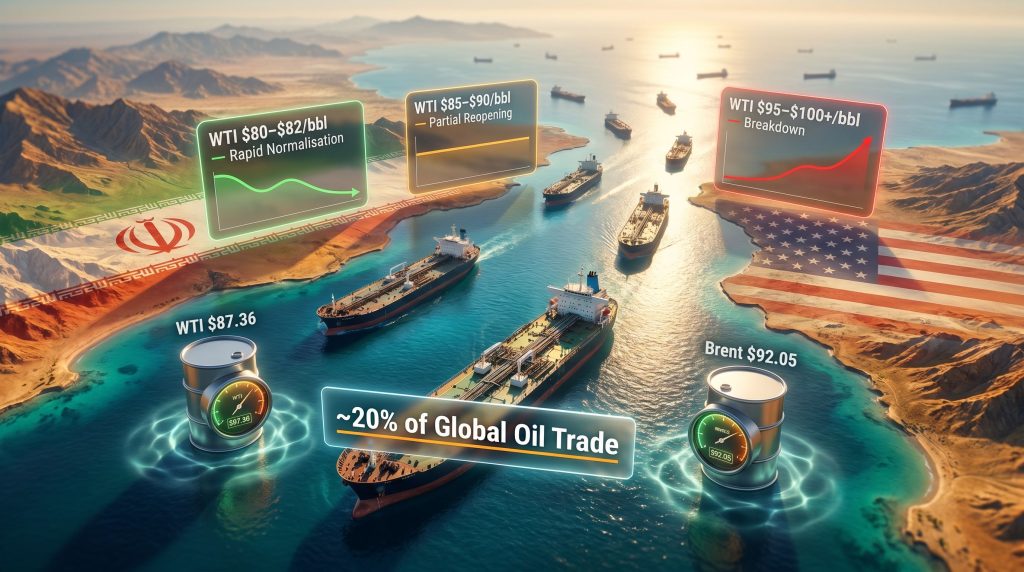
Commodity markets are fundamentally forward-looking instruments. Long before physical supply conditions shift, crude benchmarks begin repricing based on probability-weighted expectations of how the future will unfold. This mechanism is especially pronounced in geopolitically sensitive markets, where risk premiums can inflate or deflate rapidly in response to diplomatic signals — even unconfirmed ones. Understanding this dynamic is essential context for interpreting why oil settles at six-week low territory, with WTI touching $87.36 per barrel and Brent settling at $92.05 per barrel during the July contract expiry session.
The catalyst behind this decline is not a sudden improvement in physical supply. Crude inventories remain stressed, tanker movements through key shipping lanes are still restricted, and no formal agreement has been signed. What has changed is the perceived probability that a resolution is approaching. Ceasefire extension talks between Washington and Tehran have generated enough optimism to compress the geopolitical oil price pressures that have been embedded in crude prices throughout the conflict period.
Key Insight: When geopolitical risk premiums compress, crude benchmarks can shed value rapidly, even before physical supply conditions change. The current decline reflects anticipated normalisation, not confirmed normalisation. For energy traders and downstream industries, this distinction carries significant asymmetric risk implications.
When big ASX news breaks, our subscribers know first
How the Strait of Hormuz Exerts Disproportionate Control Over Global Oil Prices
The Chokepoint Premium: Why One Waterway Moves Entire Markets
The Strait of Hormuz is a narrow navigational corridor approximately 33 kilometres wide at its most constrained point, separating the Persian Gulf from the Gulf of Oman. Despite its modest physical dimensions, it functions as the single most consequential maritime chokepoint in global energy trade. Roughly 20% of worldwide oil trade transits this passage, including the bulk of crude exports from Saudi Arabia, the UAE, Kuwait, Iraq, and Qatar.
When this corridor is disrupted — whether by military conflict, mine deployment, or political blockade — the market immediately prices in a "chokepoint premium" on top of fundamental supply-demand conditions. This premium reflects not just current physical scarcity, but the anticipated cost and disruption of rerouting, insurance escalation, and refinery input delays. Furthermore, the oil volatility trends observed throughout this period illustrate precisely how quickly these premiums can build and unwind.
To contextualise Hormuz's influence, it helps to compare it against other strategic maritime bottlenecks:
| Chokepoint | Daily Oil Flow (Approx.) | Disruption Risk Level | Alternative Route Available? |
|---|---|---|---|
| Strait of Hormuz | ~17–20 million bbl/day | Very High | Limited (Abqaiq-Yanbu pipeline) |
| Suez Canal | ~5–6 million bbl/day | Moderate | Yes (Cape of Good Hope) |
| Strait of Malacca | ~16 million bbl/day | Moderate | Yes (Lombok/Sunda Strait) |
| Turkish Straits | ~3 million bbl/day | Low–Moderate | Limited |
No other chokepoint combines Hormuz's volume significance with its limited bypass capacity. The Abqaiq-Yanbu pipeline in Saudi Arabia provides the only meaningful land-based alternative, but its capacity is substantially below the volume that normally transits the strait by sea.
The Cascading Effects of a Hormuz Blockade
When Hormuz is fully or partially closed, the market disruptions extend well beyond simple supply reduction. Key cascading effects include:
- Tanker rerouting around the Cape of Good Hope, adding weeks to voyage times and significantly increasing freight costs
- War risk insurance premiums surging for Persian Gulf transits, raising the effective cost of every barrel shipped
- Refinery input delays, as processing facilities in Asia and Europe face intermittent crude supply gaps
- "Shadow fleet" dynamics intensifying, as operators of sanctioned-oil tankers exploit the disruption to capture premium pricing through alternative routing
One notable data point from the current conflict: approximately one-quarter of non-Iranian large oil tankers that were trapped inside the Persian Gulf at the outbreak of hostilities have since managed to exit through available passages. This gradual vessel liberation has provided modest physical relief to global supply chains, but the majority of trapped tonnage remains inside the Gulf.
The Architecture of the Current US–Iran Ceasefire Negotiations
What the Truce Extension Framework Actually Involves
The ongoing diplomatic process is not a simple bilateral negotiation. It involves multiple interconnected sticking points, each of which carries its own timeline and political complexity:
- Iran's nuclear enrichment program: The disposition of highly enriched uranium (HEU) stockpiles is a central technical and political issue. The Trump administration has identified HEU transfer under verifiable conditions as a non-negotiable precondition, with Treasury Secretary Scott Bessent publicly stating this as one of two firm requirements for any lasting agreement.
- Hormuz sovereignty and operational control: Iran's insistence on retaining control over Hormuz operations creates a structural tension with US demands for unrestricted commercial passage.
- Sanctions relief sequencing: The order in which sanctions are lifted relative to Iranian compliance steps remains a contentious architectural question in any agreement framework.
The proposed 60-day truce extension under discussion is designed as a confidence-building mechanism, not a final resolution. Iran's Foreign Ministry has publicly stated that no final understanding has been reached, while message exchanges between the two governments continue through intermediary channels. In addition, the broader trade war impact on oil has further complicated the diplomatic backdrop against which these negotiations are unfolding.
Why Markets Are Pricing In Resolution Before It Materialises
Crude oil traders are collectively expressing a view that the probability of resolution now outweighs the probability of renewed escalation. This is reflected directly in the roughly 6% weekly decline recorded by both WTI and Brent benchmarks.
However, it is worth noting that this optimism has historical precedent for being premature. Throughout the conflict period, earlier signals of diplomatic progress have dissolved without producing agreements, leaving markets exposed to sharp price reversals. The current price compression is therefore best understood as hope-driven rather than evidence-driven.
Dennis Kissler, head of energy trading at BOK Financial Securities, has characterised the current market sentiment as cautiously optimistic but fundamentally premature, noting that increased Strait of Hormuz traffic is an encouraging signal but that markets will need to see conditions stabilise over an extended period before WTI prices in the mid-to-low $80 per barrel range can be considered fundamentally justified.
Chevron CEO Mike Wirth provided a particularly sobering perspective during the week, acknowledging that vessel attacks continued through the current period, including incidents that have not been publicly reported. Despite this, Wirth observed that market psychology has broadly coalesced around the view that the conflict is closer to conclusion than continuation.
Three Scenarios for What Happens Next to Oil Prices
Scenario 1: Rapid Normalisation (Optimistic Case)
If a ceasefire is formalised, mine clearance operations proceed efficiently, and tanker traffic resumes at scale, the following conditions apply:
- WTI price trajectory: further compression toward $80–$82 per barrel
- Field restart timelines: oil fields shut in during the conflict may require several months of preparation before reaching previous production capacity
- Vessel transit lag: tankers departing the Persian Gulf would require several weeks to reach major importing nations in Asia and Europe
Scenario 2: Partial Reopening With Residual Risk (Base Case)
Under this scenario, the truce is extended but core nuclear and sanctions issues remain unresolved, resulting in intermittent Hormuz access:
- WTI likely stabilises in the $85–$90 per barrel band
- Key variable: the pace at which energy infrastructure damaged by drone and missile strikes can be assessed and repaired
- Shipowner risk assessments remain elevated, constraining full traffic normalisation
Scenario 3: Negotiation Breakdown (Downside Case)
If ceasefire talks collapse and the blockade is reinforced, the market faces a very different trajectory:
- WTI could rebound sharply toward $95–$100 or above per barrel
- Mine density in Hormuz shipping lanes potentially increases
- US distillate stockpiles, already at their lowest level in more than two decades, would face further pressure
| Scenario | Hormuz Status | WTI Price Range | Timeline to Normalisation |
|---|---|---|---|
| Rapid Normalisation | Fully reopened | $80–$82/bbl | 3–6 months |
| Partial Reopening | Intermittently open | $85–$90/bbl | 6–12 months |
| Negotiation Breakdown | Closed/restricted | $95–$100+/bbl | Indefinite |
How the Market Has Managed Disruption Without a Full Price Catastrophe
Three Buffers That Absorbed the Supply Shock
Despite the significance of the Hormuz disruption, oil prices have not reached the extreme levels many analysts initially feared. Three structural buffers have absorbed much of the supply-side pressure:
- Elevated US crude exports partially offset Gulf supply losses in key importing markets, leveraging America's expanded production capacity developed over the past decade
- Reduced Chinese import demand provided temporary inventory relief globally, as China's economic activity absorbed less crude than historical seasonal patterns would suggest
- Strategic reserve releases from OECD member nations provided spot market cushioning during the most acute phases of supply disruption
Where Domestic US Supply Stress Is Now Clearly Visible
These buffers have not come without cost. The domestic US supply picture has deteriorated significantly. Consequently, the US shale slowdown has further constrained the industry's ability to rapidly compensate for lost Persian Gulf volumes.
- Crude inventories at the Cushing, Oklahoma storage hub fell for a fifth consecutive week to approximately 23 million barrels, approaching the widely cited 20-million-barrel minimum operating threshold below which pipeline and refinery logistics become technically constrained
- Distillate stockpiles declined to their lowest level in over 20 years, signalling acute downstream fuel market stress across heating oil, diesel, and jet fuel supply chains
Risk Warning: The convergence of near-minimum Cushing storage levels and multi-decade-low distillate inventories means that any delay in Hormuz normalisation could trigger a supply shock of disproportionate severity relative to current price levels. Markets may be underestimating this tail risk.
The Physical Barriers Between a Ceasefire and Actual Oil Flow Restoration
Infrastructure and Logistics: The Restoration Checklist
Even under the most optimistic diplomatic scenario, multiple physical barriers stand between an agreement on paper and restored oil flows in practice:
- Mine clearance operations: Naval mines deployed in Hormuz shipping lanes must be systematically located and neutralised by specialist vessels. This process is measured in weeks to months, not days, and cannot be accelerated without compromising safety standards
- Field restart timelines: Oil fields that have been shut in during the conflict require gradual pressure restoration, equipment inspection, and production ramping processes that typically span several months
- Infrastructure damage assessment: Drone and missile strikes on energy facilities across the Persian Gulf region require systematic damage surveys, procurement of replacement components, and supervised repair programs before production can resume
- Vessel repositioning: Commercial tankers must physically transit from the Persian Gulf to destination ports, a journey requiring several weeks at standard sailing speeds
Why Shipowner Risk Assessments Remain Elevated
A critical and often underappreciated dimension of the supply restoration challenge is the gap between diplomatic progress and commercial shipping confidence. War risk insurance premiums for Persian Gulf transits remain at elevated levels, and shipowners conducting their own independent risk assessments are unlikely to resume normal routing patterns until they observe sustained safe passage over an extended observation period.
This behavioural lag in the shipping industry means that even a formalised ceasefire will not immediately translate into restored tanker traffic volumes. The insurance market, which prices risk independently of diplomatic statements, will likely require weeks of incident-free transit data before premiums return to pre-conflict levels. OPEC's market influence will similarly play a significant role in determining how quickly production levels can be recalibrated once the strait reopens.
The next major ASX story will hit our subscribers first
Benchmark Divergence: What WTI and Brent Are Telling Different Stories
Reading the Price Spread as a Market Signal
The specific settlement levels recorded during the session carry analytical meaning beyond the headline decline. As reported by the Wall Street Journal, markets are closely gauging the prospects of Hormuz reopening in their pricing:
- WTI July delivery: settled at $87.36 per barrel, down approximately 1.7% on the session
- Brent July contract (expiry session): settled at $92.05 per barrel, down 1.8%
- Brent August contract (more active forward position): settled at $91.12 per barrel, down 1.7%
- Weekly performance: both benchmarks recorded approximately 6% weekly declines, reflecting sustained ceasefire optimism across the full trading week
The WTI-Brent spread is itself a signal worth monitoring. Tightening Cushing inventories typically exert upward pressure on WTI relative to Brent, as domestic US supply stress reduces the discount at which American crude historically trades. The current spread compression therefore reflects two simultaneous market forces working in opposite directions: Hormuz reopening expectations applying bearish pressure to Brent, while domestic US tightness provides relative support to WTI.
Forward Indicators to Monitor in the Weeks Ahead
For energy market participants seeking to track how this situation evolves, the following leading indicators carry the most analytical weight:
- Official ceasefire confirmation: any formal joint announcement from Washington and Tehran will trigger immediate and significant benchmark repricing across both WTI and Brent
- Real-time tanker traffic data through Hormuz: vessel tracking services provide the most reliable leading indicator of physical supply restoration, preceding official data releases by days or weeks
- Weekly EIA storage reports: Cushing inventory trajectory and distillate stockpile data will signal whether domestic US supply stress is stabilising or intensifying
- Mine clearance progress announcements: naval operations updates will set credible timelines for commercial shipping lane resumption
- Structure of the 60-day extension framework: the specific sequencing and verification mechanisms embedded in any truce extension will indicate whether a durable resolution is architecturally achievable
Strategic Takeaway: The current position — where oil settles at six-week low levels — reflects market psychology pricing a scenario that has not yet materialised. The gap between diplomatic optimism and the physical reality of supply restoration creates a significant asymmetric risk environment. Traders, refiners, and downstream industries should treat the current price level as contingent on continued diplomatic progress, not as a new fundamental baseline.
Frequently Asked Questions
Why did oil prices fall if the Strait of Hormuz is still closed?
Crude benchmarks are forward-pricing instruments. Prices decline when the market collectively assesses that a supply-disrupting event is approaching resolution, even before physical supply conditions change. The current decline reflects probability-weighted expectations of normalisation, not confirmed reopening.
What is the minimum operating level for Cushing crude storage?
The Cushing hub is widely regarded as having a minimum operational threshold of approximately 20 million barrels, below which pipeline logistics and refinery supply systems become technically constrained. Current inventories near 23 million barrels are approaching this floor after five consecutive weeks of draws.
How long after Hormuz reopens before oil flows reach importers?
Even under optimal conditions, tankers departing the Persian Gulf require several weeks to reach major importing nations. Combined with field restart preparation and mine clearance timelines, a complete supply normalisation cycle is realistically measured across three to six months from agreement date.
What are the stated preconditions for a permanent US-Iran agreement?
Treasury Secretary Scott Bessent has publicly identified two non-negotiable requirements from the Trump administration: the physical reopening of the Strait of Hormuz to unrestricted commercial traffic, and Iran's transfer of highly enriched uranium under verifiable conditions.
What happens to oil prices if ceasefire talks collapse?
A breakdown in negotiations would likely trigger a rapid reversal of the risk premium compression observed throughout May. Consequently, oil settles at six-week low levels only while diplomatic progress holds — with WTI potentially rebounding toward the $95–$100 or above per barrel range, amplified by the already-depleted state of US strategic and commercial inventories. This scenario underscores why the current price environment should not be mistaken for a durable new baseline, as conditions remain highly contingent on the diplomatic track continuing to advance.
Want to Stay Ahead of the Next Major Commodity Market Move?
While energy markets reprice on geopolitical signals, savvy investors are also watching ASX mineral discoveries that can deliver equally dramatic returns — Discovery Alert's proprietary Discovery IQ model scans ASX announcements in real time, turning complex commodity data into actionable opportunities the moment they emerge. Explore historic discovery returns on Discovery Alert's dedicated discoveries page and begin your 14-day free trial to ensure you're positioned ahead of the market.