July 20, 2026
The Hidden Mechanics of Crude Oil Shipping Through a Contested Waterway
Every barrel of oil moving through the world's most surveilled stretch of water carries with it a story that goes far beyond commodity pricing. The Strait of Hormuz is not simply a geographic feature on an energy trade map. It is the physical embodiment of global supply chain fragility, where tankers exit the Strait of Hormuz with crude oil amid decisions made by tanker operators, insurance underwriters, and national energy agencies converging in real time.
When that corridor comes under stress, the consequences ripple outward with a speed and complexity that headline crude price moves rarely capture in full. Understanding the crude oil geopolitics at play here requires examining systems that most market observers never see: transponder logic, war-risk underwriting thresholds, fleet positioning economics, and the geopolitical calculations of state-owned energy companies managing billion-dollar supply chains under fire.
When big ASX news breaks, our subscribers know first
One Waterway, One-Fifth of the World's Oil
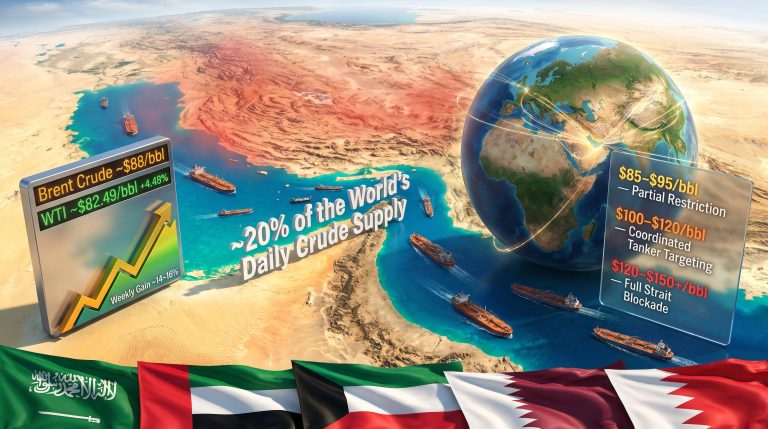
The Strait of Hormuz spans just 21 nautical miles at its narrowest navigable point, yet this slender corridor carries approximately one-fifth of all oil supplied globally under normal conditions. Persian Gulf producers including Saudi Arabia, Iraq, Kuwait, Qatar, and the UAE funnel their exports through this single chokepoint toward Asian, European, and global refining markets.
The concentration of supply through one passage creates an inherent structural vulnerability in global energy architecture. Unlike pipeline networks, which can be rerouted or expanded, maritime chokepoints cannot be duplicated. The only credible alternative for Persian Gulf crude — the East-West Pipeline running across Saudi Arabia to Yanbu on the Red Sea — has a maximum capacity of roughly 5 million barrels per day, far below the 15 to 17 million barrels per day that typically transits Hormuz during peak periods.
What this means in practical terms is that even a partial or behavioural disruption — where vessels are not physically blocked but choose to delay, anchor, or take evasive measures — can remove significant effective supply from the market. Furthermore, the current situation is precisely this type of soft disruption: not a closure, but a profound alteration of normal operating patterns.
Why Tankers Are Turning Off Their Trackers
The AIS System and Its Limitations in Conflict Zones
Automatic Identification System technology was designed to prevent maritime collisions and improve port traffic management. Every commercial vessel above a certain tonnage is legally obligated under the International Maritime Organization's SOLAS convention to operate with AIS active. The system broadcasts a vessel's identity, position, speed, course, and destination to nearby ships and shore stations.
In peacetime, this is a routine safety feature. In an active conflict zone, however, it becomes a targeting vector.
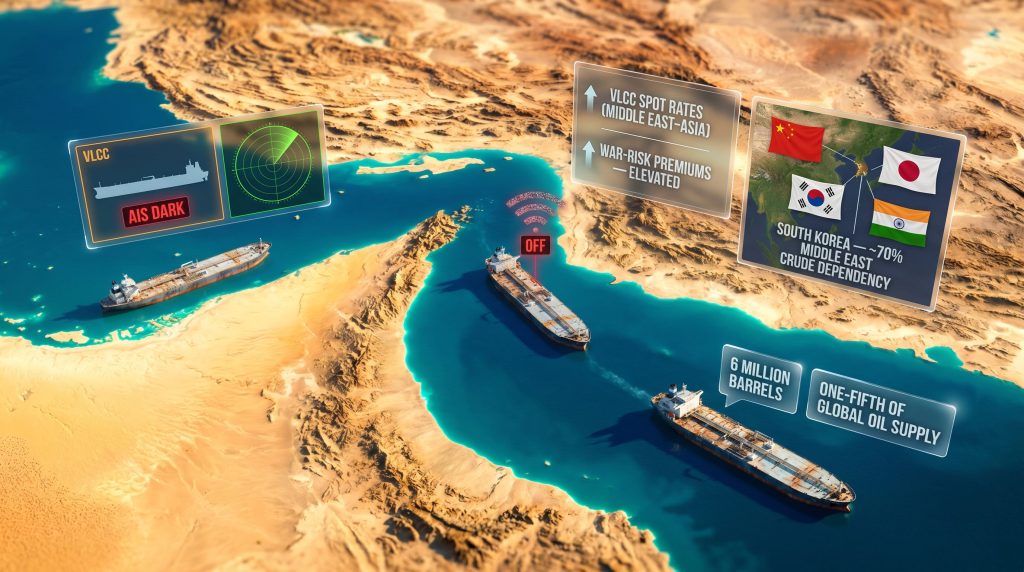
According to Reuters, when tankers exit the Strait of Hormuz with crude oil under current conditions, many are doing so with their AIS transponders deliberately deactivated. This practice, often described in shipping intelligence circles as going dark, is not new. It has been observed in earlier periods of Persian Gulf tension, during the 2019 tanker incident surge, and throughout the Red Sea disruptions of 2023 and 2024. What distinguishes the current episode is the scale and the duration of the blackouts.
The reasons operators choose to deactivate AIS in conflict corridors typically include:
- Targeting risk reduction — broadcasting real-time position in a zone where vessels face hostile attention increases exposure to interdiction
- Cargo confidentiality — owners and charterers may prefer that the origin, grade, or destination of sensitive crude cargoes not be publicly visible
- Insurance advisory compliance — certain Protection and Indemnity clubs issue risk advisories suggesting reduced electronic visibility in active war-risk zones
- Regulatory enforcement gaps — in contested maritime zones, flag state authorities have limited practical ability to enforce AIS compliance requirements
Critically, deactivating AIS is not the same as disappearing. The most advanced cargo tracking platforms now use Synthetic Aperture Radar (SAR) satellite imaging, which can detect vessel presence through cloud cover and darkness regardless of transponder status. Optical satellite systems, combined with historical movement modelling and port call data, allow firms with access to these tools to reconstruct voyage trajectories with reasonable confidence even when AIS data is absent.
This creates an asymmetry: tanker operators may reduce their real-time public visibility, but sophisticated institutional users can still track movements with high reliability.
Six Million Barrels: The Scale of Stranded Crude
The volume of crude oil accumulating in anchored VLCCs in the Persian Gulf since conflict began in late February 2026 is significant both commercially and strategically. Shipping intelligence data from LSEG and Kpler confirms that multiple VLCCs waited for periods exceeding 60 days before beginning their transit, with a combined cargo load of approximately 6 million barrels.
| Vessel | Flag | Approximate Cargo | Crude Grade | Load Date | Destination |
|---|---|---|---|---|---|
| Yuan Gui Yang | Chinese | ~2 million barrels | Iraqi Basrah crude | February 27 | Shuidong Port, Guangdong |
| Ocean Lily | Hong Kong | ~2 million barrels | Qatari al-Shaheen + Iraqi Basrah | Late Feb/Early March | Quanzhou Port, Fujian |
| Universal Winner | South Korean | ~2 million barrels | Kuwaiti crude | March 4 | Ulsan, South Korea |
| Yuan Hua Hu | Chinese | ~2 million barrels | Iraqi crude | Prior week | Zhoushan Port, China |
To contextualise that volume: 6 million barrels represents approximately four to five days of South Korea's total crude import requirements, or roughly two days of China's daily crude import pace based on recent import run rates above 10 million barrels per day. The extended anchorage was not voluntary delay for commercial reasons. It reflected a genuine risk calculus in which the cost and danger of transit exceeded operators' threshold for action.
What Drove the 60-Day Wait
The decision by vessel owners and charterers to hold position in the Gulf for over two months was shaped by several reinforcing pressures:
- War-risk insurance premium escalation — underwriters dramatically increased premiums for Hormuz transit, with some market reports indicating additional voyage costs reaching levels that made marginal cargoes economically questionable
- Flag state risk advisories — maritime authorities in South Korea, China, and Hong Kong issued precautionary guidance to vessels under their flags operating in the conflict zone
- Charterer hesitation — trading divisions at Sinopec's Unipec arm, Sinochem, and other majors deferred departure orders pending security clearance
- Corridor compliance requirements — new transit routing mandates required coordination between operators and regional authorities before departure could be authorised
The Companies Directly Exposed
The identity of the vessels and their beneficial owners reveals the extent to which China's three largest state-owned energy and shipping conglomerates carry direct exposure to Hormuz disruption. The OPEC market influence on these supply dynamics further complicates the commercial calculus for buyers and charterers alike.
Sinopec / Unipec chartered the Yuan Gui Yang, carrying Iraqi Basrah crude destined for Shuidong Port. Basrah crude is a medium-sour grade that forms a core feedstock component for large-scale Chinese refining complexes, particularly those in Guangdong province configured for heavier, sulphur-rich barrels.
Sinochem owns the Ocean Lily, which carries a mixed cargo of Qatari al-Shaheen and Iraqi Basrah crude. Al-Shaheen is a medium offshore crude grade produced by TotalEnergies and QatarEnergy from Qatar's northern shelf and is particularly valued by Chinese refiners for its processing flexibility.
Cosco Shipping, China's dominant tanker operator, is co-manager of the Yuan Gui Yang, linking the world's largest tanker fleet directly to the disruption event.
On the South Korean side, SK Energy at Ulsan is the designated discharge point for the Universal Winner's Kuwaiti crude cargo. Ulsan is one of Asia's largest single-site refinery complexes, and Kuwaiti crude is a staple feedstock for its configuration. South Korea sources approximately 70% of its crude imports from the Middle East, making it among the most structurally exposed importers to any sustained Hormuz disruption.
The combined exposure of Sinopec, Sinochem, Cosco, and SK Energy to a single episode of Hormuz disruption illustrates how deeply the supply chains of Asia's largest energy economies are anchored to a corridor that spans less than 25 nautical miles.
The Empty Tanker Paradox: What the Grand Lady Signals
Among the most analytically interesting data points in the current disruption is the movement of the Cypriot-flagged VLCC Grand Lady. According to LSEG tracking data, this vessel entered the Strait of Hormuz with its transponder deactivated and was subsequently observed at anchor off Dubai in ballast condition, meaning it was carrying no cargo.
Marine Insight reports that an empty VLCC positioning into the Gulf under AIS blackout conditions sends a layered signal to market observers:
- Commercial appetite for new cargo liftings from Persian Gulf loading terminals has not collapsed entirely
- Vessel owners are willing to absorb the war-risk premium on both laden and ballast voyages
- The market has not priced in a full closure scenario; operators are positioning for resumption of normal trade patterns
- Transponder discipline now extends to vessels regardless of cargo status, suggesting the security threat perception is route-wide rather than cargo-specific
This is a subtle but important distinction. If operators were only concerned about laden voyages being targeted, empty vessels would transit normally. The fact that a ballast VLCC is also going dark suggests the risk assessment has shifted to cover the entire corridor, not just specific cargo movements.
The next major ASX story will hit our subscribers first
Market Implications: Freight, Pricing, and the Hidden Fleet Effect
How Anchored VLCCs Tighten the Global Tanker Market
The VLCC market operates on a global pool of roughly 800 to 850 active vessels at any given time. When a meaningful number of these ships are pinned at anchor in a single region for 60 or more days, the effect on effective fleet supply is non-trivial. Each VLCC held at anchor is unavailable for spot charter on any other route, consequently compressing tonnage availability across the entire market.
| Market Segment | Direction of Pressure | Timeframe |
|---|---|---|
| VLCC spot rates, Middle East to Asia | Elevated war-risk surcharges | Near-term |
| VLCC spot rates, West Africa to Asia | Upward from fleet tightening | Near to medium-term |
| VLCC spot rates, US Gulf to Asia | Upward from alternative demand | Medium-term |
| Middle East crude differentials | Potential discount widening | Near-term |
| Asian refinery margins | Compression from logistics cost escalation | Medium-term |
| Non-Gulf crude premiums | Strengthening relative value | Medium to long-term |
The freight rate implications extend well beyond the Gulf. When tonnage is effectively removed from the trading pool, operators on alternative routes experience tighter supply and correspondingly firmer rates. This creates a transmission mechanism through which a regional security event produces freight market effects in basins as distant as the US Gulf Coast and West Africa.
The Crude Grade Discount Phenomenon
One lesser-appreciated consequence of sustained Hormuz uncertainty is the potential for Middle Eastern crude grades to trade at widening discounts to benchmark prices. Buyers incorporating war-risk freight premiums, delayed delivery risk, and insurance surcharges into their total cost calculations may require larger price concessions to absorb Gulf barrels compared to Hormuz-free alternatives.
Iraqi Basrah crude, Kuwaiti Export Blend, and Qatari al-Shaheen are all grades that could face competitive pressure from West African and US crudes on a delivered cost basis when Hormuz transit carries elevated risk premiums. In addition, the oil market effects of broader trade tensions compound this dynamic further. This is a market dynamic that typically emerges gradually, but becomes structurally significant if disruption persists beyond a quarter.
Strategic Diversification: Who Benefits From Hormuz Disruption?
Every period of Hormuz stress accelerates conversations that Asian energy importers have been having for years regarding supply diversification. The strategic incentives are well understood; it is the commercial economics that shift when disruption materialises.
Current conditions strengthen the relative attractiveness of several alternative supply origins:
- US WTI-linked crude grades transported via VLCCs from the US Gulf Coast are entirely free of Hormuz routing risk and have become increasingly competitive with Middle Eastern crudes for Asian buyers
- West African grades including Nigerian Bonny Light, Forcados, and Angolan crudes offer Atlantic Basin routing entirely independent of Persian Gulf chokepoints
- Strategic Petroleum Reserve releases by governments including the US, Japan, South Korea, and IEA member states can buffer short-term supply gaps without requiring additional seaborne procurement
- Pipeline diversification through Saudi Arabia's East-West Pipeline provides partial relief for Saudi crude exports but does not address Iraqi, Kuwaiti, or Qatari volumes
The structural limits of diversification are real: Asian refineries are largely configured around the sulphur content and density profiles of Middle Eastern crude grades. However, switching feedstock is not instantaneous or cost-free. Asian energy security concerns extend well beyond oil, meaning that every Hormuz disruption episode expands both the commercial and political will to invest in refinery configuration flexibility and long-term supply diversity.
What Happens Next: Reading the Forward Signals
The resumption of tanker movements through the Strait of Hormuz is a constructive signal in isolation, but several structural questions remain unresolved for market participants monitoring this corridor:
- Sustainability of staged departures — whether the current trickle of exiting vessels can scale back to normal traffic volumes depends on whether the security environment stabilises
- Insurance market recalibration — war-risk premium levels will be a leading indicator; if underwriters begin normalising rates, it signals improved commercial confidence in the route
- Chinese state company posture — Sinopec, Sinochem, and Cosco collectively move an enormous share of Asia's crude imports; their willingness to resume normal chartering activity in the Gulf is a bellwether for market normalisation
- VLCC fleet repositioning — vessels anchored for 60-plus days will require maintenance scheduling and cargo coordination; the return of effective capacity to the trading pool will be gradual, not immediate
- Alternative supply flow adjustments — any increase in non-Gulf crude purchasing by Asian refiners during the disruption period will take time to unwind even after Hormuz conditions improve
Monitoring current crude oil prices alongside these freight and logistics signals provides the clearest composite picture of how markets are absorbing the disruption in real time.
Disclaimer: This article contains forward-looking analysis and market projections based on publicly available shipping intelligence and historical precedent. It does not constitute financial or investment advice. Commodity markets, freight rates, and geopolitical risk environments are inherently unpredictable, and actual outcomes may differ materially from the scenarios discussed.
The continued movement of tankers exit the Strait of Hormuz with crude oil is being watched not just by energy traders and refinery schedulers, but by government energy security agencies across Asia and beyond. What appears on the surface to be a logistics story is, at a deeper level, a live stress test of the assumptions underpinning global oil supply chain architecture — and a reminder that the world's most critical energy corridor remains as consequential, and as fragile, as it has ever been.
Ready to Identify the Next Major Resource Discovery Before the Market Does?
While geopolitical disruptions reshape global energy supply chains, Discovery Alert's proprietary Discovery IQ model scans ASX announcements in real time, instantly notifying subscribers of significant mineral discoveries with the potential for substantial returns — explore historic discovery outcomes that demonstrate what early positioning can deliver, and begin a 14-day free trial to secure a genuine market-leading edge.