June 6, 2026
Cuba's energy infrastructure crisis has catalysed a transformative partnership with China that extends far beyond traditional bilateral trade relationships. This Cuba energy alliance with China represents a sophisticated geopolitical strategy where Beijing deploys renewable energy technology as both commercial opportunity and strategic influence mechanism. Furthermore, the partnership demonstrates how energy transition security considerations increasingly shape international relationships in an era of shifting global power dynamics.
China's Strategic Energy Architecture in the Caribbean
China's renewable energy engagement with Cuba represents a sophisticated approach to international influence that transcends conventional bilateral trade relationships. Beijing deploys its manufacturing dominance in solar technology as a comprehensive geopolitical instrument, creating interdependencies that serve multiple strategic objectives simultaneously while positioning itself as an enabler of energy independence.
The partnership operates through three distinct mechanisms: direct infrastructure investment, comprehensive technology transfer programs, and structured long-term financing arrangements. Unlike traditional energy partnerships focused on resource extraction, this model positions China as a facilitator of energy autonomy while simultaneously establishing new forms of economic interdependence that serve Beijing's broader strategic interests.
Key Strategic Components:
• Manufacturing leverage through solar panel exports
• Technical expertise deployment and knowledge transfer
• Financial structuring through patient capital mechanisms
• Grid integration technology and smart systems installation
• Long-term maintenance and operational support frameworks
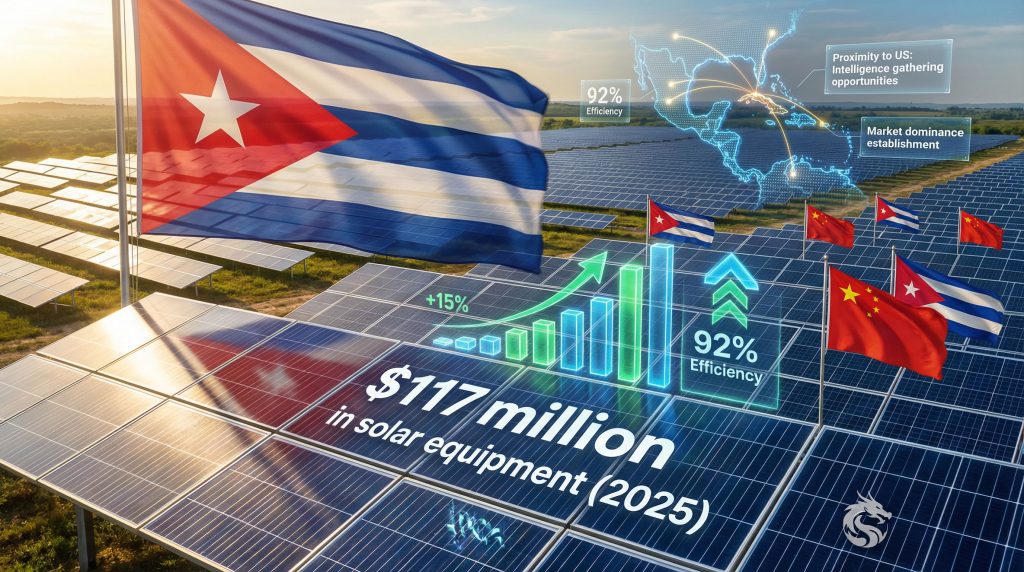
China shipped $5 million worth of solar equipment to Cuba in 2023, dramatically increasing to $117 million in 2025, representing a 2,240 percent increase in just two years. This exponential growth demonstrates China's commitment to establishing technological dominance in Cuba's energy transition while creating dependencies that extend far beyond initial equipment sales.
The Cuba energy alliance with China includes pledges to construct nearly 100 solar parks by 2028, with more than half reportedly operational as of March 2026. China also backs construction of La Herradura 1, described as Cuba's largest wind farm, indicating a comprehensive approach to renewable energy infrastructure development that mirrors successful battery-grade lithium refinery projects in other regions.
When big ASX news breaks, our subscribers know first
Cuba's Strategic Value as a Renewable Energy Laboratory
Cuba's unique position as a sanctions-isolated economy with deteriorating fossil fuel infrastructure creates optimal conditions for China to demonstrate renewable energy capabilities without competitive interference. The island's exclusion from Western financial systems eliminates traditional competitive bidding processes, allowing Chinese companies to operate without the pricing pressures encountered in open markets.
Strategic Advantages for Chinese Operations:
| Factor | Strategic Value | Long-term Impact |
|---|---|---|
| Sanctions isolation | Reduced Western competition | Market dominance establishment |
| Energy desperation | Accelerated project approval | Rapid deployment testing |
| Government alignment | Streamlined negotiations | Model replication potential |
| Geographic proximity to US | Intelligence opportunities | Regional monitoring enhancement |
Cuba consumes approximately 100,000 barrels of oil daily to power aging thermal power plants inherited from the former Soviet Union. This dependency on imported fossil fuels creates vulnerability that China exploits through renewable energy alternatives, positioning itself as the primary solution provider for Cuba's energy security challenges.
Renewables contribute just 9 percent of Cuba's national energy mix as of March 2026, indicating massive potential for expansion and Chinese market penetration. The Cuban market serves as a real-world laboratory where Chinese companies refine renewable energy deployment strategies before expanding to larger Latin American markets.
The absence of Western renewable energy companies from the Cuban market eliminates price competition and technology alternatives. Consequently, this allows China to establish comprehensive technological dependencies that extend beyond initial equipment installation to include ongoing maintenance, software updates, and system optimization requirements.
Blackout Events as Geopolitical Catalysts
Cuba's recurring power grid failures create strategic windows that China exploits through rapid response mechanisms and technical assistance programs. Each blackout episode strengthens the narrative that Chinese renewable technology offers Cuba's only viable path to energy security, deepening the partnership beyond mere commercial relationships into strategic alliance territory.
In March 2026, Cuba experienced an extended 29-hour blackout following a weeks-long US oil blockade, with the power grid collapsing under fuel supply constraints. The timing of Chinese support announcements and technical assistance following such events demonstrates sophisticated crisis management strategies that contrast sharply with Western sanctions regimes.
Blackout Impact Analysis:
• Complete national grid failure affecting entire population
• 29-hour duration highlighting system vulnerability
• Direct correlation to US sanctions and fuel supply disruption
• Chinese technical assistance positioned as primary solution
• Enhanced narrative supporting renewable energy transition
Beijing's ability to provide immediate technical support and accelerated project timelines following grid failures creates powerful demonstration effects for other sanctioned economies. This responsiveness positions China as a reliable partner during energy crises, while Western powers remain constrained by their own sanctions policies.
The March 2026 blackout occurred during a period of increased Trump administration rhetoric, with public discussions about taking control of Cuba creating additional geopolitical tension. Chinese Embassy spokesman Liu Pengyu emphasised opposition to unwarranted interference by external forces, framing energy cooperation as resistance to US coercion.
Economic Constraints on Chinese Caribbean Ambitions
Despite aggressive expansion, China's Cuban energy investments face significant financial limitations that constrain the partnership's ultimate scope. Energy economist Ricardo Torres estimates that Cuba's complete energy transition requires investments of $8 billion to $10 billion over the next decade, far exceeding China's typical infrastructure lending patterns even for strategically important projects.
Financial Reality Assessment:
• Current Chinese investment: $117 million in solar equipment (2025)
• Total transition requirement: $8-10 billion over decade
• Funding gap: Approximately 98% of total needs unfunded
• Chinese capacity: Limited by competing global commitments
Torres explains that Cuba simply lacks the financial resources for comprehensive energy transition, and China will not fund everything required. This constraint suggests Chinese support will remain selective, focusing on high-visibility projects that maximise geopolitical impact while minimising financial exposure and risk.
The dramatic 2,240 percent increase in solar equipment exports from 2023 to 2025 demonstrates China's willingness to scale investment rapidly. However, the absolute value of $117 million represents a minimal fraction of multi-billion dollar requirements, indicating structural limits on Chinese generosity despite strategic importance.
Investment Scaling Challenges:
• Current annual investment rate insufficient for transition timeline
• Multi-decade funding requirements exceed typical Chinese project scope
• Competing global infrastructure commitments limit available capital
• Cuban inability to self-finance creates dependency on external funding
Moreover, these economic energy transition challenges mirror difficulties faced by other nations attempting comprehensive energy transformation without adequate financial resources or international support mechanisms.
Technology Dependencies and Control Mechanisms
Chinese renewable energy systems create comprehensive technological dependencies that extend far beyond initial equipment installation. Unlike fossil fuel imports sourceable from multiple suppliers, integrated renewable systems lock recipients into specific technological ecosystems requiring ongoing Chinese support and expertise.
Dependency Layer Structure:
• Hardware components: Solar panels, inverters, battery systems
• Software systems: Grid management platforms, monitoring technology
• Technical expertise: Maintenance protocols, system optimisation
• Upgrade pathways: Capacity expansion, efficiency improvements
These dependencies prove more difficult to diversify than traditional energy imports, creating durable influence mechanisms that persist long after initial investments. Chinese companies maintain technological control through proprietary systems, specialised maintenance requirements, and exclusive upgrade pathways that prevent easy substitution by competitors.
Grid integration technology represents a particularly critical dependency, as renewable energy systems require sophisticated management software to balance variable generation with demand patterns. Chinese control over these systems provides ongoing influence over Cuban energy security and grid stability.
In addition, the Cuba energy alliance with China demonstrates how technological ecosystems can create decarbonisation benefits while simultaneously establishing strategic dependencies that serve broader geopolitical objectives beyond environmental considerations.
Regional Replication Potential and Strategic Expansion
Success in Cuba establishes a replicable template for Chinese energy diplomacy throughout sanctioned or economically isolated nations. Countries facing Western sanctions or seeking alternatives to traditional energy partnerships may view the Cuban model as an attractive development pathway that offers energy independence without Western financial system integration.
Potential Target Nations:
• Venezuela: Oil-dependent economy seeking diversification alternatives
• Iran: Sanctions-isolated with significant renewable energy potential
• North Korea: Extreme energy isolation creating desperate demand
• Myanmar: Post-coup international isolation from Western systems
Each represents an opportunity for China to expand renewable energy influence while Western powers remain constrained by sanctions regimes and political considerations. The Cuban model demonstrates that energy diplomacy can create strategic footholds in regions where traditional influence projection faces obstacles.
Chinese renewable energy deployment in sanctioned economies could establish a new form of technological sphere of influence, where countries excluded from Western financial systems become dependent on Chinese energy technology and expertise. This creates alternative development pathways that bypass traditional Western-dominated institutions.
The next major ASX story will hit our subscribers first
Sanctions Policy Counterproductivity Analysis
American sanctions policies create market vacuums that Chinese companies exploit without competitive pressure from Western alternatives. The absence of European and American renewable energy companies from the Cuban market eliminates price competition and technology choice, allowing China to establish monopolistic technological dependencies.
This dynamic suggests that sanctions-based isolation strategies may prove counterproductive when facing competitors with alternative economic models and patient capital deployment capabilities. Rather than forcing compliance, sanctions create opportunities for strategic competitors to establish exclusive relationships with isolated nations.
Sanctions Impact Paradox:
• Market exclusion creates Chinese monopoly opportunities
• Technology isolation increases dependency on Chinese systems
• Financial exclusion drives partnerships with alternative providers
• Strategic isolation enhances value of Chinese support
The March 2026 blackout, directly attributed to US oil blockade policies, strengthened Chinese positioning as Cuba's primary energy security partner. Rather than forcing Cuban compliance with US objectives, the crisis deepened the Cuba energy alliance with China and provided justification for accelerated renewable energy cooperation.
Furthermore, these developments occur alongside broader US-China trade war impacts that complicate traditional diplomatic approaches and create incentives for alternative partnership structures outside established Western frameworks.
Future Scenario Modeling and Strategic Implications
What Could Accelerated Success Look Like?
If Cuban renewable projects demonstrate exceptional reliability and cost-effectiveness, China could leverage this success to expand throughout Latin America, potentially challenging traditional US energy influence across the hemisphere while establishing Chinese renewable energy standards as regional benchmarks.
How Might Technical Limitations Constrain Progress?
Grid integration challenges or equipment performance failures could slow progress and limit replication potential, while still maintaining China's strategic foothold in Cuba as a demonstration of alternative development partnerships outside Western-dominated systems.
What About Geopolitical Escalation Dynamics?
Increased US pressure on China could trigger expanded Chinese commitments in Cuba as a demonstration of resolve, potentially escalating the partnership beyond economic considerations into a broader strategic confrontation with enhanced military and intelligence cooperation components.
Global Energy Security Architecture Transformation
The Cuba energy alliance with China represents a fundamental shift in global energy relationships, where technological capability increasingly determines geopolitical influence rather than traditional resource control mechanisms. Success in Cuba could establish precedents for renewable energy technology as an international influence tool comparable to historical fossil fuel leverage.
This evolution suggests future energy security will depend less on physical resource control and more on technological ecosystem dominance, fundamentally altering strategic calculations for both energy producers and consumers. Nations controlling renewable energy technology and manufacturing capacity gain advantages traditionally held by fossil fuel exporters.
Strategic Transformation Elements:
• Technology providers replace resource suppliers as dominant players
• Manufacturing capacity becomes more strategically important than reserves
• Dependency relationships shift from fuel imports to technology systems
• Influence mechanisms evolve from resource leverage to technical control
Chinese renewable energy diplomacy in Cuba demonstrates how technological leadership translates into geopolitical influence through dependency creation rather than resource extraction. This model could reshape international relations as renewable energy adoption accelerates globally and traditional energy relationships face disruption.
The partnership indicates that future energy alliances will likely centre on technological compatibility and upgrade pathways rather than simple supply relationships, creating more durable and complex forms of international interdependence that resist easy substitution or diversification efforts by recipient nations.
Moreover, China's strengthened energy presence in Cuba reflects broader strategic considerations beyond immediate commercial interests, positioning renewable energy cooperation as a cornerstone of alternative international development models that challenge traditional Western dominance in global energy markets.
Want to Stay Ahead of Energy Transition Opportunities?
Discovery Alert's proprietary Discovery IQ model delivers instant notifications on significant ASX mineral discoveries across the critical minerals powering renewable energy infrastructure. Subscribers gain immediate insights into actionable trading and investment opportunities in lithium, rare earth elements, and other commodities driving the global energy transformation. Begin your 14-day free trial today and secure your market-leading advantage in the energy transition investment landscape.