
May 20, 2026
The Power Convergence Reshaping Mining Operations
Mining operations worldwide face mounting pressure to reduce carbon emissions while maintaining production efficiency. Traditional diesel-powered haul trucks consume massive quantities of fuel, particularly in high-altitude environments where atmospheric conditions demand greater engine performance. The emergence of Cummins hybrid-electric haul truck systems represents a strategic response to these operational challenges, offering immediate deployment capabilities without requiring extensive infrastructure modifications.
The convergence of proven diesel technology with advanced battery systems creates new possibilities for mining fleet optimisation. Unlike fully electric solutions that require charging infrastructure development, hybrid systems operate independently while capturing energy that would otherwise be lost during routine operations. This technological approach addresses the immediate need for emissions reduction while providing operational experience necessary for future electrification strategies.
When big ASX news breaks, our subscribers know first
Hybrid-Electric System Architecture and Performance Integration
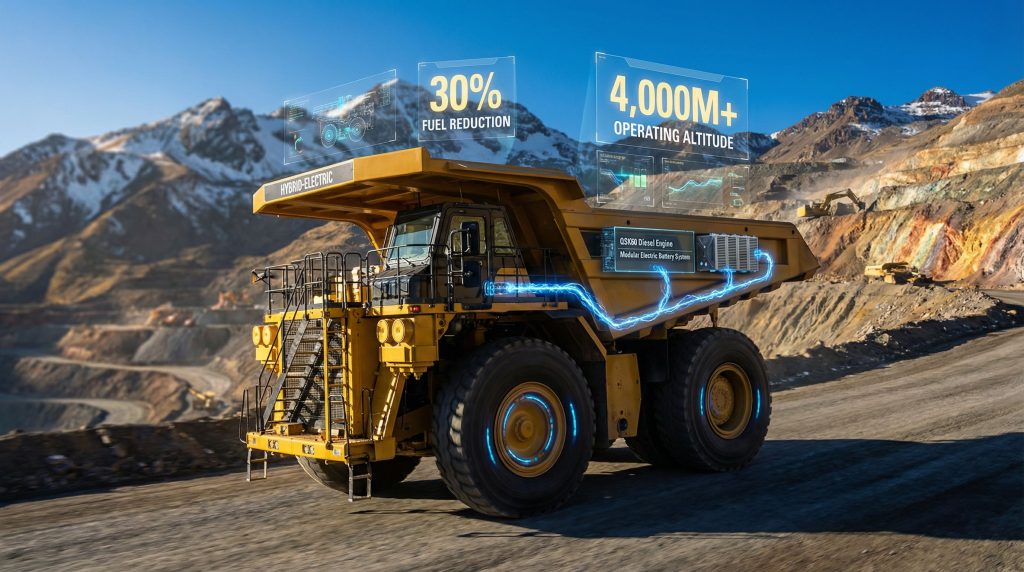
The Cummins hybrid-electric haul truck system represents a sophisticated integration of multiple power sources within existing mining equipment platforms. Furthermore, the technology combines a QSK60 diesel engine with modular battery systems, creating dual-power architecture that optimises energy utilisation across varied operational cycles.
Core Technology Components
The hybrid system's foundation rests on intelligent power management software that seamlessly coordinates energy flow between diesel and electric power sources. This control system monitors operational demands in real-time, directing stored battery energy during high-power requirements and managing engine operation for sustained performance. The modular battery design allows for maintenance flexibility and system scalability based on specific operational requirements.
Key System Specifications:
- Engine Platform: Cummins QSK60 diesel providing baseline power generation
- Battery Architecture: Modular high-power electric storage with interchangeable components
- Control Software: Intelligent power distribution managing dual-source coordination
- Retrofit Compatibility: Designed for integration with existing 300-ton ultra-class mining fleets
- Operational Validation: Performance tested at elevations exceeding 4,000 metres
The February 11, 2026 deployment at Caserones mine marked a significant milestone, representing the first commercial application of retrofit hybrid technology in ultra-class mining operations. This implementation demonstrated the system's ability to integrate with existing Komatsu equipment platforms without disrupting production workflows.
Regenerative Energy Capture Mechanisms
Regenerative braking technology transforms gravitational potential energy into stored electrical power during loaded downhill operations. This energy capture process occurs continuously throughout haul cycles, with battery systems storing recovered energy for subsequent use during uphill climbs or high-power demands.
The effectiveness of regenerative braking depends significantly on operational terrain characteristics. Steep haul profiles provide optimal conditions for energy recovery, with systems capturing substantial energy during each loaded descent. Consequently, this captured energy supplements diesel power during subsequent operational phases, reducing overall fuel consumption and emissions output.
Energy Recovery Performance Metrics:
| Operational Parameter | Specification | Impact |
|---|---|---|
| Target Fuel Reduction | Up to 30% | Direct operational cost savings |
| Energy Capture Method | Regenerative braking | Gravitational energy recovery |
| Storage System | Modular battery architecture | Scalable energy capacity |
| Power Management | Intelligent control software | Optimised energy utilisation |
| Altitude Validation | 4,000+ metres | High-altitude performance confirmation |
Economic Impact and Return on Investment Analysis
The Cummins hybrid-electric haul truck retrofit approach provides mining operations with immediate access to efficiency improvements without requiring complete fleet replacement. In addition, this capital preservation strategy enables gradual fleet modernisation while maintaining existing operational investments and extending equipment service life.
Retrofit Implementation Advantages
Retrofit compatibility with existing ultra-class mining equipment represents a significant economic advantage over complete fleet replacement strategies. Mining operations can implement hybrid technology selectively, prioritising high-utilisation equipment or specific operational profiles that maximise fuel savings potential.
The 30% fuel and emissions reduction target translates directly to operational cost savings, particularly significant for large-scale mining operations where fuel represents a substantial operational expense. In remote mining locations, fuel transportation costs amplify these savings, making hybrid retrofits economically attractive even with moderate efficiency gains.
"Economic Reality Check: Mining operations consuming thousands of gallons of diesel fuel daily can realise millions in annual savings from relatively modest efficiency improvements, making hybrid retrofits financially compelling within 2-3 year payback periods."
Capital Investment Strategy
The modular nature of hybrid retrofit systems allows mining companies to implement technology upgrades incrementally, spreading capital investment across multiple budget cycles. This approach reduces financial risk while enabling operational learning that informs future deployment decisions through data-driven mining insights.
Financial Considerations for Hybrid Adoption:
- Immediate Implementation: No infrastructure development delays or costs
- Scalable Deployment: Selective retrofit based on operational priorities
- Extended Asset Life: Improved efficiency extending equipment service periods
- Operational Learning: Performance data informing future electrification strategies
- Risk Mitigation: Proven technology reducing deployment uncertainty
Extreme Environment Performance Validation
The Caserones copper-molybdenum mine in Chile's Tierra Amarilla region provides an exceptional testing environment for hybrid-electric technology validation. Operating at elevations exceeding 4,000 metres in Andean conditions, this location presents atmospheric pressure, temperature extremes, and terrain challenges that thoroughly test system capabilities.
High-Altitude Operational Challenges
High-altitude mining operations face unique challenges that intensify equipment performance demands. Reduced atmospheric oxygen affects diesel engine combustion efficiency, while temperature extremes stress battery systems and thermal management components. However, the successful deployment of hybrid technology under these conditions validates system reliability across diverse mining environments.
The steep terrain profiles characteristic of Andean mining operations create optimal conditions for regenerative energy capture. Loaded downhill hauls generate substantial energy recovery opportunities, while steep ascents demand maximum power output from combined diesel-electric systems. This operational profile provides comprehensive validation of hybrid system performance capabilities.
Real-World Performance Metrics
Operational validation under production conditions demonstrates that hybrid systems can deliver measurable efficiency improvements without disrupting production workflows. The seamless integration with existing mining operations proves hybrid technology's practical viability for immediate deployment across similar operational environments.
Environmental Testing Parameters:
- Altitude Stress Testing: 4,000+ metre elevation performance validation
- Temperature Extremes: Andean climate condition assessment
- Terrain Challenges: Steep gradient energy recovery optimisation
- Production Integration: Continuous operation within existing workflows
- Durability Assessment: Long-term component performance evaluation
Strategic Position in Mining Decarbonisation Pathways
Hybrid-electric technology serves as a transition bridge enabling immediate emissions reductions while supporting long-term electrification strategies. This positioning addresses the temporal gap between current operational requirements and future full-electric capabilities, providing practical progress toward decarbonisation objectives through mining industry innovation.
Technology Readiness Timeline
The immediate availability of hybrid retrofit technology contrasts sharply with longer development timelines required for full-electric and hydrogen fuel cell alternatives. This timing advantage enables mining operations to begin emissions reduction efforts immediately while infrastructure and technology development continues for advanced solutions.
| Decarbonisation Technology | Implementation Timeline | Infrastructure Requirements | Technology Maturity |
|---|---|---|---|
| Hybrid Retrofits | 2026 – Commercial | Minimal | Production ready |
| Battery Electric Trucks | 2028-2030 | Charging infrastructure | Development phase |
| Hydrogen Fuel Cells | 2030+ | Hydrogen supply systems | Research stage |
| Renewable Grid Integration | Ongoing | Power infrastructure | Variable by location |
Operational Learning Platform
Hybrid system deployment provides mining operations with essential experience managing electric power systems, battery maintenance, and energy optimisation strategies. This operational learning creates foundational knowledge necessary for successful transition to more advanced electrification technologies as they become available.
The data collection capabilities of hybrid systems generate valuable insights into energy consumption patterns, operational efficiency opportunities, and equipment performance optimisation. These analytics inform future fleet planning and technology investment decisions while supporting immediate operational improvements.
Mining Operation Profiles Optimised for Hybrid Technology
Specific operational characteristics determine the economic viability and performance benefits of hybrid-electric haul truck implementation. Understanding these operational profiles enables mining companies to prioritise retrofit applications for maximum return on investment and operational impact.
Optimal Terrain and Operational Characteristics
Steep gradient operations provide the greatest opportunity for regenerative energy capture, with loaded downhill hauls generating substantial energy recovery potential. Mining operations with consistent elevation changes throughout haul cycles maximise the efficiency benefits of hybrid systems compared to flat-terrain operations.
High-frequency haul cycles amplify the cumulative benefits of individual efficiency improvements, with energy recovery and utilisation occurring repeatedly throughout operational shifts. For instance, large-scale operations with continuous equipment utilisation realise greater absolute savings from percentage-based efficiency gains.
Fleet Characteristics for Maximum ROI
Existing ultra-class fleets represent ideal candidates for hybrid retrofits, combining high fuel consumption profiles with compatible equipment platforms. The 300-ton Komatsu platform compatibility demonstrates retrofit applicability across substantial portions of the global mining fleet.
Remote mining locations benefit disproportionately from fuel efficiency improvements due to elevated fuel transportation costs and supply chain complexities. Operations in regions with limited infrastructure access realise enhanced value from reduced fuel dependency and improved operational autonomy.
The next major ASX story will hit our subscribers first
Partnership Strategy Accelerating Market Deployment
The collaborative development model demonstrates how multi-stakeholder partnerships accelerate technology deployment while distributing development risks and costs. The integration of Cummins power systems expertise with Komatsu equipment knowledge and mining operation experience creates comprehensive solution development.
Risk Distribution and Capability Integration
Technology partnerships enable specialisation focus while ensuring comprehensive solution development. Furthermore, Cummins' engine and power management expertise combines with First Mode's electric system capabilities and Komatsu's equipment integration knowledge to create optimised hybrid solutions.
The one-year anniversary of Cummins acquiring First Mode, coinciding with the February 2026 commercial deployment, illustrates accelerated technology integration through strategic acquisition. This timeline demonstrates how targeted acquisitions can rapidly advance commercial readiness for emerging technologies.
Local Deployment Expertise
Regional expertise proves essential for successful technology deployment in diverse global mining environments. Local deployment capabilities address site-specific challenges, regulatory requirements, and operational integration needs that vary significantly across mining regions.
The emphasis on combining global power technology expertise, local deployment expertise and real-world mining operations reflects the complex requirements for successful technology commercialisation in the mining industry. This multi-level approach addresses technical, operational, and regional implementation challenges simultaneously.
Future Technology Evolution and Industry Transformation
Hybrid-electric systems establish foundational infrastructure for mining industry electrification while providing immediate operational benefits. The experience gained through hybrid deployment creates essential knowledge for successful transition to advanced electrification technologies as they mature.
Technology Progression Pathway
The data collection opportunities inherent in hybrid system operation provide valuable insights into energy consumption patterns, operational optimisation potential, and equipment performance characteristics. These analytics inform both immediate operational improvements and long-term technology investment strategies for sustainable mining transformation.
Supply chain development through hybrid system deployment creates service infrastructure, maintenance capabilities, and technical expertise necessary for supporting more advanced electrification technologies. This infrastructure development reduces deployment barriers for future technology adoption.
Industry Transformation Indicators
The retrofit market expansion signals growing demand for fleet upgrade solutions that avoid complete equipment replacement. This market development indicates mining industry preference for gradual transition approaches that preserve existing capital investments while achieving operational improvements.
OEM strategy integration of hybrid capabilities into standard equipment offerings suggests technology mainstream adoption. The collaboration between engine manufacturers, equipment producers, and mining operators demonstrates industry-wide commitment to electrification progress.
Technical Performance Considerations
The intelligent control software managing power flow between diesel and electric systems represents a critical technological advancement enabling seamless hybrid operation. This software continuously optimises energy utilisation based on real-time operational demands, terrain conditions, and system status.
Battery System Performance
Modular battery architecture provides operational flexibility for maintenance, replacement, and capacity optimisation based on specific operational requirements. The interchangeable design enables system customisation while supporting standardised maintenance procedures across mining fleets.
Thermal management in extreme environments requires sophisticated cooling systems capable of maintaining battery performance across wide temperature ranges. Additionally, high-altitude operations present additional challenges with reduced atmospheric cooling capacity and extreme temperature variations.
System Integration Complexity
The seamless integration of hybrid systems with existing mining equipment requires extensive compatibility testing and custom adaptation for different equipment platforms. The successful Komatsu integration demonstrates hybrid technology's adaptability across major mining equipment manufacturers.
Performance monitoring capabilities enable continuous optimisation of hybrid system operation while providing predictive maintenance insights. These monitoring systems collect operational data supporting both immediate performance optimisation and long-term reliability improvement.
Regulatory Environment and Compliance Considerations
Mining operations worldwide face increasing emissions reduction regulations that favour technologies providing immediate environmental benefits. Hybrid systems offer compliance pathway options for operations in jurisdictions implementing stricter environmental standards.
Carbon pricing mechanisms in various jurisdictions create direct economic incentives for emissions reduction technologies. The 30% fuel and emissions reduction potential of hybrid systems translates to measurable compliance benefits and potential carbon credit generation.
However, effective implementation requires consideration of renewable energy solutions and broader energy transition security strategies to maximise long-term value.
Disclaimer: Performance projections and economic analyses are based on pilot programme data and may vary significantly based on operational conditions, equipment age, maintenance practices, and specific site characteristics. Mining operations should conduct detailed feasibility studies considering local conditions before making investment decisions.
Conclusion: Pragmatic Progress Toward Mining Electrification
The Cummins hybrid-electric haul truck technology represents practical progress in mining industry decarbonisation, offering immediate implementation capabilities while supporting long-term electrification objectives. The successful deployment at Caserones validates hybrid technology's ability to deliver meaningful efficiency improvements under demanding operational conditions.
The retrofit approach preserves existing capital investments while providing substantive environmental benefits, creating an economically viable pathway for mining operations to begin their energy transition journey. As infrastructure development and battery technology continue advancing, hybrid systems provide essential operational experience and economic justification for industry-wide transformation.
The collaborative development model demonstrates how strategic partnerships can accelerate technology deployment while managing development risks and costs. This approach creates comprehensive solutions addressing technical, operational, and economic requirements for successful mining industry electrification.
Ready to Capitalise on Mining Innovation Breakthroughs?
Hybrid-electric technology developments like Cummins' commercial deployment represent the innovation momentum transforming mining operations and creating substantial investment opportunities for forward-thinking investors. Discovery Alert's proprietary Discovery IQ model instantly identifies significant ASX mineral discoveries, enabling subscribers to position themselves ahead of major technological and operational breakthroughs that drive market returns through our discoveries page.