
June 6, 2026
How Do Currency Crises Drive Central Bank Gold Liquidation?
Venezuela gold sales amid dollar shortage have become a defining feature of the country's economic crisis, as central banks facing severe foreign exchange constraints follow predictable liquidation patterns. When emerging market economies encounter dollar shortages, central banks typically follow a sequence that reveals the mechanics of financial desperation. The process begins with foreign exchange reserves, progresses through sovereign bonds, and ultimately reaches precious metals as the asset of last resort.
Venezuela's recent disposal of nearly six tons of gold during the second half of 2025 exemplifies this crisis-driven pattern. Furthermore, geopolitical restrictions created immediate balance-of-payments pressure requiring hard asset mobilisation. The historic gold surge explanation provides context for understanding how precious metals markets responded to these crisis conditions.
The Mechanics of Foreign Exchange Desperation
The relationship between official and parallel exchange rates during currency crises creates powerful arbitrage incentives that force central bank intervention. In Venezuela's case, the gap between official and parallel rates reached record highs as oil export restrictions eliminated primary dollar inflows. This divergence pattern follows established crisis economics, where parallel market rates can exceed official rates by 200-500% during severe monetary stress.
| Crisis Indicator | Venezuela 2025 | Argentina 2001 | Turkey 2018 |
|---|---|---|---|
| Official vs Parallel Rate Gap | Record High | 300%+ | 150%+ |
| Reserve Depletion | 80%+ over 12 years | 65% in 18 months | 40% in 6 months |
| Gold Sales Timing | December peak | Q4 concentration | Throughout crisis |
The timing of Venezuela's December 2025 gold sales coincided directly with the seizure of the first Venezuelan oil tanker on December 10. Consequently, this specific trigger date anchored the acceleration of foreign exchange crisis as the embargo dried up remaining dollar supplies into the Latin American economy. The global trade impact analysis demonstrates how such geopolitical shocks compress timelines for asset mobilisation.
Central Bank Asset Liquidation Patterns in Emerging Markets
Currency crises follow mechanical sequences regardless of domestic policy preferences. The transmission mechanism operates through multiple channels:
• First Stage: Sanctions eliminate dollar inflows from primary export revenue
• Second Stage: Balance-of-payments pressure cascades into parallel market currency trading
• Third Stage: Widening exchange rate gaps create arbitrage incentives and inflationary expectations
• Fourth Stage: Authorities deploy remaining hard assets to inject dollars into official foreign exchange markets
Venezuela's gold liquidation represents the fourth stage response, where preserving monetary stability metrics takes priority over long-term reserve accumulation. However, the December concentration of sales reflects both seasonal dollar demand for remittances and year-end import settlements, combined with crisis acceleration from the oil tanker seizure.
Despite selling six tons of gold, Venezuela's total reserves grew 30% in dollar terms due to precious metal price appreciation, illustrating how commodity price rallies can mask underlying asset depletion during crisis periods.
When big ASX news breaks, our subscribers know first
What Economic Factors Triggered Venezuela's 6-Ton Gold Sale Strategy?
The confluence of sanctions escalation and structural fiscal dependency created the immediate catalysts for Venezuela's gold liquidation strategy. When the Trump administration ratcheted up restrictions on Venezuelan oil exports throughout 2025, the economy faced a classic resource curse scenario. In addition, narrow export dependence amplified external shock transmission into domestic monetary conditions.
Oil Export Revenue Collapse and Fiscal Dependency
Venezuela's oil production trajectory illustrates the severity of export revenue collapse that drove gold sales necessity:
- 2013: Peak production of 3.2 million barrels per day
- 2018: Decline to 2.1 million barrels per day under initial sanctions
- 2022: Further reduction to 1.5 million barrels per day
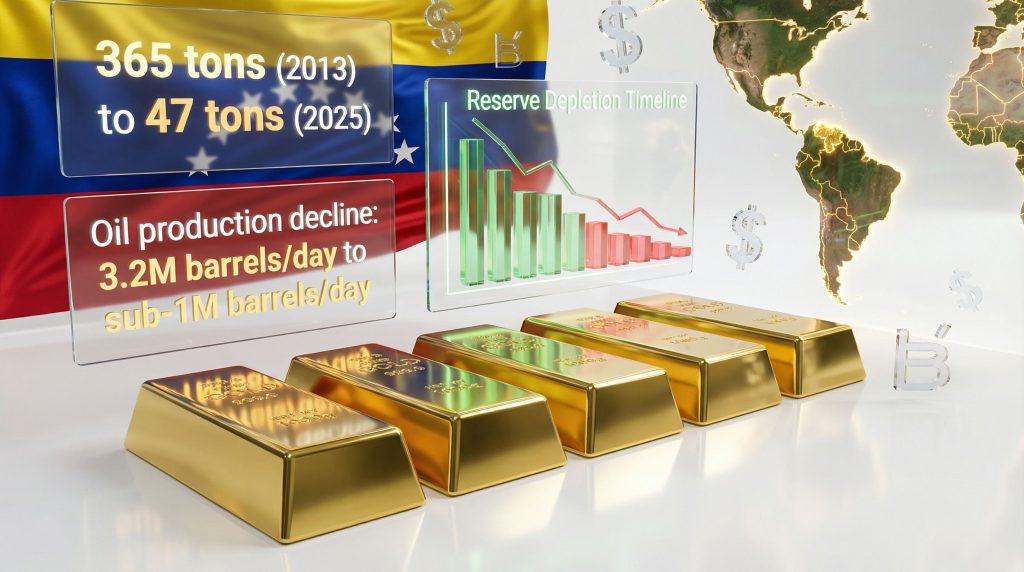
- 2025: Collapse to sub-1 million barrels per day following intensified restrictions
The December 10, 2025 oil tanker seizure represented the culmination of export revenue elimination. As a result, this created immediate dollar shortage that required gold asset mobilisation. This timeline demonstrates how geopolitical restrictions produce mechanical macroeconomic outcomes independent of domestic economic management capacity.
Featured Insight: Venezuela's oil-dependent economy lost approximately 85% of export revenues between 2013-2025, creating fiscal pressures that necessitated central bank asset liquidisation despite the strategic importance of gold reserves for monetary stability.
Exchange Rate Arbitrage and Inflation Pressure Points
The mechanics of Venezuela's exchange rate crisis reveal how dollar shortages create self-reinforcing pressure cycles. As enterprises sought dollars for essential imports through parallel markets, the widening gap between official and market rates created arbitrage opportunities that further drained official reserves.
Central bank authorities faced a policy trilemma: impose currency controls, allow official rate devaluation, or liquidise hard assets to maintain exchange rate stability. Venezuela's choice to sell physical gold represented a deliberate strategy to preserve official exchange rate fiction while generating immediate dollar liquidity.
The gold market performance during this period shows how crisis-driven sales occurred alongside broader precious metals rallies.
How Does Geopolitical Asset Freezing Amplify Liquidity Crises?
Asset freezing mechanisms create perfect illiquidity scenarios where nominally valuable reserves become operationally useless for monetary policy purposes. Venezuela's experience with Bank of England gold holdings since 2019 illustrates how geopolitical non-recognition translates into durable economic constraints extending beyond the original political conflicts.
The Bank of England Gold Holdings Dilemma
An important portion of Venezuela's current gold position remains physically held at the Bank of England, but the country cannot access these funds because the UK has not recognised the government since 2019. This freeze encompasses approximately $1.8 billion in reserves, representing a material portion of Venezuela's total gold holdings.
The inaccessibility creates accounting asymmetry where official reserve figures may include frozen assets, but operational liquidity capacity reflects only disposable holdings. Furthermore, the persistence of the freeze following political transition in January 2026 demonstrates institutional rigidity in foreign policy positions.
Even after US special forces captured President Nicolas Maduro, UK asset recognition policy remained unaltered. This suggests that government recognition and asset access operate through separate institutional channels requiring independent diplomatic resolution.
Sanctions-Driven Market Fragmentation
Geopolitical asset freezes create systematic market fragmentation patterns observed across multiple sanctioned economies:
• Russia (2022): Western central banks froze over $300 billion in Russian Central Bank assets following Ukraine invasion
• Iran (2012): Nuclear sanctions created central bank asset freezes affecting both gold and foreign currency reserves held abroad
• Afghanistan (2021): Taliban takeover triggered US authorities to freeze approximately $7 billion in Afghan central bank reserves
• Venezuela (2019-present): UK non-recognition policy immobilised Bank of England gold holdings worth $1.8 billion
This pattern reveals how asset freezes become mechanised through financial infrastructure decisions. Consequently, they create path-dependent economic consequences that persist beyond regime changes or political transitions.
What Does Venezuela's Reserve Depletion Reveal About Resource Curse Economics?
Venezuela's gold reserves have dropped more than 80% over the past 12 years, declining from approximately 365 tons in 2013 to 47 tons in 2025. This massive asset depletion spanning over a decade illustrates classic resource curse dynamics where commodity export dependence creates vulnerability to external shocks.
12-Year Gold Reserve Decline Analysis
| Year | Gold Reserves (tons) | Percentage Decline | Key Events |
|---|---|---|---|
| 2013 | 365 | Baseline | Peak oil production era |
| 2018 | 220 | -40% | Initial sanctions implementation |
| 2022 | 95 | -74% | Intensified economic pressure |
| 2025 | 47 | -87% | Accelerated liquidation period |
The depletion pattern reveals several critical insights about resource curse mechanics. During commodity boom periods, governments experience fiscal windfalls that reduce budgetary discipline. In addition, they often fund inefficient state enterprises or military expenditures rather than productive investment.
When commodity prices decline or export access becomes restricted, the narrow fiscal revenue base creates immediate liquidity crises requiring asset liquidisation. The record high gold prices of 2025 provided some cushioning effect, but could not prevent the underlying depletion pattern.
Commodity Price Volatility as Economic Buffer
Despite physical gold sales of nearly six tons in 2025, Venezuela's total reserves grew 30% in dollar terms due to precious metal price appreciation. This paradoxical outcome illustrates how commodity price cycles create optical distortions in reserve positions during crisis periods.
The surge in gold prices provided temporary nominal strength that masked underlying physical asset depletion. Venezuelan authorities shortened the time span used to calculate average gold prices, capturing price rallies more rapidly and inflating reported reserve values.
This methodological adjustment represents sophisticated crisis management designed to present favourable optical metrics whilst underlying fundamentals deteriorated.
The disconnect between headline reserve growth and physical asset depletion demonstrates how commodity-dependent economies experience false confidence signals during price rallies, potentially delaying necessary structural adjustments.
How Do Political Transitions Impact Monetary Policy in Crisis States?
The capture of President Nicolas Maduro in January 2026 by US special forces created immediate shifts in Venezuela's external sector dynamics. However, institutional constraints from previous policy decisions continued to influence monetary conditions. Political transitions in crisis states typically face inherited structural problems requiring sustained policy coordination beyond regime change.
Post-Transition Economic Stabilisation Mechanisms
Following Maduro's capture, the US allowed some dollars from Venezuelan oil sales to flow back into the country. This revived the official foreign exchange market and narrowed the gap with parallel rates. This $300 million oil revenue repatriation created immediate stabilisation effects.
The development demonstrates how controlled dollar injections can rapidly improve exchange rate dynamics in severely distressed economies. Furthermore, the repatriation mechanism operated through established channels rather than creating new institutional frameworks, suggesting that crisis-period monetary infrastructure remained functional despite political upheaval.
Central bank financial statements indicated no gold sales occurred in January 2026. For instance, this implies that modest dollar inflows eliminated immediate liquidation pressure, providing temporary relief from Venezuela gold sales amid dollar shortage pressures.
International Financial Reintegration Challenges
Political transition success in crisis states requires systematic financial reintegration addressing multiple institutional relationships:
- Sanctions Relief Coordination: Achieving consistent policy alignment across multiple sanctioning jurisdictions
- Asset Access Restoration: Negotiating unfreezing of central bank reserves held abroad
- Market Access Rehabilitation: Rebuilding relationships with international financial institutions
- Debt Restructuring Framework: Addressing accumulated external obligations during crisis period
- Monetary Policy Normalisation: Establishing credible exchange rate and inflation targeting regimes
The persistence of the Bank of England gold freeze despite political transition illustrates how asset reintegration operates through separate diplomatic channels. These require independent negotiation beyond regime recognition.
What Are the Broader Implications for Global Gold Markets?
Venezuela's gold liquidation strategy reveals important dynamics about how sovereign distress affects global precious metals markets. The relationship between crisis-driven sales and strategic accumulation patterns among emerging market central banks demonstrates market resilience mechanisms.
Emerging Market Central Bank Gold Demand Patterns
Central bank gold demand exhibits bifurcated patterns depending on economic conditions and geopolitical positioning. Whilst Venezuela liquidated assets under crisis conditions, other emerging market economies continued strategic accumulation as hedges against currency volatility and geopolitical uncertainty.
The contrast between crisis-driven sales and strategic purchases creates market dynamics where distressed sovereign sellers meet opportunistic sovereign buyers. However, this potentially maintains overall central bank demand levels whilst shifting geographic distribution of official gold holdings.
The central bank gold accumulation patterns show how institutional demand continues despite isolated crisis-driven sales from countries facing severe balance-of-payments pressures.
Geopolitical Risk Premium in Precious Metals Pricing
Asset freezes affecting Russia, Iran, Afghanistan, and Venezuela have created systematic precedents for geopolitical immobilisation of central bank reserves. This pattern contributes to geopolitical risk premiums in precious metals pricing as central banks assess the probability that their own foreign-held assets could face similar restrictions.
The Bank of England's continued freeze of Venezuelan gold despite political transition signals institutional momentum in asset control decisions. Consequently, this potentially influences other central banks' decisions about reserve custody arrangements and geographic diversification strategies.
The Venezuela tensions and gold market impact illustrates how geopolitical uncertainty creates sustained demand for precious metals as safe-haven assets.
The next major ASX story will hit our subscribers first
Frequently Asked Questions About Venezuela's Gold Sales Strategy
Why December 2025 Specifically?
December timing reflected the convergence of seasonal fiscal pressures with acute crisis acceleration. Year-end periods typically witness elevated dollar demand for:
• Remittance flows from diaspora populations sending money home
• Import settlement obligations for annual trade balances
• Capital flight acceleration as investors position for new calendar year uncertainty
• Government expenditure concentrations including salary payments and subsidies
The December 10 oil tanker seizure created additional urgency by eliminating remaining export revenue expectations. As a result, this compressed the timeline for alternative dollar generation through gold liquidation.
How Do Sanctions Affect Gold Market Access?
Sanctions create market fragmentation between compliant and non-compliant trading channels:
Compliant Channels:
• Traditional London bullion markets with enhanced due diligence requirements
• Established precious metals dealers with sanctions screening protocols
• Bank-mediated transactions through financial institutions with compliance frameworks
Alternative Channels:
• Direct bilateral transactions with non-sanctioning jurisdictions
• UAE and Turkey pathway arrangements bypassing traditional Western markets
• Regional trading networks in Latin America and Asia
Venezuela's gold sales likely occurred through alternative channels given sanctions restrictions on traditional market access. However, specific transaction mechanisms remain undisclosed in public documentation.
Economic Recovery Scenarios and Reserve Rebuilding Strategies
Venezuela's path toward economic stabilisation requires addressing both immediate liquidity constraints and long-term structural vulnerabilities that created the crisis conditions necessitating Venezuela gold sales amid dollar shortage.
Oil Sector Revival Investment Requirements
Comprehensive oil sector rehabilitation requires an estimated $200+ billion in infrastructure investment across multiple categories:
| Investment Category | Estimated Cost | Timeline | Priority Level |
|---|---|---|---|
| Production Infrastructure | $150 billion | 8-10 years | Critical |
| Refining Capacity | $35 billion | 5-7 years | High |
| Pipeline Networks | $15 billion | 3-5 years | High |
| Environmental Remediation | $20 billion | 10+ years | Medium |
The magnitude of required investment exceeds Venezuela's current fiscal capacity. Therefore, this necessitates international financial assistance or foreign direct investment arrangements to achieve meaningful production recovery.
Alternative Foreign Exchange Generation Models
Economic diversification strategies beyond oil export dependence could reduce vulnerability to commodity price volatility and geopolitical restrictions:
Mining Sector Development:
• Gold production expansion through foreign investment partnerships
• Base metals exploration in Guyana Shield geological formations
• Rare earth elements development for strategic mineral exports
Agricultural Export Potential:
• Coffee production rehabilitation for premium export markets
• Cacao cultivation expansion leveraging favourable growing conditions
• Cattle ranching modernisation for regional protein exports
Strategic Reserve Accumulation Framework:
• Graduated gold reserve rebuilding during oil revenue recovery periods
• Geographic diversification of reserve custody arrangements
• Multi-asset reserve composition reducing single-commodity dependence
The success of alternative development models depends on achieving political stability, institutional capacity building, and international market reintegration following the crisis period. The gold price forecast suggests that future accumulation strategies could benefit from sustained precious metals strength.
Investment Disclaimer: This analysis is provided for informational purposes only and does not constitute investment advice. Commodity markets, particularly those involving politically sensitive jurisdictions, carry substantial risks including price volatility, regulatory changes, and geopolitical uncertainty. Readers should conduct independent research and consult qualified financial advisors before making investment decisions related to precious metals or emerging market assets.
Are You Positioned to Capitalise on Crisis-Driven Gold Market Opportunities?
Discovery Alert's proprietary Discovery IQ model delivers real-time alerts on significant ASX mineral discoveries, empowering subscribers to identify actionable opportunities ahead of the broader market whilst geopolitical events reshape global commodity flows. Understand why major mineral discoveries can lead to substantial market returns by exploring Discovery Alert's dedicated discoveries page, showcasing historic examples of exceptional outcomes, and begin your 14-day free trial today to position yourself ahead of the market.