
July 14, 2026
Understanding Global Risk Appetite Through Currency Cross-Rates
Market psychology during geopolitical uncertainty reveals itself through currency movements and cross-rate relationships that often signal broader institutional sentiment shifts before equity markets reflect fundamental changes. The impact of Iran war on ASX market demonstrates how sophisticated institutional investors calibrate risk exposure based on multiple scenario outcomes rather than binary conflict predictions.
Professional portfolio managers increasingly rely on currency cross-rates as leading indicators of geopolitical stress, with the Australian dollar's sensitivity to global risk sentiment creating measurable transmission effects across ASX sectors. When shipping insurance rates spike due to Middle Eastern tensions, the resulting supply chain cost increases flow through currency markets before appearing in corporate earnings reports.
Historical Precedent Analysis for Middle Eastern Market Shocks
Previous regional conflicts have established recognisable patterns in Australian equity responses, with initial declines typically ranging between 2-5% followed by recovery phases lasting 2-4 weeks when conflicts remain geographically contained. The current measured response suggests institutional memory of past volatility cycles has improved risk calibration mechanisms.
The 2008 oil price spike to $147 per barrel created inflationary pressures that required coordinated central bank responses, while the 2011 Libya intervention generated more localised energy sector impacts. These historical benchmarks provide context for current institutional positioning strategies, particularly regarding oil price rally analysis.
Sector Vulnerability Mapping During Geopolitical Events
Energy and materials sectors demonstrate the highest correlation to regional conflict duration, while defensive sectors including healthcare and utilities maintain greater stability during uncertainty periods. This sectoral differentiation reflects underlying business model resilience to supply chain disruptions and demand pattern shifts.
Defence technology companies benefit from immediate risk premium adjustments, though sustainability depends on government procurement cycle timing and budget allocation decisions that typically lag initial market movements by several quarters. Furthermore, the trade war impacts from broader geopolitical tensions add another layer of complexity to these market dynamics.
When big ASX news breaks, our subscribers know first
Strategic Beneficiaries of Extended Regional Instability
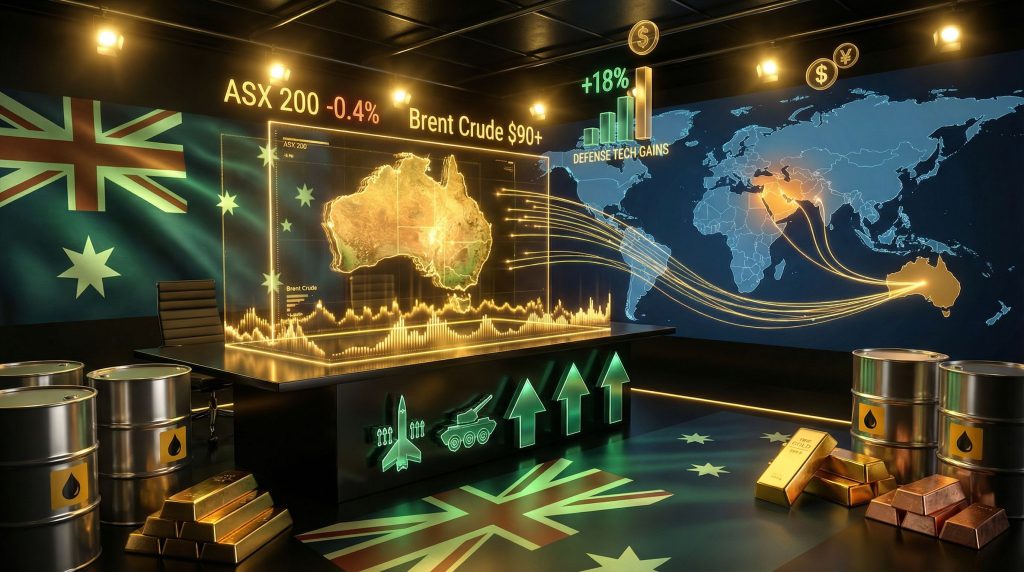
Defence technology emerged as the primary beneficiary sector, with Electro Optic Systems gaining 18% during initial trading following weekend military escalation. However, these gains reflect market sentiment rather than confirmed revenue pipeline improvements, creating sustainability questions for medium-term positioning strategies.
The broader defence sector opportunity encompasses three distinct subsectors with varying risk-reward profiles and different fundamental drivers affecting long-term performance sustainability.
Technology Integration and Surveillance Systems
Companies developing advanced surveillance and drone technology benefit from increased government focus on border security and critical infrastructure protection. Electro Optic Systems reached near record highs, reflecting market recognition of competitive positioning in space-based surveillance technology that serves both military and commercial applications.
DroneShield demonstrated positive performance though remaining below historical peaks, suggesting investor caution about valuation sustainability despite favourable operating environment conditions. This performance differential indicates market discrimination between companies with proven revenue streams versus those dependent on contract pipeline development.
Cybersecurity Infrastructure Protection
Critical infrastructure protection requirements create opportunities for cybersecurity firms providing specialised services to government agencies and strategic industry sectors. The increasing digitalisation of defence systems amplifies the importance of cyber protection capabilities across multiple threat vectors.
Supply chain security becomes particularly relevant when traditional logistics routes face disruption, creating demand for companies offering alternative sourcing solutions and supply chain optimisation technologies. In addition, considerations about the US economy and inflation affect global supply chain strategies.
Energy Sector Risk-Reward Assessment Matrix
Australian energy producers face complex positioning dynamics where global price increases must be balanced against operational cost inflation from energy-intensive production processes. Karoon Energy outperformed other ASX energy producers, though this reflected relative valuation positioning rather than fundamental operational advantages.
| Company Category | Risk Assessment | Upside Potential | Primary Dependencies |
|---|---|---|---|
| Domestic Oil Producers | Low | Moderate | Sustained price elevation |
| LNG Export Operations | Medium | High | Asian demand stability |
| Renewable Energy Developers | Low | Limited | Policy framework continuity |
| Energy Infrastructure | Medium | Moderate | Capital deployment timing |
The energy sector's response to geopolitical events depends heavily on conflict duration and geographic scope, with different company categories demonstrating varying sensitivity to oil price movements and supply chain disruption risks.
Oil Price Scenarios and Monetary Policy Implications
Current market pricing suggests three distinct conflict duration scenarios with corresponding oil price trajectories that would trigger different Reserve Bank of Australia policy responses based on inflation transmission mechanisms and economic growth impact assessments.
Market analyst commentary indicates that oil prices could climb well above US$80 per barrel depending on shipping route disruption duration, with Trump administration statements suggesting a four-week operational timeline that could push Brent Crude above US$90 per barrel.
Short-Term Disruption Framework (2-4 weeks)
Oil prices reaching $85-90 per barrel would likely result in inflation impacts contained primarily to fuel components without triggering broader price pressures across the economy. The Reserve Bank of Australia would maintain current policy settings while monitoring second-round inflation effects through producer cost indices.
This scenario assumes shipping insurance rates normalise relatively quickly and alternative routing through longer sea lanes provides adequate supply chain continuity for most Australian import-dependent industries.
Extended Conflict Parameters (2-3 months)
Sustained oil prices above $95 per barrel would generate broader inflationary pressures through transport cost increases affecting producer input costs across multiple industry sectors. The RBA would likely delay planned rate adjustments while assessing whether energy-driven inflation becomes embedded in longer-term expectations.
Supply chain adaptations typically require 6-8 weeks to implement alternative logistics solutions, meaning extended conflicts create genuine economic disruption beyond initial market sentiment effects. Consequently, understanding tariffs impact on investments becomes crucial for portfolio planning.
Regional Escalation Scenario (3+ months)
Oil prices exceeding $110 per barrel would necessitate emergency policy coordination between fiscal and monetary authorities, with significant economic growth revisions required across forward guidance frameworks. Historical precedent from 2008 suggests such price levels create systemic economic stress requiring coordinated international policy responses.
The Strait of Hormuz carries approximately 21 million barrels per day representing roughly 20% of global crude oil supply, making sustained disruption a systemic rather than regional economic risk factor.
Currency Market Amplification Effects on ASX Performance
The Australian dollar's role as a risk-sensitive currency creates additional complexity for ASX-listed companies with international revenue exposure, as currency movements can either amplify or offset underlying business performance during geopolitical uncertainty periods.
Early Asian trading demonstrated USD strength patterns typical of geopolitical risk events, potentially benefiting Australian exporters through improved conversion rates while pressuring import-dependent sectors through higher input costs.
Precious Metals Market Dynamics
Gold's modest 1.5% increase suggests the precious metals rally may have already incorporated conflict expectations over preceding weeks, with institutional positioning reflecting measured rather than panic-driven allocation adjustments. This subdued response indicates sophisticated risk management rather than reflexive safe-haven buying.
Australian gold miners face operational complexity where higher gold prices must be evaluated against energy cost inflation affecting mining operations, creating margin compression risks that offset commodity price benefits for higher-cost producers. However, the gold price forecast suggests longer-term upward momentum.
Base Metals and Strategic Mineral Positioning
Supply chain disruptions could benefit Australian base metals producers, particularly copper and lithium miners serving Asian markets seeking supply diversification away from potentially affected regions. This creates structural demand shifts beyond short-term price volatility.
Strategic mineral producers benefit from government focus on supply chain security, though this requires sustained policy support rather than temporary market sentiment to generate meaningful revenue improvements.
Investment Strategy Frameworks for Geopolitical Uncertainty
Portfolio construction during geopolitical events requires distinguishing between temporary volatility and structural market shifts that could reshape investment opportunities across extended time horizons. Professional investors apply scenario-based allocation models rather than binary positioning strategies.
The key methodology involves balancing defensive positioning against opportunistic exposure to beneficiary sectors while maintaining flexibility for tactical adjustments based on conflict duration and escalation indicators.
Defensive Portfolio Construction Principles
Utilities and Infrastructure companies providing essential services demonstrate historical resilience during uncertainty periods, offering stable cash flows and regulated revenue streams that prove less sensitive to short-term sentiment shifts.
Healthcare and Pharmaceuticals sectors benefit from defensive characteristics combined with government spending support, creating dual protection through both recession resistance and public sector demand stability.
Consumer Staples businesses serving domestic demand patterns maintain revenue predictability even during economic disruption, though margin pressures from input cost inflation require careful company selection within the sector.
Opportunistic Sector Allocation Strategies
Energy Independence themes create opportunities in renewable energy development and domestic production capabilities that benefit from policy focus on supply chain security and strategic resource development.
Technology and Innovation applications in defence and cybersecurity demonstrate accelerated adoption patterns during geopolitical stress periods, though valuation discipline remains essential for sustainable returns.
Resource Security positioning in critical minerals and alternative supply chain solutions offers structural growth potential beyond immediate conflict-driven demand spikes.
Strategic Allocation Framework: Professional portfolio managers typically maintain 60-70% defensive positioning during geopolitical uncertainty while allocating 20-30% to potential beneficiary sectors, with 10% cash reserves for opportunistic deployment during volatility spikes.
Market Response Timeline Analysis and Leading Indicators
Historical analysis of Middle Eastern conflicts reveals three distinct phases of market adjustment that provide frameworks for timing investment decisions and risk management strategies based on information flow and sentiment evolution patterns.
Understanding these phases allows investors to differentiate between emotional market responses and fundamental repricing based on actual economic impact assessments.
Phase 1: Initial Risk Repricing (Days 1-3)
Markets typically experience 2-5% declines as investors reduce risk exposure and seek safe-haven asset allocation. The ASX's measured 0.4% response suggests this phase may be compressed due to institutional pre-positioning based on advance geopolitical intelligence.
Professional money managers often use this phase for tactical rebalancing rather than strategic positioning changes, recognising that initial market reactions frequently overstate fundamental economic impacts.
Phase 2: Information Assessment Period (Weeks 1-2)
Volatility remains elevated as markets evaluate conflict scope, economic impact magnitude, and policy response effectiveness. Energy prices become the primary market indicator during this phase, serving as real-time measures of supply chain disruption severity.
Institutional research teams focus on supply chain impact assessment and alternative routing feasibility studies that determine whether initial price spikes reflect temporary disruption or structural supply changes requiring portfolio repositioning. For instance, recent market commentary highlights these assessment challenges.
Phase 3: New Equilibrium Development (Weeks 2-8)
Markets begin incorporating conflict conditions as baseline assumptions rather than temporary disruptions, with sector rotations based on fundamental impact assessments replacing sentiment-driven trading patterns.
This phase typically sees the emergence of sustainable investment themes that extend beyond immediate conflict resolution, creating opportunities for longer-term strategic positioning.
The next major ASX story will hit our subscribers first
Critical Monitoring Indicators for Investment Decision-Making
Successful navigation of geopolitical market conditions requires systematic monitoring of leading indicators that signal escalation or de-escalation scenarios before they become reflected in equity pricing patterns.
Professional investment managers employ multi-indicator frameworks that combine market-based signals with fundamental economic data to optimise timing for portfolio adjustments.
Primary Market-Based Indicators
Oil Price Trajectory Analysis: Sustained movements above $90 per barrel signal market consensus expectations of extended disruption beyond initial 4-week estimates, requiring portfolio positioning adjustments across energy-sensitive sectors.
Shipping Insurance Rate Monitoring: Real supply chain impact assessment beyond speculative pricing, with insurance premium increases providing measurable data on actual logistics disruption severity and duration expectations.
Currency Cross-Rate Movements: AUD/USD fluctuations indicate global risk sentiment shifts affecting Australian export competitiveness and international revenue conversion rates for multinational ASX companies.
Secondary Economic Assessment Metrics
Bond Yield Curve Analysis: Flight-to-quality capital flows affect interest rate expectations and monetary policy assumptions, creating valuation impacts across rate-sensitive sectors including REITs and utilities.
Commodity Price Correlation Studies: Broader inflation expectations beyond energy components, indicating whether geopolitical effects remain contained or spread across multiple economic sectors.
Regional Market Performance Comparisons: Asian market stability measurements provide early warning indicators of economic contagion limits and regional demand pattern sustainability.
The impact of Iran war on ASX market ultimately depends on conflict duration, geographic containment, and global policy coordination effectiveness. While initial market reactions demonstrate institutional sophistication in risk assessment, investors must prepare for multiple scenario outcomes ranging from rapid resolution to extended regional instability.
Success requires portfolio flexibility combined with disciplined response to short-term volatility, focusing on distinguishing between temporary market disruption and fundamental shifts in global economic relationships. The critical insight lies in recognising that geopolitical events create both immediate risks and structural opportunities that may reshape investment landscapes for extended periods beyond initial conflict resolution.
Understanding these complex dynamics enables investors to position portfolios for scenario-based outcomes while avoiding overreaction to sentiment-driven market movements that frequently reverse as information clarity improves and institutional assessment processes mature.
Looking to Capitalise on Geopolitical Market Movements?
Discovery Alert's proprietary Discovery IQ model delivers instant notifications on significant ASX mineral discoveries, helping subscribers identify actionable opportunities during market volatility when commodity prices shift due to geopolitical events. Explore how major mineral discoveries can generate substantial returns and begin your 14-day free trial today to position yourself ahead of market movements.