
August 14, 2026
Modern hydrometallurgy faces mounting pressure to develop environmentally sustainable extraction methods as traditional processes encounter increasingly stringent regulatory frameworks. The evolution of cyanide-free gold leaching technologies represents a fundamental shift in mining industry evolution, driven by environmental stewardship requirements and operational risk mitigation strategies.
While conventional cyanidation has dominated gold recovery for over a century, achieving consistent extraction rates exceeding 90% from various ore types, the inherent toxicity concerns create substantial operational complexities and compliance costs for mining enterprises worldwide.
Understanding Alternative Gold Extraction Methods
The metallurgical industry has invested significant resources in developing non-cyanide leaching systems that maintain comparable recovery efficiency while eliminating toxic reagent handling protocols. These alternative technologies encompass diverse chemical pathways, including thiosulfate-based systems, thiourea formulations, halogen chemistry applications, and proprietary water-based solutions.
Environmental regulations across major mining jurisdictions increasingly restrict cyanide usage, particularly in proximity to water sources or sensitive ecosystems. Countries including several European Union members and certain U.S. states have implemented partial or complete cyanide bans, necessitating alternative processing methodologies for gold extraction operations.
The economic framework for evaluating cyanide-free technologies extends beyond simple reagent cost comparisons to encompass insurance premiums, environmental bonding requirements, regulatory compliance expenditures, and potential liability exposure. Furthermore, gold market analysis must consider comprehensive risk-adjusted analyses when mining companies select processing technologies for both greenfield developments and existing operation retrofits.
Historical development of alternative leaching methods began in the 1970s with academic research into thiosulfate chemistry, accelerated through the 1990s with thiourea investigations, and gained commercial momentum in the 2000s as environmental regulations tightened globally. Current technological advancement focuses on optimising reaction kinetics, minimising reagent consumption, and achieving compatibility with existing processing infrastructure.
When big ASX news breaks, our subscribers know first
Key Performance Metrics for Gold Leaching Technologies
Recovery rate benchmarking establishes the fundamental viability criterion for any alternative leaching system. Industry-standard cyanidation typically achieves 85-95% gold extraction from oxide ores under optimal conditions, with higher-grade concentrates often exceeding 98% recovery rates through controlled processing parameters.
Recent laboratory testing demonstrates that advanced cyanide-free formulations can achieve comparable performance metrics. Independent SGS Canada testing of RZOLV Technologies' proprietary water-based formula recovered 98.7% of gold from Nome-area placer concentrates within 96 hours, compared to 99.9% recovery using 2,000 parts per million sodium cyanide under identical conditions.
For refractory sulfide materials, the performance differential between alternative and conventional methods varies significantly based on ore mineralogy. Testing on Alaska hardrock sulfide concentrates showed the water-based formula achieving 89.4% recovery in 96 hours versus 90.7% with cyanide treatment, indicating near-parity performance for complex ore types.
Processing time considerations become critical for operational economics, particularly in high-throughput applications. While cyanide leaching typically requires 24-48 hours for optimal extraction, certain alternative technologies demonstrate accelerated kinetics with some systems achieving target recovery rates within 2-8 hours under optimal conditions.
Economic viability indicators must account for reagent costs, energy consumption, equipment requirements, and processing duration. The total cost per tonne of ore processed encompasses reagent pricing, infrastructure modifications, operational complexity, and waste management solutions that vary significantly across different alternative technologies.
How Modern Cyanide-Free Leaching Systems Operate
Thiosulfate-Based Gold Extraction
Thiosulfate leaching operates through oxidative dissolution mechanisms where gold forms soluble complexes with thiosulfate ions in alkaline solutions. The process requires careful pH control between 9.5-11.0 and temperature management around 45-50°C to optimise gold complex stability while minimising thiosulfate degradation.
The chemical mechanism involves copper catalyst systems that facilitate gold oxidation and subsequent complexation with thiosulfate ligands. Oxygen serves as the primary oxidant, creating environmentally benign reaction products without persistent toxic compounds in solution or solid residues.
Recovery rates of 85-95% are achievable under controlled laboratory conditions, with commercial applications demonstrating similar performance ranges for appropriate ore types. The technology shows particular effectiveness for preg-robbing ores where carbonaceous materials interfere with conventional cyanide systems.
Equipment specifications for thiosulfate systems require corrosion-resistant materials due to alkaline operating conditions and elevated temperatures. Consequently, stainless steel construction becomes necessary for reaction vessels, piping, and heat exchangers, increasing capital expenditure compared to conventional cyanide infrastructure.
Thiourea Leaching Technology
Thiourea chemistry operates in acidic conditions, typically pH 1.0-2.0, using ferric iron as an oxidant to dissolve gold into thiourea complexes. The acidic environment provides advantages for certain refractory ore types while requiring specialised equipment materials resistant to acid corrosion.
Dissolution kinetics in thiourea systems demonstrate rapid gold extraction rates, often achieving target recovery within 4-8 hours compared to conventional cyanide processing times. This acceleration derives from the highly acidic conditions and elevated redox potential that facilitate rapid metal dissolution.
Laboratory testing indicates recovery rates exceeding 90% for appropriate ore types, though commercial applications must address thiourea regeneration costs and equipment corrosion challenges. However, the rapid kinetics provide operational advantages that may offset higher reagent consumption in certain applications.
Material selection for thiourea systems requires acid-resistant alloys or specialised coatings to prevent equipment degradation. The corrosive environment necessitates more frequent maintenance schedules and replacement of wetted components compared to neutral or alkaline processing systems.
Halogen-Based Extraction Methods
Chloride leaching with electrodeposition-redox replacement (EDRR) utilises chlorine chemistry to oxidise and dissolve gold, followed by electrochemical recovery methods. This approach demonstrates effectiveness for sulfur-bearing ores where conventional cyanide faces interference from sulfide minerals.
Bromination processes offer advantages for specific ore types through enhanced selectivity and reduced reagent consumption compared to chloride systems. The halogen chemistry provides multiple oxidation pathways that can be optimised for different mineralogical compositions and processing conditions.
Iodine-based systems represent specialised applications for particular ore types or concentrate processing, though higher reagent costs limit widespread commercial adoption. These systems may provide niche solutions for specific metallurgical challenges where conventional methods prove inadequate.
Energy requirements for halogen-based systems vary significantly depending on electrochemical processing components and reagent regeneration needs. For instance, the total energy consumption must be evaluated against conventional processing costs to determine economic viability for specific applications.
Commercial Technology Readiness and Market Positioning
Hypochlorite-Based Processing Systems
Sodium hypochlorite chemistry enables rapid gold dissolution through oxidative mechanisms that function effectively in alkaline solutions. The system design incorporates closed-loop reagent recycling to minimise chemical consumption and waste generation while maintaining consistent processing performance.
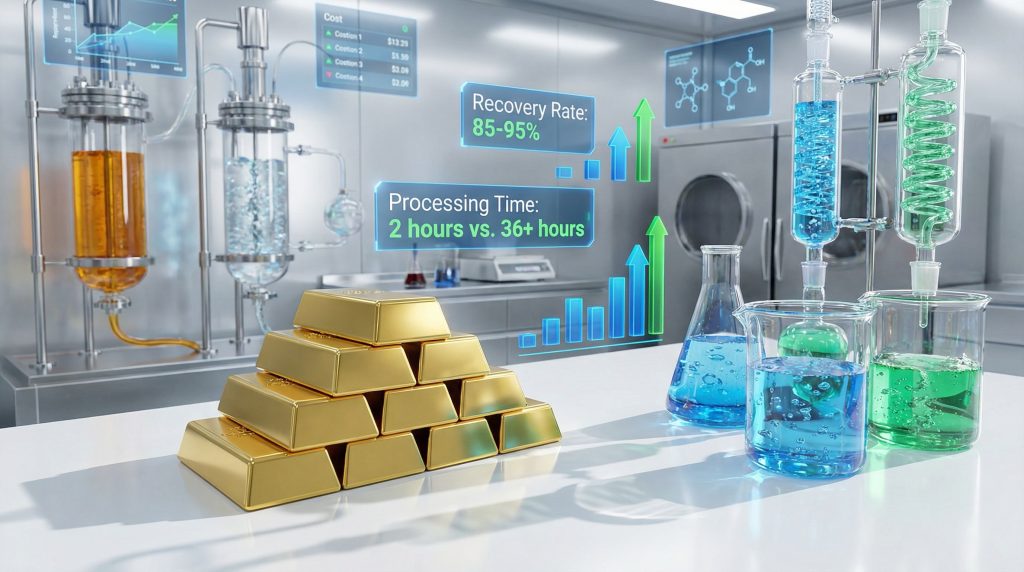
Processing time advantages represent a significant operational benefit, with some systems achieving target recovery in approximately 2 hours compared to 36+ hours required for conventional cyanide heap leaching operations. This acceleration enables higher throughput processing and reduced inventory management requirements.
Operational cost estimates for hypochlorite systems suggest approximately $20 per tonne for 10,000 tonne-per-day operations, though actual costs depend on reagent pricing, energy consumption, and specific ore characteristics. The closed-loop design reduces overall reagent consumption through effective recycling protocols.
Recovery efficiency targets exceed 95% under optimal operating conditions, positioning hypochlorite technology as a viable alternative for operations requiring high extraction rates. Furthermore, the chemistry demonstrates effectiveness across multiple ore types including oxides, sulfides, and refractory materials.
Proprietary Water-Based Solutions
Advanced water-based formulations represent emerging technologies that achieve gold extraction without traditional toxic reagents. These systems maintain compatibility with conventional recovery methods including carbon adsorption, electrowinning, and ion exchange, minimising infrastructure modification requirements.
Versatility across ore types constitutes a primary advantage of water-based systems, with demonstrated effectiveness for placer concentrates, hardrock sulfides, and oxidised materials. Testing results show recovery rates ranging from 89-99% depending on ore characteristics and processing parameters.
The technology addresses significant market opportunities, particularly for Alaska placer operations where an estimated 5-30% of gold remains locked in heavy black sand concentrates that resist conventional processing methods. This represents substantial value recovery potential for existing operations.
Commercial readiness progression involves scaling laboratory successes to pilot-scale operations, then full commercial implementation. Recent bulk testing on 73.5 metric tons of Arizona oxidised material achieved 67.51% recovery, comparable to conventional cyanide reference testing under similar conditions.
Infrastructure Integration and Retrofit Compatibility
Drop-in cyanide substitutes offer significant advantages for existing operations through compatibility with current processing infrastructure. These systems minimise capital expenditure requirements while providing environmental and safety benefits through reduced toxicity profiles.
Retrofit compatibility extends to conventional heap leach, vat leaching, and agitation systems with minimal modification requirements. The ability to utilise existing carbon circuits, electrowinning facilities, and pregnant solution handling systems reduces implementation barriers for operational transitions.
Implementation timelines for retrofit projects typically span 6-12 months depending on system complexity and integration requirements. This relatively rapid deployment capability enables mining operations to respond quickly to changing regulatory requirements or market conditions.
Conversion costs vary significantly based on existing infrastructure compatibility and required modifications. Operations with modern processing facilities generally require minimal capital investment, while older installations may need substantial upgrades to achieve optimal performance with alternative technologies.
Recovery Rate Performance Analysis
Comparative Technology Performance
| Technology Type | Recovery Rate Range | Processing Time | Primary Advantages | Optimal Ore Types |
|---|---|---|---|---|
| Thiosulfate | 85-95% | 24-48 hours | Non-toxic, preg-robbing resistance | Carbonaceous ores |
| Thiourea | >90% | 4-8 hours | Rapid kinetics, refractory processing | Sulfide concentrates |
| Chloride (EDRR) | 75-85% | Variable | Sulfide compatibility | Complex sulfides |
| Hypochlorite | >95% | 2 hours | Ultra-rapid processing | Oxide ores |
| Water-based | 89-99% | 48-96 hours | Non-toxic, versatile | Multiple ore types |
Performance optimisation depends critically on ore mineralogy, with gold grain size distribution, liberation characteristics, and interfering minerals significantly affecting recovery efficiency. Fine-grained gold typically requires extended processing times or enhanced reagent concentrations to achieve target extraction rates.
Temperature and pressure parameters influence reaction kinetics across all alternative technologies, though optimal conditions vary significantly between systems. Elevated temperatures generally accelerate dissolution rates but increase energy costs and equipment requirements for effective process control.
Reagent concentration optimisation balances extraction efficiency against chemical consumption costs. Higher reagent levels typically improve recovery rates and processing speed but increase operational expenses and waste treatment requirements.
Pre-treatment requirements for specific ore types can substantially impact overall processing economics. Oxidative pre-treatment for refractory sulfides, grinding optimisation for liberation enhancement, and pH adjustment protocols all influence final recovery performance and total processing costs.
Economic Analysis and Cost Comparisons
Capital Expenditure Considerations
New installation costs for alternative leaching systems vary substantially based on technology selection, processing capacity, and site-specific requirements. Thiosulfate systems typically require 15-25% higher capital investment compared to conventional cyanide facilities due to specialised materials and temperature control equipment.
Equipment specifications for corrosion-resistant materials increase initial capital costs but provide long-term operational reliability. In addition, stainless steel construction, specialised pump systems, and enhanced monitoring equipment contribute to higher upfront investment requirements.
Infrastructure development needs encompass power supply upgrades, water treatment facilities, and reagent storage systems that vary significantly between technology options. Remote mining locations may require substantial infrastructure investments to support alternative processing methods.
Modular system designs enable phased implementation strategies that spread capital expenditure over extended timeframes. This approach allows mining operations to validate technology performance while managing financial exposure during transition periods.
Operational Cost Structure Analysis
Reagent costs constitute the primary variable expense for alternative leaching systems, with pricing volatility affecting long-term economic projections. Thiosulfate reagent costs typically range $800-1,200 per tonne, while proprietary formulations may command premium pricing during initial market adoption phases.
Energy consumption varies significantly across different technologies, with electrically-driven systems requiring substantial power input for temperature control, agitation, and electrochemical processing. Remote operations must factor in power generation costs and reliability considerations.
Labor requirements for alternative systems often exceed conventional cyanide operations due to increased process complexity and monitoring requirements. Specialised technical training and additional supervision may be necessary during initial implementation periods.
Maintenance schedules for corrosion-resistant equipment typically require more frequent inspection and component replacement compared to conventional systems. The enhanced material specifications provide longer service life but increase replacement part costs when maintenance becomes necessary.
Return on Investment Calculations
Payback period analysis for alternative technology implementation ranges from 2-7 years depending on ore characteristics, processing capacity, and commodity pricing. Operations with high-grade ores and stable processing conditions generally achieve faster cost recovery through improved environmental compliance and operational efficiency.
Net present value calculations must incorporate regulatory compliance benefits, insurance premium reductions, and potential liability cost avoidance that alternative technologies provide. These factors often justify higher initial investment costs through reduced operational risk profiles.
Sensitivity analysis for commodity price fluctuations indicates that alternative technologies provide enhanced economic stability during market downturns through reduced regulatory compliance costs and simplified operational requirements.
However, risk-adjusted cost modelling incorporates potential regulatory changes, environmental liability exposure, and operational disruption possibilities that favour non-toxic processing methods over conventional cyanide systems.
The next major ASX story will hit our subscribers first
Environmental Benefits and Regulatory Advantages
Toxicity Reduction and Safety Improvements
Elimination of persistent cyanide compounds from processing operations provides immediate environmental benefits through reduced groundwater contamination risk and simplified waste management protocols. Alternative technologies typically generate benign reaction products that pose minimal long-term environmental concerns.
Worker exposure risk reduction represents a significant safety improvement for mining operations implementing cyanide-free gold leaching systems. Emergency response procedures become substantially simplified without requirements for cyanide antidote protocols, specialised protective equipment, and extensive hazmat training.
Community acceptance benefits extend beyond immediate safety considerations to encompass social licence advantages that facilitate operational expansion and regulatory approval processes. Public perception improvements can translate into tangible business benefits through enhanced stakeholder relationships.
Insurance cost reductions result from eliminated cyanide liability exposure, with some operations reporting 20-40% decreases in environmental insurance premiums following alternative technology implementation. These savings contribute to improved operational economics over extended timeframes.
Waste Stream Management Advantages
Tailings reprocessing opportunities increase substantially with non-toxic leaching systems that eliminate cyanide contamination concerns in historical waste materials. This capability unlocks significant value recovery potential from previously uneconomic tailings deposits.
Water treatment and recycling capabilities improve dramatically without cyanide destruction requirements, enabling higher water recovery rates and reduced fresh water consumption. Closed-loop water systems become feasible with alternative technologies that generate minimal toxic byproducts.
Solid waste disposal requirements simplify significantly when processing residues contain no persistent toxic compounds. Alternative technology waste streams often qualify for standard industrial waste classification rather than hazardous waste protocols.
Furthermore, in-situ leaching benefits and long-term environmental monitoring needs decrease substantially without cyanide persistence concerns, reducing operational compliance costs and regulatory oversight requirements throughout facility operating life and post-closure periods.
Optimal Ore Type Applications
Refractory Ore Processing Advantages
Sulfide-rich materials that interfere with conventional cyanide processing often respond favourably to alternative leaching technologies. Thiourea systems demonstrate particular effectiveness for copper-bearing sulfide ores where cyanide consumption becomes prohibitively expensive.
Antimony and arsenic interference mitigation represents a significant advantage for certain alternative technologies that function effectively in the presence of these problematic elements. Conventional cyanide systems often require expensive pre-treatment to remove these interfering species.
Pre-oxidation requirements vary significantly between alternative technologies, with some systems eliminating the need for costly roasting or pressure oxidation procedures. This capability provides substantial cost advantages for operations processing refractory gold ores.
Complex ore mineralogy compatibility enables alternative technologies to process materials that prove challenging for conventional cyanide systems. The diverse chemical pathways available through alternative technologies provide flexibility for optimising extraction from difficult ore types.
Concentrate and Specialised Applications
Heavy mineral concentrate processing represents an ideal application for cyanide-free technologies, particularly for placer mining operations generating black sand concentrates with locked gold values. These concentrates often resist conventional processing methods while responding favourably to alternative chemical approaches.
Small-scale and artisanal mining applications benefit significantly from simplified processing requirements and reduced safety protocols associated with non-toxic leaching systems. The elimination of cyanide handling requirements enables broader technology adoption in developing regions.
Urban mining and electronic waste gold recovery applications favour alternative technologies due to complex matrix compositions and environmental sensitivity considerations. The selective dissolution capabilities of certain alternative systems provide advantages for recovering gold from electronic waste streams.
Processing versatility across multiple ore types enables mining operations to optimise single processing facilities for handling diverse feed materials. This flexibility provides operational advantages for operations with variable ore characteristics or multiple ore sources.
Current Implementation Challenges and Solutions
Technical Limitations and Development Needs
Process control complexity increases substantially with alternative leaching systems that require precise parameter monitoring and adjustment protocols. However, data-driven mining operations and advanced automation systems become necessary to maintain optimal operating conditions and achieve consistent performance results.
Equipment corrosion challenges persist across multiple alternative technologies, particularly for systems operating under acidic or high-temperature conditions. Material selection and protective coating technologies continue advancing to address these operational concerns.
Reagent stability and storage requirements vary significantly between alternative technologies, with some systems requiring specialised handling protocols or climate-controlled storage facilities. These requirements can increase operational complexity and infrastructure costs.
Scale-up challenges from laboratory to commercial operations remain significant for emerging technologies that lack extensive commercial operating data. Pilot-scale testing becomes critical for validating performance projections and identifying potential operational issues.
Market Adoption Barriers and Solutions
Industry conservatism regarding unproven technologies creates substantial barriers for alternative leaching system adoption, particularly for major mining operations with significant production commitments. Technology validation through pilot programmes and demonstration projects provides pathways for reducing adoption risks.
Financing considerations for alternative technology implementation often require specialised technical due diligence and risk assessment protocols that extend project development timelines. Development of standardised evaluation criteria could accelerate adoption processes.
Regulatory approval timelines for new processing technologies vary significantly between jurisdictions, with some regions requiring extensive environmental assessment and permitting procedures. Harmonised regulatory frameworks could facilitate broader technology adoption.
Technology licensing and intellectual property considerations may limit access to optimal alternative technologies for certain operations. Industry collaboration and technology sharing agreements could address these competitive barriers.
Technology Evolution and Market Outlook
Emerging Research Directions
Glycine-based leaching systems represent promising development areas that combine environmental benefits with potentially superior extraction performance. Recent research indicates that glycine chemistry may provide advantages for specific ore types while maintaining benign environmental characteristics.
Hybrid processing approaches that combine multiple alternative technologies or integrate alternative and conventional methods show potential for optimising recovery performance while minimising costs. These systems could provide transition pathways for operations converting from cyanide processing.
Biotechnology integration possibilities include biological pre-treatment systems and bio-leaching applications that could enhance alternative technology performance. The combination of biological and chemical processing methods may unlock new processing opportunities.
Artificial intelligence and process control advances enable more sophisticated monitoring and optimisation of alternative leaching systems. Machine learning applications could optimise reagent dosing, temperature control, and processing duration for maximising recovery efficiency.
Industry Development Trends
Mining company pilot programmes increasingly focus on alternative technology validation through controlled testing environments that minimise operational risk while generating performance data. These programmes provide essential commercial readiness validation for emerging technologies.
Technology developer strategic alliances facilitate faster commercial deployment through combined technical expertise and financial resources. Partnership agreements between technology companies and major mining operations accelerate development timelines.
Research institution involvement provides technical expertise and independent validation services that support technology development and commercial adoption processes. University research programmes contribute fundamental scientific understanding that enables improved system design.
Government support programmes and incentives in various jurisdictions provide financial assistance for alternative technology development and implementation. These programmes recognise the environmental and economic benefits of reducing cyanide dependency in mining operations.
Strategic Evaluation Framework for Mining Companies
Technology Selection and Assessment Criteria
Ore characterisation and compatibility assessment requires comprehensive metallurgical testing to determine optimal processing conditions and expected recovery performance. Laboratory testing programmes should encompass variable conditions to identify operational parameter windows and sensitivity factors.
Economic feasibility analysis must incorporate all relevant cost factors including capital expenditure, operational expenses, regulatory compliance costs, and potential liability exposure. Life-cycle cost analysis provides comprehensive evaluation frameworks for technology comparison.
Environmental and social impact evaluation encompasses direct environmental benefits, community acceptance factors, and regulatory compliance advantages that alternative technologies provide. These factors often justify higher initial costs through reduced operational risks.
Implementation timeline and resource requirements vary significantly between technology options, with some systems requiring extensive infrastructure modifications while others enable rapid deployment. Project scheduling considerations must account for technology-specific requirements.
Due Diligence and Risk Assessment
Technology maturity and commercial readiness evaluation requires assessment of operating history, performance data availability, and technical support capabilities. Emerging technologies may offer superior performance but carry higher implementation risks.
Intellectual property and licensing considerations affect long-term operational flexibility and cost predictability. Understanding technology ownership, licensing terms, and potential royalty obligations becomes critical for strategic planning.
Supplier evaluation and risk assessment encompasses financial stability, technical capabilities, and ongoing support commitments from technology providers. Long-term supplier relationships become critical for sustained operational success.
Performance guarantee and warranty terms provide important risk mitigation mechanisms during initial implementation periods. Contractual provisions should address performance targets, remediation procedures, and liability allocation for underperformance scenarios.
The advancement of cyanide-free gold leaching technologies continues reshaping mining industry approaches to metal extraction, offering pathways toward more sustainable and environmentally responsible operations while maintaining economic viability through comparable recovery performance.
Looking to Stay Ahead of Cyanide-Free Gold Mining Innovation?
Discovery Alert provides instant notifications when ASX-listed companies announce breakthrough developments in sustainable gold extraction technologies, powered by its proprietary Discovery IQ model. Don't miss emerging opportunities in companies developing next-generation mining solutions—explore Discovery Alert's track record of identifying major discoveries and begin your 30-day free trial today to position yourself at the forefront of mining industry evolution.