August 14, 2026
East Africa's Refining Vacuum and Why It Changes Everything
Across the global energy landscape, few structural vulnerabilities are as commercially significant as a large, import-dependent regional economy operating without a single barrel of domestic refining capacity. That is precisely the position East Africa finds itself in today. When the Mombasa refinery ceased operations in 2023, Kenya became entirely reliant on imported refined petroleum products, exposing the region's eight-plus nations to the full force of international price volatility, freight costs, and supply chain risks.
This is the backdrop against which the proposed Dangote-backed Lamu refinery jobs narrative must be understood. The project is not simply a commercial venture. It is, structurally, a response to a regional energy security deficit that has been years in the making.
East Africa's Refining Capacity vs. Regional Demand
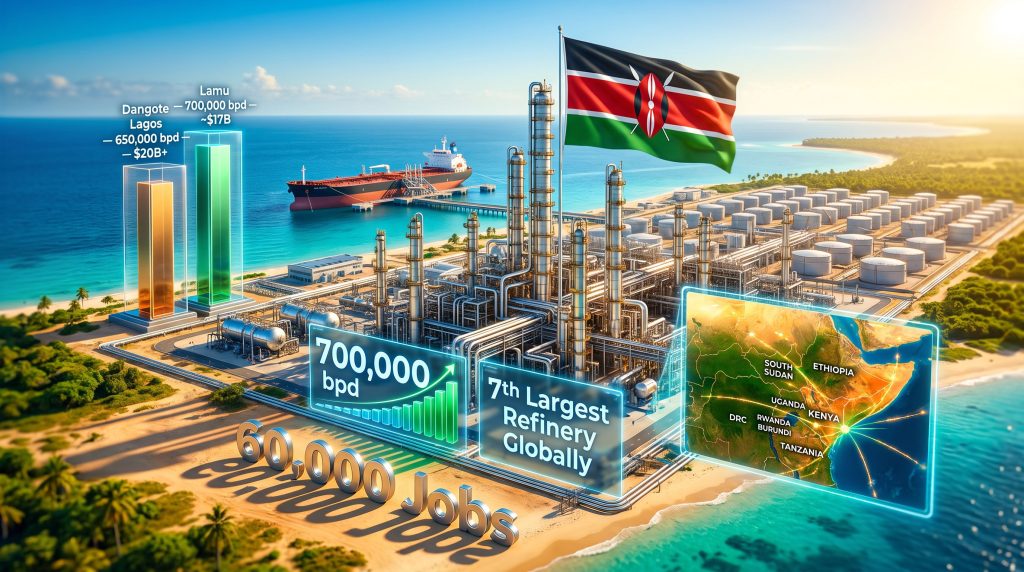
The numbers framing this deficit are striking. Kenya's domestic refining capacity currently stands at zero. The proposed Lamu facility is designed to process 700,000 barrels of crude oil per day, which would position it as the seventh-largest refinery in the world upon completion and the largest on the African continent by throughput capacity. Bloomberg's cost projections for the project sit at approximately $17 billion.
| Metric | Current Status |
|---|---|
| Kenya domestic refining capacity | Zero (post-2023) |
| Proposed Lamu refinery daily capacity | 700,000 barrels |
| Estimated project cost | ~$17 billion (Bloomberg) |
| Target supply nations | 8 countries |
| Global ranking if completed | 7th largest refinery |
The eight nations targeted for fuel supply include Kenya, Ethiopia, South Sudan, Uganda, Tanzania, Rwanda, Burundi, and the Democratic Republic of Congo. A single facility capable of restructuring the petroleum supply chain for this many countries simultaneously would represent one of the most consequential industrial infrastructure decisions in post-independence East African history.
Strategic Insight: The closure of Kenya's only domestic refinery in 2023 did not merely remove processing capacity. It transferred the region's energy price risk entirely to international markets, making every price spike in Rotterdam or Singapore a direct cost burden on East African consumers and businesses alike.
When big ASX news breaks, our subscribers know first
Project Architecture: What the Lamu Refinery Actually Involves
Scale, Cost, and Financing Structure
The proposed refinery would marginally exceed the capacity of Dangote's existing Nigerian facility, which processes 650,000 barrels per day and cost more than $20 billion to complete. The Lamu project's lower projected cost of approximately $17 billion despite higher throughput capacity is a figure that warrants scrutiny. It may reflect different site conditions, a more competitive construction environment, or optimistic early-stage cost modelling that has yet to be stress-tested against detailed engineering studies.
Financing is expected to draw from three sources:
- Internal capital from the Dangote Group
- Capital market borrowing against the project's future cash flows
- Proceeds from a partial initial public offering of the refinery vehicle
As of mid-2026, the group is still actively seeking strategic partners to supplement this financing stack, meaning the capital structure remains incomplete.
Why Lamu Was Selected
The site selection logic is anchored in the LAPSSET Corridor (Lamu Port-South Sudan-Ethiopia Transport Corridor), a multi-billion-dollar infrastructure network that connects Kenya's northern coast to landlocked neighbours through roads, pipelines, and port infrastructure. Furthermore, Lamu's coastal position enables both crude oil imports via Indian Ocean shipping lanes and refined product distribution across the regional land network. From a logistics standpoint, the site aligns well with the refinery's eight-nation supply mandate.
The Lagos Refinery as a Benchmark
Any credible analysis of the Lamu project must be grounded in what actually happened with Dangote's comparable Nigerian facility. The Lagos refinery:
- Took more than a decade to reach operational status
- Cost in excess of $20 billion, well above initial projections
- Directly employs approximately 10,000 workers, according to company data published in 2024
- Processes 650,000 barrels per day
These benchmarks matter enormously when evaluating both the Lamu timeline and its employment projections.
Dissecting the 60,000 Jobs Claim
The Political Context of the Announcement
Kenyan President William Ruto publicly stated that the Dangote-backed Lamu refinery jobs figure would reach at least 60,000 positions for young Kenyans. The announcement was made during the launch of the second phase of the NYOTA youth support program in Nairobi on July 10, 2026, a context that is important for evaluating the figure analytically. Employment projections announced at political events tied to youth programs carry inherent optimism bias and typically aggregate multiple employment categories into a single headline number.
Understanding the Direct vs. Indirect Employment Gap
The Lagos refinery benchmark of approximately 10,000 direct employees creates an immediate arithmetic question. If a 650,000 bpd facility with more than a decade of construction history directly employs 10,000 people, how does a 700,000 bpd facility reach 60,000?
The answer lies in how employment figures are defined and measured:
Analyst Note: Major industrial projects routinely aggregate direct operational roles, construction-phase employment, and indirect economic activity (transport, catering, security, logistics, professional services) into a single employment claim. Understanding which categories are included is essential for evaluating any headline figure's credibility.
| Employment Category | Estimated Scope |
|---|---|
| Direct refinery operations (Lagos benchmark) | ~10,000 workers |
| Construction-phase employment | Significant but temporary |
| Indirect supply chain and services | Multiplier-dependent |
| Total stated projection (Ruto, July 2026) | 60,000+ |
The implied ratio of approximately 6:1 between the headline figure and the direct operational benchmark from Lagos strongly suggests the 60,000 figure aggregates all employment categories across the full project lifecycle, including construction workers who would be on-site for a finite period. This is not unusual for mega-infrastructure announcements, but it is a critical distinction for anyone attempting to assess the project's long-term employment legacy.
Three Scenario Projections for Employment Outcomes
Scenario A: Optimistic (Full Multiplier Realised)
The refinery reaches its full 700,000 bpd target within five years. Regional supply agreements are secured with all eight target nations. The LAPSSET corridor is fully operational, enabling substantial logistics-sector employment. Employment multipliers of 4x to 8x the direct workforce, as observed in comparable emerging-market mega-refinery projects, push total economic impact toward or beyond 60,000.
Scenario B: Base Case (Partial Realisation)
Construction begins in late 2026 but encounters delays of 12 to 18 months. Initial operational capacity reaches 400,000 to 500,000 bpd. Direct employment lands in the range of 8,000 to 12,000, with indirect employment adding 20,000 to 30,000. Total employment impact: approximately 30,000 to 45,000.
Scenario C: Constrained (Regulatory and Financing Delays)
Environmental approval processes extend the pre-construction phase by two or more years. Financing partners are slow to commit given the project's scale and regional risk profile. Construction does not begin until 2028 or 2029, and employment projections are revised materially downward.
Regulatory Hurdles and the LAPSSET Legal Precedent
The Environmental Approval Bottleneck
As of mid-2026, the Lamu refinery has not completed its Environmental and Social Impact Assessment (ESIA) for the proposed Lamu Island site. Technical studies are still ongoing. Under Kenyan regulatory frameworks, construction cannot commence legally until these clearances are secured. For projects of this scale and ecological sensitivity, ESIA processes in East Africa typically span 12 to 24 months, creating a material buffer between the current state and any 2026 construction start.
A Court Ruling That Reshaped the Region's Infrastructure Playbook
The legal history of the LAPSSET corridor provides a sobering precedent. In 2018, Kenya's High Court ruled that LAPSSET developers had failed to conduct adequate public consultations and that thousands of affected families had not been properly compensated. This ruling, reported by the Daily Nation at the time, established a legal standard that any major infrastructure developer operating in the same geographic corridor must now proactively address.
For the Lamu refinery, this precedent translates into three concrete risks:
- Legal challenges modelled on the 2018 ruling could delay construction by years
- Community opposition, if mobilised, could complicate regulatory approvals even where the technical criteria are met
- Reputational exposure for financing partners who are increasingly sensitive to social licence requirements
Community Employment Demands
Local leaders and residents in Lamu have made their expectations clear, calling for 70% of all project jobs to be allocated to local youth. This demand reflects both genuine economic need and a deep wariness shaped by years of unfulfilled promises tied to LAPSSET infrastructure delays. If the project is perceived as importing labour rather than developing local capacity, organised community opposition becomes a realistic scenario that could intersect with the regulatory approval process.
Kenya's Youth Employment Crisis: The Demand That Makes This Project Matter
The Numbers Behind the Policy Urgency
Data published by the Federation of Kenya Employers in November 2025 reveals that 67% of Kenyans aged 15 to 34 lack stable employment. More than 1 million young Kenyans enter the labour market every year. These are the structural conditions that give the Lamu refinery its political resonance, regardless of where the final employment figure lands.
Against this backdrop, even the most conservative scenario-modelled outcome of 30,000 to 45,000 jobs would represent a meaningful, if partial, response. The 60,000-job headline figure, if it materialises, would absorb roughly 6% of a single year's new labour market entrants, a significant but not transformative contribution to Kenya's structural employment challenge.
Policy Lens: The Lamu refinery's most durable employment contribution may not come from the facility itself but from the ecosystem of secondary industries it could catalyse in the region, including engineering services, fuel logistics, port operations, petrochemical downstream processing, and professional services. Embedding strong local content legislation into the project's operating framework from the outset is the mechanism that would lock these benefits in rather than leaving them aspirational.
How the Lamu Project Compares Across Africa's Refinery Landscape
| Refinery | Country | Capacity (bpd) | Estimated Cost | Construction Duration | Status |
|---|---|---|---|---|---|
| Dangote Refinery (Lagos) | Nigeria | 650,000 | $20B+ | 10+ years | Operational |
| Lamu Refinery (proposed) | Kenya | 700,000 | ~$17B | ~30 months (projected) | Pre-approval |
| EACOP-linked processing | Uganda/Tanzania | Smaller scale | Varies | Ongoing | In development |
The projected 30-month construction timeline for Lamu stands in stark contrast to the decade-plus build history of the Lagos facility. This discrepancy does not automatically invalidate the Lamu estimate. Construction technology and project management practices have evolved, and a greenfield site with purpose-designed infrastructure could theoretically be built faster than a project that encountered Nigeria's particular regulatory and logistical environment. However, the gap is large enough to demand explanation rather than assumption, particularly given that the projected cost is also lower despite higher throughput capacity.
The next major ASX story will hit our subscribers first
Frequently Asked Questions: Dangote-Backed Lamu Refinery Jobs
How many Dangote-backed Lamu refinery jobs are projected?
President William Ruto has stated the facility will create at least 60,000 jobs for young Kenyans. This figure is understood to encompass direct operational roles, construction-phase employment, and indirect economic activity across the supply chain and wider regional economy. According to regional analysts, the breakdown between direct and indirect roles is critical to interpreting the headline number accurately.
When will construction begin?
Construction is targeted to start in late 2026, pending completion of the Environmental and Social Impact Assessment and all required regulatory clearances. The build phase is projected at approximately 30 months, though comparable projects suggest this timeline is ambitious.
Who is financing the refinery?
The Dangote Group plans to fund the project through internal resources, capital market borrowing, and proceeds from a partial initial public offering. As of mid-2026, strategic financing partners are still being recruited.
Which countries will the refinery supply?
The facility is designed to supply Kenya, Ethiopia, South Sudan, Uganda, Tanzania, Rwanda, Burundi, and the Democratic Republic of Congo with refined petroleum products.
What are the main risks to the project's timeline?
The key risks include an incomplete ESIA, community consultation obligations informed by the 2018 LAPSSET court ruling, incomplete financing partner recruitment, and the historically long construction timelines associated with mega-refinery development globally. In addition, the broader geopolitical risk landscape across East Africa adds another layer of uncertainty for investors and project planners alike.
The Strategic Verdict: Transformative Potential, Conditional on Execution
What Would Need to Go Right
For the Lamu refinery to deliver anywhere near its headline employment and capacity targets, several conditions would need to align:
- Timely completion of the ESIA and full regulatory clearance by mid-2027 at the latest
- Successful recruitment of at least one major financing partner to anchor the capital structure ahead of construction mobilisation
- A proactive community engagement programme that credibly addresses the 70% local employment demand from Lamu residents
- A phased construction strategy that incorporates lessons from the Lagos refinery's protracted build history
What Could Derail the Timeline
The downside scenario list is equally substantive. Furthermore, the risks do not operate in isolation — each one can compound the others in ways that are difficult to model in advance:
- Legal challenges built on the 2018 LAPSSET High Court ruling template
- Adverse global capital market conditions affecting the partial IPO component of the financing structure
- Global industry disruptions reducing demand certainty for investors across the eight target supply nations
- Environmental objections specific to the ecological sensitivity of the Lamu Island site
The Generational Test at the Heart of the Project
If delivered at scale, the Lamu refinery would fundamentally restructure East Africa's petroleum supply architecture, shifting the region from total import dependency to domestically anchored processing capacity for the first time since 2023. The facility's success or failure will function as a proof-of-concept for whether African-led, African-financed mega-infrastructure can be executed within commercially viable timelines and at projected cost.
For Kenya's youth, 67% of whom lack stable employment according to Federation of Kenya Employers data, the refinery represents more than a jobs announcement. It represents a test of whether industrial policy ambition and political commitment can translate into durable economic transformation at the scale the moment demands. Consequently, the stakes extend well beyond resource and energy exports — they speak to the broader question of how government intervention and private capital can combine to reshape a generation's economic prospects.
Disclaimer: This article contains forward-looking projections, scenario modelling, and employment estimates sourced from public statements and third-party data. These figures are inherently uncertain and should not be interpreted as guaranteed outcomes. Readers are encouraged to conduct independent research before drawing conclusions. For ongoing coverage of African energy and industrial policy, visit Ecofin Agency.
Want to Spot the Next Major Resource Discovery Before the Market Does?
Discovery Alert's proprietary Discovery IQ model delivers real-time alerts on significant ASX mineral discoveries, turning complex resource data into actionable investment insights — explore the historic returns major discoveries have generated and begin your 14-day free trial to position yourself ahead of the market.