June 11, 2026
Africa's Refining Ambition Meets Industrial Reality
Few industrial transformations carry as much symbolic and economic weight as a developing nation converting its own raw resources into refined products for domestic use and export. For decades, the global refining industry has witnessed a gradual shift toward complexity, with high-conversion facilities displacing simple distillation units as the benchmark for commercial competitiveness. Within this context, the Dangote Refinery in Lagos represents Africa's most ambitious attempt to capture downstream value from crude oil, yet a recurring pattern of disruptions at its core gasoline-producing unit raises fundamental questions about operational maturity versus infrastructural ambition.
The Dangote Refinery gasoline unit technical failure that emerged in late May 2026 is not simply a maintenance story. It is a case study in the gap between nameplate capacity and sustained commercial reliability, a distinction that energy analysts and institutional investors increasingly treat as the defining variable when assessing mega-refinery projects in emerging markets. Furthermore, this disruption intersects directly with broader concerns around crude oil price volatility and regional supply chain resilience.
When big ASX news breaks, our subscribers know first
Understanding the RFCC Unit and Why Its Reliability Defines the Refinery's Commercial Value
The $20 Billion Facility Built to Break Nigeria's Import Dependency
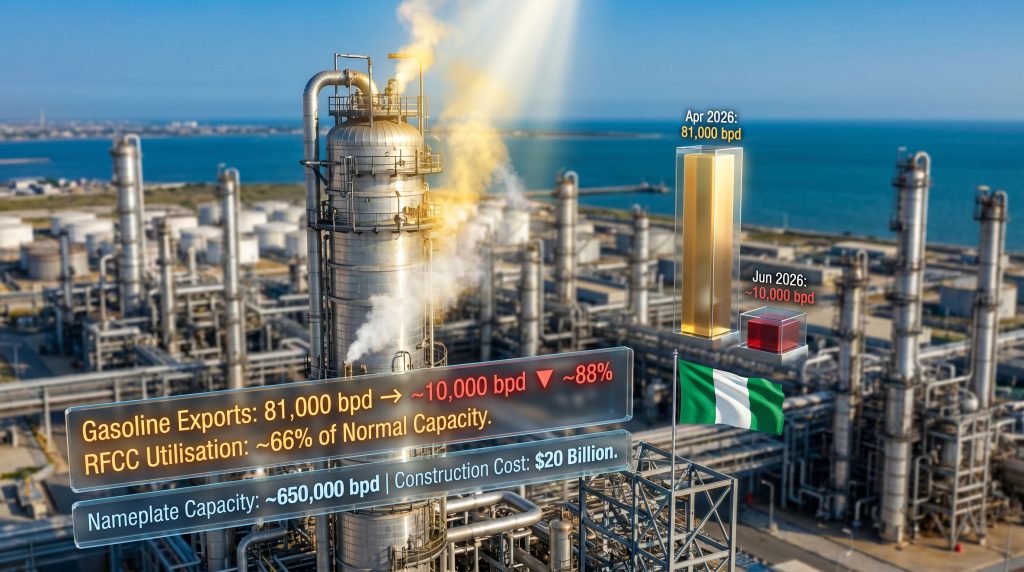
Constructed at a total cost of $20 billion in the Lekki Free Zone near Lagos, the Dangote Refinery is the largest single-train refinery on the African continent. Its nameplate capacity exceeds 650,000 barrels per day, positioning it well above any comparable facility on the continent and within the global tier of mega-refineries. The facility completed a phased commissioning process that began in late 2023, reaching full nameplate capacity in February 2026.
Nigeria's historical relationship with refined fuel has long been paradoxical. Despite being Africa's largest crude oil producer, the country imported the overwhelming majority of its refined petroleum products for decades, creating an annual import burden that drained foreign reserves and exposed ordinary consumers to global price volatility. The Dangote Refinery was conceived as the structural answer to this paradox, with capacity sufficient to cover a significant portion of domestic consumption while generating export volumes competitive in Atlantic Basin markets and across West Africa.
Beyond its scale, the facility's significance lies in its technological configuration. Unlike the simple distillation-focused refineries that historically characterised African refining infrastructure, the Dangote facility was built around high-conversion units designed to maximise yields of higher-value light products. This distinction matters enormously for commercial performance, and it places the Residual Fluid Catalytic Cracking unit at the very centre of the refinery's value proposition.
What the RFCC Unit Actually Does and Why a Valve Failure Matters So Much
The RFCC unit is the refinery's primary gasoline-producing technology. It functions by converting heavy residual hydrocarbon streams — the dense fractions that remain after atmospheric and vacuum distillation — into lighter, higher-value products including gasoline, diesel, and liquefied petroleum gas (LPG). Notably, shifts in LPG price benchmarks can be directly influenced by the throughput performance of units such as this one.
The conversion process relies on a fluidised catalyst that continuously cycles between a reactor and a regenerator, cracking heavy molecules under carefully controlled conditions before the spent catalyst is regenerated through controlled combustion and returned to the reactor.
This continuous regeneration cycle is where flue gas control valves become critical. These valves regulate the flow of combustion gases within the RFCC regenerator system. Their failure can disrupt the thermal and pressure balance required for efficient catalyst regeneration, ultimately forcing output reductions or unit shutdown. In a facility as large as the Dangote Refinery, the downstream consequences of even a partial RFCC failure cascade rapidly through gasoline production volumes and export capacity.
It is important to understand what the RFCC unit is not. It is not the entire refinery. The crude distillation unit, which separates crude oil into its basic fractions, remained fully operational throughout the disruption. The hydrocracker continued producing diesel and jet fuel independently of RFCC operations. The catalytic reformer provided residual gasoline production capacity. The disruption was therefore product-specific rather than a total facility shutdown, but its commercial impact was severe precisely because gasoline is the refinery's highest-volume, highest-margin light product.
"The RFCC unit is not merely a processing component. It is the primary determinant of the refinery's gasoline export competitiveness and domestic price influence. Its operational reliability functions as a systemic variable for Nigeria's fuel market, not simply an internal engineering matter."
What Caused the Dangote Refinery Gasoline Unit Technical Failure?
Two Separate Problems Converging at the Worst Possible Time
The Dangote Refinery gasoline unit technical failure that emerged in late May 2026 resulted from two distinct but compounding problems that occurred within days of each other, according to IIR Energy, an independent refinery monitoring firm cited by Reuters on June 10, 2026.
The first problem was a feedstock miscalibration. In the weeks preceding the disruption, the refinery processed crude oil grades with an excessively light composition, reducing the availability of heavy residual feedstock that the RFCC unit requires to sustain throughput. The RFCC unit is specifically engineered to process heavier hydrocarbon fractions. When feedstock composition shifts toward lighter crude grades, the unit's feed volume and conversion efficiency decline because there is simply less residual material available for the cracking process to act upon.
Crude slate management — the discipline of selecting and blending crude oil grades to match a refinery's specific configuration — is one of the most operationally sensitive aspects of refinery management. Processing grades that are too light for an RFCC-configured facility is a feedstock planning failure with predictable consequences for throughput. In mature refinery operations, this type of miscalibration is rare. In facilities navigating their first full year of commercial operation, it represents a recognised challenge within the broader ramp-up learning curve.
The second problem was mechanical. A flue gas control valve at the RFCC unit failed at the end of May 2026. IIR Energy reported that repair work on this component was nearly complete by early June, with the firm projecting a return to full capacity by mid-June 2026.
Conflicting Characterisations and Acknowledged Design Issues
The disruption was characterised differently across reporting sources, creating some ambiguity about its precise nature and severity.
| Source | Characterisation | Key Detail |
|---|---|---|
| Bloomberg | Unit described as undergoing maintenance | Exact timeline unclear |
| IIR Energy via Reuters | Operational disruption attributed to feedstock issues and valve failure | Full recovery projected mid-June 2026 |
| S&P Global | RFCC acknowledged to have design issues | 2026 turnaround work intended to stabilise operations |
| Regional media | Technical shutdown with potential duration of up to two weeks | No specific engineering detail provided |
The S&P Global characterisation is particularly significant. Dangote's leadership separately acknowledged pre-existing design challenges within the RFCC unit, according to S&P Global's reporting. This suggests the mechanical valve failure may have occurred against a backdrop of unresolved engineering vulnerabilities, rather than as a standalone random event. If accurate, this framing upgrades the incident from an operational inconvenience to a signal of structural risk requiring capital remediation.
"The most operationally accurate framing of this event is that a pre-existing technical vulnerability, compounded by feedstock miscalibration, precipitated a partial shutdown that was subsequently addressed through maintenance and repair activity. Whether that vulnerability has been fully resolved remains the central unanswered question."
How Severe Was the Production Impact?
A Two-Thirds Refinery and an Eighty-Eight Percent Export Collapse
The quantitative impact of the Dangote Refinery gasoline unit technical failure is striking across two separate dimensions: capacity utilisation and export volumes.
From late May 2026, the RFCC unit operated at approximately 66% of its normal capacity, according to IIR Energy. This represents a one-third reduction in the unit's gasoline production throughput, with corresponding effects on the refinery's ability to supply both domestic markets and international buyers.
The export data tells an even sharper story. Gasoline exports to international markets collapsed from 81,000 barrels per day in April 2026 to approximately 10,000 barrels per day in early June 2026, according to data reported by Naija247News. That represents a reduction of approximately 88% over a period of roughly six weeks.
| Metric | April 2026 | Early June 2026 | Change |
|---|---|---|---|
| Gasoline Export Volume | 81,000 bpd | ~10,000 bpd | Down approximately 88% |
| RFCC Capacity Utilisation | ~100% | ~66% | Down approximately 34 percentage points |
The disproportion between the capacity reduction (34 percentage points) and the export decline (approximately 88%) deserves analytical attention. It suggests that reduced RFCC output was disproportionately absorbed by domestic supply obligations, with exports bearing the full weight of the shortfall. This pattern is consistent with a facility prioritising its domestic supply mandate over export commitments during periods of constrained production, which reflects a rational operational decision but creates significant reliability concerns for international buyers who had begun incorporating Dangote output into their supply planning.
Nigerian Retail Fuel Prices Already Under Pressure Before the Disruption
The production shortfall did not create Nigeria's fuel price crisis. It compounded one that was already firmly established. Nigerian retail gasoline prices in early June 2026 ranged between 1,248 naira and 1,364 naira per litre (approximately $0.85 to $0.93), according to GlobalPetrolPrices data and market reports. These levels substantially exceeded the Central Bank of Nigeria's projected annual average of approximately 950 naira per litre (approximately $0.65).
CNBC Africa reported that retail fuel prices had already surged by nearly 65% following the closure of the Strait of Hormuz at the end of February 2026, establishing an elevated price baseline well before the RFCC disruption began. This price surge mirrors the broader oil price rally dynamics that had already been reshaping global energy costs. The refinery's partial output reduction therefore removed a domestic supply buffer at precisely the moment when Nigerian consumers were most exposed to global market volatility.
This timing matters significantly for how the disruption should be assessed. Had the RFCC failure occurred during a period of stable global energy markets, its domestic impact would have been more contained. Against the backdrop of a post-Hormuz global supply shock, the loss of domestic refining throughput carried amplified consequences for consumer affordability and Nigeria's foreign exchange position.
Is This an Isolated Event or a Pattern of Operational Instability?
Three Disruptions to the Same Unit in Under Twelve Months
The late May 2026 failure is not the first time the RFCC unit has caused operational disruption at the Dangote Refinery. According to CNBC Africa's reporting, the refinery shut down the RFCC unit completely for maintenance in August 2025. The facility subsequently restarted at only 60% capacity in October 2025, before gradually ramping toward full operation. The June 2026 incident therefore represents the third recorded disruption to the same unit within less than a year.
| Incident | Timing | Nature of Disruption | Recovery Status |
|---|---|---|---|
| First Shutdown | August 2025 | Full RFCC maintenance shutdown | Restarted at 60% capacity, October 2025 |
| Second Disruption | October 2025 | Partial restart at reduced capacity | Gradual ramp-up toward full operation |
| Third Incident | Late May to June 2026 | Feedstock miscalibration plus valve failure | Full recovery projected mid-June 2026 per IIR Energy |
Three disruptions to the same unit within twelve months is an unusual pattern regardless of the context. The question facing analysts and energy market participants is whether this pattern reflects expected commissioning variability or a more durable structural reliability risk.
The Ramp-Up Phase Explanation: Legitimate Context With a Finite Shelf Life
Industrial operators and refinery engineers consistently acknowledge that complex greenfield refinery facilities experience elevated failure rates during their initial years of operation. This period, commonly referred to as the ramp-up phase, involves progressively understanding equipment behaviour under real operating conditions, refining crude slate selections, optimising process parameters, and resolving engineering issues that laboratory and commissioning testing did not expose.
The Dangote Refinery reached full nameplate capacity only in February 2026, meaning all three RFCC disruptions occurred while the facility was still within or transitioning out of its commissioning and stabilisation window. This context is legitimate and should prevent premature conclusions about the facility's long-term reliability profile.
However, the ramp-up phase explanation has boundaries. S&P Global's reporting that Dangote's leadership acknowledged pre-existing design challenges within the RFCC unit raises a more pointed question. Normal ramp-up turbulence typically involves process optimisation, not design remediation. If the recurring failures trace back to design constraints rather than operational learning, the resolution pathway becomes more complex, more costly, and potentially more disruptive.
"At what point does a pattern of repeated failures at the same critical unit transition from expected commissioning turbulence to a structural reliability risk requiring capital remediation? This is the question that energy analysts and regional policymakers must now apply to the Dangote Refinery's RFCC performance trajectory."
What Continues to Function When the RFCC Goes Offline
Understanding what keeps running during an RFCC disruption is important for contextualising the actual severity of any given incident. During the late May to June 2026 event:
- The crude distillation unit remained fully operational, continuing to process incoming crude oil at design throughput rates
- The hydrocracker continued producing diesel and jet fuel, maintaining commercial output in those product categories independently of RFCC operations
- The catalytic reformer provided residual gasoline production capacity, partially offsetting RFCC shortfalls
- Total refinery throughput was not at risk; only gasoline-specific commercial output was materially weakened
This operational segmentation explains why the disruption, despite generating a near-total collapse in gasoline exports, did not constitute a refinery shutdown in any comprehensive sense.
Broader Market and Strategic Implications
Regional Supply Reliability and the Trust Deficit With West African Buyers
The approximately 88% decline in Dangote's gasoline export volumes between April and early June 2026 carries implications that extend well beyond Nigeria's domestic market. West African markets neighbouring Nigeria had begun orienting their fuel import strategies around the refinery's growing output. The sharp and sudden reduction in available export volumes signals to those regional buyers that Dangote cannot yet be treated as a fully reliable baseload supplier.
This reliability gap is likely to sustain demand for European and Middle Eastern refined product imports into West Africa during periods of Dangote operational disruption. Regional buyers managing supply chains must maintain contingency arrangements with alternative suppliers, which partially offsets the supply consolidation and price stabilisation benefits that the refinery was expected to deliver across the region. Consequently, OPEC's market influence and broader production decisions will continue to shape the pricing environment in which Dangote competes for regional buyers.
The wider implication is that the refinery's transformational impact on West African fuel markets, while structurally credible given its scale, will be realised more gradually than initial commissioning timelines suggested. Regional price premiums driven by fragmented import markets may persist longer than expected if operational disruptions continue to create supply uncertainty.
The Expansion Target: Ambition That Requires an Operational Foundation
Despite the operational setbacks, Dangote Refinery CEO David Bird stated at the S&P Global Energy Conference in London on June 2, 2026, that the company targets an expansion of refining capacity to 1.4 million barrels per day within 30 months. This target represents more than double the current nameplate capacity and would make the facility one of the largest refineries on the planet.
The announcement creates a strategic tension that investors and regional policymakers will scrutinise carefully. Pursuing aggressive capacity expansion while the existing RFCC unit experiences recurring failures at its current scale generates a credibility gap between announced ambition and demonstrated operational performance. Expansion credibility is not built on capacity announcements alone. It requires a foundation of sustained, consistent throughput at existing scale.
The 1.4 million barrel per day target will attract investor and institutional confidence in proportion to the refinery's ability to demonstrate stable RFCC operations over the next 12 to 18 months. A third disruption within a year, coinciding with expansion announcements made just days earlier, creates a challenging narrative for stakeholders seeking evidence that operational maturity is keeping pace with commercial ambition. In addition, the LNG supply outlook for the region will interact with these dynamics as West African energy buyers weigh their longer-term supply diversification options.
The next major ASX story will hit our subscribers first
Comparing Dangote's Reliability Profile to Global Refinery Benchmarks
What Normal RFCC Performance Actually Looks Like
To assess the significance of Dangote's RFCC disruption pattern, it is useful to understand what normal looks like across global refinery operations. Major refineries worldwide typically schedule RFCC turnarounds every three to five years, with planned downtime lasting between four and eight weeks per cycle. These turnarounds are carefully sequenced months in advance to minimise commercial impact and are accompanied by comprehensive catalyst system inspections and mechanical overhauls.
Unplanned RFCC outages involving mechanical failures such as valve malfunctions or catalyst system faults are treated as high-severity events within refinery operations management. They generate immediate price support responses in regional gasoline markets and trigger scrutiny from buyers who depend on the facility for baseload supply. Three unplanned or semi-planned disruptions within twelve months falls outside the normal reliability envelope for a mature RFCC operation.
However, the qualification for maturity is critical. Facilities within their first full year of commercial operation at nameplate capacity do experience elevated incident rates across multiple unit categories. The relevant benchmark is not a mature refinery with a decade of operational history but rather comparable greenfield projects during their equivalent commissioning and stabilisation periods.
Africa's Broader Refinery Reliability Context
The Dangote disruptions do not occur in isolation from Africa's historical refinery reliability record. African refinery infrastructure has, for decades, suffered from chronic underinvestment in maintenance and operational capability development, contributing to persistently low utilisation rates across the continent. South Africa's Sapref facility and Egypt's Midor refinery have both experienced extended outages driven by deferred maintenance investment, providing cautionary precedents for the consequences of prioritising throughput over equipment condition.
The Dangote disruptions differ in their origin. They reflect commissioning and design challenges rather than maintenance neglect. But the market consequences — reduced domestic supply and elevated consumer prices — follow a pattern that African energy consumers have experienced repeatedly. Whether the resolution pathway proves faster at Dangote than at those earlier facilities will depend largely on whether the acknowledged design issues within the RFCC unit can be comprehensively addressed during scheduled turnaround work.
Frequently Asked Questions: Dangote Refinery Gasoline Unit Technical Failure
What is the RFCC unit and why does it matter for gasoline production?
The Residual Fluid Catalytic Cracking unit is the primary conversion technology at the Dangote Refinery responsible for transforming heavy hydrocarbon residues into lighter, higher-value products, principally gasoline, diesel, and LPG. Without this unit operating at full capacity, the refinery's gasoline output falls substantially, even if other processing units such as the crude distillation unit and hydrocracker continue to function normally.
When did the Dangote Refinery gasoline unit technical failure occur?
The disruption began in late May 2026 and involved two concurrent problems: a feedstock miscalibration resulting from processing crude grades that were too light for optimal RFCC performance, and a mechanical failure affecting a flue gas control valve. IIR Energy, cited by Reuters, projected recovery to full capacity by mid-June 2026.
How much did Dangote's gasoline exports fall during the disruption?
Gasoline export volumes declined from approximately 81,000 barrels per day in April 2026 to roughly 10,000 barrels per day in early June 2026, a reduction of approximately 88% over that period, according to data reported by Naija247News and cited in regional coverage.
Has the Dangote Refinery RFCC unit failed before?
Yes. The late May 2026 incident was the third recorded disruption to the RFCC unit in under twelve months. The unit underwent a full maintenance shutdown in August 2025 and restarted at only 60% capacity in October 2025, according to CNBC Africa's reporting. S&P Global has reported that Dangote's management acknowledged pre-existing design challenges within the unit, suggesting the disruptions may reflect more than routine commissioning variability.
Did the failure affect the entire refinery?
No. The crude distillation unit remained fully operational throughout the disruption. The hydrocracker continued producing diesel and jet fuel, and the catalytic reformer provided partial gasoline output. The failure was product-specific, primarily affecting gasoline yields rather than total refinery throughput.
What are Dangote Refinery's expansion plans?
Dangote Refinery CEO David Bird announced at the S&P Global Energy Conference in London on June 2, 2026, that the company aims to expand total refining capacity to 1.4 million barrels per day within 30 months, more than doubling the current nameplate capacity.
Key Takeaways: Operational Maturity as the Missing Variable
Summary Statistics at a Glance
| Indicator | Value |
|---|---|
| Refinery construction cost | $20 billion |
| Current nameplate capacity | ~650,000 bpd |
| RFCC utilisation during disruption | ~66% of normal capacity |
| Gasoline exports in April 2026 | ~81,000 bpd |
| Gasoline exports in early June 2026 | ~10,000 bpd |
| Export volume decline | ~88% |
| Nigerian retail fuel price (June 2026) | 1,248 to 1,364 naira per litre (~$0.85 to $0.93) |
| Central Bank of Nigeria projected average | |
| Fuel price increase since Hormuz closure | ~65% |
| RFCC disruptions within 12 months | 3 incidents |
| Expansion capacity target | 1.4 million bpd within 30 months |
Three Structural Observations for Energy Analysts
-
Operational reliability is the missing variable in assessments of Dangote's market impact. The refinery's capacity figures are well-documented, but its ability to sustain throughput consistently remains the critical unanswered question for regional buyers and energy market participants alike.
-
The ramp-up phase explanation has a finite shelf life. As the facility moves further from its commissioning window, recurring failures at the same unit will increasingly be interpreted as structural engineering constraints rather than transitional growing pains. The acknowledged design issues within the RFCC unit will determine how long the commissioning narrative remains analytically credible.
-
Expansion credibility depends on stabilisation first. The 1.4 million barrel per day target announced by CEO David Bird will only attract sustained investor and institutional confidence if the existing RFCC unit demonstrates consistent, uninterrupted reliability over the next 12 to 18 months. Capacity announcements made against a backdrop of recurring disruptions at the same core unit create a credibility gap that operational performance, not press conferences, must ultimately close.
This article draws on reporting from Ecofin Agency, IIR Energy as cited by Reuters, S&P Global, CNBC Africa, GlobalPetrolPrices, and Naija247News. Forward-looking statements regarding capacity recovery timelines and expansion targets reflect publicly announced intentions and should not be interpreted as confirmed outcomes. Investors and market participants should conduct independent analysis before making decisions based on refinery operational projections.
Want To Catch the Next Major Mineral Discovery Before the Market Does?
Discovery Alert's proprietary Discovery IQ model delivers real-time alerts the moment significant ASX mineral discoveries are announced, transforming complex geological data into clear, actionable investment opportunities for both short-term traders and long-term investors. Explore historic discoveries and the returns they generated, then start your 14-day free trial at Discovery Alert to position yourself ahead of the broader market.