June 14, 2026
Understanding Data Center Steel Consumption Fundamentals
Modern digital infrastructure construction represents one of the most material-intensive sectors in commercial development, with hyperscale facilities requiring massive quantities of structural steel that dwarf conventional building projects. This surge in data centers steel demand stems from unique operational requirements that differentiate data centers from traditional commercial structures.
Server configurations in these facilities can impose loads exceeding 2,000 pounds per square foot, demanding robust structural frameworks capable of supporting dense computing equipment while maintaining operational resilience. Critical infrastructure standards mandate 99.99% uptime requirements, necessitating earthquake-resistant designs and redundant support systems that drive steel consumption well beyond typical construction projects.
The thermal management systems alone require extensive steel infrastructure to support industrial-scale HVAC equipment, while power distribution networks demand reinforced mounting systems for heavy electrical components. These technical specifications create steel consumption patterns that industry analysts have identified as transformative for regional demand dynamics, particularly influencing iron ore price trends in global commodity markets.
Steel Grade Requirements for Digital Infrastructure
Data center construction demands specific metallurgical properties optimised for performance characteristics unique to digital infrastructure applications. High-strength structural steel with yield strengths exceeding 50,000 PSI forms the backbone of these facilities, while specialised grades serve distinct functional requirements.
| Steel Category | Primary Application | Critical Specifications |
|---|---|---|
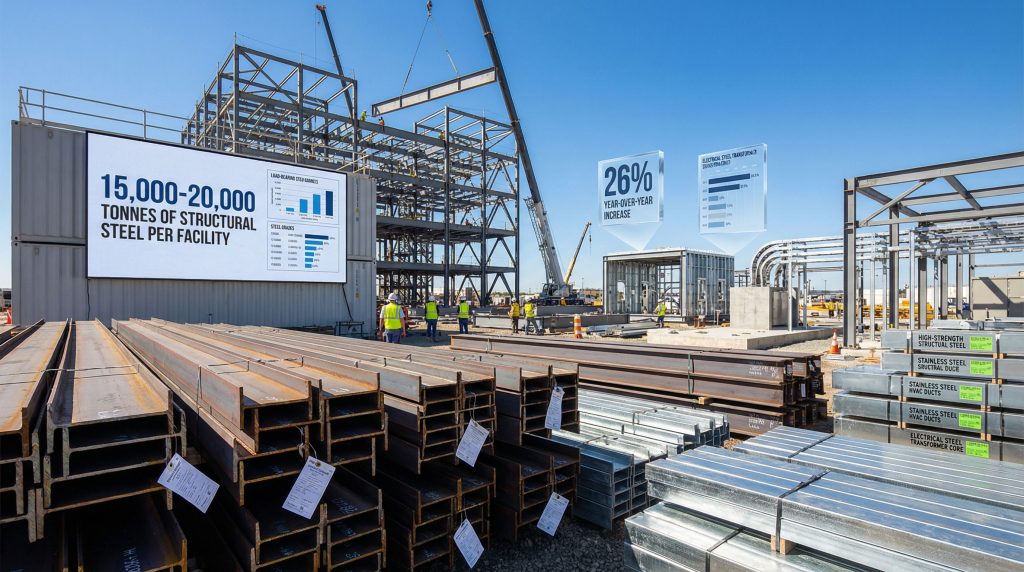
| High-strength structural steel | Primary load-bearing framework | Yield strength 50,000+ PSI, seismic certification |
| Galvanised steel products | External equipment housing | Enhanced corrosion resistance, humid environment tolerance |
| Stainless steel components | HVAC and cooling systems | Temperature fluctuation resistance, chemical compatibility |
| Electrical steel | Transformer cores and power equipment | Low magnetic permeability, energy efficiency ratings |
Market participants have noted that buyers tied to data centre construction have already secured orders extending well into the coming year, indicating sustained demand momentum for these specialised steel products. Furthermore, the mining industry innovation continues to drive efficiency improvements in steel production processes.
When big ASX news breaks, our subscribers know first
Regional Steel Demand Transformation Through Data Center Expansion
The United States has emerged as the epicentre of data centre-driven steel consumption, with construction spending reaching $41.4 billion annually on a seasonally-adjusted basis as of August 2025, representing a 26% increase compared to the previous year. This growth trajectory has created measurable impacts across regional steel markets, though the pace of expansion has moderated from the 63% growth rate recorded in the twelve months through August 2024.
Industry analysts note that this deceleration in growth rates, while still positive, raises questions about the sustainability of data centers steel demand patterns. The concentration of construction activity in specific geographic regions has created localised supply pressures that steel producers are adapting their operations to address.
North American Market Dynamics
The transformation of steel demand patterns has been particularly pronounced in regions with dense data centre development. Flat steel products have experienced significant consumption increases, with hot-rolled coil, cold-rolled steel, and galvanised products seeing elevated demand from infrastructure projects requiring precision-cut sections and specialised surface treatments.
Market concentration risks have emerged as a critical concern, with industry participants noting that data centre construction has become the strongest performing sector for steel consumption in recent months. This dependency creates vulnerability to sector-specific downturns, particularly as other construction categories have shown weakness.
US Steel Production and Trade Flows (January-September 2025):
| Metric | Volume | Year-over-Year Change |
|---|---|---|
| Domestic Steel Production | 66.7 million short tons (60.6 million tonnes) | +2.2% |
| Flat Steel Imports (HRC, CRC, HDG) | 3.3 million tonnes | -38% (from 4.9 million tonnes) |
| Nonresidential Construction Spending | Seasonally-adjusted annual rate | -1.5% |
The modest growth in domestic production despite significant import reductions exposes the limitations of market share capture alone in driving demand growth. Consequently, steel buyers have expressed concerns about broader construction market weakness beyond the data centre sector.
Asia-Pacific Infrastructure Development
Asian markets are experiencing parallel infrastructure expansion as cloud computing adoption accelerates across the region. Hyperscale facility construction in Singapore, Tokyo, and Sydney has created similar steel demand pressures, while edge computing deployment requires numerous smaller facilities that collectively represent substantial material consumption.
Government digitisation initiatives throughout the Asia-Pacific region have mandated domestic data processing capabilities, further driving infrastructure investment and associated steel demand. However, Australia iron ore leadership in the global supply chain continues to influence regional pricing dynamics. These policy-driven requirements create sustained demand visibility that differentiates the sector from cyclical construction markets.
Technical Specifications Driving Steel Selection
The shift toward modular construction methodologies has created new demand patterns for prefabricated steel assemblies that can reduce on-site construction time significantly. This approach requires standardised connection systems using high-tensile fasteners and precise dimensional tolerances to ensure equipment compatibility across modular components.
Modular Framework Requirements
Prefabricated steel modules demand factory-welded assemblies that meet stringent quality control standards, including AISC certification for all structural components and comprehensive mill test certificates for primary steel elements. Third-party inspection protocols exceed standard commercial construction requirements, reflecting the critical nature of digital infrastructure applications.
The energy-intensive nature of data centre operations, typically consuming 30-50 megawatts of electrical power per facility, requires extensive steel infrastructure for power distribution systems. This secondary demand driver creates additional consumption beyond the primary structural requirements.
Power Infrastructure Steel Applications:
- Transformer pad foundations utilising reinforcing steel for seismic resistance
- Cable tray systems requiring galvanised steel for corrosion protection
- Switchgear mounting platforms demanding precision-machined steel components
- Emergency backup power systems with specialised housing requirements
Energy sector expansion has emerged as a complementary demand source, as data centre operations necessitate comprehensive approaches to power generation and distribution. In addition, industry participants highlight energy infrastructure as both current and future sources of steel demand, even amid changes in energy policy frameworks.
Supply Chain Implications for Steel Producers
Steel mills are adapting production schedules to accommodate data centre project timelines, which often require coordinated delivery schedules to maintain construction momentum. This operational shift creates new challenges in inventory management and quality certification documentation for critical applications.
Production Scheduling Adaptations
The demanding timeline requirements of data centre construction have prompted steel producers to develop specialised capabilities for data centre applications. This includes stockpiling specialty sections for rapid deployment and coordinating delivery schedules with modular fabricators to ensure project continuity.
Geographic production shifts have become evident as data centers steel demand concentration influences steel production geography. For instance, regions with high facility density have seen capacity expansions and new production line installations focused on data centre specifications.
Market Share Dynamics and Trade Policy Impact
Section 232 tariffs on steel imports, raised to 50% under current trade policy, have blocked substantial import volumes from countries including Canada. Despite this import substitution opportunity, the modest 2.2% year-to-date growth in domestic production through September 2025 demonstrates the limitations of trade policy alone in driving demand expansion.
Import volumes for hot-rolled coil, cold-rolled coil, and hot-dipped galvanised steel totalled 3.3 million tonnes year-to-date through September 2025, representing a 38% decline from the 4.9 million tonnes imported during the same period in 2024. Furthermore, the US tariffs impact continues to reshape global trade patterns in steel markets.
Future Steel Demand Projections
Artificial intelligence-focused data centres are emerging as the next phase of infrastructure development, with enhanced requirements that could drive steel consumption beyond traditional facility specifications. These advanced installations require reinforced cooling infrastructure for high-performance computing applications and expanded power distribution networks to handle increased electrical loads.
AI Infrastructure Requirements
The computational density of AI-focused facilities demands enhanced structural support systems, including reinforced flooring configurations for dense server arrangements and expanded cooling infrastructure that requires additional steel mounting systems. These specifications represent an evolution in data centre design that could sustain data centers steel demand growth even as traditional facility construction moderates.
Edge Computing Proliferation:
- Standardised steel enclosures for rapid deployment across distributed locations
- Weather-resistant materials for outdoor installations in diverse climates
- Modular expansion capabilities requiring repeatable steel specifications
- Integration with existing infrastructure through standardised connection systems
The proliferation of edge computing facilities creates distributed demand patterns that differ from hyperscale concentration, potentially spreading steel consumption across broader geographic regions while maintaining overall sector demand levels. Moreover, steel manufacturing innovations are being driven by this data centre boom.
Economic Constraints and Market Headwinds
Consumer sentiment indicators present challenges for sustained demand growth beyond data centre applications. The University of Michigan Consumer Sentiment Index recorded 52.9 in December 2025, representing a 29% decline from the previous year and marking eight months in 2025 with readings below 60.
This consumer sentiment weakness has translated into real economic impacts affecting steel demand from other sectors. Retail spending on new vehicles and auto parts showed 5.1% nominal growth in September year-over-year, but this figure narrowed to 2.1% real growth when adjusting for the 3% annual consumer price index gain, indicating price inflation masked underlying demand weakness.
Risk Factors and Market Vulnerabilities
The concentration of steel demand in data centre construction creates systemic risks for regional markets where this sector represents a disproportionate share of consumption. Market participants have identified this dependency as a primary concern, particularly given the moderation in data centre spending growth rates.
Supply Chain Concentration Risks
Heavy reliance on data centre construction creates potential vulnerabilities across the steel supply chain. The concentration of demand in specific geographic regions has led to inventory volatility when construction schedules experience delays, while technology shifts could potentially reduce facility requirements in future development cycles.
Sectoral Weakness in Alternative Markets:
Agricultural industry demand has declined significantly due to global trade uncertainty affecting farmers' ability to sell crops overseas. This sector weakness was exemplified by companies like John Deere, which implemented workforce reductions at Iowa facilities in September following reports of higher tariff costs, reduced profitability, and lowered demand throughout 2025.
Automotive and consumer products demand, while more favourable than agricultural sectors, faces constraints from strained consumer spending patterns. The weak consumer sentiment environment creates headwinds for sustained demand growth across multiple steel-consuming industries.
Competitive Material Pressures
Alternative construction materials present long-term competitive challenges for steel in data centre applications. Composite materials offer weight advantages in certain applications, while aluminium structures provide enhanced corrosion resistance for specific environmental conditions. Concrete systems can deliver cost benefits for particular structural applications, though they lack steel's versatility across the full range of data centre requirements.
However, developments in green iron production may provide environmental advantages that strengthen steel's position in sustainable construction projects.
The next major ASX story will hit our subscribers first
Investment and Strategic Considerations
Leading steel manufacturers are developing specialised capabilities to serve the data centre market's demanding requirements. This strategic positioning involves product development initiatives focused on high-strength, low-alloy grades suitable for seismic applications and precision-cut sections that reduce field fabrication requirements.
Steel Producer Positioning Strategies
The development of integrated logistics solutions for project coordination has become a competitive differentiator among steel producers serving the data centre market. Successful companies are establishing partnership opportunities through joint ventures with modular fabricators and long-term supply agreements with hyperscale developers.
Strategic Development Areas:
- Specialised product development for data centre applications
- Precision manufacturing capabilities reducing field installation time
- Quality certification programmes exceeding standard commercial requirements
- Technology licensing opportunities for advanced applications
Market participants note that steel producers must balance the opportunities presented by data centre demand growth against the risks of over-dependence on a single sector. The most successful strategies appear to involve developing data centre capabilities while maintaining diversified customer bases across multiple construction and manufacturing sectors.
Market Psychology and Demand Sustainability
The psychological impact of data centre success on steel market participants has created optimistic outlooks that may not fully account for potential demand moderation. Industry observers note that the concentration of positive sentiment around data centre construction could mask underlying weaknesses in broader steel demand fundamentals.
Forward-looking indicators suggest that demand growth may not expand significantly above 2025 levels across virtually every other sector of steel consumption. This creates a scenario where data centre demand must continue growing to offset weakness elsewhere, potentially creating unsustainable concentration risks.
Conclusion: Structural Transformation of Steel Markets
The expansion of data centre infrastructure represents a fundamental shift in steel demand patterns, creating concentrated consumption in specific geographic regions while driving technical innovation in product development and supply chain management. Market participants have identified data centers steel demand as the primary growth driver in recent periods, though this concentration creates both opportunities and vulnerabilities.
The sector's growth trajectory suggests sustained demand elevation through the near term, particularly as artificial intelligence applications drive enhanced facility requirements. However, successful market navigation requires careful attention to concentration risks, evolving technology requirements, and broader economic conditions that could affect sector sustainability.
The intersection of digital infrastructure needs and steel production capabilities continues reshaping both industries, with leading steel producers adapting operational models to serve this demanding but potentially lucrative market segment. The challenge lies in capitalising on current growth while preparing for potential demand moderation as the sector matures.
Investment decisions should consider the cyclical nature of infrastructure spending and the potential for technology changes to affect long-term demand patterns. Market participants are advised to monitor consumer sentiment indicators and broader economic conditions that could impact sustained growth in data centre construction.
Considering Steel Sector Investment Opportunities?
Discovery Alert's proprietary Discovery IQ model delivers instant notifications on significant ASX steel and iron ore discoveries, helping investors identify actionable opportunities in mining companies positioned to benefit from rising steel demand. Begin your 30-day free trial today to secure your market-leading advantage ahead of the broader market.