June 18, 2026
The Productivity Crisis Hidden Inside Every Complex Mining Operation
Across the global extractive industry, a persistent and expensive problem has been compounding quietly for decades. It is not a shortage of ore, a lack of capital, or a deficit of skilled engineers. It is something far more fundamental: the structural lag between when geological and operational data is collected and when it actually influences decision-making on the ground.
In complex resource environments, where ore variability is high and mineralogy shifts unpredictably across short distances, the gap between data collection and operational response can represent millions of dollars in lost efficiency. Traditional mining workflows rely on periodic laboratory assays, static geological block models, and manual reconciliation processes that were designed for a different era of operations. The result is a sector that frequently makes multi-million-dollar processing decisions based on information that is hours, days, or weeks old.
This is the environment into which a new generation of data-driven mining tools is arriving, and the implications for operational economics are substantial.
When big ASX news breaks, our subscribers know first
Why Static Data Environments Create Compounding Financial Losses
The conventional model of resource characterisation depends on a cycle that looks roughly like this: drill samples are collected, dispatched to a laboratory, analysed, and eventually fed back into geological models that inform blasting, hauling, crushing, and flotation decisions. At each transition point in that chain, time passes. And in that time, ore with variable characteristics continues to move through a processing circuit that was calibrated for something different.
The financial consequences of this misalignment are not confined to a single stage of the value chain. Consider the cascading effect:
- Inaccurate ore characterisation leads to suboptimal blast fragmentation patterns
- Suboptimal fragmentation increases energy consumption in crushing circuits
- Crusher settings calibrated for the wrong particle hardness or size distribution waste energy on material that doesn't require it, or fail to adequately process material that does
- Grade reconciliation errors between the resource model and actual mill feed introduce further financial uncertainty at the revenue stage
- Non-target-bearing material processed through energy-intensive circuits consumes reagents, water, and power with zero recoverable value
Each of these inefficiencies is individually manageable. Together, they represent a structural drag on operational economics that conventional workflows are architecturally incapable of resolving without a fundamental rethink of how data-driven mining operations flow through an organisation.
The financial burden is not just in what is lost during processing. It is in every decision made with incomplete, delayed, or statically modelled geological information across the entire drill-to-mill workflow.
What Data-Driven Mining Tools Actually Are
The term data-driven mining tools encompasses a wide spectrum of technologies, and clarity about what sits within this category matters for anyone evaluating their potential application.
At one end of the spectrum sit general-purpose analytical platforms. These are tools like RapidMiner, KNIME, Weka, and Scikit-learn that were developed primarily for data science and business analytics workflows. They bring powerful capabilities in pattern recognition, classification, regression modelling, and clustering. They are well-documented, widely adopted, and, in many cases, freely available. For a broader overview of how these platforms compare, leading data mining platforms are catalogued in detail across several industry resources.
At the other end sit purpose-built mining intelligence systems that embed geological knowledge models, real-time sensor feeds, and mine planning logic directly into their analytical architecture. These are not simply analytics platforms applied to mining data. They are systems designed from the ground up to address the specific technical challenges of heterogeneous ore environments, underground sensing constraints, and processing circuit optimisation.
The distinction matters because deploying a general-purpose analytics platform in a mining environment without domain-specific integration is equivalent to using a powerful calculator to solve a problem that requires a purpose-built engineering simulation. The raw analytical capability may be present, but the contextual intelligence is absent.
The Five Functional Layers of Mining Data Intelligence
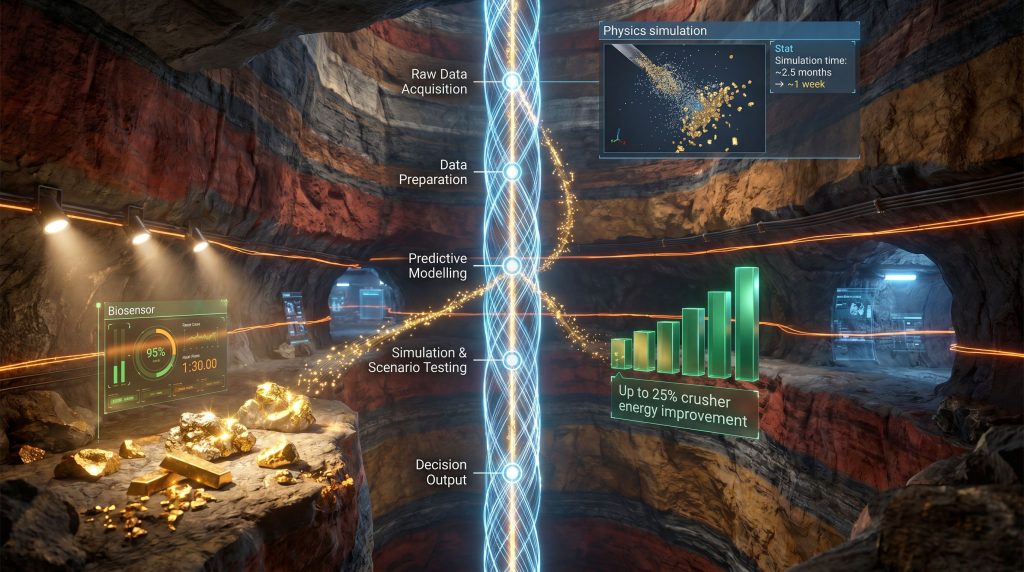
Regardless of where a specific tool sits on this spectrum, effective data-driven mining systems share a common processing architecture:
- Raw Data Acquisition involves the continuous capture of information from sensor arrays, drill core logging systems, geochemical sampling units, and operational telemetry networks
- Data Preparation and Normalisation structures, cleans, and standardises these inputs to make them compatible with downstream modelling systems
- Predictive Modelling and Classification applies machine learning algorithms to identify ore-bearing patterns, classify material types, and generate probabilistic resource estimates
- Simulation and Scenario Testing uses physics engine-based modelling to replicate particle behaviour and material flow dynamics under different operational parameters
- Decision Output and Operational Integration feeds analytical outputs directly into processing plant control systems and mine planning software in a form that operators can act on immediately
The critical innovation is not in any single layer of this pipeline. It is in their integration, and specifically in the speed at which information moves from acquisition to operational action.
The Leading General-Purpose Data Mining Platforms: A Practical Comparison
For mining organisations building out analytical capabilities, the choice of platform depends heavily on three variables: the technical proficiency of the in-house team, the scale of data being processed, and the degree of integration required with operational systems.
| Tool | Key Capabilities | Deployment Model | Best Suited For | Cost Structure |
|---|---|---|---|---|
| RapidMiner | Visual workflows, predictive analytics, text mining | Freemium, desktop and cloud | End-to-end analytics, minimal coding | Free tier + commercial |
| KNIME | Modular pipelines, Python/R/Spark integration | Open-source, desktop and cloud | Scalable low-code analytical pipelines | Free (open-source) |
| Weka | Clustering, classification, regression, visualisation | Open-source, desktop | Research and education, smaller datasets | Free (open-source) |
| Orange | Visual programming, interactive visualisation | Open-source, desktop | Lightweight analytics, interactive learning | Free (open-source) |
| SAS Enterprise Miner | Advanced predictive modelling, grid computing | Commercial, SAS ecosystem | Enterprise-scale analytics with vendor support | Commercial licence |
| H2O.ai | Automated machine learning, deep learning | Open-source + commercial | High-volume automated ML workflows | Free tier + enterprise |
| Scikit-learn | Python-native statistical modelling | Open-source, code-based | Python developers, research-grade modelling | Free (open-source) |
| Apache Mahout | Distributed ML on Hadoop architecture | Open-source, distributed | Big data environments, large-scale clustering | Free (open-source) |
Selecting the right platform requires honest assessment of organisational capability gaps alongside technical requirements:
- Cost-constrained environments benefit most from KNIME, Weka, and Orange, which offer robust open-source functionality with active developer communities
- Enterprise-scale deployments requiring validated vendor support and governance infrastructure typically require SAS Enterprise Miner or comparable commercial platforms
- Automation-first operational teams looking to minimise coding overhead consistently find RapidMiner's no-code workflow builder among the most practical options available in 2026
- Python-proficient analytics teams can extract significant flexibility from Scikit-learn combined with modern ETL platforms for pipeline management
One important limitation that is often understated: Weka, while excellent for research and teaching applications, performs poorly on the large, high-velocity datasets typical of operational mining environments. Similarly, Scikit-learn and MATLAB, while analytically powerful, require meaningful programming proficiency that many operational teams do not have without dedicated data science resourcing.
Research-Validated Technologies Closing the Lab-to-Operations Gap
The most significant development in data-driven mining tools currently is not the refinement of general-purpose platforms. It is the emergence of research-validated, domain-specific technologies that are transitioning from academic validation into commercial pilot readiness.
The ARC Training Centre for Integrated Operations for Complex Resources, operating out of Adelaide University and supported by the Australian Research Council, has developed four distinct technologies that its research team describes as ready for immediate industry deployment. These technologies were developed independently within separate PhD research tracks before the team identified meaningful integration opportunities across their respective outputs.
Professor Peter Dowd, Director of the Training Centre and Professor of Mining Engineering at Adelaide University, has been direct about the current status of these tools. His position is that these are not theoretical constructs or early-stage proofs of concept. The validation work is complete, and the current priority is identifying operational mining partners willing to trial and deploy these systems in real-world environments.
His assessment is that mining companies willing to engage now will gain both operational performance benefits and the opportunity to co-shape the standards these technologies will set for the broader industry.
The Four Technology Archetypes Seeking Operational Partners
1. Continuous Orebody Knowledge Systems
These platforms use integrated sensor data to update geological models in near real time, replacing the periodic sampling cycle that has characterised conventional resource characterisation for generations. Furthermore, 3D geological modelling capabilities have advanced significantly, enabling far more precise visualisation of ore distribution across complex deposits.
In ore environments where grade and mineralogy vary significantly over short intervals, the difference between a static model updated weekly and a dynamic model updated continuously can translate directly into more accurate blast design, more appropriate crusher settings, and more efficient flotation circuit management.
2. AI-Driven Mine-to-Mill Optimisation
This framework connects upstream resource characteristics to downstream processing performance and financial outcomes through a continuous analytical chain. AI in mining operations has advanced considerably in this domain, enabling dynamic adjustment of crushing, grinding, and flotation parameters based on real-time ore characterisation data.
The projected energy efficiency improvement in crushing operations through optimised particle size targeting reaches up to 25%, a figure that translates to material operating cost reductions at scale.
3. Cave Draw-Point and Fragmentation Monitoring
Block caving and sub-level caving are among the most complex underground mining methods in commercial operation. Managing material flow, predicting fragmentation distributions, and minimising dilution events requires sensing capability that most operations currently lack. This technology targets the monitoring of draw-point conditions and fragmentation characteristics in real time, supporting more precise extraction scheduling and reducing the operational risk associated with hang-ups and unplanned draw-point closures.
4. Protein-Based Real-Time Gold Biosensors
This is arguably the most technically novel of the four technologies. Developed under the research leadership of Dr Akhil Kumar, the biosensor uses proteins with selective binding affinity for gold to detect the presence and concentration of gold in ore samples in real time, on-site, without the need for X-ray fluorescence analysis or off-site laboratory assay.
The core operational value of this technology is straightforward: if you can determine in real time which material contains gold and which does not, you can avoid processing material that will never return value. The energy, reagent, and water costs of processing non-gold-bearing ore through a full hydrometallurgical circuit are not trivial.
Dr Kumar has characterised this system as a faster and more environmentally considered alternative to existing methods. Furthermore, real-time ore sensing innovations are demonstrating that on-site mineral detection can eliminate time delays and cost structures at the point of ore sorting, before processing commences.
The Physics Engine Breakthrough Compressing Simulation Timelines
One of the more technically striking achievements within the ARC IOCR research programme is the application of physics engine simulation to particle size and material flow modelling, an area where conventional computational methods have historically imposed severe time constraints on operational planning.
In conventional simulation workflows, linking particle size distribution data to material flow characteristics through a processing circuit can take approximately two and a half months of computational and analytical work. This timeline makes real-time or near-real-time simulation-guided operational adjustment essentially impossible.
The physics engine approach developed by Dr Kumar's team has compressed this same simulation task to approximately one week, representing a reduction in computational lead time exceeding 90%. This is not a marginal improvement. It is a qualitative change in what simulation-guided decision-making can look like in an operational mining context.
| Operational Area | Technology Applied | Reported or Projected Improvement |
|---|---|---|
| Simulation lead time | Physics engine modelling | Reduced from approximately 2.5 months to approximately 1 week (over 90% reduction) |
| Crusher energy efficiency | Particle size optimisation via AI | Up to 25% improvement projected |
| Gold ore processing | Real-time protein-based biosensor | Elimination of non-target ore processing costs |
| Resource model accuracy | Continuous sensor-integrated updating | Near real-time geological model refresh |
| Mine-to-mill financial alignment | AI optimisation engine | Direct linkage of resource characteristics to revenue outcomes |
The team has also noted that what began as separate, independently developed research projects is now being explored as an integrated system. The convergence of real-time orebody sensing, AI-driven processing optimisation, and physics engine simulation into a unified operational intelligence platform represents a qualitatively different proposition from any single technology deployed in isolation.
The next major ASX story will hit our subscribers first
Overcoming the Barriers to Technology Adoption in Mining
Understanding the technical capability of data-driven mining tools is only part of the adoption challenge. Mining companies face a distinct set of structural, cultural, and commercial barriers that frequently slow or prevent the deployment of technically validated technologies.
Technical Integration Challenges
- Legacy operational data infrastructure is frequently incompatible with modern sensor networks and AI platforms without significant architectural investment
- Multi-vendor operational environments create data standardisation challenges that require careful management before any unified analytical layer can be deployed
- Connected underground sensing systems introduce cybersecurity considerations that surface-level IT teams may not have prior experience managing
- Real-time data streaming requirements impose latency and reliability standards that legacy communications infrastructure may not support
Organisational and Cultural Resistance
Even where technical integration is feasible, organisational resistance can stall deployment. Operational teams with decades of experience using established workflows often view AI-assisted decision tools with appropriate scepticism rather than automatic acceptance. This is not irrational. Poorly designed or inadequately validated tools have failed visibly in operational mining environments before.
The response to this challenge is not to dismiss cultural resistance but to address it through structured change management, transparent validation data, and pilot programme designs that allow operational teams to build direct experience with new tools before full deployment is required.
Commercial Partnership and IP Considerations
For research-originated technologies transitioning to commercial deployment, the partnership framework matters enormously. Pilot programme design, data sharing arrangements, intellectual property ownership structures, and risk allocation between technology developers and operational partners are all variables that require careful negotiation. The pathway from pilot to full commercial licensing must be clearly defined before operational partners will commit the resources required for meaningful trial programmes.
Frequently Asked Questions: Data-Driven Mining Tools
What is the difference between data mining software and purpose-built AI mining tools?
General data mining software such as RapidMiner, KNIME, or Weka focuses on extracting patterns from structured datasets using statistical and machine learning methods. Purpose-built AI mining tools go considerably further by integrating real-time sensor feeds, geological knowledge models, and process plant control systems to deliver dynamic, context-aware operational recommendations. The distinction is between analytical capability applied to historical data and intelligence embedded within live operational workflows.
How long does implementation of a data-driven mining tool typically take?
General-purpose platforms can be deployed for analytical applications within weeks. Purpose-built mining systems requiring sensor integration, geological model connectivity, and processing plant interfacing typically require structured pilot programmes spanning three to twelve months, depending on infrastructure maturity and the complexity of the operational environment.
Are open-source data mining tools suitable for operational mining applications?
Open-source platforms are well suited to analytical and research functions within mining organisations. However, safety-critical operational deployments typically require commercial-grade support, formal validation documentation, and integration capabilities that open-source tools rarely provide natively without significant customisation investment.
How does a protein-based gold biosensor actually work?
The biosensor uses proteins that have a selective binding affinity for gold at the molecular level. When ore material is introduced, the protein responds to the presence of gold, generating a detectable signal that can be measured and quantified in real time. This enables on-site, pre-processing ore sorting decisions without the time delays and costs associated with X-ray fluorescence analysis or dispatch to an off-site laboratory.
Which mining operations benefit most from AI-driven mine-to-mill optimisation?
Operations processing heterogeneous ore types with significant variability in hardness, grade, and mineralogy extract the greatest value from mine-to-mill optimisation tools. These environments generate the largest financial losses from suboptimal processing parameters, making real-time operational adjustment economically compelling. Complex resource environments, including porphyry copper-gold systems and structurally complex gold deposits, are particularly well suited to this approach. In addition, XRT ore sorting technologies are increasingly complementing AI-driven optimisation in these settings.
The Convergence Trajectory: From Standalone Tools to Integrated Operational Intelligence
The near-term direction of data-driven mining tools is not toward more powerful standalone applications. It is toward integration. The combination of continuous orebody sensing, AI-driven processing optimisation, physics-based simulation, and real-time mineral detection into a unified operational intelligence platform represents the logical endpoint of the technology trajectories currently emerging from research environments.
Several emerging capability areas are visible on the research horizon:
- Next-generation sensing technologies targeting multi-mineral detection extending beyond gold to copper, lithium, and other critical minerals
- Autonomous draw-point management systems that use real-time fragmentation data to self-adjust extraction schedules without manual intervention
- Expanded physics engine applications spanning blasting pattern optimisation, haulage route modelling, and tailings facility management
- Digital twin frameworks that create persistent, real-time virtual representations of entire mining operations, enabling scenario testing without interrupting production
The mining companies that establish early partnerships with research-validated technology developers are not simply improving current operations. The ARC IOCR team's position is that companies engaging now with these technologies will participate in defining the operational standards against which the broader industry will eventually be benchmarked.
For operators in complex resource environments, the question is no longer whether data-driven mining tools will transform operational economics. The research validation is complete. The question is which organisations will have the forward-looking disposition to engage with these technologies before their competitors do. Industry analysts at Gartner's process mining reviews continue to document the accelerating pace of adoption across extractive industries globally.
Disclaimer: This article contains references to projected efficiency improvements and operational performance estimates derived from research-validated results reported by the ARC Training Centre for Integrated Operations for Complex Resources. These projections represent anticipated outcomes based on laboratory and simulation-stage validation and are not guarantees of operational performance. Forward-looking statements involve inherent uncertainty. Readers considering investment or commercial decisions based on emerging mining technologies should conduct independent due diligence.
Want to Identify the Next Major ASX Mineral Discovery Before the Broader Market?
Discovery Alert's proprietary Discovery IQ model delivers real-time alerts on significant ASX mineral discoveries, transforming complex geological data into actionable investment insights for both short-term traders and long-term investors — explore historic examples of exceptional discovery returns to understand the opportunity, and begin your 14-day free trial at Discovery Alert to position yourself ahead of the market.