June 18, 2026
The Infrastructure Race Against a Measurable Deadline
Energy infrastructure projects rarely succeed or fail on engineering merit alone. The defining variable is almost always timing: whether the physical asset can be made ready before the supply gap it is designed to fill becomes economically catastrophic. Across Sub-Saharan Africa, several countries have learned this lesson at considerable cost, watching industrial output contract and grid reliability deteriorate while replacement infrastructure remained stranded in pre-feasibility.
South Africa now finds itself at precisely this inflection point, with a quantifiable production decline curve bearing down on its natural gas supply system and a hard deadline of 2030 concentrating the minds of project developers, utilities, and international energy majors alike.
The entry of ExxonMobil backs South Africa's first LNG import terminal through a preliminary supply arrangement, and it is, in this context, far more than a routine commercial filing. It is a signal that one of the world's largest integrated energy companies has assessed the country's supply deficit, weighed the commercial fundamentals, and concluded the project warrants serious engagement.
When big ASX news breaks, our subscribers know first
South Africa's Approaching Gas Supply Cliff
The Mozambican Pipeline Dependency Problem
South Africa's natural gas sector has operated for decades on a relatively straightforward model: piped gas from Mozambique's Pande-Temane fields travels westward via the Republic of Mozambique Pipeline Investment Company (ROMPCO) pipeline, supplying Sasol's operations and a range of industrial and power generation customers. This arrangement has functioned effectively, but it carries an inherent structural vulnerability.
The Pande-Temane fields are mature producing assets, and their output trajectory follows the same depletion curve that affects all conventional gas reservoirs over time. Industry analysts have identified a production decline from these fields that, without a material replacement supply source, will create a significant gas supply shortfall for South Africa before the end of this decade.
The phrase gas cliff has been used by energy sector stakeholders to describe this transition point: the moment when declining Mozambican volumes and domestic South African demand diverge sharply enough to create measurable economic disruption. Furthermore, the global LNG supply outlook underscores just how critical it is for South Africa to secure alternative import pathways before this point is reached.
Why 2030 Is the Operative Deadline
The 2030 timeline is not arbitrary. It represents the convergence of several trends:
- Production volumes from Pande-Temane are expected to fall materially within this timeframe absent significant new upstream investment in Mozambique
- South Africa's industrial base, including fertiliser producers, petrochemical operations, and energy-intensive manufacturers, relies on uninterrupted gas supply for process heat and feedstock
- Power generation capacity in South Africa remains under acute stress, and gas-fired generation provides dispatchable backup that intermittent renewable sources cannot replicate without storage infrastructure
- Construction lead times for major import terminal infrastructure mean that any facility intended to be operational by 2030 must reach Final Investment Decision well in advance, making 2028 the effective FID deadline for a realistic commissioning scenario
The downstream consequences of missing this window are not abstract. Load-shedding has already cost the South African economy billions of rands annually in lost productivity. A gas supply shortfall layered on top of existing grid instability would compound those losses significantly, particularly for industries that cannot easily switch to alternative energy carriers.
What Is the Zululand Energy Terminal?
Project Structure and Ownership
The Zululand Energy Terminal, commonly referred to as ZET, is the designated project vehicle for developing South Africa's first purpose-built LNG import facility. The terminal is structured as a joint venture between two entities whose combined capabilities address the full infrastructure chain from port to pipeline:
- Vopak Terminal Durban, a subsidiary of Royal Vopak, one of the world's largest independent tank terminal operators, bringing deep expertise in LNG storage, handling, and terminal operations
- Transnet Pipelines, the state-owned transmission infrastructure operator responsible for South Africa's gas and liquid fuels pipeline network, providing the critical distribution link between the import terminal and downstream customers
This pairing is strategically deliberate. Vopak contributes proven operational competency in LNG terminal management across multiple international jurisdictions, while Transnet provides access to the existing pipeline infrastructure that would connect regasified LNG to industrial and power generation consumers without requiring greenfield distribution construction. You can read more about this on Offshore Energy's coverage of how ExxonMobil formally joined the Vopak-Transnet JV.
Richards Bay: Why This Location Makes Infrastructure Sense
The Port of Richards Bay on South Africa's KwaZulu-Natal coastline offers several characteristics that make it the logical site for the country's first LNG import gateway:
- Deep-water port capacity capable of accommodating large LNG carrier vessels, including Q-Flex and potentially Q-Max class ships depending on final berth specifications
- Existing heavy industrial infrastructure and established energy demand centres in the surrounding region
- Proximity to the gas pipeline network that Transnet operates, enabling distribution without constructing entirely new transmission corridors
- East coast positioning that reduces sailing distances from major Atlantic and Indian Ocean LNG supply origins compared to west coast alternatives
What the Terminal Will Actually Do
The functional scope of ZET covers the complete LNG import value chain. Ships carrying liquefied natural gas at cryogenic temperatures would offload at the Richards Bay berth into onshore storage tanks. From storage, the LNG would pass through regasification equipment that converts it back into pipeline-quality gas, which then enters the Transnet pipeline network for delivery to power generators and industrial customers.
This is the standard architecture for land-based LNG import terminals, as distinct from Floating Storage and Regasification Unit (FSRU) solutions. The table below illustrates the key differences between these two common import terminal approaches:
| Feature | FSRU Solution | Land-Based Terminal |
|---|---|---|
| Development Timeline | 12–24 months | 4–7 years |
| Upfront Capital Cost | Lower | Higher |
| Throughput Capacity | Moderate | High |
| Long-Term Scalability | Limited | High |
| Asset Permanence | Relocatable | Fixed national infrastructure |
| Financing Complexity | Lower | Higher |
ZET's land-based architecture reflects a long-term national infrastructure ambition rather than a short-term bridging solution, which is consistent with the scale of the supply gap it is designed to address.
ExxonMobil Backs South Africa's First LNG Import Terminal: What the HoA Actually Means
The Commercial Mechanics of a Heads of Agreement
A Heads of Agreement occupies a specific and important position in LNG project development. It is not a binding supply contract, but it is considerably more than an expression of interest. An HoA typically establishes the commercial framework, key terms, and mutual intent between parties, creating a structured basis for negotiating the definitive agreements that follow a positive Final Investment Decision.
In the context of LNG project financing, HoAs perform a critical function: they allow project developers to demonstrate to lenders and potential equity partners that credible counterparties are engaged in the commercial ecosystem surrounding the proposed facility. Banks financing large-scale infrastructure are highly averse to merchant risk, meaning they want evidence of both supply sources and demand commitments before advancing project loans.
"The convergence of a globally recognised LNG supplier on the input side and a national utility on the offtake side represents the precise commercial architecture that infrastructure lenders require before credit committees will engage seriously with a project of this scale."
ExxonMobil's Strategic Significance as a Supply Partner
ExxonMobil operates one of the world's largest LNG portfolios, with equity production and offtake positions spanning multiple liquefaction projects across Papua New Guinea, the United States, Qatar, and beyond. Its entry into a preliminary supply arrangement for the ZET project carries outsized signalling value for several reasons.
Major integrated energy companies conduct rigorous internal due diligence before entering any preliminary commercial arrangement. ExxonMobil's LNG Market Development division, the entity that signed the ZET HoA, exists specifically to identify and structure new market development opportunities where global LNG supply can be matched with emerging demand centres.
Andrew Barry, Chairman of ExxonMobil LNG Market Development Inc., indicated that the company views the South African market as presenting a genuine opportunity to support energy security through reliable LNG supply, describing the arrangement as "consistent with ExxonMobil's global LNG experience and its commitment to addressing energy security challenges in growing markets."
Eskom as the Demand-Side Foundation
Equally important to the supply-side credibility that ExxonMobil provides is the demand-side anchor that Eskom represents. South Africa's national electricity utility has entered a framework agreement to serve as a foundation offtake customer for the ZET facility. This matters enormously in the project finance context.
Eskom's scale of gas consumption, if it commits to purchasing regasified LNG at meaningful volumes, would provide the minimum contracted throughput that lenders need to see before advancing senior debt. The combined structure, with ExxonMobil supplying and Eskom purchasing, creates a bankable commercial framework that significantly de-risks the path to Final Investment Decision. However, the energy export challenges observed in other markets serve as a reminder that commercial frameworks must be robust enough to withstand shifting regulatory and geopolitical conditions.
Project Timeline and the Road to First Gas
Where the Project Stands Today
As of mid-2026, the ZET project has completed several foundational commercial milestones while regulatory and technical workstreams remain in progress. The milestone tracker below summarises the current development status:
| Milestone | Status | Estimated Timing |
|---|---|---|
| Eskom foundation customer agreement | Completed | Prior to June 2026 |
| HoA signed with ExxonMobil | Completed | June 2026 |
| Regulatory approvals process | In Progress | 2026–2027 |
| Customer commitment threshold | Pending | 2027–2028 |
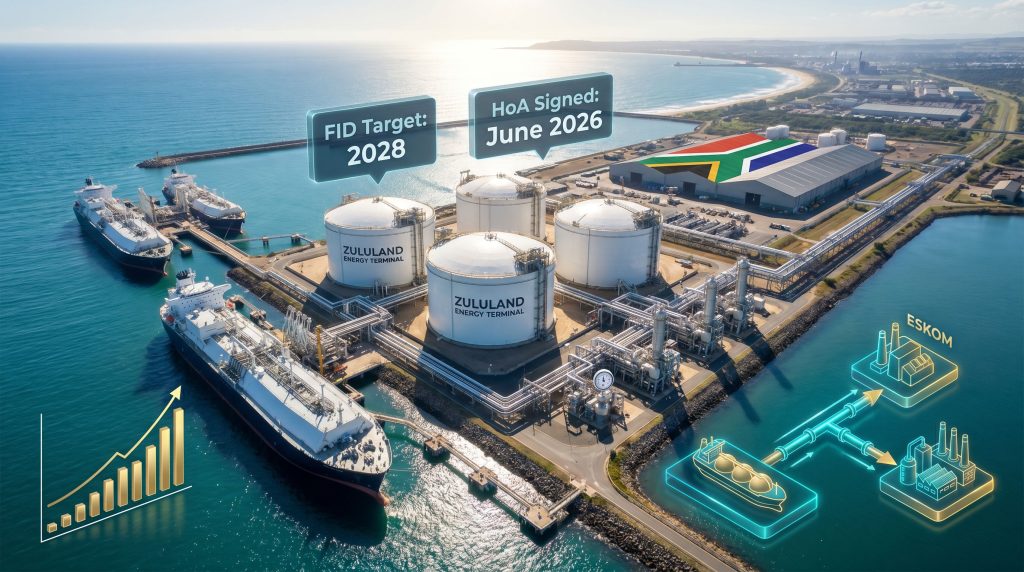
| Final Investment Decision (FID) | Pending | Target 2028 |
| Construction and Commissioning | Pending | Post-FID |
Understanding the 2028 FID Target
Vopak has indicated a revised FID target of 2028 for the ZET project. This timeline reflects the realistic duration of the remaining workstreams: completing technical and environmental feasibility studies, obtaining regulatory approvals from South African port authorities and environmental assessment bodies, accumulating sufficient contracted customer volumes to satisfy lender requirements, and negotiating definitive supply and offtake agreements to replace the preliminary HoA framework.
Construction and commissioning of a land-based LNG import terminal of meaningful scale typically requires a minimum of three to four years following FID. This compresses the timeline against the 2030 gas supply deadline considerably, meaning that any further delays in reaching FID would push operational commencement into a period when the supply gap will already be manifesting.
LNG's Role in South Africa's Broader Energy Architecture
Dispatchable Gas as a Complement to Renewable Capacity
A common misconception in energy transition discussions is that natural gas infrastructure and renewable energy investment are competing priorities. The operational reality is considerably more nuanced. Solar and wind generation are inherently intermittent, producing power only when meteorological conditions allow. Gas-fired generation, by contrast, is dispatchable, meaning it can be ramped up or down within minutes to match grid demand regardless of weather conditions.
South Africa's Integrated Resource Plan recognises the role of gas in the generation mix precisely because of this operational complementarity. In addition, renewable energy integration across other resource-intensive sectors demonstrates how dispatchable gas can bridge the gap between intermittent clean generation and firm baseload requirements.
Industrial Gas Markets: Beyond Power Generation
The demand for gas in South Africa extends well beyond electricity generation. Key industrial sectors dependent on reliable gas supply include:
- Petrochemical and synthetic fuels production, where Sasol's operations represent some of the largest gas consumption volumes in Sub-Saharan Africa
- Fertiliser manufacturing, which requires natural gas as both an energy source and a chemical feedstock for ammonia production
- Glass, ceramics, and food processing industries that rely on gas for precise process heat applications
- Mining sector operations where gas is used for thermal processes and potentially as a future vehicle fuel
A functioning LNG import terminal at Richards Bay would, for the first time, give South African industrial consumers access to globally priced LNG spot and term markets. This introduces competitive pricing dynamics that are entirely absent from the current single-corridor pipeline supply model, where Mozambican gas moves through a limited transmission infrastructure with relatively constrained commercial flexibility.
South Africa as a Potential Regional Gas Distribution Hub
A less frequently discussed dimension of the ZET project is its potential regional significance. Several of South Africa's neighbouring countries, including landlocked nations such as Zimbabwe, Zambia, and Botswana, have limited or no access to natural gas infrastructure. A well-capitalised, operationally proven LNG import terminal at Richards Bay could function as a regional distribution point, with regasified LNG transported by road in cryogenic tankers or, over longer timeframes, through new pipeline interconnections.
This regional hub potential amplifies the commercial case for ZET beyond the domestic South African demand base. Furthermore, global trade tensions affecting LNG routing and pricing globally may, counterintuitively, accelerate demand from emerging markets seeking supply diversification, providing additional throughput volume that could improve the project's unit economics and strengthen the overall bankability analysis.
The next major ASX story will hit our subscribers first
Key Risks That Could Affect Project Delivery
Commercial and Contractual Risks
Despite the progress represented by the ExxonMobil HoA and the Eskom framework agreement, ZET faces meaningful risks that investors and industry observers should weigh carefully:
- Volume commitment gaps: Lenders will require contracted throughput volumes above a minimum threshold. If industrial customers delay commitment or negotiate smaller initial volumes, the project may need additional commercial rounds before FID becomes viable
- LNG price volatility: Global LNG spot prices have experienced extreme volatility since 2021, complicating long-term offtake contract negotiations where both buyer and seller must agree on pricing mechanisms and risk allocation
- HoA to binding contract conversion: The ExxonMobil arrangement remains a preliminary instrument. The translation of HoA terms into a definitive supply agreement is a complex negotiating process that introduces execution risk
Regulatory and Environmental Approval Risks
South African environmental law requires comprehensive impact assessments for major industrial infrastructure projects, particularly those involving port-based facilities with potential coastal and marine environmental implications. The regulatory pathway for ZET involves:
- Environmental Impact Assessment under the National Environmental Management Act framework
- Port authority approvals from Transnet National Ports Authority for the Richards Bay berth and storage footprint
- National energy regulatory engagement for import, storage, and distribution licensing
- Stakeholder consultation processes with local communities, industrial neighbours, and environmental interest groups in the Richards Bay zone
Any of these workstreams can extend timelines if contested or if technical studies require revision and resubmission.
Currency and Macroeconomic Exposure
LNG is priced and traded globally in US dollars. South Africa's energy consumers, including Eskom, operate in South African rand. This structural currency mismatch creates a persistent cost exposure: when the rand depreciates against the dollar, the rand cost of imported LNG rises independently of any movement in the underlying commodity price.
Long-term offtake contracts will need to incorporate currency risk mechanisms, and project financing structures will need to account for sovereign and currency transfer risks that international lenders will price carefully. Consequently, the broader oil and gas market trends shaping global energy pricing will have a direct bearing on how these currency and cost structures are ultimately negotiated.
Disclaimer: This article contains forward-looking statements and projections based on publicly available information and announced commercial arrangements. LNG project development timelines, commercial outcomes, and market conditions are subject to change. Nothing in this article constitutes financial advice or a recommendation to invest in any company or project referenced.
Frequently Asked Questions: South Africa's First LNG Import Terminal
What is the Zululand Energy Terminal?
ZET is a proposed land-based LNG import facility to be built at the Port of Richards Bay in KwaZulu-Natal, South Africa. It is jointly developed by Vopak Terminal Durban and Transnet Pipelines and is designed to import, store, regasify, and distribute LNG to power generation and industrial customers across South Africa.
Why is Richards Bay the preferred location?
Richards Bay offers deep-water port infrastructure capable of accommodating large LNG carriers, proximity to existing pipeline networks operated by Transnet, and access to a significant industrial demand base in the surrounding region.
What role does ExxonMobil play in the ZET project?
ExxonMobil South Africa LNG Ltd. has signed a Heads of Agreement with ZET as a preliminary LNG supply partner. ExxonMobil is not a terminal owner or equity participant in the joint venture; its role is as a potential supply counterparty once the project reaches Final Investment Decision and definitive agreements are executed.
When could the terminal become operational?
Vopak has indicated a target FID date of 2028. Given typical construction and commissioning timelines for land-based LNG import facilities, commercial operations would realistically begin in the early 2030s, subject to regulatory approvals and sufficient customer commitments being achieved.
How does this terminal address South Africa's gas supply problem?
By creating an LNG import gateway, ZET would allow South Africa to source natural gas from international markets, substituting declining Mozambican pipeline volumes with globally diversified supply and reducing the country's dependence on a single supply corridor.
What the ExxonMobil Arrangement Signals for South Africa's Energy Future
The commercial architecture taking shape around the Zululand Energy Terminal reflects a maturation of South Africa's LNG import ambitions from concept to credible project. Several key conclusions can be drawn from the developments to date:
- Supply credibility is established at a global level: An HoA with ExxonMobil, which manages one of the world's most extensive LNG supply portfolios, positions ZET with access to reliable supply volumes and significant counterparty credibility in lender discussions
- Demand anchor is in place: Eskom's foundation customer framework agreement provides the offtake foundation that infrastructure financiers require before credit committees engage seriously with a project of this type
- The 2030 deadline is a real constraint: The Mozambican production decline curve is measurable and documented; the gas supply shortfall will materialise on a specific timeline, making project velocity a commercial and economic priority rather than an aspirational target
- LNG infrastructure multiplies market development options: A functioning import terminal at Richards Bay would create South Africa's first connection to global LNG pricing, introduce competitive supply dynamics, and potentially anchor a broader southern African gas market development trajectory
- Transition compatibility strengthens the investment case: Gas-fired generation's operational complementarity with renewable capacity means that LNG infrastructure investment aligns with, rather than conflicts with, South Africa's long-term decarbonisation objectives
For industry observers tracking energy security developments across Sub-Saharan Africa, the ZET project, and specifically the ExxonMobil engagement confirming that ExxonMobil backs South Africa's first LNG import terminal ambitions at a meaningful commercial level, represents one of the most consequential infrastructure milestones in the region's energy sector in the current decade. The distance between here and operational status remains substantial, but the foundations are more credible today than they have been at any prior point in the project's development history.
Want to Stay Ahead of the Next Major Resource Discovery Before the Market Moves?
Discovery Alert's proprietary Discovery IQ model delivers real-time alerts on significant ASX mineral discoveries, translating complex data across more than 30 commodities into clear, actionable insights for both traders and long-term investors — explore Discovery Alert's discoveries page to understand how historic finds have generated substantial returns, and begin your 14-day free trial today to position yourself ahead of the broader market.