June 23, 2026
Understanding the Data Management Crisis in Modern Mining Operations
The mining industry stands at a technological crossroads where stronger data frameworks in mining have evolved from a mere operational requirement to the most valuable asset driving every strategic decision. Yet beneath the surface of this data-driven transformation lies a profound operational inefficiency that threatens to undermine the sector's digital ambitions. Mining professionals worldwide are dedicating an extraordinary portion of their working hours to administrative data tasks rather than extracting strategic insights from the information they collect.
Recent industry research reveals that geoprofessionals across mining operations spend over a quarter of their working time on data management activities rather than value-creating analysis and interpretation. This translates to approximately 10-13 hours per week in administrative data handling for a standard 40-hour work schedule. The implications extend far beyond individual productivity losses, creating systemic barriers to operational excellence and competitive advantage.
When big ASX news breaks, our subscribers know first
The Hidden Cost of Poor Data Infrastructure
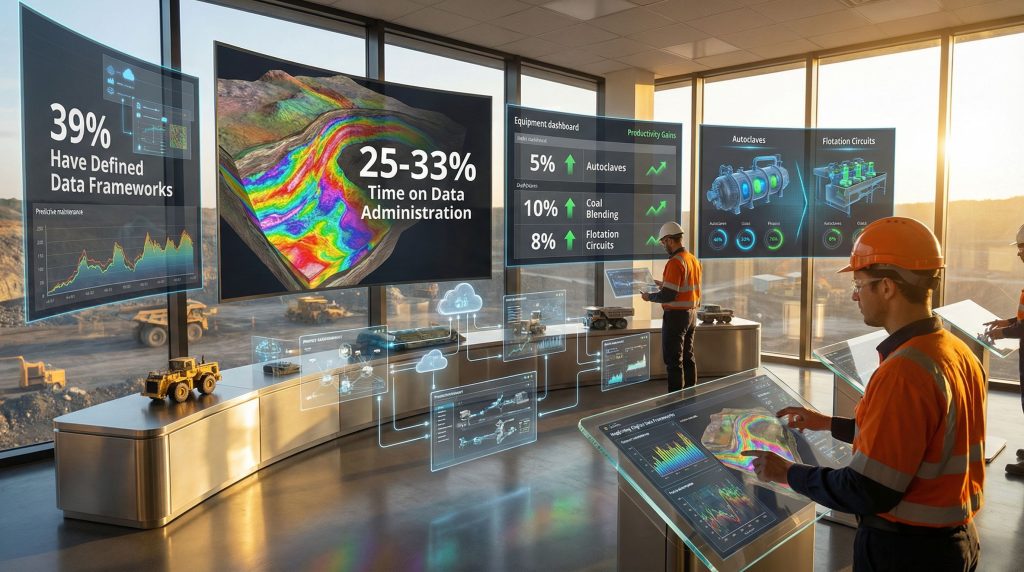
The financial and operational impact of inadequate data infrastructure manifests through multiple channels that collectively undermine mining operations' efficiency and profitability. Professional time allocation studies demonstrate that geoprofessionals spend 25-33% of their time on data administration tasks rather than geological interpretation, resource modeling, or strategic analysis work.
This time allocation crisis becomes more concerning when viewed against the backdrop of organizational readiness for data utilization. Industry surveys indicate that only 39% of mining organizations maintain defined data management frameworks, meaning that approximately 61% of operations manage their most critical asset without formalized governance structures or systematic approaches.
The productivity paradox emerges clearly when examining how mining professionals perceive data management importance versus their organizational capabilities. While 80% of mining geoprofessionals rate data management as highly or critically important to their operations, the absence of proper frameworks forces them into reactive, time-consuming data administration rather than proactive analysis and decision-making.
Statistical breakdowns of time allocation reveal specific inefficiencies across data tasks:
- Data entry and validation: 8-12 hours per week
- System integration and reconciliation: 4-6 hours per week
- Historical data retrieval and formatting: 3-5 hours per week
- Compliance documentation: 2-4 hours per week
- Quality assurance and error correction: 3-6 hours per week
Multi-Source Data Integration Challenges
Modern mining operations generate data streams from dozens of disparate sources, creating integration challenges that compound exponentially as operations scale. Furthermore, geological surveys, drilling programs, processing equipment, environmental monitoring systems, and financial platforms each operate within isolated software ecosystems that resist seamless information sharing.
The fragmentation problem extends beyond technical incompatibility to encompass data format standardisation, temporal synchronisation, and quality assurance across systems. When geological modelling software cannot efficiently access real-time processing data, or when historical drilling logs remain trapped in legacy database formats, organisations lose the integrated perspective necessary for optimal decision-making.
Historical data accessibility presents particularly acute challenges for mining operations where geological knowledge accumulated over decades becomes effectively invisible due to poor indexing, outdated storage formats, or inadequate documentation standards. Consequently, knowledge management systems frequently fail to capture the contextual information that makes historical data valuable for current operations.
The absence of a centralised single source of truth creates decision-making delays that cascade through operational planning, resource allocation, and strategic initiatives. When executives cannot access integrated dashboards showing geological, operational, and financial performance metrics simultaneously, response times to market conditions or operational challenges increase significantly.
What Are the Core Components of Effective Mining Data Frameworks?
Successful mining data frameworks require architectural components that address both current operational needs and future scalability requirements. The foundation must accommodate real-time data capture, advanced analytics capabilities, and seamless integration across existing technological infrastructure whilst positioning organisations for AI in mining and automation deployment.
Industry momentum toward AI implementation demonstrates the urgency of establishing robust data foundations. Current adoption indicators show that 51% of organisations now use or are considering AI applications, representing a 70% relative increase from 30% adoption rates two years prior. This acceleration in AI consideration reflects growing recognition that stronger data frameworks in mining serve as essential infrastructure for competitive advantage rather than merely operational efficiency tools.
Real-Time Data Capture Systems
Contemporary mining operations require data capture systems that operate continuously across multiple operational domains without human intervention. IoT sensor networks deployed throughout processing facilities, mining equipment, and environmental monitoring stations generate streams of operational data that enable predictive maintenance, quality optimisation, and safety enhancement.
5G-enabled connectivity infrastructure addresses the bandwidth and latency requirements for instant data transmission from remote mining sites to centralised processing and analysis systems. Ultra-low latency communication enables real-time adjustments to processing parameters, equipment operation, and safety protocols based on immediate environmental or operational changes.
Integration with existing SCADA and distributed control systems requires careful architectural planning to avoid disrupting critical operational processes whilst enabling enhanced data collection and analysis capabilities. Modern frameworks implement edge computing solutions that process data locally before transmission, reducing bandwidth requirements and improving response times for time-sensitive operations.
Digital Twin Technology Implementation
Digital twin platforms create virtual replicas of physical mining assets that enable scenario testing, optimisation modelling, and predictive analysis without disrupting actual operations. These systems integrate real-time sensor data with historical performance information to simulate operational changes and predict outcomes before implementation.
Digital Twin Applications in Mining Performance
| Process Area | Productivity Enhancement | Implementation Timeline | Key Benefits |
|---|---|---|---|
| Processing Equipment | 5-15% throughput increase | 6-12 months | Predictive maintenance, optimisation |
| Material Handling | 8-12% efficiency improvement | 3-8 months | Route optimisation, equipment utilisation |
| Environmental Systems | 10-20% monitoring enhancement | 4-10 months | Compliance automation, risk mitigation |
Virtual processing equipment models enable operators to test parameter changes, maintenance scheduling, and capacity adjustments without risking production disruptions or equipment damage. However, scenario testing capabilities allow mining engineers to evaluate the impacts of geological variations, equipment modifications, or operational procedure changes before implementation.
Production enhancement potential through digital twin deployment varies significantly based on operational complexity and implementation scope. Conservative estimates suggest 5-15% productivity improvements through predictive modelling, though specific results depend on baseline operational efficiency and data quality.
AI and Machine Learning Integration
Artificial intelligence applications in mining focus primarily on predictive maintenance, geological interpretation, and operational optimisation rather than replacement of human decision-making. Machine learning algorithms analyse equipment sensor data to identify failure patterns and maintenance requirements before breakdowns occur.
Ore grade estimation enhancement through pattern recognition enables more accurate resource modelling and mine planning. AI systems process geological survey data, historical drilling results, and geophysical measurements to identify mineralisation patterns that might escape traditional analytical approaches.
Resource allocation optimisation algorithms analyse historical performance data to recommend equipment deployment, workforce scheduling, and material handling strategies that maximise operational efficiency whilst minimising costs and environmental impacts.
How Do Advanced Analytics Transform Mining Decision-Making?
The transformation from reactive to predictive decision-making represents perhaps the most significant operational advancement enabled by robust data frameworks. Advanced analytics applications shift mining operations from responding to problems after they occur to preventing issues through pattern recognition and predictive modelling.
Predictive Equipment Maintenance Strategies
Predictive maintenance algorithms process continuous equipment sensor data to identify developing mechanical issues before they result in unplanned downtime. Vibration analysis, temperature monitoring, hydraulic pressure tracking, and electrical consumption patterns provide early warning indicators for component wear, lubrication degradation, and system malfunctions.
Implementation of predictive maintenance typically reduces unplanned equipment downtime by 20-30% compared to reactive maintenance approaches, though specific results vary based on equipment type, operating conditions, and historical maintenance practices. The transition from time-based to condition-based maintenance scheduling optimises both equipment availability and maintenance resource allocation.
Cost-benefit analysis frameworks for predictive maintenance must account for initial sensor installation costs, data processing infrastructure requirements, and staff training expenses against avoided downtime costs, extended equipment life, and optimised maintenance inventory management. Furthermore, sensor integration advancements continue to improve the accuracy and cost-effectiveness of these systems.
Integration challenges with existing maintenance management systems require careful planning to avoid creating duplicate data entry requirements or conflicting scheduling protocols. Successful implementations typically involve gradual expansion from pilot equipment groups to full operational coverage.
Geological Data Processing and Modelling
Advanced analytics applications in geological interpretation leverage machine learning algorithms to process complex subsurface datasets that exceed traditional analytical capabilities. 3D geological modelling benefits from pattern recognition algorithms that identify mineralisation trends, structural controls, and alteration patterns across large datasets.
Quantum computing applications for subsurface analysis remain largely experimental but offer potential for solving complex geological modelling problems that require enormous computational resources. Current implementations focus on research applications rather than routine operational deployment.
Machine learning enhancement of exploration success rates involves training algorithms on historical exploration datasets to identify geological signatures associated with successful discoveries. These systems process geochemical, geophysical, and geological datasets to prioritise exploration targets and optimise drilling programs.
Integration of LiDAR surveying, drilling logs, geophysical surveys, and geochemical analyses through unified analytical platforms enables comprehensive geological interpretation that incorporates multiple data types simultaneously rather than analysing them in isolation.
Operational Efficiency Optimisation
Real-time bottleneck identification systems monitor processing workflows continuously to detect capacity constraints, equipment inefficiencies, and material flow disruptions as they develop. Advanced analytics platforms analyse throughput data, equipment performance metrics, and material quality indicators to optimise processing parameters automatically.
Fuel consumption reduction strategies leverage operational data analysis to optimise equipment utilisation, route planning, and energy management across mining operations. Typical fuel efficiency improvements range from 10-20% through analytical optimisation, though specific results depend on baseline operational practices and equipment condition.
Material movement optimisation uses predictive routing algorithms that consider equipment availability, road conditions, weather forecasts, and processing schedules to minimise transportation costs whilst maintaining operational continuity. These systems frequently reduce material handling costs by 5-15% through improved logistics coordination.
What Role Does Data Governance Play in Mining Operations?
Data governance frameworks provide the organisational structure and procedural foundation necessary for effective data management across complex mining operations. Without formalised governance systems, even sophisticated technological infrastructure fails to deliver sustainable value due to inconsistent data quality, unclear ownership responsibilities, and inadequate security protocols.
Current industry statistics reveal significant governance gaps that undermine stronger data frameworks in mining effectiveness. With only 39% of mining organisations maintaining defined data management frameworks, the majority of operations lack the organisational structure necessary to support advanced analytics and AI deployment successfully.
Establishing Data Quality Standards
Standardised data collection protocols across departments ensure consistency and reliability in data assets that support both operational decision-making and regulatory compliance requirements. Quality standards must address data accuracy, completeness, timeliness, and relevance across geological, operational, environmental, and financial information systems.
Quality assurance frameworks for multi-source integration establish validation procedures that identify and correct data inconsistencies before they propagate through analytical systems. Automated quality checking algorithms can flag anomalous values, missing data elements, and format inconsistencies that require human review or system correction.
Chain of custody documentation protocols track data origin, transformation processes, and access history to maintain data integrity and support regulatory compliance requirements. Proper documentation becomes particularly critical when data supports resource estimation, environmental reporting, or safety compliance obligations.
Security and Access Management
Role-based access controls protect sensitive geological and operational information whilst enabling appropriate data sharing across organisational functions. Security frameworks must balance information accessibility for legitimate business purposes against protection of competitive data and compliance with regulatory requirements.
Cybersecurity frameworks specifically designed for operational technology environments address the unique vulnerabilities created by connected mining equipment and control systems. Unlike traditional IT security approaches, OT security must prioritise operational continuity whilst protecting against cyber threats that could disrupt production or compromise safety systems.
Data backup and disaster recovery protocols ensure business continuity in the event of system failures, cyber attacks, or natural disasters. Recovery procedures must address both historical data preservation and rapid restoration of operational data systems that support ongoing mining activities.
Regulatory Compliance and ESG Reporting
Automated environmental monitoring systems streamline compliance reporting by collecting, processing, and formatting environmental data according to regulatory requirements. Integration with corporate ESG dashboards enables real-time sustainability performance monitoring and automated regulatory submission preparation.
Real-time emissions tracking systems monitor air quality, water discharge, noise levels, and other environmental parameters continuously rather than through periodic manual sampling. According to the Canadian Mining Journal, automated compliance monitoring reduces administrative burden whilst improving environmental performance through immediate feedback on operational impacts.
ESG data integration platforms consolidate environmental, social, and governance metrics into unified reporting systems that support both regulatory compliance and corporate sustainability initiatives. Automated data collection and processing enable more frequent and accurate ESG reporting whilst reducing administrative costs.
Which Technologies Enable Seamless Data Integration?
Technology selection for mining data integration requires careful evaluation of scalability, reliability, and compatibility with existing operational systems. The chosen platforms must accommodate current data volumes whilst providing expansion capabilities for future growth and technological advancement.
Cloud-Based Data Platforms
Enterprise cloud platforms offer scalable data processing and storage capabilities that exceed the capacity and cost-effectiveness of traditional on-premise solutions. Microsoft Fabric and similar enterprise platforms provide integrated analytics, data warehousing, and machine learning capabilities through unified cloud environments.
Scalability considerations become critical as mining operations expand data collection through IoT deployment and increased analytical requirements. Cloud platforms offer elastic capacity scaling that adjusts to operational demands without requiring significant capital infrastructure investments.
Cost-effectiveness comparisons between cloud and on-premise solutions must consider both initial capital expenditures and ongoing operational expenses. Cloud platforms typically reduce infrastructure management requirements whilst providing access to advanced analytical tools that would be cost-prohibitive for individual mining operations to develop independently.
Laboratory Information Management Systems (LIMS)
Modern LIMS platforms automate sample tracking, analytical workflows, and quality control procedures that traditionally required significant manual administration. Integration capabilities with geological modelling software enable seamless transfer of analytical results into resource estimation and mine planning systems.
Automated sample tracking systems maintain chain of custody documentation from collection through analysis and reporting. Barcode or RFID tracking ensures sample integrity whilst reducing administrative workload and human error potential in sample management procedures.
Quality control and assay data management features ensure analytical accuracy through automated duplicate analysis scheduling, standard reference material insertion, and statistical quality assessment. Integration with external laboratory systems enables unified quality control monitoring across multiple analytical facilities.
Geospatial Data Management Tools
Specialised geological software platforms like Leapfrog Geo provide three-dimensional modelling capabilities specifically designed for subsurface geological interpretation and resource estimation. These tools integrate geological survey data, drilling logs, geophysical surveys, and analytical results into unified geological models.
Three-dimensional modelling capabilities enable visualisation and analysis of complex geological relationships that are difficult to interpret through traditional two-dimensional approaches. Interactive modelling environments allow geological staff to test different interpretations and assess their impacts on resource estimates and mine planning.
Integration with mine planning software ensures that geological models directly support operational planning, equipment scheduling, and production forecasting. Seamless data transfer between geological interpretation and mine planning reduces manual data handling and improves consistency between geological understanding and operational execution.
The next major ASX story will hit our subscribers first
How Can Mining Companies Overcome Data Framework Implementation Challenges?
Successful data framework implementation requires careful attention to organisational change management, technical integration challenges, and long-term sustainability planning. Mining companies must address both technological and human factors that influence adoption success and operational effectiveness.
Workforce Development and Training
Reskilling programs prepare operational staff for data-driven work environments that require analytical thinking and technological proficiency. Training initiatives must address both technical skills for system operation and analytical skills for data interpretation and decision-making.
Change management strategies acknowledge the significant cultural shift required to move from experience-based decision-making to data-driven approaches. Successful implementations typically involve gradual introduction of analytical tools alongside traditional methods rather than immediate replacement of established procedures.
Collaboration between IT and operational teams becomes essential for developing data systems that support actual operational requirements rather than theoretical analytical capabilities. For instance, mining technology transformation requires regular communication between technical and operational staff to ensure that data frameworks address real business needs and operational constraints.
Phased Implementation Strategies
Pilot project identification enables organisations to test data framework components on limited operational scope before enterprise-wide deployment. Successful pilots typically focus on specific operational areas where data improvements can demonstrate clear value and build organisational confidence in analytical approaches.
Success metrics for pilot implementations should include both technical performance indicators and business outcome measurements. Technical metrics might include data quality improvements, system reliability, and integration success, whilst business metrics focus on operational efficiency, cost reduction, or decision-making speed improvements.
Scalability planning ensures that pilot project architectures can expand to enterprise-wide deployment without requiring complete system replacement. Successful scaling requires careful attention to data volume growth, user capacity expansion, and integration with additional operational systems.
Budget allocation and ROI measurement frameworks establish financial parameters for implementation and provide accountability for investment returns. ROI calculations should include both direct cost savings from operational improvements and indirect benefits from enhanced decision-making capabilities and risk reduction.
Vendor Selection and Partnership Management
Evaluation criteria for data platform providers must consider long-term strategic alignment rather than only immediate functional requirements. Vendor assessment should include technological capabilities, industry experience, financial stability, and commitment to ongoing product development.
Integration capabilities with existing systems represent critical evaluation factors since most mining operations must maintain operational continuity during data framework implementation. Vendors should demonstrate successful integration experience with the specific operational systems deployed at the mining operation.
Long-term support and upgrade pathways ensure that data frameworks remain current with technological advancement and changing operational requirements. However, vendor relationships should include clear commitments to product development, technical support, and migration assistance for future system evolution.
What Are the Measurable Benefits of Stronger Data Frameworks?
Quantifying the benefits of robust stronger data frameworks in mining requires measurement across multiple operational domains including productivity, cost reduction, risk mitigation, and competitive positioning. Successful implementations typically demonstrate value through multiple complementary improvements rather than single dramatic enhancements.
Companies implementing comprehensive data frameworks report average productivity increases of 10-20% within the first year of deployment, with additional improvements continuing through the second and third years of operation.
Productivity and Efficiency Gains
Throughput optimisation through real-time process monitoring enables continuous adjustment of operational parameters to maintain optimal performance despite variations in feed material quality, equipment condition, or environmental factors. Automated process control based on data analytics typically improves processing efficiency by 5-15% compared to manual operational approaches.
Reduced material waste through predictive quality control allows operations to adjust processing parameters before production of off-specification material occurs. Early detection of quality variations through continuous monitoring typically reduces waste generation by 10-25% whilst improving product consistency.
Enhanced resource recovery rates result from optimised processing conditions that maximise extraction efficiency for valuable minerals. Advanced analytics applications frequently improve recovery rates by 2-8% through better understanding of metallurgical relationships and optimal operating parameter identification.
Cost Reduction and Risk Mitigation
Maintenance cost reductions through predictive strategies typically range from 15-30% compared to reactive maintenance approaches. Predictive maintenance enables optimal timing of maintenance activities, reduces emergency repair requirements, and extends equipment service life through better operational management.
Safety incident prevention through early warning systems provides both human and financial benefits through reduced accident rates and associated costs. Advanced monitoring systems can detect developing safety hazards before they result in incidents, potentially reducing safety-related costs by 20-40%.
Insurance premium reductions become available to operations that demonstrate improved risk profiles through enhanced monitoring, predictive maintenance, and safety systems. Insurance providers increasingly recognise the risk reduction benefits of comprehensive data frameworks and adjust premiums accordingly.
Competitive Advantage and Market Position
Faster decision-making capabilities enable mining operations to respond more quickly to market conditions, operational challenges, and strategic opportunities. Data-driven decision-making typically reduces decision cycle times by 30-50% whilst improving decision quality through access to comprehensive analytical information.
Enhanced ESG performance attracts investment from funds focused on sustainable mining practices and environmental responsibility. Strong data frameworks enable accurate ESG reporting and demonstrate commitment to operational transparency and environmental stewardship.
Improved operational transparency for stakeholders builds confidence among investors, regulators, and community members through demonstrable performance monitoring and reporting capabilities. Furthermore, as noted by the AusIMM, transparent operations typically experience fewer regulatory challenges and stronger community relationships.
What Does the Future Hold for Mining Data Management?
The trajectory of mining data management points toward increasing integration of artificial intelligence, quantum computing capabilities, and blockchain applications that will transform how mining operations collect, process, and utilise information for competitive advantage.
Emerging Technology Integration
Artificial intelligence advancement in geological interpretation promises to revolutionise mineral exploration and resource estimation through pattern recognition capabilities that exceed human analytical capacity. AI systems will likely identify geological relationships and mineralisation patterns that traditional analysis methods cannot detect.
Quantum computing applications for complex subsurface modelling may enable solution of geological problems that currently require simplified assumptions due to computational limitations. Quantum algorithms could process the massive datasets required for comprehensive three-dimensional geological modelling at unprecedented scale and detail.
Blockchain integration for supply chain transparency addresses growing demands for mineral traceability and ethical sourcing verification. Blockchain systems can provide immutable records of mineral origin, processing history, and custody transfer that support responsible sourcing initiatives and regulatory compliance.
Industry Standardisation Trends
Common data formats and exchange protocols will likely emerge as industry standards mature and interoperability becomes increasingly important. These industry evolution trends reduce integration costs and complexity whilst enabling more effective collaboration across mining operations and service providers.
Interoperability standards across equipment manufacturers address current challenges with proprietary data formats and communication protocols that limit system integration flexibility. Industry-wide standards development will likely accelerate as operations demand greater flexibility in vendor selection and system integration.
Regulatory framework evolution for data management reflects growing government interest in mining sector transparency, environmental monitoring, and safety oversight. Future regulations will likely mandate specific data collection, retention, and reporting requirements that influence technology selection and implementation approaches.
Sustainability and Environmental Monitoring
Real-time environmental impact assessment systems will enable continuous monitoring of operational environmental effects rather than periodic assessment through manual sampling and analysis. Continuous monitoring provides immediate feedback for operational adjustments that minimise environmental impacts.
Carbon footprint tracking and optimisation systems address growing focus on greenhouse gas emissions reduction across industrial operations. Advanced data systems can monitor energy consumption, equipment efficiency, and process optimisation opportunities that reduce carbon emissions whilst maintaining operational effectiveness.
Water usage monitoring and conservation strategies benefit from real-time data collection and analysis that identifies optimisation opportunities and ensures compliance with environmental regulations. Water management optimisation typically reduces consumption by 15-30% through better understanding of usage patterns and conservation opportunities.
Frequently Asked Questions About Mining Data Frameworks
Implementation planning for mining data frameworks requires careful consideration of organisational readiness, technical requirements, and investment parameters that influence success probability and return on investment.
How Long Does Data Framework Implementation Take?
Timeline variations for data framework implementation depend significantly on operational complexity, existing system integration requirements, and organisational change management factors. Simple implementations focusing on specific operational areas typically require 6-12 months, whilst comprehensive enterprise-wide deployments may extend to 18-36 months.
Critical success factors for accelerated deployment include strong executive sponsorship, clear project scope definition, adequate resource allocation, and effective change management. Organisations with established project management capabilities and technical expertise typically achieve faster implementation timelines.
Common implementation pitfalls include underestimating integration complexity, inadequate staff training, unclear success criteria, and insufficient attention to change management. Successful implementations typically involve experienced implementation partners and careful attention to organisational readiness factors.
What Investment Level Is Required for Effective Data Frameworks?
Capital expenditure considerations vary significantly based on operation size, existing infrastructure, and implementation scope. Small to medium operations typically require initial investments of $500,000 to $2 million, whilst large operations may invest $5 million to $20 million for comprehensive frameworks.
Operating expense implications include ongoing software licensing, cloud services, technical support, and staff training costs. Annual operating expenses typically range from 15-25% of initial capital investment, though cloud-based solutions may shift costs from capital to operational categories.
Return on investment calculation methodologies should consider both direct cost savings from operational improvements and indirect benefits including risk reduction, improved decision-making, and competitive advantage. Typical ROI periods range from 18 months to 4 years depending on implementation scope and operational improvements achieved.
How Do Data Frameworks Support Remote Operations?
Connectivity requirements for remote mining sites represent critical infrastructure considerations for data framework deployment. Satellite communication, cellular networks, and private wireless systems must provide sufficient bandwidth and reliability to support real-time data transmission and remote system monitoring.
Edge computing applications enable local data processing that reduces bandwidth requirements whilst providing rapid response capabilities for time-sensitive operational decisions. Edge systems can process sensor data locally and transmit only analysed results and alerts to centralised systems.
Satellite communication integration strategies address connectivity challenges in remote locations where terrestrial communication infrastructure is unavailable or unreliable. Modern satellite systems provide sufficient bandwidth for most data framework requirements, though costs and latency considerations influence system design decisions.
Looking to Capitalise on the Next Major ASX Discovery?
Mining operations with stronger data frameworks consistently outperform competitors in identifying and evaluating new opportunities as they emerge. Discovery Alert's proprietary Discovery IQ model delivers instant notifications on significant ASX mineral discoveries, empowering subscribers with actionable insights precisely when data-driven decisions matter most. Begin your 14-day free trial today to secure your competitive advantage in an increasingly information-driven mining sector.