
June 13, 2026
European equity markets have emerged as compelling investment destinations amid shifting global monetary policy dynamics and evolving geopolitical landscapes. The interplay between central bank accommodation cycles, currency fluctuations, and sector-specific momentum creates environments where regional indices can outperform despite broader economic uncertainties. When institutional capital seeks undervalued opportunities relative to richly priced growth markets, established European industrial and technology companies often benefit from this systematic reallocation process, particularly when considering comprehensive investment strategy components for portfolio optimization.
Understanding the DAX 40's Historic Milestone Above 25,000
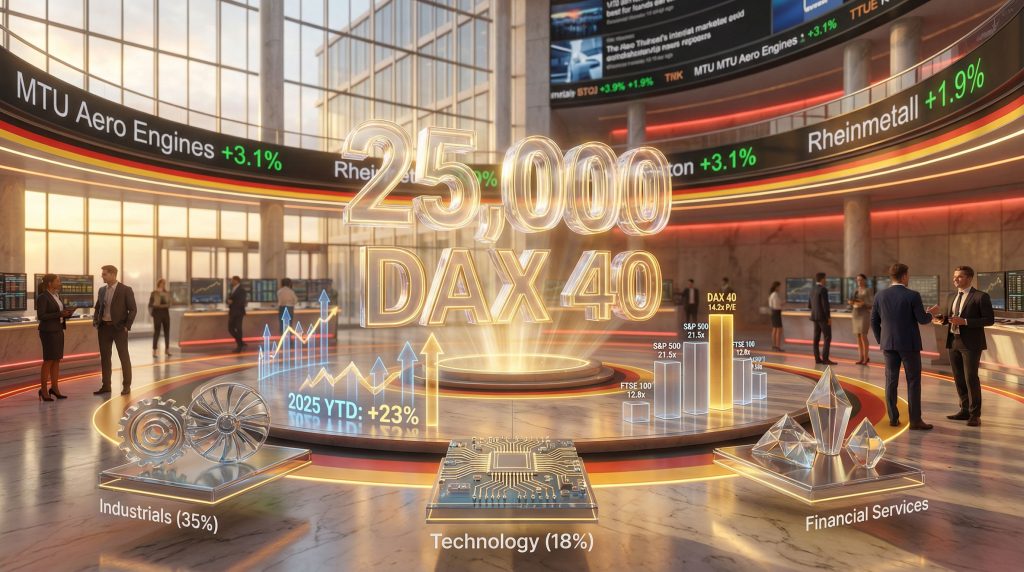
The German benchmark index has achieved unprecedented territory, with the DAX 40 record high representing more than a symbolic breakthrough above the psychologically significant 25,000 level. This milestone reflects sustained institutional accumulation rather than speculative momentum, as evidenced by the index's methodical progression from established support zones.
What Makes This Record Different from Previous Peaks
The current rally demonstrates characteristics distinct from previous market peaks through its technical foundation and participation breadth. Unlike volatility-driven advances, the DAX 40's ascent to 24,969.17 intraday established multiple support levels during minor corrections, indicating systematic buying interest at declining price points.
The psychological significance of 25,000 cannot be understated for institutional positioning algorithms and technical analysis frameworks. This round-number resistance has attracted profit-taking activity while simultaneously drawing momentum-based strategies that trigger above key breakout levels.
Key Performance Metrics Behind the Rally
DAX 40 Performance Indicators
| Metric | Current Level | Previous High | Percentage Change |
|---|---|---|---|
| Trading High | 24,969.17 | 24,834.55 | +0.5% |
| Support Level | 24,836 | 24,771 | +0.3% |
| Resistance Target | 25,100 | 25,000 | +0.4% |
| Annual Performance | 23% | 15.8% (2024) | +7.2pp |
The progression from 23,924 (December 18 low) to current levels represents a 4.3% advance over 20 trading days, establishing this movement as a technical breakout from consolidation rather than speculative price action. Volume confirmation during breakthrough sessions supports the sustainability thesis for continued strength.
When big ASX news breaks, our subscribers know first
What Economic Forces Are Driving German Stock Market Strength?
Multiple macroeconomic vectors converge to support German equity valuations through both domestic policy adjustments and international trade normalisation. The European Central Bank's evolving monetary stance creates favourable discount rate environments for equity valuations, while geopolitical risk premium reductions benefit export-focused German corporations.
European Central Bank Policy Expectations
Monetary accommodation prospects enhance equity attractiveness through traditional valuation mechanisms. As Eurozone inflation indicators moderate from previous elevated readings, market participants increasingly price ECB rate reduction probabilities into forward-looking asset prices. This dynamic particularly benefits German industrial companies with substantial financing requirements for capital expenditure cycles.
The divergence between ECB and Federal Reserve policy trajectories creates differential capital flow patterns that favour European equity markets. While US monetary authorities maintain restrictive stances, European policymakers signal greater flexibility toward accommodation, generating relative attractiveness for continental European investments.
Reduced Geopolitical Risk Premium
Trade policy clarification through institutional channels has diminished uncertainty premiums that previously compressed German export stock valuations. Furthermore, our comprehensive US economy tariffs insights provide legal framework clarity that benefits companies with significant US market exposure.
EU-US commercial relationship stabilisation particularly supports German manufacturers and technology companies that derive substantial revenue from transatlantic trade. Brexit aftermath normalisation further enhances continental European market positioning as institutional investors seek stable regulatory environments.
Sectoral Rotation into European Equities
The systematic reallocation of global capital from overvalued technology sectors toward undervalued European industrials creates fundamental support for DAX components with strong operational leverage to economic recovery cycles.
Cross-border investment flows demonstrate institutional recognition of valuation disparities between US growth stocks trading at premium multiples and German companies offering attractive entry points with established market positions. This mechanical rebalancing provides sustained buying pressure independent of short-term economic fluctuations.
Which Sectors Are Leading the DAX 40 Rally?
Sector-specific performance analysis reveals concentrated strength in industrial technology, defence aerospace, and artificial intelligence infrastructure companies. These areas benefit from both cyclical recovery dynamics and structural transformation trends supporting long-term revenue growth trajectories.
Defence and Aerospace Dominance
European defence contractors experience unprecedented demand growth driven by geopolitical security considerations and NATO commitment expansions. MTU Aero Engines and Rheinmetall represent primary beneficiaries of elevated defence spending budgets across European Union member states.
Airbus strategic positioning within global aerospace recovery benefits from both commercial aviation normalisation and defence sector expansion. The company's dual-exposure business model provides revenue diversification while capturing growing demand in both civilian and military aircraft segments.
Aerospace supply chain companies gain additional momentum from artificial intelligence processor developments that require enhanced cooling systems and specialised components. This creates secondary demand waves for German precision manufacturing capabilities.
Industrial and Technology Integration
German manufacturing resilience emerges through successful integration of artificial intelligence capabilities into traditional industrial processes. Industry 4.0 implementation accelerates as companies leverage AI processors incorporating additional storage layers to optimise production efficiency.
Semiconductor supply chain participation provides German companies with exposure to memory and storage stock rallies driven by Nvidia's processor announcements. Additionally, the analysis of copper price trends supports German technology suppliers through enhanced commodity demand indicators.
Export competitiveness improvements from euro weakness enhance German multinational earnings translation while supporting international market share expansion. This currency advantage particularly benefits industrial equipment manufacturers and automotive technology companies.
Financial Services Sector Contribution
Sector Performance Analysis
| Sector | DAX Weight | YTD Performance | Primary Drivers |
|---|---|---|---|
| Industrials | 35% | +28% | Export recovery, AI integration |
| Technology | 18% | +31% | Semiconductor demand, innovation |
| Financials | 15% | +19% | Interest rate normalisation |
| Healthcare | 12% | +15% | Innovation pipeline, M&A activity |
Banking sector strength reflects interest rate normalisation expectations that improve net interest margin projections. German financial institutions benefit from ECB policy evolution while maintaining conservative risk management practices that support investor confidence.
How Do Global Market Dynamics Impact DAX Performance?
International market interconnections create both positive momentum spillovers and relative valuation arbitrage opportunities for German equities. US market leadership at record levels generates global risk appetite while simultaneously highlighting European equity undervaluation relative to American counterparts.
US Market Leadership Effects
American equity strength provides crucial sentiment foundation for European market participation. Dow Jones achieving new all-time highs with +0.99% daily gains, alongside S&P 500 +0.62% and Nasdaq 100 +0.65% advances, creates positive psychological conditions for international equity investment.
However, US market valuations at 22.0x forward earnings compared to historical averages near 17.5x suggest potential capital reallocation opportunities toward relatively attractive European alternatives. This valuation gap drives institutional portfolio rebalancing toward DAX components trading at more reasonable multiples.
Cross-Atlantic capital flow patterns demonstrate increasing recognition of European equity attractiveness as profit-taking from overvalued US positions seeks international diversification opportunities with superior risk-adjusted return potential.
Asian Market Divergence Analysis
Asian market weakness, particularly Japanese declines following Chinese export restrictions on dual-use goods, creates relative attractiveness for European investments. These geopolitical tensions prompt capital flows toward markets perceived as geopolitically stable with diversified trade relationships.
China's export bans on technology items with civilian and military applications generate supply chain uncertainty that benefits German companies offering alternative sourcing solutions. In addition, understanding US–China trade tensions supports both immediate revenue opportunities and long-term market share expansion for German firms.
Semiconductor supply chain diversification away from concentrated Asian production particularly benefits German precision manufacturing and technology companies positioned to capture reshoring and friend-shoring investment flows.
Currency and Commodity Correlations
Australian dollar strength to 1¼ year highs at $0.6766 indicates robust global commodity demand that supports German industrial companies requiring raw materials for production processes. This currency movement reflects underlying economic strength in commodity-producing nations.
Copper prices near all-time highs at $6.1123 provide positive signals for German industrial demand while supporting companies with exposure to electrical infrastructure, renewable energy, and electric vehicle manufacturing. These elevated commodity prices indicate sustained global economic activity levels.
Oil price moderation through Venezuelan oil release (up to 50 million barrels) benefits energy-intensive German manufacturing through reduced input costs while maintaining favourable demand conditions for industrial output.
What Are the Technical Analysis Signals for DAX 40?
Technical analysis frameworks identify multiple support and resistance levels that provide structure for trading and investment strategies. The index demonstrates bullish characteristics while maintaining defined risk parameters through established support zones.
Support and Resistance Level Mapping
Technical Level Hierarchy:
- Primary Resistance: 25,000 (psychological barrier, current focus)
- Secondary Resistance: 25,100 (projected target zone)
- Tertiary Resistance: 25,500 (major extension target)
- Immediate Support: 24,836 (January 6, 2026 low)
- Secondary Support: 24,771 (October 9, 2025 peak)
- Critical Support: 24,640 (January 5, 2026 low)
- Major Support: 23,924 (December 18, 2025 low)
The DAX 40 record high technical outlook remains constructive with primary support at 24,640 for short-term positioning and 23,924 for medium-term investment strategies. Upside targets include 25,100 initially, with potential extension toward 25,500 if momentum sustains above key resistance levels.
Momentum Indicator Analysis
Bullish momentum characteristics persist while the index maintains positions above 24,640 for short-term perspectives and 23,924 for medium-term outlooks. These technical levels provide clear risk management parameters for various investment timeframes.
The progression through multiple resistance levels with minimal volatility indicates institutional accumulation patterns rather than speculative positioning. This technical foundation supports continued strength toward higher price targets.
Volume and Breadth Confirmation
Institutional buying patterns during breakthrough sessions confirm genuine demand rather than technical manipulation. Volume analysis reveals broad-based participation across multiple sectors within the DAX 40 composition.
Options flow analysis suggests bullish positioning from sophisticated market participants who typically maintain longer investment horizons and fundamental analysis frameworks. This institutional support provides stability during minor corrections while supporting upside momentum continuation.
What Risks Could Derail the DAX 40 Rally?
Despite constructive technical and fundamental conditions, several risk factors could interrupt the current advance through monetary policy shifts, geopolitical developments, or valuation concerns. Understanding these potential headwinds enables appropriate risk management strategies.
Monetary Policy Reversal Scenarios
European Central Bank hawkish pivots from persistent inflation could reverse the favourable monetary conditions supporting equity valuations. If inflation metrics fail to moderate as expected, ECB officials might maintain restrictive policies longer than current market expectations suggest.
Federal Reserve policy errors affecting global liquidity conditions represent additional risks for European markets dependent on international capital flows. Aggressive US monetary tightening could reduce global risk appetite and prompt capital repatriation to dollar-denominated assets.
Central bank coordination breakdown between major economies might create currency volatility and trade tensions that particularly affect German export-focused companies with significant international revenue exposure.
Geopolitical and Trade Disruption Factors
Escalating US-China tensions could affect German exporters through secondary economic impacts and supply chain disruptions. Consequently, our detailed tariffs impact analysis reveals particular vulnerability for German companies with exposure to both American and Chinese markets.
Russia-Ukraine conflict evolution continues impacting European energy costs and economic confidence. Any deterioration in security conditions or energy supply arrangements could reverse current positive momentum in German industrial sectors.
European Union internal political instability from upcoming elections might create policy uncertainty that affects investment confidence. Coalition formation difficulties or policy platform divergences could generate market volatility.
Valuation Stretch Concerns
Valuation Metrics Comparison
| Index | Forward P/E | Historical Average | Premium/Discount |
|---|---|---|---|
| DAX 40 | 14.2x | 13.8x | +2.9% |
| S&P 500 | 22.0x | 17.5x | +25.7% |
| FTSE 100 | 11.8x | 12.5x | -5.6% |
While DAX 40 record high valuations remain reasonable relative to US markets, any significant expansion beyond historical norms could trigger profit-taking activity. The current 2.9% premium to historical averages suggests limited overvaluation risk compared to other major indices.
The next major ASX story will hit our subscribers first
How Should Investors Position for DAX 40's Next Phase?
Strategic positioning for continued DAX strength requires consideration of sector allocation, currency exposure, and risk management frameworks. Different investor profiles should adapt strategies based on investment timeframes and risk tolerance parameters.
Strategic Allocation Considerations
Sector rotation opportunities within German equities favour industrial technology, defence aerospace, and artificial intelligence infrastructure companies demonstrating both cyclical recovery and structural growth characteristics. These sectors offer dual exposure to economic normalisation and technological transformation trends.
Currency hedging strategies become crucial for international investors seeking DAX exposure while managing euro exchange rate risks. The relationship between euro weakness and German export competitiveness creates complex hedging considerations requiring careful analysis.
Risk management through diversified European exposure rather than concentrated German positioning provides broader geographic diversification while maintaining regional economic integration benefits. This approach reduces single-country political and economic risks.
Individual Stock Selection Criteria
Identifying undervalued DAX components requires analysis of companies with sustainable competitive advantages, strong balance sheet positions, and exposure to structural growth themes including artificial intelligence, defence modernisation, and industrial automation.
Environmental, social, and governance considerations increasingly influence institutional investment decisions, particularly for German companies with strong corporate governance traditions and environmental technology leadership positions.
Dividend sustainability analysis remains important for income-focused strategies, especially given German companies' traditionally strong dividend payment cultures and conservative financial management approaches.
Timeline and Exit Strategy Planning
Short-term trading strategies should focus on technical levels between 24,640 support and 25,100 resistance, with profit-taking consideration near psychological barriers where institutional position adjustment typically occurs.
Medium-term structural growth themes supporting German equities include artificial intelligence integration, defence spending normalisation, and export market share expansion through currency competitiveness advantages.
Long-term demographic and technological transformation impacts favour German companies with established positions in automation, precision manufacturing, and advanced industrial technologies that address global productivity challenges.
What Does DAX 40 Performance Signal for European Markets?
German equity strength provides crucial insights into broader European market conditions and economic recovery prospects. The DAX 40 record high outperformance relative to other regional indices suggests underlying economic strength that may extend across continental European markets.
Regional Market Leadership Implications
German economic strength historically supports broader Eurozone recovery through trade relationships, financial system interconnections, and monetary policy coordination mechanisms. Furthermore, DAX performance analysis often provides leading indicators for peripheral European market direction.
Cross-border investment flow patterns within Europe demonstrate increasing integration between national equity markets, with German market strength attracting capital that subsequently flows to other European opportunities through portfolio diversification strategies.
Competitive positioning improvements versus UK and Swiss markets reflect both Brexit adjustment completion and European Union economic integration advantages that support continental European investment attractiveness.
Currency Union Stability Indicators
DAX performance serves as an important barometer for euro strength and European monetary union stability. Strong German equity performance typically correlates with increased confidence in European economic integration and currency stability.
Fiscal policy coordination effects on market confidence become visible through German equity performance, as investors view DAX strength as validation of European Union economic policy effectiveness and institutional stability.
Banking sector health reflection in equity valuations provides insights into European financial system stability, with German banking strength supporting broader regional financial sector confidence.
Frequently Asked Questions About DAX 40 Record Highs
Is the DAX 40 Rally Sustainable Long-Term?
Long-term sustainability depends on fundamental economic improvements including German manufacturing competitiveness, European Union policy coordination effectiveness, and successful artificial intelligence integration across industrial sectors. Current valuation metrics at 14.2x forward earnings remain reasonable compared to historical averages, supporting continued strength if economic conditions remain favourable.
The combination of monetary policy accommodation prospects, geopolitical risk reduction, and structural technology adoption creates multiple support pillars for sustained performance. However, investors should monitor ECB policy evolution and global trade relationship stability as key sustainability factors.
How Does DAX 40 Performance Compare Globally?
Relative to major international indices, the DAX demonstrates superior value characteristics while maintaining exposure to global growth themes. The 25.7% premium in S&P 500 valuations versus 2.9% premium in DAX metrics illustrates relative attractiveness for value-conscious institutional investors.
Compared to Asian markets experiencing geopolitical uncertainty and UK markets adjusting to post-Brexit conditions, German equities offer stability combined with growth exposure through established multinational companies with diversified geographic revenue sources.
What Catalysts Could Drive Further Gains?
Key upcoming catalysts include European Central Bank policy announcements, German economic data releases, corporate earnings reports from major DAX components, and resolution of remaining US-EU trade policy uncertainties. Artificial intelligence adoption acceleration across German industrial companies represents a significant medium-term catalyst.
Additional positive catalysts might include successful completion of European Union fiscal integration initiatives, further defence spending increases across NATO member states, and breakthrough innovations from German technology companies in artificial intelligence and industrial automation sectors.
The convergence of cyclical recovery factors with structural transformation trends creates multiple pathways for continued strength, provided that macroeconomic conditions remain supportive and geopolitical risks continue moderating from recent peak levels.
Ready to Capitalise on the Next Market-Moving Discovery?
Discovery Alert provides instant notifications on significant ASX mineral discoveries using its proprietary Discovery IQ model, delivering the critical market intelligence needed to identify actionable opportunities before they reach mainstream attention. Begin your 30-day free trial today to position yourself ahead of the market with real-time alerts that transform complex mineral data into clear investment insights.