June 13, 2026
The Midstream Gap Nobody Talks About: North America's Missing Nickel Refinery
Battery supply chain conversations in North America tend to cluster around two poles: the mines pulling critical minerals from the earth, and the gigafactories assembling cells into finished battery packs. The territory between those two endpoints — the refining and processing stage that converts raw or intermediate materials into battery-grade chemical compounds — receives comparatively little attention. Yet it is precisely this midstream segment where the most consequential supply chain vulnerabilities have taken root.
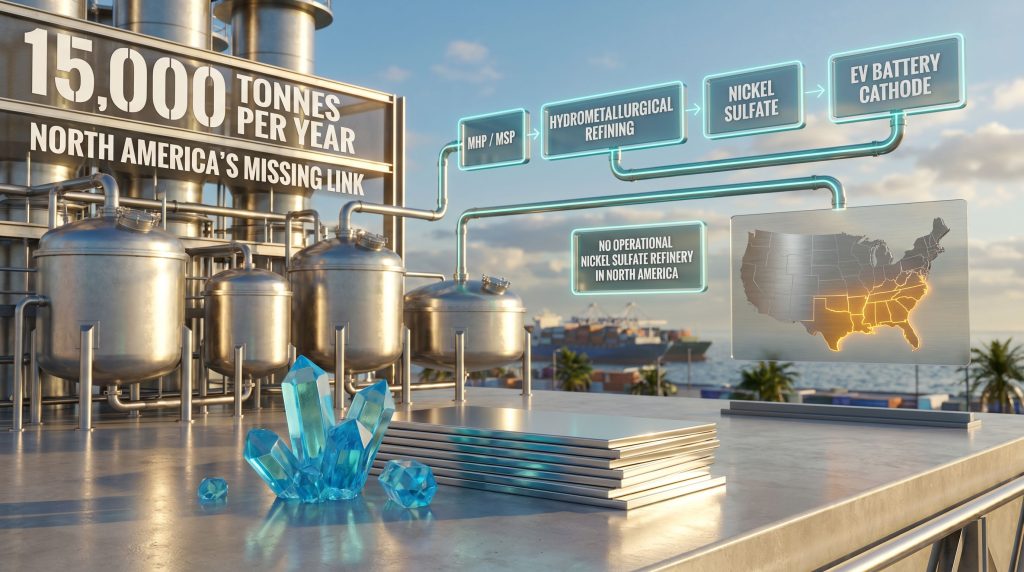
Nowhere is this more visible than in nickel. Despite hosting significant nickel mining operations, major electric vehicle assembly plants, and a rapidly expanding battery cell manufacturing corridor, North America currently operates zero nickel sulfate refineries. Every tonne of battery-grade nickel sulfate consumed by North American cathode producers must travel through offshore refining capacity, the overwhelming majority of which is concentrated in Asia.
That structural reality is now attracting serious engineering attention. Electra Battery Materials Corp. has engaged external engineering consultants to evaluate what building a domestic nickel refinery in the southeastern United States would actually require, placing the Electra U.S. nickel refinery concept at the centre of a broader effort to reconstruct the North American battery materials supply chain from the inside out.
When big ASX news breaks, our subscribers know first
Why Nickel Sulfate Is Not the Same as Nickel Ore
Understanding the significance of this project requires separating nickel the mineral from nickel the battery input. Nickel ore extracted from the ground is geologically useful but commercially incomplete. Before it can enter a lithium-ion battery cathode, it must be transformed into nickel sulfate, a soluble crystalline compound with tightly controlled chemical specifications that cathode active material producers require for consistency in cell performance.
This transformation is not trivial. It demands a series of precise hydrometallurgical steps, and the chemistry involved is sensitive to impurity levels that would be invisible in industrial-grade nickel but catastrophic in a battery cell. Battery-grade nickel sulfate must meet specifications for purity that standard metallurgical nickel cannot satisfy without additional refinement.
Nickel's strategic importance extends well beyond batteries. The metal serves dual roles across multiple industries:
| End-Use Application | Nickel Form Required | Strategic Sector |
|---|---|---|
| EV battery cathode materials | Nickel sulfate | Clean energy / automotive |
| Defense and aerospace components | Nickel metal | National security |
| Stainless steel and superalloys | Nickel metal | Industrial manufacturing |
| Energy infrastructure components | Nickel metal | Power and grid systems |
This dual-use nature makes nickel categorically different from more single-purpose battery materials. A refinery capable of producing both nickel sulfate and nickel metal serves not just the EV industry, but simultaneously addresses supply chain requirements across defence procurement and advanced industrial manufacturing.
Where Global Nickel Refining Capacity Actually Sits
The global nickel refining landscape is geographically concentrated in ways that create systemic risk for Western supply chains. The Indonesian nickel industry has become the dominant force in nickel processing through its aggressive development of high-pressure acid leach (HPAL) operations and nickel pig iron production, while China controls the downstream refining infrastructure that converts intermediate Indonesian output into battery-grade compounds.
According to the U.S. Geological Survey, China accounts for the majority of global nickel refining capacity, processing not only domestic production but substantial volumes of intermediate material sourced from Indonesian and Philippine operations.
This concentration means that even nickel mined outside China frequently passes through Chinese refining before reaching Western battery manufacturers. The midstream processing step has become, in effect, a chokepoint that geographic diversification of mining alone cannot resolve.
The U.S. federal government has formally recognised domestic nickel refining capacity as a critical supply chain vulnerability. Policy frameworks have increasingly directed attention toward closing this midstream processing gap, though no specific government funding or project designation has been confirmed for the Electra U.S. nickel refinery at this stage of engineering evaluation.
Electra's Cobalt Refinery: The Technical Blueprint for Nickel
Electra Battery Materials did not arrive at nickel refining arbitrarily. The company has spent years developing what is positioned to become the only cobalt sulfate refinery of its kind in North America, located in northern Ontario, with commissioning targeted for Q2 2027. That project has generated something arguably more valuable than the facility itself: an institutional body of knowledge about the engineering, permitting, feedstock logistics, and commercial contracting required to bring a critical minerals refinery into production in a Western jurisdiction.
Cobalt sulfate and nickel sulfate share meaningful process chemistry. Both are produced through hydrometallurgical refining pathways. Both serve lithium-ion battery cathode applications. Both rely on intermediate feedstocks that must meet specific chemical profiles before refining can commence. The technical and operational learning curve that Electra has climbed through its cobalt refinery development translates directly into a more credible and de-risked starting point for evaluating nickel.
Electra's Cobalt Refinery: Key Development Parameters
- Location: Northern Ontario, Canada
- Product: Battery-grade cobalt sulfate for lithium-ion cathode applications
- Strategic position: Targeting status as the only facility of its kind in North America upon commissioning
- Expected commissioning: Q2 2027
- Relevance to nickel study: Provides validated engineering methodology and process chemistry expertise applicable to hydrometallurgical nickel refining
Electra's CEO Trent Mell has indicated that as the company approaches a key construction milestone on its cobalt sulfate refinery, the expertise developed through that project's design and construction process provides a strong foundation for evaluating nickel refining opportunities. This framing is significant: the nickel study is not a speculative pivot but a sequential extension of capabilities already being built.
Inside the Proposed Facility: Production Targets and Processing Technology
The engineering study is structured around a target output of approximately 15,000 metric tonnes per year of nickel sulfate and nickel metal, alongside 1,000 metric tonnes per year of cobalt metal as a co-product. The cobalt metal co-product stream reflects the chemical reality of processing nickel intermediate feedstocks, which typically carry cobalt as an associated element requiring separation and recovery.
The proposed processing route is conventional hydrometallurgical refining, a well-established technology pathway with documented capital and operating cost profiles. Here is how the process would function in practice:
- Feedstock intake and characterisation — Intermediate nickel material arrives by port and is sampled against chemical specifications before entering the process circuit.
- Leaching — The feedstock is dissolved in an acidic solution, liberating nickel and cobalt ions into solution while leaving gangue minerals behind.
- Purification — Sequential solvent extraction and ion exchange steps strip out metallic impurities including iron, manganese, zinc, and magnesium that would compromise product quality.
- Product separation — Purified nickel and cobalt streams are separated through selective precipitation or solvent extraction circuits, allowing each metal to be processed independently.
- Crystallisation or electrowinning — Nickel sulfate is produced through controlled crystallisation of the purified nickel solution. Nickel metal is produced through electrowinning, where electrical current plates nickel onto cathode blanks. Cobalt metal follows a parallel electrowinning circuit.
- Product finishing and quality assurance — Final products are tested against battery-grade or industrial-grade specifications before packaging and dispatch.
The selection of conventional hydrometallurgy over more novel processing routes is itself a strategic decision. More experimental technologies may offer theoretical efficiency advantages, but they introduce engineering risk, extended timelines, and uncertain capital cost profiles that complicate project financing. Conventional hydrometallurgy, furthermore, has been bankable for decades.
MHP and MSP: The Feedstocks That Make Near-Term Development Possible
One of the less-discussed but commercially critical aspects of the proposed Electra U.S. nickel refinery is its feedstock strategy. Rather than depending on a single upstream mining partner or a specific North American deposit, the study is centred on mixed hydroxide precipitate (MHP) and mixed sulfide precipitate (MSP), intermediate nickel products produced at mining and processing operations globally.
| Feedstock Type | Primary Source | Approximate Nickel Content | Processing Route |
|---|---|---|---|
| Mixed Hydroxide Precipitate (MHP) | Global laterite HPAL operations | ~35-40% Ni | Hydrometallurgical refining |
| Mixed Sulfide Precipitate (MSP) | Global sulfide processing operations | ~55-65% Ni | Hydrometallurgical refining |
| Battery black mass (future) | Domestic EV battery recycling | Variable, dependent on chemistry | Recycling-integrated refining |
| North American mine concentrate (future) | Domestic sulfide deposits | Variable | Direct processing pathway |
The decision to anchor the near-term feedstock strategy around globally sourced MHP and MSP is commercially astute. Indonesia's HPAL buildout has generated substantial MHP supply that is currently routed predominantly through Chinese refiners. A U.S.-based refinery with port access could compete for that intermediate material supply, effectively inserting North American processing capacity into an existing global trade flow rather than waiting for domestic upstream supply to develop.
The long-term pathway envisions North American mining production and domestic battery recycling supplementing or replacing imported intermediate feedstocks over time, but the near-term economics do not depend on that transition occurring on any particular schedule.
This feedstock flexibility also reduces concentration risk during ramp-up — a period when refinery projects are most vulnerable to supply disruptions. In addition, the growing interest in battery recycling breakthroughs globally signals that black mass feedstreams will become increasingly significant over the coming decade.
The next major ASX story will hit our subscribers first
Why the Southeastern United States Makes Strategic Sense
Site selection for a hydrometallurgical nickel refinery is not arbitrary. The southeastern United States scores strongly across multiple evaluation criteria that determine whether a refinery can be built, operated, and commercially sustained:
- Deep-water port infrastructure — MHP and MSP are traded globally in bulk. A refinery dependent on imported feedstocks requires port access capable of handling large vessel tonnages efficiently. The southeastern U.S. coastline offers multiple established deep-water port facilities.
- Battery manufacturing proximity — Battery cell gigafactories have concentrated in the southeastern United States over the past several years, driven by a combination of land availability, state incentive programmes, and logistics factors. A refinery in the same region dramatically reduces the transport cost and supply chain complexity of delivering nickel sulfate to cathode and cell producers.
- Industrial workforce availability — The region has a well-developed chemical processing and industrial manufacturing workforce, reducing the human capital risk associated with commissioning a complex hydrometallurgical operation.
- Utility infrastructure — Hydrometallurgical refining is energy and water intensive. Access to reliable, cost-competitive power and process water is a foundational requirement, and the southeastern U.S. industrial corridor generally satisfies this threshold.
- Incentive frameworks — Federal and state-level incentive structures for critical minerals processing are available in this region, though no specific government support has been confirmed for this project at its current study stage.
The 2022 Technical Foundation: Why This Is Not Starting From Zero
A detail that deserves more attention than it typically receives is the engineering lineage behind the current study. In 2022, Electra completed collaborative technical work with Glencore plc, Talon Metals Corp., and the Ontario government that examined battery-grade nickel sulfate refining using a range of potential feedstock scenarios. That work was framed within a broader battery materials park concept that also contemplated precursor cathode active material production near Electra's existing Ontario infrastructure.
The current U.S.-focused engineering study does not rebuild that technical analysis from scratch. It draws on validated process chemistry assumptions, feedstock characterisation data, and capital cost frameworks developed through that prior engagement, then reorients them toward a U.S. processing location with different logistics, regulatory, and market access parameters.
This heritage is meaningful from an investor and project risk perspective. Engineering studies that build on prior validated work carry more credible cost estimates and fewer technical unknowns than greenfield analyses conducted without precedent. Consequently, the battery metals investment landscape is paying close attention to projects that demonstrate this kind of technical continuity.
What the Engineering Study Must Resolve
The current phase of work is focused on answering specific questions that will determine whether the Electra U.S. nickel refinery advances toward a final investment decision. These include:
- Capital expenditure definition — What does it cost to construct a 15,000 tpy nickel refinery in the southeastern U.S., including infrastructure, equipment, contingency, and owner's costs?
- Operating cost parameters — What are the ongoing costs of energy, acid and reagent consumption, labour, port logistics, and product finishing at the target production scale?
- Development timeline modelling — What permitting, engineering, procurement, and construction sequence would apply, and what realistic timeline does that generate from study completion to first production?
- Commercial viability thresholds — At what combination of capital cost, operating cost, nickel price, and offtake terms does the project generate returns that satisfy investment criteria?
Until those questions are resolved through the current engineering engagement, the project remains a study-stage concept. Investors should note that no construction decision has been made, and the results of the engineering study will determine whether more detailed feasibility work is warranted.
Electra's Expanding Critical Minerals Platform
The nickel refinery study sits within a broader multi-asset strategy that Electra is assembling across the North American critical minerals processing landscape:
| Asset / Initiative | Location | Development Stage | Strategic Function |
|---|---|---|---|
| Cobalt sulfate refinery | Northern Ontario, Canada | Construction / commissioning (Q2 2027) | Primary revenue anchor and platform proof of concept |
| U.S. nickel refinery study | Southeastern United States | Engineering study | Midstream expansion into battery-grade nickel |
| Black mass recycling | North America | Development stage | Circular economy and secondary critical mineral supply |
| Iron Creek cobalt project | Idaho Cobalt Belt, USA | Exploration and resource stage | Domestic upstream feed optionality for cobalt supply |
The black mass recycling initiative is particularly forward-looking. As North America's EV fleet ages and first-generation batteries reach end-of-life volumes, the volume of recoverable nickel and cobalt in retired cells will grow substantially. A refinery infrastructure already capable of processing nickel and cobalt intermediate products is, furthermore, well-positioned to integrate recycling feedstreams, creating a circular supply model that reduces dependence on primary mining over the long term.
The Iron Creek cobalt project in Idaho's Cobalt Belt provides a longer-dated optionality on domestic upstream feed. Idaho's Cobalt Belt is one of the few primary cobalt-bearing mineral systems in the United States, and Electra's land package there represents a hedge against long-term import dependence that complements the refinery-focused core strategy. This approach also aligns with the broader surge in critical minerals demand being driven by the global energy transition.
The Competitive Landscape and First-Mover Significance
The midstream nickel refining segment in North America remains almost entirely undeveloped relative to both upstream mining and downstream cell manufacturing. This asymmetry creates a genuine first-mover opportunity, but also signals the structural reasons why this segment has been slow to develop. Hydrometallurgical refineries require significant capital, long permitting timelines, specialised workforce expertise, and durable offtake agreements before project financing becomes achievable.
The companies that navigate those barriers first will occupy supply positions that are difficult to replicate quickly. Battery-grade nickel sulfate supply agreements with cathode producers and cell manufacturers are multi-year commercial relationships. Producers who establish domestic supply credentials early will benefit from both pricing and strategic partnership advantages that later entrants cannot easily match. For a detailed overview of the project's engineering scope and commercial rationale, Recycling Today's coverage provides additional context, as does Electra's own project page for those seeking primary source documentation.
Disclaimer: This article contains forward-looking analysis and speculative projections regarding project development timelines, market conditions, and commercial outcomes. Readers should conduct their own due diligence and consult qualified financial advisors before making investment decisions. The Electra U.S. nickel refinery remains in the engineering study phase, and no construction decision or final investment decision has been announced.
Want to Track the Next Major Battery Minerals Discovery Before the Broader Market Does?
Discovery Alert's proprietary Discovery IQ model delivers real-time alerts on significant ASX mineral discoveries — including battery metals like nickel and cobalt — instantly converting complex geological data into actionable investment insights for both short-term traders and long-term investors. Explore historic examples of exceptional discovery returns or start your 14-day free trial today to position yourself ahead of the next major critical minerals announcement.