July 7, 2026
The Hidden Bottleneck That's Quietly Killing Critical Minerals Innovation
Every few years, a metallurgical breakthrough emerges from a university lab or pilot facility that promises to transform how the world recovers metals. Recovery rates that dwarf conventional methods. Environmental profiles that appeal to ESG-conscious investors. Processing costs that, on paper, undercut incumbents by a wide margin.
And then, more often than not, the technology stalls.
Not because the science fails. Not because the market disappears. But because the gap between a successful pilot plant and a functioning commercial operation is, for most emerging metals technology companies, essentially uncrossable without either enormous capital or a stroke of strategic luck. This is the infrastructure bottleneck that has quietly buried dozens of promising hydrometallurgical innovations over the past two decades, and it is precisely the bottleneck that NVRO Metals Ltd. is attempting to leapfrog through its proposed acquisition of a fully constructed processing complex in Australia's Northern Territory.
Understanding why NVRO acquiring a critical metals hub site matters requires understanding this structural problem first, because the acquisition only makes sense when viewed through the lens of how brutally difficult commercialisation actually is in this sector.
When big ASX news breaks, our subscribers know first
Why the Valley of Death Is Wider Than Most Investors Realise
In aerospace and defence, the Technology Readiness Level (TRL) framework is used to map the maturity of a technology from conceptual design through to full operational deployment. The mining and metallurgical processing sectors have increasingly adopted the same framework, and it reveals something important: the jump from TRL 7 (pilot demonstration under operational conditions) to TRL 9 (full commercial deployment) is not a single step. It is a chasm.
What is a Technology Readiness Level (TRL)? In metallurgical processing, TRL 6 represents a pilot-scale demonstration in a representative environment, TRL 8 means the system has been demonstrated at near-commercial scale, and TRL 9 confirms full commercial operation. Most emerging technologies stall between TRL 7 and TRL 8 due to capital constraints.
For context, building a new hydrometallurgical processing facility from the ground up in a jurisdiction like Australia's Northern Territory typically involves:
- Multi-year environmental and mining regulatory approvals
- Substantial pre-feasibility and feasibility study costs
- Construction timelines spanning three to five years or longer
- Capital expenditure requirements that can run into the hundreds of millions of dollars
- Ongoing commissioning and ramp-up phases that delay first production further still
This is precisely why fully constructed, already-permitted processing infrastructure represents such a rare and strategically significant asset class. When those facilities become available at distressed prices through insolvency proceedings, the capital efficiency opportunity can be extraordinary. Furthermore, definitive feasibility studies for new facilities add yet another layer of time and cost that distressed acquisitions can largely bypass.
NVRO Metals: From Technology Developer to Integrated Producer
NVRO Metals Ltd., formerly known as EnviroGold Global Ltd. and headquartered in British Columbia, Canada, has spent several years developing a proprietary hydrometallurgical recovery system called the NVRO Process. The technology is designed to extract precious, base, and critical metals from mine tailings, waste rock, and sulphide materials, while simultaneously addressing one of the mining industry's most persistent environmental problems: acid rock drainage generated by sulphide oxidation.
The dual-value proposition here is worth unpacking. Most hydrometallurgical technologies are optimised purely for metal recovery. The NVRO Process is engineered to simultaneously oxidise the sulphide minerals responsible for generating acidic leachate from legacy tailings deposits. This means a single processing campaign can both recover economic value and reduce the long-term environmental rehabilitation liability associated with the host deposit. In an era of tightening ESG scrutiny and growing government pressure on mining companies to address historical tailings, this is a commercially meaningful differentiator.
How Does the NVRO Process Perform at Bench Scale?
Bench-scale testing has produced recovery data that, if replicated at commercial scale, would position the technology favourably against conventional critical minerals processing methods:
| Metal Target | Demonstrated Recovery Rate |
|---|---|
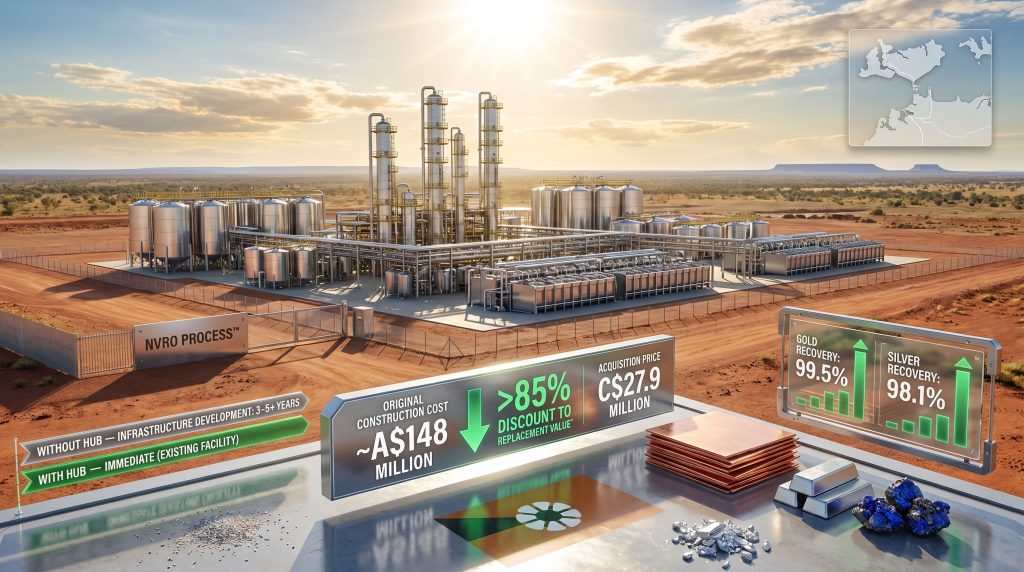
| Gold (from tailings) | 99.5% |
| Silver (from tailings) | 98.1% |
| Secondary metals (e.g., copper) | ~95% |
| Tertiary metals (less common) | 60% to 90% |
These figures were generated through testing of tailings from Hecla Mining Company's Greens Creek silver mine in Southeast Alaska, one of the largest primary silver mines in the United States. The Greens Creek tailings stockpile is estimated to contain approximately $6.8 billion in contained metals, making it one of the most closely watched feedstock evaluation programmes in the junior mining technology sector.
It is important to note these are bench-scale results. Scaling metallurgical performance from bench to pilot to commercial scale is rarely a linear process, and recovery rates in commercial operations frequently differ from those achieved under controlled laboratory or pilot conditions. Investors should treat these figures as indicative of the technology's potential rather than as guaranteed commercial outcomes.
The Fremantle Facility and the TRL Progression
NVRO's Project Development Facility in Fremantle, Western Australia, hosts a pilot-scale NVRO Process plant currently being used to evaluate third-party feedstocks and advance the technology along the TRL pathway. The Greens Creek tailings programme, with samples shipped from Southeast Alaska to the Fremantle facility in early 2026, is central to this progression.
The Fremantle work is designed to generate the engineering and process performance data required to move the technology from TRL 7 toward TRL 8, the threshold representing near-commercial scale demonstration. The intended destination for the first full TRL 9 commercial installation is the proposed NVRO Metals Hub in Australia's Northern Territory, contingent on the acquisition being successfully completed and financed.
NVRO's CEO has publicly described the Greens Creek programme as defining a clear pathway to full commercial deployment and supporting the company's broader strategy of transitioning from technology developer to revenue-generating operator. The Northern Territory hub is positioned as the physical infrastructure that makes that transition possible.
Breaking Down the NVRO Critical Metals Hub Acquisition
NVRO has entered into an agreement to acquire Northern Territories Resources Pty Ltd (NTR), an Australian mining and exploration company whose asset package includes:
- 48 exploration and mining tenements across the Northern Territory
- A fully constructed hydrometallurgical processing plant, already permitted as an operating facility
- A tank leach plant with integrated solvent extraction, electrowinning (SX-EW), and resin-in-pulp circuits
- Associated site infrastructure including roads, power, and water services
- A polymetallic mineral resource base spanning copper, cobalt, nickel, silver, lead, and zinc
The processing complex is located approximately 35 miles south of Darwin, providing direct access to Darwin Port, one of northern Australia's primary export gateways and a critical logistics node for Asian-facing mineral supply chains.
The Financial Case: Price vs. Replacement Value
| Metric | Value |
|---|---|
| Agreed acquisition price | C$27.9 million (~A$20 million) |
| Estimated original construction cost of processing plant | ~A$148 million |
| Implied discount to replacement cost | Greater than 85% |
The previous owner entered insolvency proceedings, which created the conditions for this acquisition to occur at a fraction of the facility's replacement cost. For investors familiar with distressed asset investing in the resources sector, this type of acquisition structure — buying productive infrastructure from insolvency at deep discounts to intrinsic replacement value — has historically produced asymmetric risk-reward outcomes when execution follows through.
Important Transaction Status Note: As of June 2026, this remains a proposed transaction. The acquisition is subject to financing arrangements, regulatory approvals, and standard conditions precedent. The NVRO Metals Hub does not yet constitute an operational asset, and NVRO has not disclosed a confirmed closing date. Investors should conduct independent due diligence before drawing conclusions about the transaction's certainty.
The Hub's Multi-Revenue Architecture
What distinguishes the NVRO Metals Hub concept from a conventional mine development is its design as a multi-pathway commercial platform. Management has outlined four distinct revenue streams the Hub is intended to support:
- Near-term oxide production using existing SX-EW circuits to produce copper cathode and cobalt-nickel intermediate products through heap leaching of oxide material on the property
- Commercial toll processing of third-party feedstocks including mine tailings, waste rock, and sulphide concentrates using the NVRO Process
- Technology licensing to external clients globally, with the Northern Territory Hub serving as the primary reference and demonstration facility
- Tailings and legacy waste re-mining targeting historical stockpiles as feedstock sources for the processing plant
This multi-revenue structure is strategically significant because it does not require the NVRO Process to be operating at full commercial scale before the facility begins generating cash flow. The existing SX-EW infrastructure can theoretically support oxide copper production independently of the NVRO Process deployment timeline, providing a nearer-term revenue pathway while the technology commercialisation continues to advance.
Metals Profile of the Northern Territory Property
The polymetallic nature of the Northern Territory resource base is worth examining in the context of current critical minerals demand dynamics:
| Metal | Strategic Relevance |
|---|---|
| Copper | Primary near-term production target via heap leach oxide |
| Cobalt | High-value battery material; concentrated supply creates premium |
| Nickel | EV battery supply chain; targeted via electrowinning circuits |
| Silver | Aligned with demonstrated NVRO Process recovery capability |
| Lead and Zinc | Additional base metals within sulphide mineralisation |
The cobalt and nickel components of this asset are particularly noteworthy given ongoing supply chain concerns in the battery materials sector. Global cobalt supply remains heavily concentrated in the Democratic Republic of Congo, and Western governments have consistently sought to diversify sourcing toward stable, allied jurisdictions. A Northern Territory cobalt-nickel production facility would sit squarely within that policy context, even if no specific project-level government support has been confirmed at this stage.
The next major ASX story will hit our subscribers first
The Distressed Infrastructure Acquisition Model: An Emerging Pattern
NVRO's approach to commercialisation reflects a broader strategic logic that is beginning to appear across the critical minerals technology space. Rather than absorbing the capital intensity and timeline risk of greenfield construction, a growing number of metals technology companies are targeting underutilised, mothballed, or distressed processing infrastructure as the fastest route to commercial scale.
This model has precedent. In the lithium processing sector, for instance, several companies have repurposed existing solvent extraction infrastructure originally built for other applications, with direct lithium extraction technologies increasingly finding new homes within refurbished facilities. In the rare earths space, mothballed processing circuits from earlier commodity cycles have similarly been acquired and refitted at a fraction of new-build cost.
For NVRO specifically, the comparison is stark:
| Development Pathway | Without Existing Hub | With Existing Hub |
|---|---|---|
| Infrastructure construction | 3 to 5+ years | Not required |
| Regulatory permitting | Multi-year process | Already in place |
| Capital requirement | Hundreds of millions | C$27.9M acquisition |
| Time to first production | 5 to 7+ years (estimated) | Targeting end of 2027 |
Tailings as a Resource: The Scale of the Global Opportunity
One dimension of this story that is rarely discussed in mainstream coverage is the sheer scale of the global mine tailings opportunity that technologies like the NVRO Process are targeting. Global tailings stockpiles are estimated to collectively contain trillions of dollars in unrecovered metals, accumulated over more than a century of mining activity that prioritised primary ore processing over waste stream optimisation.
What makes modern hydrometallurgical recovery technologies increasingly viable is the convergence of three factors that did not exist simultaneously in earlier decades:
- Rising commodity prices for critical minerals that were previously considered uneconomic to recover from tailings
- Tightening environmental regulations that are raising the cost of long-term tailings storage and creating financial incentives to process and neutralise historical waste
- Technological advances in leaching chemistry, solvent extraction, and electrowinning that have materially improved recovery rates from low-grade and complex feedstocks
For a technology platform like NVRO's, designed specifically to address both the economic recovery opportunity and the environmental remediation challenge simultaneously, this convergence represents a structurally favourable demand environment for toll processing services.
Northern Territory Positioning: Logistics and Strategic Context
The geographic placement of the proposed NVRO Metals Hub carries strategic significance beyond the immediate project. Darwin sits at the northern apex of Australia and functions as the country's closest major port to Southeast Asian manufacturing hubs, where demand for battery materials and processed critical minerals is growing rapidly.
For a processing facility targeting cobalt, nickel, and copper products destined for battery supply chains, this proximity translates into a tangible shipping cost and transit time advantage over processing facilities located in southern Australia. Furthermore, Australia's critical minerals push at a national policy level creates a broadly supportive regulatory backdrop for projects of this nature.
Australia's Northern Territory also operates under an established mining regulatory framework with existing infrastructure corridors, reducing sovereign risk compared to frontier jurisdictions where regulatory uncertainty can add years to development timelines.
NVRO has indicated its financing structure for the acquisition will include government funding streams alongside commodity-linked financing and equity. It should be noted, however, that no specific government funding commitment or project designation has been publicly confirmed at this stage. Readers should not interpret this as confirmed project-level government support for the NVRO Metals Hub specifically.
Key Risks and Considerations for Investors
Any analysis of the NVRO Metals Hub opportunity would be incomplete without a candid assessment of the execution risks involved:
- Transaction completion risk: The acquisition has not yet closed and remains subject to financing and regulatory conditions
- Technology scale-up risk: Bench-scale recovery results do not guarantee equivalent performance at commercial scale; the NVRO Process has not yet been deployed at TRL 9
- Financing risk: The company is assembling a multi-source financing package that has not yet been fully secured
- Resource definition risk: NVRO has flagged the need for an updated resource estimate at the Northern Territory property, meaning the current mineral inventory is not yet compliant with modern reporting standards
- Production timeline risk: The end-of-2027 initial production target is contingent on multiple milestones that remain outstanding
Investor Disclaimer: This article is for informational purposes only and does not constitute financial advice. All forward-looking statements regarding timelines, production targets, and financial outcomes involve material uncertainty and should not be relied upon as predictions of future performance. Past recovery results from bench-scale testing are not necessarily indicative of commercial-scale outcomes.
FAQ: NVRO Acquiring a Critical Metals Hub Site
What Is the NVRO Metals Hub?
It is a proposed critical minerals processing platform in Australia's Northern Territory, to be established through NVRO acquiring a critical metals hub site via its acquisition of Northern Territories Resources Pty Ltd. It is designed to function as a commercial-scale processing facility for both company-owned resources and third-party feedstocks.
How Much Is NVRO Paying for the Acquisition?
The agreed purchase price is approximately C$27.9 million (roughly A$20 million), compared to an estimated original construction cost of approximately A$148 million for the processing plant alone, representing a discount of more than 85% to replacement value.
What Metals Will the Facility Target?
Near-term production is expected to focus on copper cathode and cobalt-nickel intermediate products. Silver, lead, and zinc are also present within the polymetallic resource base.
Is the Acquisition Finalised?
As of June 2026, the transaction remains a proposed acquisition subject to financing, regulatory approvals, and conditions precedent. Initial production is targeted for the end of 2027.
What Is the NVRO Process?
A proprietary hydrometallurgical technology designed to recover precious, base, and critical metals from mine tailings, waste rock, and sulphide materials, while simultaneously oxidising sulphides that generate acid rock drainage.
Where Is NVRO Currently Testing Its Technology?
At a pilot-scale facility in Fremantle, Western Australia, where it is currently evaluating feedstocks including tailings from Hecla Mining's Greens Creek silver mine in Alaska.
Further coverage of critical minerals processing technology and Northern Territory mining developments is available at Metal Tech News.
Want to Track the Next Major Critical Minerals Discovery Before the Broader Market?
Discovery Alert's proprietary Discovery IQ model delivers real-time alerts on significant ASX mineral discoveries — instantly transforming complex data across more than 30 commodities into clear, actionable insights for both traders and long-term investors. Explore historic discoveries and the substantial returns they have generated, then begin your 14-day free trial at Discovery Alert to position yourself ahead of the market.