August 11, 2026
Why Browse Has Waited Decades While the World's LNG Appetite Has Grown
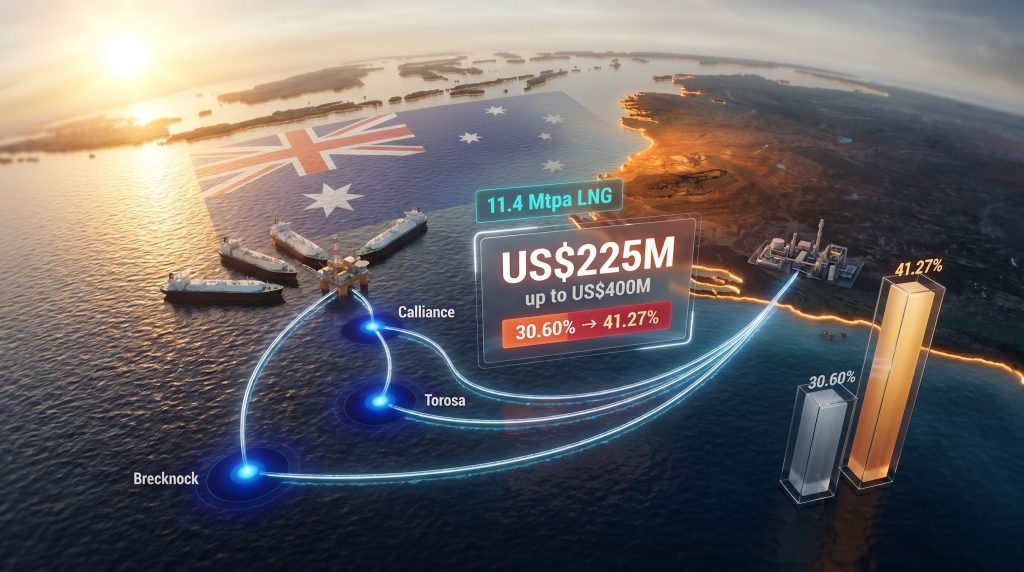
Few paradoxes in the global energy industry are as striking as that of the Browse Basin. Sitting off the northwest coast of Western Australia, one of the most resource-rich maritime regions on the planet, the Woodside Browse Joint Venture pre-emption has become the most-discussed ownership development in Australian LNG circles. The fields have been extensively mapped, drilled, and assessed for decades. Geologists understand the reservoir. Engineers have modelled the development pathways. Yet Brecknock, Calliance, and Torosa remain stubbornly unproduced, their approximately 11.4 million tonnes per year of LNG potential locked beneath the seabed while Asian buyers continue absorbing cargoes from competing suppliers across Qatar, the United States, and elsewhere in Australia.
The reason Browse has stayed dormant is not geological uncertainty. It is the compounded challenge of cost structure, infrastructure access, and commercial alignment among a consortium of partners with different strategic priorities. That calculus, however, is shifting. And Woodside Energy's recent decision to exercise its pre-emption rights over PetroChina's 10.67% participating interest represents the most consequential ownership development the project has seen in years.
When big ASX news breaks, our subscribers know first
What the Woodside Browse Joint Venture Pre-Emption Actually Involves
The Contractual Mechanism That Made This Possible
Pre-emption rights are a standard governance feature embedded in large-scale resource joint venture agreements, designed to give existing partners first right of refusal when a fellow participant seeks to sell their stake to an outside party. When the transaction is triggered, the pre-empting partner steps directly into the buyer's position, acquiring the interest on precisely the same commercial terms already negotiated between the selling and purchasing parties.
In this instance, PetroChina International Investment (Australia) Pty Ltd agreed to sell its 10.67% participating interest in the Browse Joint Venture to a subsidiary of INPEX Corporation, the Japanese upstream operator. That agreement automatically activated Woodside's contractual pre-emption right, and the company formally exercised that right, displacing INPEX as the acquirer and securing the stake for itself on identical terms.
"Pre-emption rights are not passive legal formalities. In practice, they function as strategic levers that allow incumbent operators to consolidate ownership, prevent competitor entry, and reorient long-term development trajectories in their favour."
This distinction matters because the alternative outcome would have materially altered the Browse JV's internal dynamics. INPEX already holds an existing stake in the venture. Allowing a major Japanese operator to absorb additional equity would have introduced a different set of development priorities, potentially complicating the integrated Browse-to-North West Shelf development concept that Woodside has been advancing.
The Browse Joint Venture: Australia's Most Significant Undeveloped Gas Asset
Three Fields, One Enormous Resource Question
The Browse Joint Venture covers three offshore fields in the Browse Basin, located off Western Australia's northwest coastline:
- Brecknock — the northernmost of the three fields
- Calliance — the central field within the Browse resource complex
- Torosa — the largest of the three fields by estimated resource volume
Together, these fields hold the scale to support potential production of up to 11.4 million tonnes per year of LNG, alongside significant LPG volumes and gas supply designated for the Western Australian domestic market. To contextualise that figure: Australia's current total LNG export capacity sits in the range of 80 to 90 Mtpa, meaning Browse at full production could represent a meaningful addition of roughly 13% to the country's existing export base.
The Browse-to-North West Shelf Development Concept
The key to unlocking Browse economics has long been the proposed development pathway that would avoid constructing a standalone LNG processing facility. Instead, the concept involves piping gas from the offshore fields to the existing North West Shelf onshore processing infrastructure, significantly compressing the capital expenditure required compared to a greenfield build. The North West Shelf extension plans make this integrated approach all the more strategically compelling for Woodside.
This integrated model provides several structural advantages:
- Lower capital intensity — leveraging sunk infrastructure costs already absorbed by NWS project participants
- Faster potential production ramp — avoiding the multi-year construction timeline associated with new processing facilities
- Improved project economics — reducing the breakeven LNG price required to justify Final Investment Decision
- Utilisation efficiency — making productive use of NWS processing capacity as existing contracts mature
Woodside's combined ownership in both the upstream Browse resource and the NWS onshore processing infrastructure makes this integrated pathway directly aligned with the company's portfolio strategy. Increasing equity in the BJV from 30.60% to 41.27% strengthens Woodside's ability to steer internal decision-making toward this model, particularly as the project approaches the critical FID window before June 2032.
Who Holds the Browse Joint Venture and How Ownership Changes
Pre-Transaction and Post-Transaction Ownership Structure
| Partner | Approximate Pre-Transaction Interest | Post-Transaction Position |
|---|---|---|
| Woodside Energy | 30.60% | Up to 41.27% (if no other partner pre-empts) |
| PetroChina (CNPC) | 10.67% | Exiting via divestment |
| INPEX Corporation | Existing stake | Remains as original position (pre-empted as acquirer) |
| Other JV Participants | Remaining interest | Unchanged unless they also exercise pre-emption |
An important conditional element in this transaction is that other Browse JV participants may also hold pre-emption rights over the same CNPC stake. If any of those partners elect to exercise their own rights, Woodside's ultimate equity uplift would be proportionally reduced. Assuming no other partner pre-empts, Woodside's participating interest rises from 30.60% to 41.27%, representing a meaningful shift in both economic exposure and strategic influence within the joint venture.
Breaking Down the Transaction's Financial Architecture
A Structure Built Around Development Risk
The financial terms of the Woodside Browse Joint Venture pre-emption are structured to reflect genuine uncertainty surrounding the Browse project's development timeline, balancing Woodside's desire to consolidate ownership with fiscal discipline around capital deployment.
| Payment Component | Amount | Trigger Condition |
|---|---|---|
| Base acquisition payment | US$225 million | Payable to CNPC upon transaction completion |
| Cash call reimbursement | Variable (calculated from contributions) | CNPC's BJV cash call contributions from 30 June 2025 to completion |
| Contingent development payment | US$175 million | FID achieved on Brecknock, Calliance and Torosa before 30 June 2032 |
| Maximum total consideration | ~US$400 million+ | All conditions met |
The US$225 million base payment provides certainty for PetroChina as the divesting party while keeping Woodside's immediate capital commitment relatively measured for an asset of Browse's strategic scale. The contingent US$175 million payment represents the more complex component, directly tying maximum consideration to actual project delivery.
If the Browse JV does not reach a Final Investment Decision for the three core fields by 30 June 2032, Woodside will not pay this additional sum, creating a financial structure that rewards development progression rather than requiring full payment irrespective of project outcomes.
"The contingent payment mechanism functions as a built-in risk-sharing instrument. Woodside pays more if the project advances, and less if it does not. This is particularly significant given Browse's decades-long development challenges."
The cash call reimbursement element adds further complexity to the total consideration. By reimbursing CNPC's cash call contributions from 30 June 2025 through to the completion date, Woodside effectively compensates PetroChina for the equity-proportional capital it has deployed during this period, ensuring the departing partner is made whole for costs incurred while the transaction was being structured and settled.
The FID Deadline and What It Signals
The 30 June 2032 deadline embedded in the contingent payment structure is analytically significant beyond its direct financial implications. It suggests that Woodside and its JV partners are working toward a development decision timeline that implies advanced project preparation work is either underway or anticipated within a horizon that makes this deadline commercially meaningful.
A contingent payment tied to a date considered essentially unreachable would serve no commercial purpose.
Disclaimer: The interpretation of the FID timeline as indicating project readiness is speculative and based on commercial logic, not confirmed statements by Woodside or its JV partners. Investors should not treat the contingent payment structure as an implicit FID announcement.
Woodside's Strategic Rationale: Integrated Value and Long-Term Cash Flow
Why Exercise Now Rather Than Waive?
The decision to exercise pre-emption rights rather than waive them reflects a specific strategic calculus that Woodside's management has communicated publicly. Woodside's CEO articulated that the pre-emption decision reflects the company's commitment to continuing to progress the proposed Browse-to-North West Shelf development, framing it as a pathway to maximise long-term shareholder value.
Furthermore, the acquisition was characterised as a disciplined and capital-efficient means of aligning integrated value across both the upstream resource and the processing infrastructure, with long-term cash flow potential identified as a primary driver.
Several strategic imperatives underpin this rationale:
-
Integrated value alignment: Woodside holds interests in both the Browse upstream resource and the NWS processing infrastructure. Increasing BJV equity deepens the coherence of this integrated ownership position, ensuring value is captured across the full development chain.
-
Influence over FID timing: A higher participating interest translates into greater voting weight within the joint venture, giving Woodside stronger influence over decisions about development configuration, contractor selection, and the timing of Final Investment Decision.
-
Blocking alternative ownership structures: Allowing INPEX to absorb additional Browse equity could have introduced competing strategic priorities, potentially complicating alignment around the Browse-to-NWS development model.
-
Capital-efficient resource acquisition: Acquiring an existing participating interest in an advanced exploration and early development asset typically involves lower execution risk than greenfield exploration spending.
The next major ASX story will hit our subscribers first
Geopolitical Dimensions: A Chinese NOC Exits a Major Australian Asset
What PetroChina's Departure Represents
The exit of a Chinese state-linked entity from a major Australian upstream resource asset is not occurring in a vacuum. PetroChina's decision to divest its Browse JV stake reflects dynamics that extend beyond simple portfolio management. Indeed, the broader geopolitical landscape for resource ownership in Australia is reshaping consortium structures across the sector.
While PetroChina's specific rationale for the divestment has not been publicly detailed, the transaction aligns with a pattern of Chinese NOCs rationalising their international upstream portfolios. The broader implications for Australian LNG ownership dynamics include:
- A shift away from Asian national oil company participation toward operator-led equity consolidation
- Concentration of Browse JV ownership among a smaller number of committed long-term development partners
- Potential simplification of JV decision-making as remaining partners may share stronger alignment around the integrated development pathway
- INPEX's continued presence as a Japanese energy security partner, maintaining Asian buyer-linked ownership within the consortium despite not absorbing the additional CNPC stake
Australia's LNG Competitive Positioning
Browse's potential 11.4 Mtpa of LNG production capacity must be evaluated against the competitive landscape for Asian LNG demand. In addition, Australia's energy exports face mounting pressure from global supply competition, making Browse's development timeline all the more consequential. The primary markets Woodside would target through Browse exports include Japan, South Korea, China, and increasingly Southeast Asian economies with growing energy demand profiles.
Browse LNG would compete with:
| Supply Source | Key Competitive Characteristics |
|---|---|
| Qatar LNG | Very low production costs, massive scale, long-term contract orientation |
| US LNG (Gulf Coast) | Flexible destination clauses, growing export capacity, Henry Hub pricing linkage |
| Australian existing projects | Established buyer relationships, proximity advantage, but ageing production profiles |
| East African LNG (emerging) | Long development timelines, higher cost structures |
Browse's competitive advantage lies primarily in geographic proximity to key Asian markets, reducing shipping costs and delivery times compared to Atlantic Basin alternatives. However, the project will need to secure long-term offtake agreements with creditworthy Asian buyers to support project financing, a process that typically begins well before Final Investment Decision.
What Needs to Happen Before Browse Can Proceed
The Path to Final Investment Decision
Several conditions must be satisfied before the Browse JV can reach the FID that would trigger Woodside's contingent US$175 million payment. Furthermore, the current oil and gas downturn adds another layer of complexity to securing the necessary financing commitments. The key prerequisites include:
- Transaction completion: The pre-emption itself must satisfy customary regulatory approvals across relevant jurisdictions before Woodside's increased equity position is formally recognised.
- JV partner alignment: All remaining Browse JV participants must reach sufficient alignment on development configuration, cost estimates, and commercial framework to support a collective FID.
- NWS integration agreements: Commercial terms governing the use of NWS processing infrastructure for Browse gas must be finalised, a negotiation involving the NWS project participants.
- LNG offtake commitments: Major project financing institutions typically require substantial proportions of LNG production to be covered by long-term purchase agreements before committing debt capital.
- Regulatory approvals: Environmental and development approvals across Western Australian and Commonwealth jurisdictions must be obtained.
- Financing structure: The capital requirements for a project of Browse's scale necessitate sophisticated project financing arrangements involving debt markets alongside equity contributions from JV partners.
Disclaimer: This analysis of Browse's development prerequisites is based on general LNG project development frameworks and publicly available information. It does not constitute investment advice, and investors should conduct independent research before making financial decisions based on Browse-related developments.
Frequently Asked Questions: Woodside Browse Joint Venture Pre-Emption
What Does It Mean for Woodside to Exercise Pre-Emption in the Browse JV?
Woodside stepped into the position of the agreed buyer, INPEX's subsidiary, and acquired PetroChina's 10.67% participating interest on the exact commercial terms already negotiated between PetroChina and INPEX. The transaction mechanics are identical; only the acquiring party has changed.
How Much Is Woodside Paying for the Browse Stake?
The base payment is US$225 million to PetroChina upon completion, plus reimbursement of cash call contributions made by CNPC from 30 June 2025 to the completion date. A further US$175 million becomes payable if a Final Investment Decision is reached on the three Browse fields before 30 June 2032, bringing total potential consideration to approximately US$400 million or more.
What Will Woodside's Browse JV Interest Be After the Transaction?
Assuming no other JV partners exercise their own pre-emption rights over the same CNPC stake, Woodside's participating interest will rise from 30.60% to 41.27%. As Reuters reported, Woodside was closely assessing this pre-emption opportunity well before the formal exercise, signalling the strategic weight the company placed on securing the additional equity.
Why Did Woodside Pre-Empt INPEX Rather Than Allow the Original Transaction to Proceed?
Woodside holds combined interests in both the upstream Browse resource and the North West Shelf onshore processing infrastructure. Increasing BJV equity strengthens the coherence of this integrated ownership position and enhances Woodside's influence over development decisions, particularly as the project approaches its critical FID window. Consequently, the trade war energy impacts on LNG pricing also likely reinforced the case for consolidating ownership before external conditions shift further.
What Is the Significance of the 30 June 2032 Deadline?
This date defines the outer boundary for the contingent payment. If the Browse JV reaches FID for the Brecknock, Calliance, and Torosa fields before this date, Woodside pays PetroChina an additional US$175 million. If FID is not achieved by this date, the contingent payment lapses.
Key Takeaways for Investors and Industry Observers
The Woodside Browse Joint Venture pre-emption carries implications that extend across corporate strategy, project development, and Australia's broader LNG sector positioning. The most important conclusions from this transaction include:
-
The US$225 million base plus US$175 million contingent payment structure represents a disciplined approach that ties maximum consideration to measurable development milestones, reducing Woodside's financial exposure if Browse does not advance on schedule.
-
A potential equity uplift from 30.60% to 41.27% materially strengthens Woodside's voting weight and economic exposure within the Browse JV, directly enhancing the company's ability to drive the integrated development pathway forward.
-
The Browse-to-North West Shelf integration concept remains the central commercial logic underpinning the acquisition, with capital efficiency arguments centred on leveraging existing infrastructure rather than funding greenfield construction.
-
PetroChina's exit continues a broader pattern of Chinese NOC portfolio rationalisation in Australian upstream assets, gradually shifting LNG ownership toward operator-led structures.
-
Browse's 11.4 Mtpa LNG potential positions it as one of the most consequential undeveloped gas resources in the Asia-Pacific basin, with the capacity to extend Australia's standing as a top-tier global LNG exporter through the 2040s if development proceeds.
-
The 30 June 2032 FID deadline embedded in the contingent payment creates a defined commercial timeline that adds measurable urgency to the Browse development progression without constituting a formal commitment to that outcome.
Important Disclaimer: This article is intended for informational purposes only and does not constitute financial or investment advice. All financial figures cited are sourced from publicly available reporting. Forward-looking statements regarding Browse development timelines, FID outcomes, and production potential are subject to material risks and uncertainties. Past strategic transactions do not guarantee future development outcomes.
Ready to Capitalise on Major ASX Energy and Resource Discoveries Before the Broader Market?
Discovery Alert's proprietary Discovery IQ model delivers real-time alerts the moment significant mineral and resource discoveries are announced on the ASX, transforming complex data across more than 30 commodities into clear, actionable insights for both short-term traders and long-term investors. Explore how historic discoveries have generated substantial returns by visiting Discovery Alert's dedicated discoveries page, and begin your 14-day free trial today to position yourself ahead of the market.